🦁 African Clawed Frog
🧾 Quick Facts
The African Clawed Frog, a fascinating aquatic amphibian, is native to regions of Sub-Saharan Africa. Known for its distinctive appearance and adaptable nature, this species thrives in diverse environments.
- Common name(s): African Clawed Frog, Xenopus
- Scientific name: Xenopus laevis
- Animal type: Amphibian
- Typical adult size: 10 to 12 cm (4 to 5 inches) in length; weight around 200 grams (7 ounces)
- Typical lifespan: 5 to 15 years in the wild; up to 20 years in captivity
- Diet type: Carnivore, feeding on insects, small fish, and aquatic invertebrates
- Activity pattern: Mostly nocturnal
- Social structure: Solitary but can be found in groups during breeding
- Speed / movement highlights: Excellent swimmer, uses hind legs for propulsion
- Intelligence/learning: Simple problem-solving abilities; not much evidence of advanced learning
- Primary habitats: Freshwater ponds, lakes, and wetlands
- Geographic range: Native to Sub-Saharan Africa but introduced in various other regions
- Predators/threats: Birds, larger fish, and some mammals; human-induced habitat changes
- Conservation status: Least Concern, but varies by region due to habitat loss
🔍 Identification & Appearance
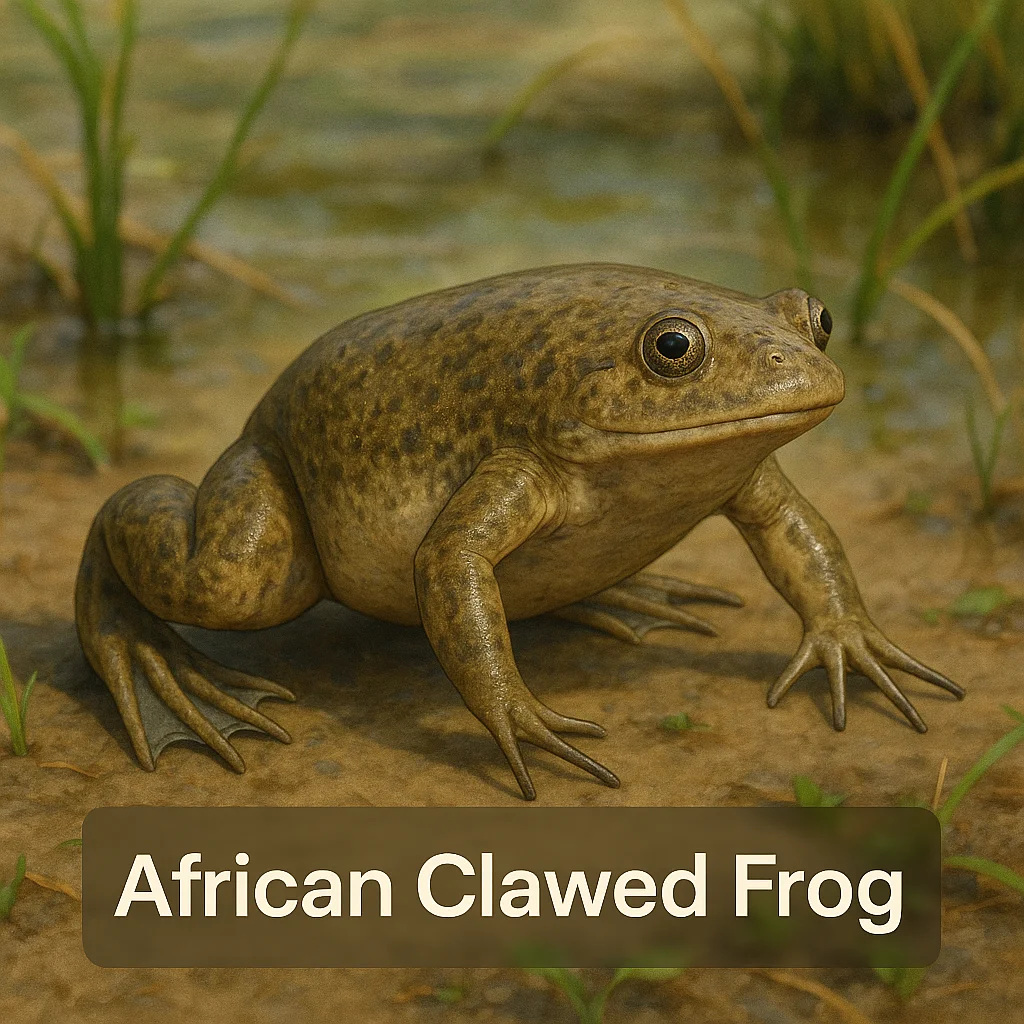
The African Clawed Frog has a robust, muscular body suited for aquatic life. Its skin is smooth, typically olive to brown with mottled patches offering excellent camouflage in murky waters. Notably, the frog lacks a tongue and visible ear openings. Its forelimbs are small with unwebbed fingers, while the hind limbs are strong with webbed toes.
- Broad, flat body with a distinctive olive to brown coloration
- Eyes positioned on the top of the head, aiding in surface surveillance
- Webbed hind feet with conspicuous claws on the inner three toes
- Absent external ear openings and tongue
- Mottled skin pattern that varies with age
- Juveniles may be more brightly colored
- Mature males can be smaller and slimmer than females
- Often confused with the African Dwarf Frog but can be distinguished by size and clawed toes
- Can be identified by the unique croaking sound, particularly during the mating season
🧱 Body Structure & Physical Adaptations
Built for an aquatic lifestyle, the African Clawed Frog has several adaptations that make it a skilled swimmer. It employs its powerful hind legs for swimming and burrowing. Its flattened body aids in maintaining a low profile in water. The skin serves as a critical organ for respiration, complementing its lungs. Sensory adaptations include lateral lines for detecting water currents and potential prey.
- Flattened, broad torso enhancing aquatic movement
- Hind legs optimized for strong swimming motions
- Clawed toes for gripping and digging
- Capability to breathe through skin and lungs
- Excellent peripheral vision via eyes on the head's top
- Lateral line system to sense vibrations
- Build suited to hiding in soft substrates
- Longevity in torpid states during droughts
🌍 Range & Distribution
The African Clawed Frog is widely spread across Sub-Saharan Africa. It has been introduced to various parts of North America, South America, Europe, and Asia, often due to the pet trade or as a research organism. It thrives in lowland regions, particularly in freshwater habitats.
- Widely distributed in Sub-Saharan Africa
- Also found in North America, Europe, and Asia due to introduction
- Tolerates a variety of freshwater habitats
- Found in both temporary and permanent water bodies
- Typically resides at elevations up to 1200 meters (4000 feet)
- Does not migrate seasonally
- Often occupies human-made water bodies
- More common in warm climates
🏞️ Habitat & Shelter
The African Clawed Frog favors still or slow-moving aquatic habitats such as ponds, marshes, and wetlands. It may also be found in agricultural landscapes where irrigation provides the necessary conditions. The frog often buries itself in soft mud or sand at the bottom of these water bodies to avoid predators and extreme temperatures. Seasonal changes, such as periods of drought, can lead the frog to become dormant until wetter conditions return.
🧭 Behavior & Ecology
Primarily nocturnal, the African Clawed Frog spends much of its time submerged or hiding in aquatic vegetation. During the night, it becomes more active, foraging for food and opportunities to mate. Communication involves unique vocalizations, especially during the breeding season. In its ecosystem, it plays a role as both predator and prey, helping to control insect populations.
- Nocturnal, with increased activity at night
- Communicates through distinctive croaking sounds
- Spends daylight hours mostly hidden
- Interacts occasionally with other aquatic species
- Prey for birds, larger amphibians, and fish
👥 Social Life & Group Dynamics
The African Clawed Frog is largely solitary except during the breeding season when it may congregate in larger groups. While not typically aggressive, competition for mates can lead to territorial behavior. Males are known for their vocal displays, attracting females through croaks and calls.
- Generally solitary, except in breeding aggregations
- Group formations not maintained outside breeding periods
- Displays minor territorial behavior
- Vocal interactions primarily male-focused during mating
- Minimal cooperative behavior observed
- Occasional basking in shared sunlit areas
🍽️ Diet, Prey & Predators
The African Clawed Frog is carnivorous, feeding on a diverse diet consisting of small invertebrates and at times other amphibians. In its natural habitat, the frog employs a suction feeding technique. It faces threats from birds, mammals, and fish, and its muddy color offers camouflage as a primary defense mechanism.
- Feeds on insects, worms, and small fish
- Employs suction feeding to capture prey
- Main predators include herons and bass fish
- Vulnerable to invasive aquatic mammals
- No known scavenging behavior
- Uses cryptic camouflage for evasion
🦌 Hunting, Foraging & Movement
As a competent swimmer, the African Clawed Frog navigates its habitat with ease. Its hunting strategy mainly involves stealth and ambush tactics, lying in wait for unsuspecting prey to come within range. The frog remains mostly stationary, conserving energy, but reacts with swift and sudden bursts of speed when catching prey.
- Excellent swimmer, leveraging webbed hind feet
- Ambush tactics common in hunting
- Occasionally explores new territories in search of food
- Primarily active after dark
- Retains a defined home range excluding migration
🧠 Intelligence & Senses
The African Clawed Frog, while not known for advanced cognitive abilities, possesses instinct-driven behaviors that aid survival. Its sensory organs are well adapted to detect environmental changes, helping it to capture prey and avoid threats. Research on their intelligence remains limited but suggests basic memory and learning capabilities.
- Relies on instinctive behavior more than learned intelligence
- Acute sense of touch via lateral line system
- Moderate vision, optimized for detecting movement
- Lacks complex problem-solving skills compared to other amphibians
- Utilizes auditory cues in mate selection
🪺 Reproduction, Pregnancy & Parenting
Breeding commonly occurs during the rainy season, triggered by environmental changes. Males vocalize to attract females, and the species exhibits a promiscuous mating system. Females can lay hundreds of eggs, which hatch within days. There is no parental care, and offspring are left to fend for themselves post-hatching.
- Anuran breeding triggered by rainfall
- Males vocalize prominently in mating rituals
- Eggs develop quickly in favorable conditions
- Young frogs are precocial
- Larvae exhibit rapid growth, minimizing vulnerability time
- No parental investment post-laying
♀️♂️ Male vs Female Differences
Males and females of the African Clawed Frog exhibit subtle size differences, with females generally being larger and broader. Males are often more vocal during the breeding season. While coloration and patterns are consistently similar between genders, size is a reliable way to differentiate mature males from females.
- Females tend to be larger than males
- Males possess more pronounced vocal sacs during breeding
- Coloration is consistent regardless of sex
- Females have a more equipped physique for egg-laying
- No significant behavioral differences outside mating
- Size difference becomes more apparent in adulthood
🧬 Subspecies & Variation
The African Clawed Frog does not have formally recognized subspecies. However, there are local variations in size and coloration depending on environmental pressures. Despite some debate over population separations, the species maintains a relatively uniform genetic pool across its range.
- No officially recognized subspecies
- Minor regional variations in color intensity
- Debates on genetic diversity between introduced populations
- Local adaptations to water chemistry common
- Coloration can differ slightly based on habitat
⚠️ Threats, Conservation & Human Interaction
While the species is not considered threatened, local populations face significant pressure from habitat destruction and water pollution. Adaptability has led to successful introductions in non-native environments, sometimes competing with local species. Their popularity in labs and as pets has also influenced their global distribution, although keeping them requires consideration of ecological impacts.
- Habitat loss due to agricultural expansion
- Pollution affecting population health
- Competition with native species in introduced areas
- Legal frameworks often regulate their trade
- Commonly used in scientific research
- Potential pet species, requiring careful management
✨ Fun Facts & Unique Traits
- The African Clawed Frog was the first vertebrate to be cloned in a laboratory.
- Its eyes are positioned on top of its head, ideal for surface hunting.
- This frog can regenerate lost limbs, a rare trait among amphibians.
- Capable of hibernating underground to survive dry spells.
- The name "clawed frog" comes from its use of claws to help tear apart food.
- Widely utilized in pregnancy tests in the early 20th century.
- It has a remarkable ability to survive in diverse climates.
- Can detect movement in water, an advantage for capturing prey.
📌 Summary
- The African Clawed Frog (Xenopus laevis) is an adaptable amphibian known for its robust, flat body and camouflage capabilities.
- Native to Sub-Saharan Africa, yet distributed globally through introductions.
- It inhabits freshwater environments like ponds and marshes.
- Carnivorous, feeding on small aquatic animals.
- Faced with natural predators such as birds and larger fish.
- Primarily solitary, aggregating only during the mating season.
- Breeding occurs in response to rains; females lay numerous eggs.
- Key adaptations include clawed toes and the ability to sense underwater vibrations.
- Known for being used in scientific research and historical pregnancy testing.