🦁 American Bullfrog
🧾 Quick Facts
The American Bullfrog, often simply referred to as the bullfrog, is a fascinating amphibian native to North America. Known for its powerful jump and distinctive croak, this species has successfully established itself in a variety of habitats across the continent. Here are some quick facts:
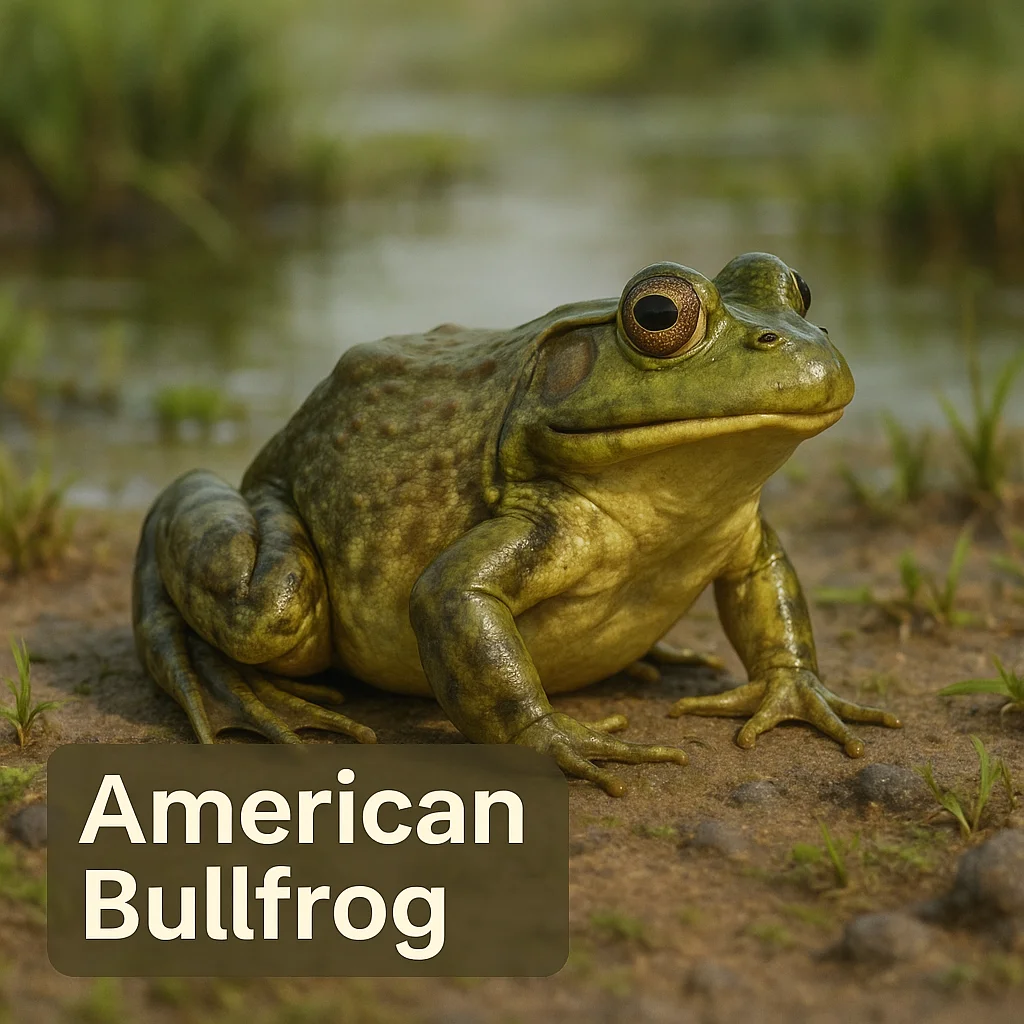
- Common name(s): American Bullfrog, Bullfrog
- Scientific name: Lithobates catesbeianus
- Animal type: Amphibian
- Typical adult size: 3.6 to 6 inches (9 to 15 cm) in body length; can weigh up to 1.5 pounds (0.68 kg)
- Typical lifespan: 7 to 9 years in the wild; up to 16 years in captivity
- Diet type: Carnivore, feeding on insects, small mammals, birds, and fish
- Activity pattern: Mostly nocturnal
- Social structure: Solitary but may gather in breeding groups
- Speed / movement highlights: Excellent jumper, can leap several feet in one jump
- Intelligence/learning: Can learn and adapt behaviors; known for their survival instincts
- Primary habitats: Still freshwater bodies like ponds, marshes, and lakes
- Geographic range: Native to eastern North America; introduced to the western U.S. and other continents
- Predators/threats: Birds, reptiles, and mammals; habitat destruction, pollution
- Conservation status: Least Concern but varies regionally
🔍 Identification & Appearance
The American Bullfrog is readily recognizable thanks to its robust size and distinctive features. Its body is smooth and moist, typically green to olive brown, with a lighter underbelly that is often mottled. Their large, round eyes and webbed feet are essential for their aquatic lifestyle.
- Body shape and silhouette: Powerfully built with a broad head and long legs
- Key colors/patterns: Green to olive brown with darker patches and a cream or yellow-tinged belly
- Distinctive features: Large tympanum (eardrum) visible behind the eyes
- Tracks, scat, or other field signs: Webbed foot impressions near water sources in soft mud
- Common look-alikes: Green Frog; distinguishable by the Bullfrog’s larger size and lack of dorsolateral ridges
- Top ID Tips:
- Look for strong hind legs and webbed feet
- Note the prominent eardrum behind the eye
- Smooth, moist skin with greenish-brown hue
- Watch for the large, powerful hopping movement
- Listen for the loud, resonant croak
- Examine beneath water surfaces in calm freshwater habitats
- Build and proportions: Stocky body with muscular legs
- Teeth/beak/jaw adaptations: Small teeth used to hold prey; strong jaw muscles for a firm bite
- Claws/hooves/wings/fins: Webbed hind feet for powerful swimming
- Sensory strengths: Excellent eyesight and hearing; can detect movement and sound from a distance
- Key Adaptations:
- Webbed feet for streamlined swimming
- Strong hind legs enabling powerful jumps
- Smooth skin aiding in camouflage in water shadows
- Sizeable tympanum for detecting predators or mates
- Flexible skin aiding in respiration when submerged
- Adaptable diet to survive in diverse environments
- Found throughout the United States, from the East Coast to newly introduced areas in the West
- Also present in Mexico and parts of Canada
- Introduced populations in Europe, Asia, and South America
- Prefers lowland areas with abundant vegetation
- Occupies marshes, ponds, lakes, and slow-moving streams
- Thrives in temperate to subtropical climates
- Non-migratory, mostly resident within its established range
- Tolerates some human-created environments near agriculture or urban areas
- Favorite habitats include ponds, lakes, and marshes
- Often found along the edges of slow-moving rivers and streams
- Utilizes aquatic plants for camouflage and hiding from predators
- During winter, may burrow into muddy bottoms to overwinter
- Mostly active during dusk and night time
- Resting in shaded or vegetated areas during the day
- Vocalizations primarily used for breeding calls
- Competitive predators in their habitat, affecting local biodiversity
- Role as both predator and prey within its ecosystem
- Contributes to aquatic balance by consuming large numbers of insects and small animals
- Generally solitary except in breeding season
- Breeding groups can comprise several dozen individuals
- Males actively defend territories during courtship
- Vocalizations help establish dominance and ward off rivals
- Minimal group cooperation outside breeding season
- Favors insects like crickets and dragonflies
- Consumes other amphibians, fish, and small birds
- Targets small mammals such as rodents
- Hunted by snakes, birds of prey, and larger mammals
- Employs camouflage and quick escapes as defense tactics
- Ambush predator staying still until prey is within reach
- Remarkably agile both in water and on land
- Forages mostly at dusk and night for optimal predation
- Lurks at water's edge to seize unsuspecting prey
- Jumping ability critical for navigating wetlands
- Outstanding night vision adapted for nocturnal lifestyle
- Sensitive to vibrations, aiding in predator/prey detection
- Remarkable ability to locate spawning sites
- Capable of navigating returning to preferred habitats
- Evidence of learning to avoid repeated threats
- Breeding season varies regionally, mostly in spring and summer
- Engages in external fertilization with females choosing nesting sites
- Clutch size ranges from thousands of eggs per spawning
- Development into froglets can span several months to two years
- Little to no parental care post-egg laying
- Males generally larger with muscular builds
- Males have enlarged tympanum compared to females
- Distinctive male vocal sac visible during calls
- Females tend to be lighter in color
- Both genders exhibit similar overall body shapes
- Local size variations based on resource availability
- Color differences based on habitat camouflage needs
- Growth rate changes in warmer vs cooler climates
- Introduced populations exhibit unique adaptations
- Subspecies classification remains debated
- Susceptible to pollution, especially pesticides and herbicides
- Habitat loss due to urbanization presents a significant risk
- Climate changes affect breeding cycles and survival rates
- Listed as an invasive species in some areas, outcompeting native fauna
- Responsible pet ownership encouraged to minimize ecological disruption
- Bullfrogs can jump ten times their body length in a single leap
- Their call is often described as resembling a deep, resonant "jug-o-rum" sound
- Tadpoles can reach up to 6 inches before transitioning into froglets, one of the largest among frog species
- Bullfrogs can puff up their bodies to appear larger when threatened
- They have been observed cannibalizing smaller bullfrogs
- Known to inhabit areas made by human activity, like irrigation channels
- Can tolerate higher salinity levels than many other amphibians
- Their skin provides additional oxygen absorption, vital for underwater resting
- American Bullfrogs are distinctive amphibians known for their size and powerful leaping abilities
- Thrives in freshwater habitats across North America and introduced regions
- Prefers nocturnal activity and solitary living, except during mating periods
- Feeds on diverse prey, fulfilling a critical role as both predator and prey in ecosystems
- Breeding occurs in warmer months with females laying thousands of eggs
- Exhibits notable sexual dimorphism in size and vocal patterns
- No recognized subspecies, but regional variations exist
- Faces challenges from habitat loss and pollution but adapts readily to new environments
- Recognized for its loud calls and exceptional jumping skills
🧱 Body Structure & Physical Adaptations
The American Bullfrog's anatomy is perfectly suited to its semi-aquatic lifestyle. Its strong limbs and powerful hind legs not only ensure efficient swimming but also facilitate its notable leaping abilities, helping it to escape predators or traverse its environment.
🌍 Range & Distribution
The American Bullfrog is native to the eastern United States, found in a variety of freshwater environments. It has been introduced to the western United States and other countries, where it has established sizable populations. The adaptability of the bullfrog allows it to thrive in numerous climates and elevations, though it prefers warmer wetland areas.
🏞️ Habitat & Shelter
The American Bullfrog thrives in diverse aquatic environments, primarily in stable freshwater systems. These amphibians prefer habitats with abundant aquatic vegetation which offers shelter and a rich supply of food. Seasonal changes in weather do not significantly affect their habitat choice; however, during colder months, they may burrow into mud to hibernate.
🧭 Behavior & Ecology
Bullfrogs are predominantly nocturnal, becoming more active at night to hunt and call. They are territorial creatures, especially during breeding season, when their distinctive croaks can be heard echoing across water bodies. As opportunistic feeders, they play a vital role in controlling insect populations, and their presence indicates a healthy ecosystem.
👥 Social Life & Group Dynamics
The American Bullfrog typically leads a solitary life but comes together in significant numbers during the breeding season. Males are known to defend their territories vociferously, minimizing conflicts through loud calls rather than physical confrontation. While not social, these gatherings are vital for breeding success.
🍽️ Diet, Prey & Predators
American Bullfrogs are sophisticated hunters. Their diet includes an array of living prey, from insects to small mammals. As adults, their large mouths enable them to consume a surprising variety of animals. Though they are top predators in their habitats, they are also preyed upon by larger animals.
🦌 Hunting, Foraging & Movement
Renowned for their jumping prowess, bullfrogs use powerful leaps both for hunting and evasion. They are opportunistic feeders, employing ambush tactics to surprise prey. Bullfrogs remain near water edges, ready to retreat at the first hint of danger, exemplifying their innate survival adaptations.
🧠 Intelligence & Senses
American Bullfrogs exhibit a range of sensory adaptations that help them thrive in diverse ecological conditions. Their acute vision and hearing make them adept at hunting and avoiding threats. Though their learning capacity is not fully understood, they demonstrate behaviors indicative of spatial awareness and problem-solving abilities.
🪺 Reproduction, Pregnancy & Parenting
Breeding for American Bullfrogs occurs in warmer seasons, typically late spring to early summer. Males call loudly to attract females, who choose mates based on call quality. Eggs are laid in masses attached to vegetation, hatching into tadpoles with prolonged development periods. Parental involvement is minimal post-spawning.
♀️♂️ Male vs Female Differences
Males and females exhibit noticeable differences in size and call patterns, essential for mating behaviors. Males are typically larger and more vocal during the breeding season, which aids in attracting mates and deterring rivals.
🧬 Subspecies & Variation
While there are no formally recognized subspecies of the American Bullfrog, regional variations exist due to adaptation to local environments. These variations may affect size, coloration, and growth rates. These differences demonstrate the species' resilience and adaptability to differing ecological conditions.
⚠️ Threats, Conservation & Human Interaction
The American Bullfrog faces several threats from human activities, including habitat destruction, pollution, and climate changes. However, they have proven adept at thriving in altered environments and as invasive species. Conservation efforts focus on mitigating the impacts of human activities and preserving natural wetland habitats.