🦁 Common Toad
🧾 Quick Facts
The common toad is a widespread amphibian known for its adaptability and distinctive appearance. Found in many regions worldwide, this resilient creature thrives in various habitats and plays an important ecological role.
- Common name(s): Common Toad
- Scientific name: Bufo bufo
- Animal type: Amphibian
- Typical adult size: 6 to 10 cm in length
- Typical lifespan: 10 to 15 years in the wild
- Diet type: Carnivore; primarily insects and small invertebrates
- Activity pattern: Nocturnal
- Social structure: Solitary but may congregate during breeding season
- Speed / movement highlights: Limited speed; adept at hopping
- Intelligence/learning: Capable of simple learning and memory
- Primary habitats: Forests, grasslands, gardens
- Geographic range: Europe, North Africa, parts of Asia
- Predators/threats: Birds, mammals, pollution, habitat destruction
- Conservation status: Least Concern, but varies by region
🔍 Identification & Appearance
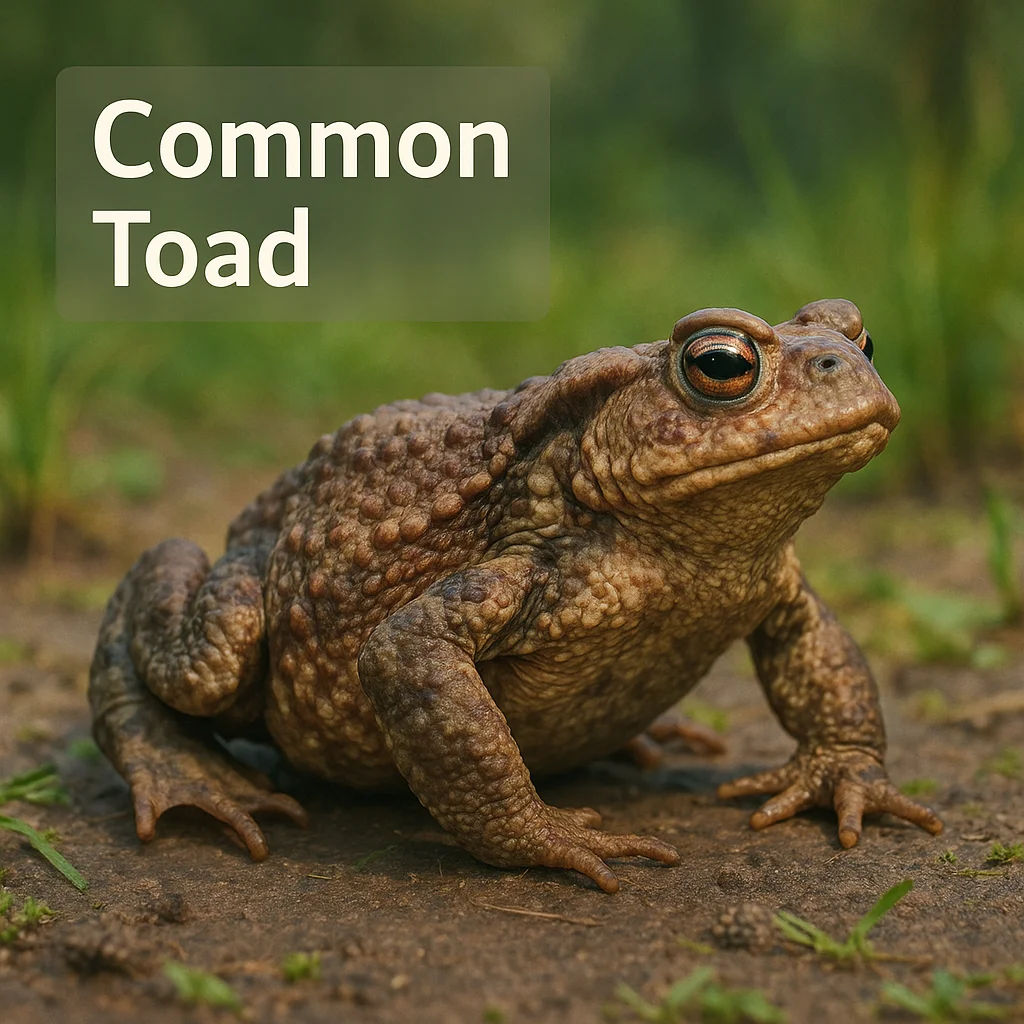
The common toad is easily recognizable by its robust and squat body, with a warty, dry skin texture. Typically brown or olive in color, it may have darker blotches. Its eyes are striking, featuring horizontal pupils and golden irises. Unlike frogs, toads have short hind legs adapted for walking rather than leaping.
- Warty, dry skin with variations in browns and olives
- Robust, squat body shape
- Golden irises; horizontal pupils in the eyes
- Short hind legs adapted for walking
- Can be confused with frogs; distinguishable by skin texture and limb length
- Common in gardens and shaded areas
- Produces toxic secretions as a defense mechanism
- Distinctive loud, gruff call during the mating season
- Round parotoid glands behind the eyes
🧱 Body Structure & Physical Adaptations
The common toad's sturdy body is well-suited for terrestrial life. Its dry and warty skin helps with camouflage and moisture retention. It has stout limbs for slow, deliberate moves, and its parotoid glands can secrete toxins to deter predators. Unlike most other amphibian species, it's better equipped for land than water.
- Sturdy, robust build with short limbs
- Dry, warty skin aiding in camouflage and water retention
- Parotoid glands secrete toxins for defense
- Horizontal, light-sensitive pupils for nighttime activity
- Limited underwater ability; primarily adapted for terrestrial environments
- Excellent sense of smell for locating food at night
- Strong jaw muscles for consuming a variety of insects
- Tympanum ears well-adapted for hearing during mating calls
🌍 Range & Distribution
The common toad inhabits a wide geographic range, found throughout Europe, parts of North Africa, and as far east as portions of Asia. It is adaptable to various climates and is frequently found in temperate zones, thriving from lowland areas up to altitudes of 1,500 meters. Residents rather than migratory, common toads may shift locally between wintering and summer habitats.
- Western and Central Europe
- Western Asia
- Northwestern Africa
- Temperate forests and grasslands
- Wide altitude range; sea level to mountainous regions
- Prefers temperate and semi-arid climates
- Non-migratory, but seasonally active in breeding shifts
- Resident in gardens, woodlands, and rural settings
🏞️ Habitat & Shelter
The common toad flourishes in diverse habitats, including forests, grasslands, gardens, and urban areas where moisture is sufficient. It often shelters during the day beneath logs, rocks, or in burrows, ensuring protection from predators and dry conditions. During winter, toads hibernate in frost-free sites, such as deep leaf litter and soft soil.
Their presence is mutually beneficial for gardeners, as they help control insect populations. Understanding their habitat needs assists in finding them during daylight or in seasonal shifts.
🧭 Behavior & Ecology
Common toads are primarily nocturnal, emerging at night to hunt and forage. They communicate through croaks and calls, particularly during the breeding season. The common toad plays an essential ecological role by controlling insect populations and serving as prey for larger animals. Its presence is a sign of a healthy ecosystem.
- Nocturnal activity; forages after dark
- Uses vocalizations during breeding for mate attraction
- Controls insect populations as a primary predator
- Terrestrial habitat preferences limit predator range
- Participates in mutualism with gardeners by reducing pests
- Contributes to nutrient cycles through waste and carcass decomposition
👥 Social Life & Group Dynamics
Common toads are mostly solitary, coming together primarily during the breeding season. These gatherings are opportunistic, with little evidence of ongoing group dynamics beyond temporary aggregations for reproduction. Despite their solitary nature, males may exhibit competitive behaviors during mating rituals, often engaging in vocalizations to attract females.
- Solitary except during mating season
- Temporary congregations near breeding sites
- Competitive vocalizations to attract mates
- Males may engage in physical skirmishes for access to females
- Generally avoid conflict, fleeing when threatened
- No established hierarchies due to solitary nature
- Limited cooperative behaviors due to overall lifestyle
🍽️ Diet, Prey & Predators
The common toad is a carnivore, primarily consuming insects, worms, and other small invertebrates. Its diet shifts with availability, often taking advantage of garden pests like slugs and beetles. Major predators include birds and some mammals. As a defense, the toad secretes a toxic substance from its skin, deterring many would-be attackers.
- Diet primarily consists of insects and worms
- Helps control pest populations in gardens
- Seasonal diet shifts depending on prey availability
- Defensive toxin secretion from skin
- Main predators: birds and small carnivorous mammals
- Typically scavenges on various small vertebrates and dead invertebrates
- Ambush foraging strategy; waits for prey to approach
🦌 Hunting, Foraging & Movement
Common toads use a slow, deliberate hunting technique, patiently waiting and ambushing prey. Though they have a limited speed, they are efficient foragers, using their excellent sense of smell. Their movement on land is achieved with short hops, and they are not adapted for swimming despite their amphibian status.
- Terrestrial ambush predator
- Utilizes short hops for movement
- Primarily hunts at night
- Relies on smell to detect prey
- Avoids extensive swimming
- Effective pest controllers in gardens
🧠 Intelligence & Senses
The common toad demonstrates basic learning abilities and can adapt behavior based on repetitive situations. Its sensory strength lies in smell, crucial for nighttime foraging. Sight and hearing are also adapted for low-light conditions, allowing effective hunting and mating communication.
- Basic learning and memory capabilities
- Strong sense of smell for detecting prey
- Adequate vision for low-light environments
- Hearing attuned to mating calls and predator warnings
- Limited research on advanced cognition
- Eye positioning aids in spotting ground-based prey
🪺 Reproduction, Pregnancy & Parenting
Breeding for common toads occurs in water bodies during early spring. Males use vocal calls to attract females. They are typically polygynous, with multiple males competing for female attention. Females lay long strings of eggs, which develop into aquatic larvae before transitioning to adult form. Both males and females show no parental care post-egg-laying.
- Spring breeding season peaks with vocal competition
- Polygynous mating system
- Strictly aquatic breeding in ponds and lakes
- Female lays hundreds to thousands of eggs
- Larvae develop in water, moving to land as adults
- No parental care shown by either sex
- Dense egg-laying increases survival despite predation
♀️♂️ Male vs Female Differences
Significant differences between male and female common toads include their size, with females generally larger. Males often exhibit brighter coloration during the breeding season, which aids in attracting mates. Behavioral roles during breeding season also differ, as males actively call and compete for females.
- Females are larger than males
- Males exhibit brighter tones during breeding season
- Males vocalize to attract breeding mates
- Females are more passive during breeding
- Size difference supports larger clutch sizes in females
🧬 Subspecies & Variation
The precise classification of common toad subspecies can vary due to range-specific differences in size, color, and adaptation. Regional environmental pressures may cause these variations, though the primary species traits remain recognizable. Common toad variability remains an open area for research.
- Some regions show size discrepancies
- Color variation adapted to local habitats
- Genetics may offer further classification insights
- Research on subspecies continues to evolve
- Island populations can exhibit unique traits
⚠️ Threats, Conservation & Human Interaction
While the common toad is listed as Least Concern, human impact like habitat destruction, pollution, and climate change pose significant long-term threats. Responsible human interaction involves habitat preservation, reducing pesticide use, and maintaining clean water sources. Keeping gardens toad-friendly helps support local populations naturally.
- Habitat loss due to urbanization and agriculture
- Vulnerable to pollution, particularly pesticides
- Climate change impacts breeding and water sources
- Support conservation by maintaining natural garden habitats
- Resilient populations can help in disease control
- Scientific interest supports further ecological understanding
✨ Fun Facts & Unique Traits
- A single common toad can eat up to 1,000 insects in a night
- Despite being amphibians, they prefer staying on land
- They can survive without water for extended periods
- Toxic skin secretions protect them from many predators
- Vital for controlling insect populations in gardens
- Common toads have been celebrated in folklore and literature
- They can live up to 40 years in captivity under optimal care
- Croaks are unique per individual, aiding in mate location
📌 Summary
- Recognizable by warty skin and robust build
- Thrives in a variety of habitats, particularly temperate regions
- Found across Europe, parts of Asia, and North Africa
- Carnivorous diet; primarily insects and small invertebrates
- Predators include birds and mammals
- Solitary but congregates during breeding season
- Reproduction involves complex vocal competitions
- Adapted to terrestrial life with defensive toxins
- Valued ecological role in pest control