🦁 Fire Salamander
The Fire Salamander is one of the most renowned amphibians in Europe, recognized for its striking black and yellow coloration. Often located in wet, forested areas, these amphibians display fascinating features and behaviors that make them an intriguing subject of study for herpetologists and nature enthusiasts alike.
🧾 Quick Facts
- Common name(s): Fire Salamander
- Scientific name: Salamandra salamandra
- Animal type: Amphibian
- Typical adult size: 15 to 25 cm (6 to 10 inches) in length
- Typical lifespan: 10 to 20 years in the wild
- Diet type: Carnivore, primarily feeds on insects, earthworms, and other small invertebrates
- Activity pattern: Nocturnal
- Social structure: Solitary
- Speed / movement highlights: Typically slow and deliberate movements
- Intelligence/learning: Limited learning but effective in navigating their environment using instinctive behaviors
- Primary habitats: Deciduous and mixed forests
- Geographic range: Europe, from Spain to western Russia
- Predators/threats: Birds, snakes, and mammals; habitat destruction by humans
- Conservation status: Varies by region; generally not endangered but threatened in some areas
🔍 Identification & Appearance
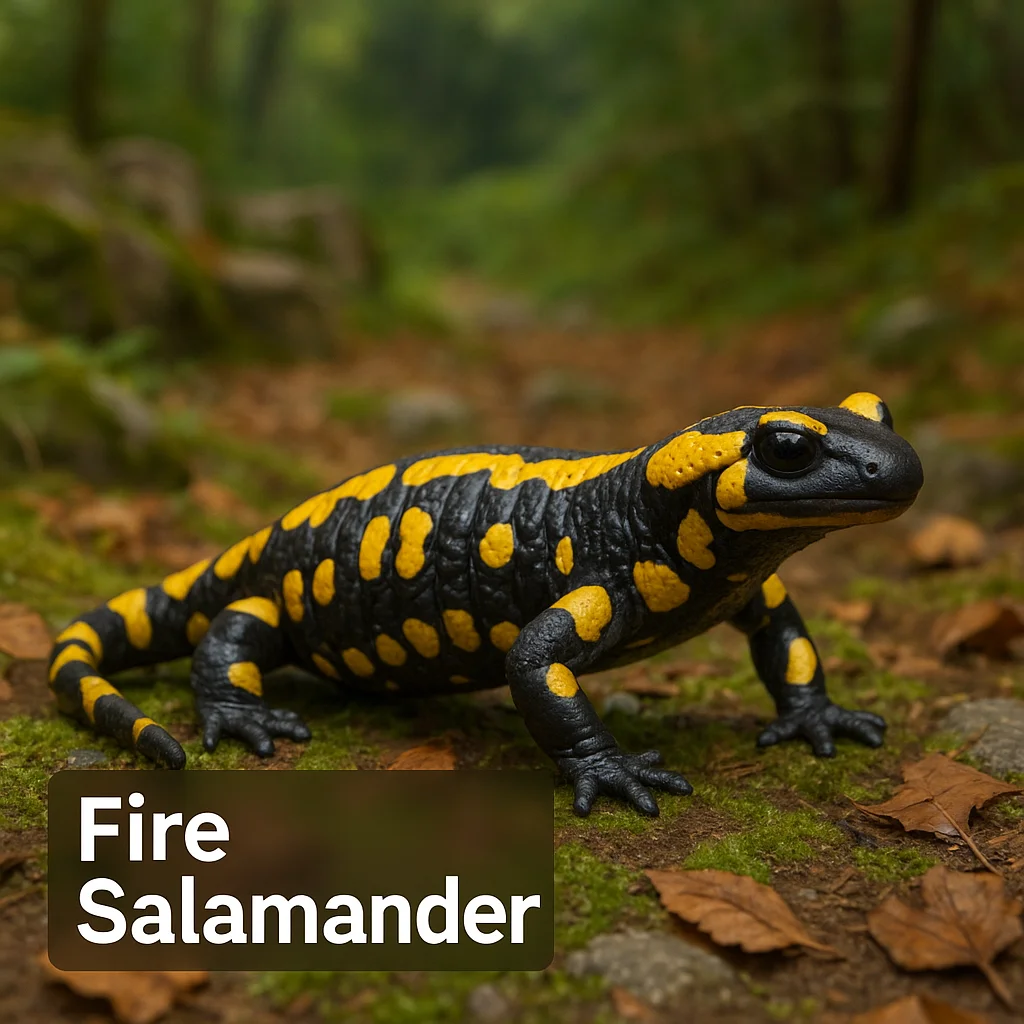
The Fire Salamander can be easily identified by its robust, smooth body that exhibits a dramatic black and yellow pattern. This aposematic coloration serves as a warning to potential predators about its toxic secretions. The salamander typically has a rounded head, short limbs, and a long, rounded tail. No significant seasonal or age-related color changes occur.
- Distinctive black and bright yellow pattern
- Robust body with short limbs
- Round, smooth head with prominent eyes
- No webbing between the toes
- Consistent coloration between individuals
- Often confused with other European salamanders but can be identified by the pattern
- Salamanders may have a unique pattern of spots that varies individually
🧱 Body Structure & Physical Adaptations
The Fire Salamander is built to thrive in its forest floor environment. Its body structure is optimized for a terrestrial lifestyle, with limbs positioned under the body for support. The salamander's teeth are small and designed for grasping soft-bodied prey. It has a moist, permeable skin that's essential for respiration and water balance.
- Stout body and short limbs for supporting weight
- Long tail aids in balance and mobility
- Moist skin for cutaneous respiration
- Toxin-secreting glands in the skin
- Small teeth designed for a carnivorous diet
- Excellent sense of smell to detect prey
- Limited eyesight adapted to low-light conditions
- Detects vibrations through the ground
🌍 Range & Distribution
Fire Salamanders are widespread across Europe, from the Iberian Peninsula to western Russia. They are typically found in humid, forested areas at lower altitudes, though populations can be found up to 1,000 meters (3,280 feet) in elevation. These salamanders are mostly resident, with little need for seasonal migration.
- Europe: from Spain and Portugal to Poland and Russia
- Present in the Alps and Carpathians
- Typically found in deciduous and mixed forests
- Favors areas with abundant leaf litter and moisture
- Avoids dry or open habitats
- May be found near streams or wetland edges
- Resident populations, no long-distance migrations
🏞️ Habitat & Shelter
The preferred habitats of Fire Salamanders are moist, deciduous, and mixed woodlands. They often seek shelter under rocks, logs, or within leaf litter to maintain the humidity necessary for their survival. Seasonal variations may cause them to seek deeper burrows or more sheltered areas during the winter months.
Habitat knowledge is crucial for understanding their behavior and survival, as it influences their diet, reproduction, and interactions with other species.
🧭 Behavior & Ecology
Fire Salamanders are primarily nocturnal, becoming active at dusk as they emerge to hunt. They spend the day hidden under cover due to their sensitivity to desiccation. Communication between individuals is limited and primarily chemical, involving pheromones for mating purposes.
The species plays an important role in controlling invertebrate populations, acting as both predator and prey in the ecosystem.
- Nocturnal hunters
- Daytime spent in cool, damp hiding places
- Chemical communication used for mating
- Important predators of insects and worms
- Prey for birds, mammals, and larger reptiles
- Contributes to nutrient cycling in forest ecology
👥 Social Life & Group Dynamics
Fire Salamanders are mostly solitary animals. They do not form complex social structures and territories may overlap. During mating season, males and females interact more frequently but do not form lasting pair bonds. Conflict is minimal, with occasional territorial displays observed.
- Primarily solitary
- Encounter each other mainly during breeding season
- No permanent social structures or groups
- Limited territorial displays when breeding
- No cooperative behaviors observed
🍽️ Diet, Prey & Predators
The diet of the Fire Salamander consists mainly of various small invertebrates, including insects, worms, and arachnids. Feeding habits may vary slightly based on availability and environmental conditions. Predators include snakes, birds, and mammals, which need to be cautious due to the salamander's toxic skin secretions.
- Primarily eats insects and worms
- Active hunters in moist conditions
- Relies on ambush tactics to capture prey
- Produces toxins as a chemical defense
- Predators need to be toxin-resistant or cautious
- Deters several potential predators via toxicity
🦌 Hunting, Foraging & Movement
Fire Salamanders exhibit slow, deliberate movements as they hunt and forage. They rely heavily on their sense of smell to locate prey, often employing a sit-and-wait strategy to ambush unsuspecting invertebrates. While they are not fast movers, they are adaptable and can navigate through the forest floor terrain.
- Slow and deliberate locomotion
- Ambush predators
- Relies on a keen sense of smell
- Prefers damp, dark environments
- Non-migratory
- Home range covers several meters
🧠 Intelligence & Senses
The Fire Salamander demonstrates basic survival instincts, using sensory adaptations to thrive in its habitats. While not known for high intelligence, it effectively uses chemical cues to identify prey and mates. Its vision is suited to nighttime activity, though it relies more on olfactory signals.
- Basic sensory processing
- Effective use of chemical signals
- Adapted vision for nocturnal life
- Relies on olfactory cues
- Limited problem-solving abilities
- Utilizes instinctual behaviors for survival
🪺 Reproduction, Pregnancy & Parenting
Reproduction in Fire Salamanders occurs during the spring and fall. The species is characterized by internal fertilization, with females retaining fertilized eggs until they hatch into larvae. The larvae are then deposited in water, where they continue to develop until metamorphosis.
Parental care is minimal, with no further involvement from parents once larvae are released into aquatic environments.
- Breeding occurs in spring and fall
- Internal fertilization
- Females give live birth to larvae
- Larvae are released in waterbodies
- No parental care post-birth
- Development from larvae to adult salamander
♀️♂️ Male vs Female Differences
Distinguishing between male and female Fire Salamanders can be challenging as the differences are subtle. Males often have slightly broader tails and may exhibit minute behavioral differences during breeding season. Their reproductive roles differ substantially, with females responsible for larval birth and males engaging in courtship behaviors more actively.
- Subtle size differences
- Males may have slightly broader tails
- No significant color variations
- Males engage more in courtship
- Females carry larvae internally
🧬 Subspecies & Variation
The Fire Salamander species has several recognized subspecies which vary in coloration, distribution, and size. The classification of these subspecies remains a subject of debate among herpetologists due to overlapping features and hybridization events.
- Differences in coloration among subspecies
- Varied geographical distribution
- Potential hybridization complicates classification
- Some subspecies exhibit unique patterns
- Environmental adaptations depending on range
⚠️ Threats, Conservation & Human Interaction
Fire Salamanders face several threats, notably habitat destruction, pollution, and climate change. Human development leads to forest clearing and fragmentation, posing significant threats to their survival. Conservation efforts vary by region, aiming to protect critical habitats and mitigate human-induced challenges without discouraging responsible observation and appreciation.
- Vulnerability to habitat destruction
- Sensitive to water pollution
- Climate changes alter habitats
- Legal protection in some areas
- Encouragement of habitat conservation efforts
- Promotional awareness of responsible human interaction
✨ Fun Facts & Unique Traits
- The Fire Salamander's bright coloration warns predators of its venomous glands.
- They can regenerate lost limbs or damaged body parts through efficient cellular processes.
- In folklore, Fire Salamanders were believed to be born from flames due to their fiery appearance.
- The skin secretions have antimicrobial properties.
- Some populations have adapted to cooler, mountainous regions, exhibiting mild physiological changes.
- They are one of the few salamanders that give birth to live young.
- A salamander's spots are unique, much like a human fingerprint.
📌 Summary
- Fire Salamanders are known for their striking black and yellow pattern.
- Thrives in moist, deciduous forest habitats.
- Primarily located across varied regions in Europe.
- Carnivorous, feeding on small invertebrates.
- Natural predators include birds, snakes, and mammals.
- Mostly solitary with limited social behaviors.
- Reproduction involves internal fertilization and live birth.
- Adaptations include toxin production for defense.
- Distinctive due to color, regenerative abilities, and cultural myths.