🦁 Leopard Frog
🧾 Quick Facts
Leopard frogs are a fascinating group of amphibians notable for their distinctive markings and widespread distribution. Commonly found across North America, they are an important part of the ecosystem and offer interesting insights into amphibian life.
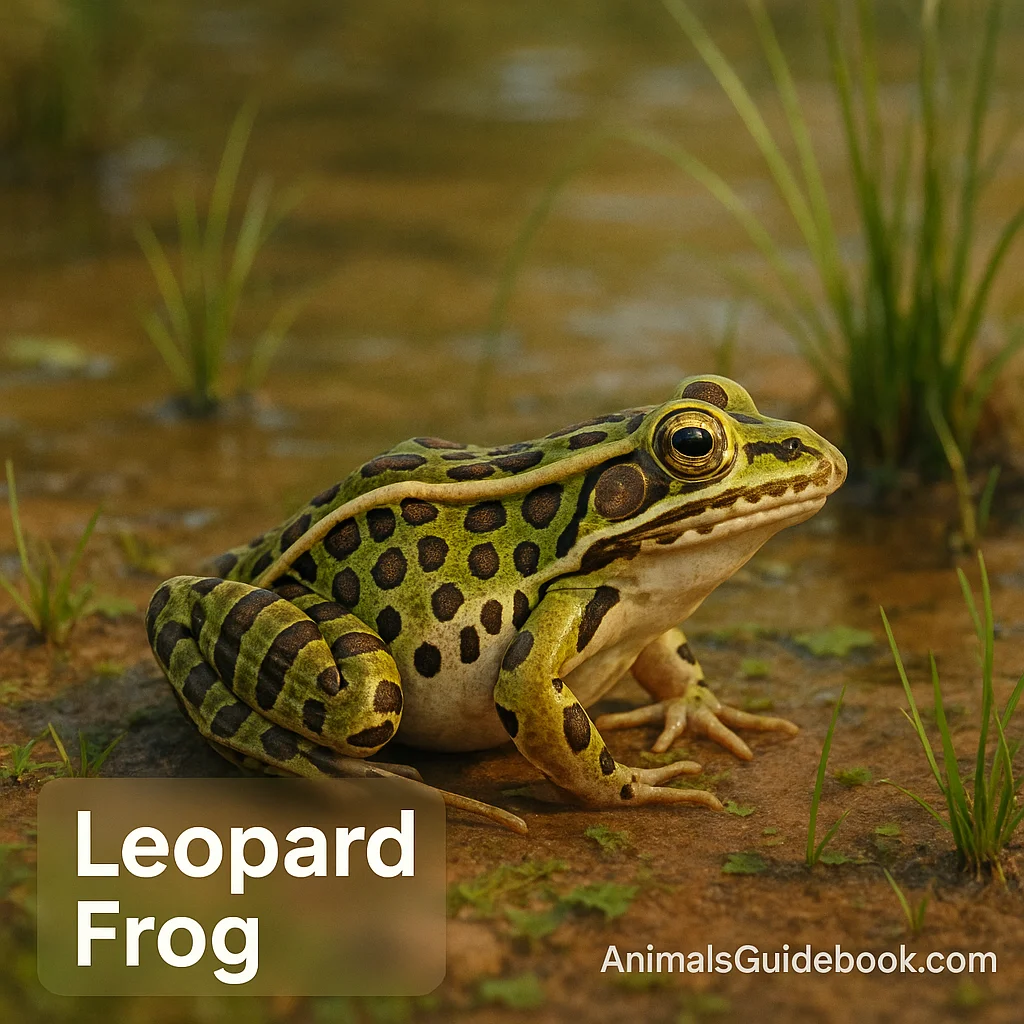
- Common name(s): Leopard Frog, Northern Leopard Frog, Southern Leopard Frog
- Scientific name: Often listed as Lithobates pipiens or Lithobates sphenocephalus
- Animal type: Amphibian
- Typical adult size: About 5 to 11 cm (2 to 4.5 inches) in length
- Typical lifespan: 2 to 4 years in the wild
- Diet type: Carnivore; insects, smaller frogs, crustaceans
- Activity pattern: Primarily diurnal but can be active at night
- Social structure: Mostly solitary, but can gather in groups during breeding season
- Speed / movement highlights: Known for jumping rather than swift running
- Intelligence/learning: Basic instinctual learning and adaptation to environments
- Primary habitats: Wetlands, ponds, streams, grassy areas near water
- Geographic range: Broadly distributed across North America
- Predators/threats: Birds, raccoons, snakes; also impacted by habitat destruction
- Conservation status: Varies by region; some populations are threatened
🔍 Identification & Appearance
Leopard frogs are identified by their sleek bodies and long legs, which facilitate their hopping movement. Their skin is typically green or brown with prominent dark spots, resembling a leopard's pattern, which gives them their name.
- Distinct dark spots surrounded by light rings, distributed across the back
- Relatively slim, agile body ideal for jumping
- White underbelly
- Tympanum (external eardrum) visible, located behind the eyes
- Dorsolateral folds running from the eye down the back
- Juveniles tend to have similar patterns but may be less vibrant
- Top ID Tips:
- Look for dark spots on a green or brown background
- Note the dorsolateral folds characteristic of the species
- Check the white underbelly for clarity
- Identify the tympanum behind the eyes
- Observe their powerful jump, a key movement feature
- Juveniles have similar but less pronounced markings
🧱 Body Structure & Physical Adaptations
Leopard frogs have evolved striking adaptations to thrive in their aquatic and terrestrial lives. Their muscular legs are designed for powerful leaps, while their streamlined bodies allow them to move efficiently in the water.
- Muscular hind legs optimized for long-distance jumps
- Slim, narrow body aiding in streamlined swimming
- Non-webbed fingers but webbed toes aid in aquatic mobility
- Strong jaw with a small row of teeth used for grasping prey
- Acute vision and hearing adapted to detect predators
- Highly permeable skin used for breathing and moisture absorption
- Key Adaptations:
- Powerful, long hind legs for jumping and quick escape
- Streamlined body for ease in water
- Specialized tympanum for acute auditory perception
- Permeable skin for environmental sensing and respiration
- Effective camouflage patterns for blending into habitats
- Efficient mouth structure for catching and holding prey
🌍 Range & Distribution
Leopard frogs are found throughout much of North America, from southern Canada through the United States and into parts of Mexico. They typically inhabit areas close to shallow bodies of water, favoring climates that range from temperate to subtropical.
- Present in wetlands, grasslands, and open areas near water sources
- Found in temperate zones, avoiding extreme desert or high mountain regions
- Range extends significantly into the southeastern parts of the U.S.
- Adaptable to a variety of biomes as long as water is accessible
- Generally occupy low to mid-elevation ranges
- Where You Might Find It:
- Southern Canada and northern United States
- Great Plains and the Midwest
- Southeastern United States
- Coastal areas with abundant amphibious habitat
- Freshwater lakes, ponds, and slow-moving streams
🏞️ Habitat & Shelter
Leopard frogs are adapted to live in environments that provide both aquatic and terrestrial resources. They prefer habitats like wetlands, marshes, and vegetation-dense areas near water bodies. During different seasons, they adjust their sheltering strategies according to environmental conditions.
In wetter conditions, they are often found in profusion near flooded areas or settling ponds. During drier periods, they may retreat to more humid microhabitats such as under logs or within dense vegetation to maintain moisture and escape heat.
🧭 Behavior & Ecology
The behavior of leopard frogs is closely tied to their lifecycle and environment. These frogs are typically most active during the day in spring and summer, whereas, in cooler times, they might engage in minimal activity.
- Behavior Highlights:
- Known for sporadic leaps from vegetation to water when startled
- Breed in groups during mating season
- Establish and defend small territories near water bodies
- Communicate through croaking calls during breeding
- Act as key predators in controlling insect populations
- Critical prey for a range of aquatic and terrestrial predators
👥 Social Life & Group Dynamics
Leopard frogs generally lead a solitary life except during the breeding season when they commonly congregate in large groups. Mating calls play a significant role in initiating such gatherings through vocal signals that establish temporary "breeding ponds."
- Social Structure Notes:
- Primarily solitary, except during mating season
- Seasonal congregations for mating are common
- Minimal cooperation observed beyond breeding
- No established hierarchy or complex social structures
- Breeding territories often defended intensely
- Aggregations influenced by population density and resource availability
🍽️ Diet, Prey & Predators
Leopard frogs are carnivorous, feeding on a diet rich in insects and small invertebrates, as well as other amphibians. They are opportunistic feeders and rely heavily on their excellent vision and quick reflexes to capture prey.
Natural predators include snakes, birds, and larger mammals, prompting leopard frogs to use rapid jumps and aquatic dives to avoid capture.
- Feeding Notes:
- Diet consists primarily of insects and small crustaceans
- Utilize a "sit and wait" hunting approach
- Predators include herons, raccoons, and water snakes
- Rely on leaping as a defense against predators
- Employ camouflage to avoid detection by both prey and predators
🦌 Hunting, Foraging & Movement
Leopard frogs are adept hunters and foragers, using their acute vision and quick reflexes to capture moving prey. These frogs are primarily ambush predators, waiting patiently for the opportune moment to strike.
- Movement & Strategy:
- Jumping is the primary form of locomotion
- Skilled at quick maneuvers in both terrestrial and aquatic settings
- Employ a "sit and wait" method for hunting
- Utilize aquatic habitats for rapid escape from predators
- Display caution and use cover as a passive defense strategy
🧠 Intelligence & Senses
Leopard frogs possess sharp sensory abilities essential for survival. Acute vision allows them to quickly detect movement, while their auditory senses help in communication and predator detection.
- Notable Abilities:
- Excellent vision for detecting prey and predators
- Sensitive hearing aids in communication and alertness
- Minimal problem-solving abilities, relying mostly on instinct
- Remarkable ability to remain motionless as camouflaged
🪺 Reproduction, Pregnancy & Parenting
Breeding occurs in early spring, where males attract females through a series of distinctive croaking calls. Reproduction involves egg laying in water, with little to no parental care as the tadpoles develop.
- Reproduction Snapshot:
- Breeding season kicks off post-winter, during spring
- Males produce call to attract females
- Eggs are laid in clusters in water
- Minimal parental involvement after egg deposition
- Tadpole stage lasts several weeks to months depending on conditions
♀️♂️ Male vs Female Differences
Male and female leopard frogs exhibit subtle differences primarily related to the breeding period. Males are often distinguished by their louder vocalization abilities and slightly swollen thumbs (nuptial pads) used during mating.
- Sex Differences at a Glance:
- Males produce calls, while females are typically silent
- Males develop nuptial pads during the breeding season
- Females are generally larger in body size
- Color and pattern differences are minimal
- Males more frequently observed in breeding congregations
🧬 Subspecies & Variation
There are several subspecies of leopard frogs, each adapted to their specific environmental conditions. Some variations include differences in size, pattern, and coloration that can be attributed to geographic separation and habitat specificity.
- Variation Notes:
- Common subspecies include the Northern and Southern Leopard Frog
- Color and pattern adapted to local environment
- Size variations noticeable among different populations
- Subspecies classification can be debated among herpetologists
- Distinctive adaptations linked to habitat specific requirements
⚠️ Threats, Conservation & Human Interaction
Leopard frogs face several challenges due to human activity, including habitat destruction and environmental pollution. Conservation efforts are focused on protecting natural habitats and curbing detrimental practices to aid in their continued survival.
- Responsible Notes:
- Habitat loss from urban development poses significant threat
- Pollution impacts water quality and amphibian health
- Conservation programs aim to restore natural habitats
- Climate change alters habitats and temperature lagoons
- Ecosystem health can be indicated by frog population statuses
✨ Fun Facts & Unique Traits
- Leopard frogs are known for their distinctive croaking sounds used in mating calls.
- Their namesake comes from the spotted pattern, reminiscent of leopards.
- Leopard frogs have historically been popular as dissection specimens, highlighting a need for ethical reconsideration and educational alternatives.
- They are vital in ecosystem functioning, controlling insect populations naturally.
- Once widely distributed, their numbers have seen a decline due to human activity.
📌 Summary
- Leopard frogs display distinctive leopard-like spots on green or brown bodies.
- They are typically found in North American wetlands and grassy areas.
- These frogs are carnivorous, relying on insects and small amphibians for food.
- Natural predators include snakes, birds, and mammals.
- They are primarily solitary but gather during the breeding season.
- Breeding involves males attracting females through croaking calls.
- Leopard frogs are important eco-friendly pest controllers.
- A variety of subspecies exist, differing primarily by regional adaptations.
- Conservation efforts are necessary due to threats like habitat destruction.