🦁 Sonoran Desert Toad
🧾 Quick Facts
The Sonoran Desert Toad, also known as the Colorado River Toad, is a remarkable amphibian that thrives in the arid environments of the southwestern United States and northern Mexico. Known for its distinctive call and large size, this toad plays a unique role in its ecosystem.
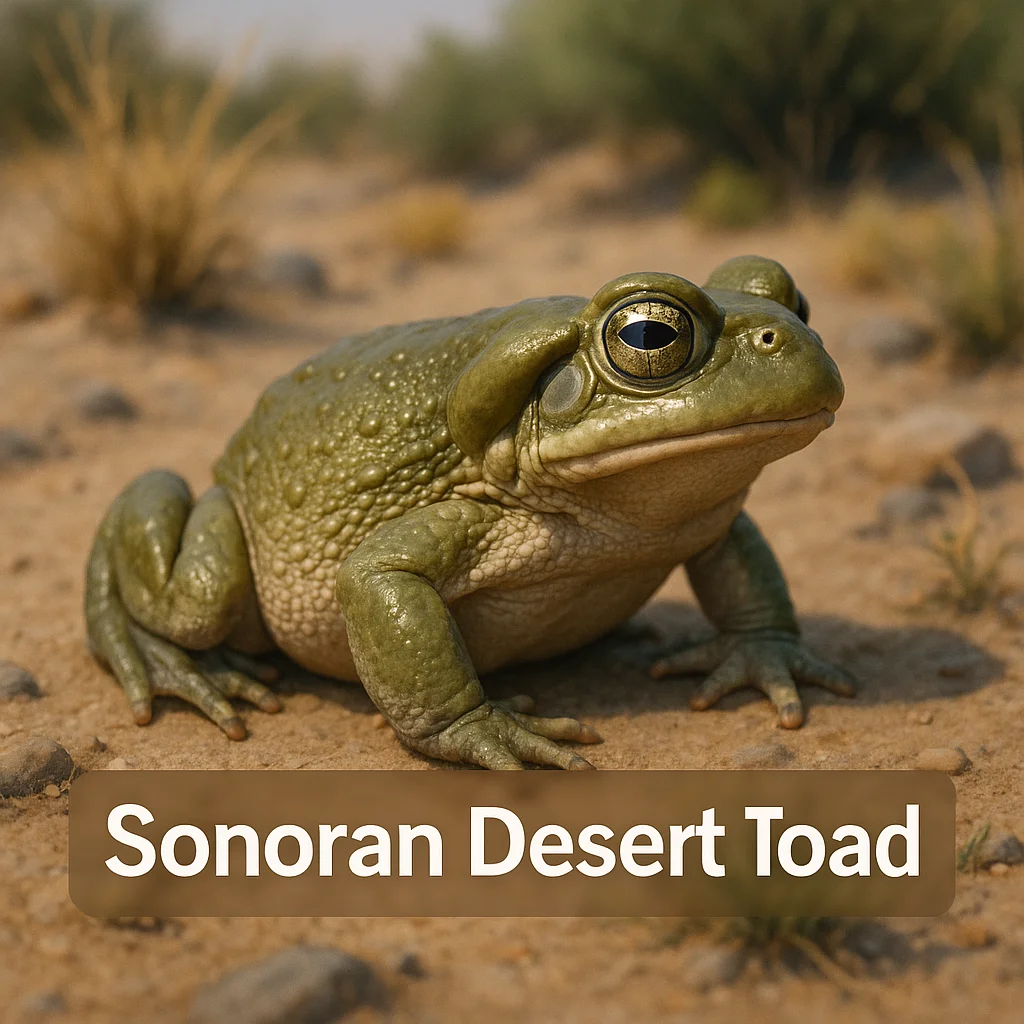
- Common name(s): Sonoran Desert Toad, Colorado River Toad
- Scientific name: Incilius alvarius
- Animal type: Amphibian
- Typical adult size: 4 to 7 inches in length
- Typical lifespan: 10 to 20 years in the wild
- Diet type: Carnivore; primarily insects
- Activity pattern: Nocturnal
- Social structure: Normally solitary
- Speed / movement highlights: Known for powerful hops
- Intelligence/learning: Capable of simple learning and problem-solving
- Primary habitats: Arid and semi-arid regions
- Geographic range: Southwestern United States, northern Mexico
- Predators/threats: Birds, snakes, habitat loss due to human encroachment
- Conservation status: Varies by region; generally not threatened
🔍 Identification & Appearance
The Sonoran Desert Toad is easily recognizable due to its large, robust body and smooth, olive green or brown skin. Their bodies are often adorned with warty bumps, and they have prominent parotoid glands behind their eyes, which secrete toxins as a defense mechanism.
- Body shape: Stout and robust
- Key colors: Olive green to brown; dark spots may be present
- Distinctive features: Prominent parotoid glands; creamy-white underside
- Tracks: Toads leave a distinctive hopping pattern; tracks can be difficult to detect in their arid habitats
- Common look-alikes: Other toad species; distinguished by size and gland characteristics
- Sexual dimorphism: Limited; males are usually smaller than females
- Top ID Tips:
- Look for large, warty bodies
- Check for prominent parotoid glands
- Smooth skin with olive to brown coloring
- Creamy-white abdomen
- More active and visible during rainy seasons
- Nocturnal; rarely seen during the day
🧱 Body Structure & Physical Adaptations
The Sonoran Desert Toad is designed for survival in harsh desert environments. Its morphology showcases adaptations that help it conserve water and avoid predation.
- Build and proportions: Stocky body; strong hind legs for hopping
- Teeth/beak/jaw adaptations: Toads do not have teeth; they use their sticky tongue to capture prey
- Claws/hooves/wings/fins: None; relies on powerful hind legs for movement
- Sensory strengths: Keen sense of smell and good night vision; hearing is adapted for detecting vibrations
- Water conservation: Capable of absorbing moisture through skin
- Toxin production: Parotoid glands secrete toxins to deter predators
- Key Adaptations:
- Powerful jumping ability aids in rapid movement
- Moist skin ideal for gas exchange and water absorption
- Toxins provide defense against many predators
- Nocturnal habits reduce water loss and predation risk
- Skin coloration camouflages in desert landscapes
🌍 Range & Distribution
The Sonoran Desert Toad occupies a specific niche, thriving in arid regions where it can take advantage of seasonal ponds and streams created by rain.
- Geographic range: Found in Arizona, California, New Mexico, and northwestern Mexico
- Elevation range: From sea level up to around 5,000 feet
- Climate: Prefers arid to semi-arid climates
- Seasonal movement: Generally sedentary, but may migrate short distances after rainfalls
- Where You Might Find It:
- Sonoran Desert regions
- Temporary rain pools
- Arid grasslands
- Desert scrub areas
- Woodlands adjacent to desert areas
- Low elevation river bottoms
🏞️ Habitat & Shelter
The Sonoran Desert Toad is well adapted to living in deserts and arid regions where they rely on transient water sources for breeding and hydration. They often seek shelter in self-dug burrows or utilize crevices to avoid extreme temperatures.
This toad's behavior is closely linked to the weather and seasons. During dry periods, they can be found staying dormant underground, emerging primarily after rainstorms when they can be more active due to higher humidity. Their reliance on water sources makes them susceptible to changes in climate patterns, showcasing the importance of understanding habitat needs for their conservation and survival.
🧭 Behavior & Ecology
Sonoran Desert Toads showcase intriguing behavior that adapts them to their ecological niche. Known for spending the majority of their time underground during dry spells, they emerge to feed and breed primarily during and after rains. Vocal communication is essential for mating during the breeding season, with males producing distinctive calls to attract females.
- Routine: Primarily nocturnal; emerges seasonally after rains
- Communication: Males call loudly during breeding season
- Interactions: Predation by birds and snakes; distance from most human activities keeps contact minimal
- Role in ecosystem: Helps control insect populations and serves as prey for larger predators
- Behavior Highlights:
- Seasonal emergence tied to rainfall
- Loud, distinctive mating calls
- Solitary outside of breeding season
- Varied diet based on availability
- Important prey and predator within the desert food web
👥 Social Life & Group Dynamics
Sonoran Desert Toads are generally solitary animals outside of the breeding season. When they do gather, it is primarily for mating purposes, in temporary pools that form after rains. These gatherings are not social in nature but rather driven by breeding opportunities.
- Social tendency: Solitary except during breeding
- Group types: Temporary congregations for mating
- Cooperation: Minimal, aside from breeding activities
- Dominance: Not observed; interactions are mostly for reproduction
- Social Structure Notes:
- Solitary lifestyle predominates
- Gather for breeding without forming lasting bonds
- Minimal social hierarchy observed
- Main social behavior revolves around reproductive needs
🍽️ Diet, Prey & Predators
The diet of the Sonoran Desert Toad is primarily carnivorous, focusing heavily on insects and small invertebrates. They exhibit opportunistic feeding behavior and will eat a wide range of prey that they can overpower and consume.
Their main predators include birds and snakes, with their toxin-producing skin acting as an effective deterrent against many potential threats. In terms of anti-predation strategy, their camouflage and nocturnal habits play a significant role in avoiding detection.
- Diet: Primarily insects and other small invertebrates
- Hunting strategy: Ambush predator, relies on stealth and quick movements
- Main predators: Birds, snakes, and occasionally mammals
- Defense: Uses toxins secreted from skin glands
- Feeding Notes:
- Opportunistic hunting style
- Insect diet aids in controlling pest populations
- Toxins deter most predators
- Nocturnal feeding aligns with prey availability
🦌 Hunting, Foraging & Movement
The Sonoran Desert Toad is a skillful ambush predator, capable of quickly capturing prey with its adept tongue. It exhibits notable agility in its hopping abilities, optimizing its leaps for both hunting and evasion.
This toad is primarily active during the night, taking advantage of cooler temperatures and the activity patterns of its prey. It does not undertake long migrations, but rather moves short distances in response to environmental conditions, particularly rainfall.
- Locomotion style: Efficient hopper; skilled in ambush tactics
- Speed and endurance: Quick bursts of speed; moderate stamina
- Hunting tactics: Ambush; relies on stealth and speed to capture prey
- Home range: Generally restricted to localized areas around ephemeral water sources
- Movement & Strategy:
- Relies on hopping for movement
- Active primarily at night
- Ambush strategy for prey capture
- Adapts movement based on rainfall
🧠 Intelligence & Senses
The Sonoran Desert Toad shows a level of intelligence suitable for problem-solving in acquiring food and avoiding predators. Their sensory faculties are well-tuned to detecting environmental changes and sensing prey even in minimal light conditions.
Research on their cognitive abilities remains limited, but their survival techniques in harsh environments indicate a degree of flexibility and learning.
- Problem-solving: Demonstrates basic problem-solving abilities
- Sensory use: Strong reliance on smell and hearing; sight adapted for low light
- Research: Limited but indicates adaptability and learning within environment
- Notable Abilities:
- Keen sense of hearing assists in avoiding predators
- Ability to locate prey in near darkness
- Adapts to changing environments and prey availability
- Toxin use as defense is a learned response
🪺 Reproduction, Pregnancy & Parenting
Reproduction for the Sonoran Desert Toad occurs after significant rainfall when suitable breeding ponds are available. Males engage in vocalizations to attract females to these temporary bodies of water.
Once fertilization occurs externally, eggs are laid in water where they will hatch into tadpoles. As with many amphibians, the roles of parenting are minimal post-fertilization, as offspring are largely left to fend for themselves from the tadpole stage onward.
- Breeding season: Occurs following summer rains
- Mating system: Promiscuous; external fertilization
- Fertilization: External; eggs laid in water bodies
- Clutch size: Can be several thousand eggs
- Reproduction Snapshot:
- Breeding aligns with rain cycles
- Vocal calls crucial for mate attraction
- Attachment to water sources for egg-laying
- High reproductive potential due to clutch size
♀️♂️ Male vs Female Differences
Male and female Sonoran Desert Toads exhibit slight differences in size, with females typically being larger. During the breeding season, males are notable for their loud calls used to attract mates.
- Size differences: Females are generally larger
- Behavior: Males vocalize during breeding season
- Coloration: Generally similar between sexes
- Sex Differences at a Glance:
- Females tend to be larger than males
- Vocalization is a male behavior
- Subtle morphological differences
🧬 Subspecies & Variation
While there's no recognized subspecies within the Sonoran Desert Toad listing, individuals may exhibit variations in size and skin pattern based on environmental conditions and geographic locations. Adaptations like these sometimes manifest as local variations in behavior or physical characteristics.
- Local adaptations: Varies slightly by region
- Environment-induced differences: Size and survival strategies
- Variation Notes:
- Adaptive traits can vary regionally
- Environmental conditions influence physical traits
⚠️ Threats, Conservation & Human Interaction
The Sonoran Desert Toad faces several threats, primarily from habitat loss due to urban sprawl and agricultural development. Climate change and associated shifts in rainfall patterns also pose significant risks. Although not currently listed as threatened, their dependence on ephemeral water bodies makes them vulnerable.
Interaction with humans is mostly indirect, unless they venture near urbanized areas, at which point, habitat disturbances can impact their populations. Considerations for their conservation focus on habitat protection and minimizing pollution in desert waterways.
- Major threats: Habitat destruction, climate change impacts
- Conservation measures: Habitat protection and legal regulations often needed
- Human interaction impacts: Primarily indirect through habitat alteration
- Responsible Notes:
- Protect wetland habitats for sustainability
- Support conservation efforts in desert regions
- Avoid creating disturbances in breeding grounds
- Encourage pollution prevention in wetlands
✨ Fun Facts & Unique Traits
- The Sonoran Desert Toad can secrete a toxin that has psychoactive properties for humans if improperly handled.
- They have evolved to survive in one of the most arid regions on the planet.
- Their mating calls can be heard over considerable distances, even in noisy environmental conditions.
- During droughts, they can remain dormant for several months.
- They're one of the largest native toad species in the United States.
📌 Summary
- Identified by robust size and olive-green to brown skin
- Lives in arid and semi-arid regions with seasonal activity patterns
- Feeds primarily on insects, making it a key insectivore in its habitat
- Has few natural predators due to its toxin-producing skin
- Solitary outside breeding season, with group dynamics focusing on reproduction
- Relies heavily on seasonal rains for breeding and hydration
- Conservation important due to habitat risks and climate challenges
- Unique for its large size and ecological adaptability in desert conditions