🦁 Spotted Salamander
🧾 Quick Facts
The Spotted Salamander, often listed as Ambystoma maculatum, is a colorful and fascinating amphibian found in North American forests. Known for its vibrant spots, this species captivates with its appearance and survival adaptations.
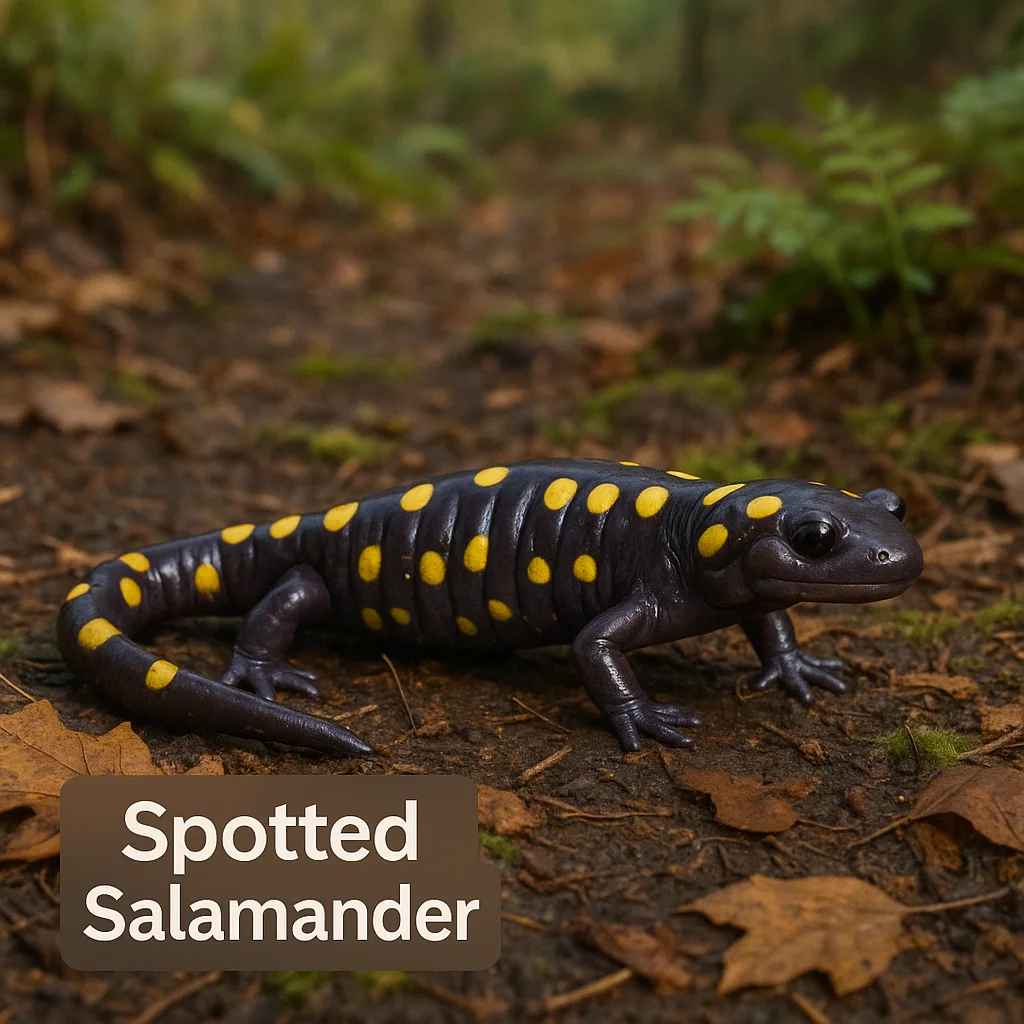
- Common name(s): Spotted Salamander
- Scientific name: Often listed as Ambystoma maculatum
- Animal type: Amphibian
- Typical adult size: 15–25 cm (6–10 inches) in length
- Typical lifespan: 20 years in the wild; up to 30 years in captivity
- Diet type: Carnivore; primarily consumes insects, worms, spiders
- Activity pattern: Primarily nocturnal
- Social structure: Mostly solitary
- Speed / movement highlights: Slow-moving; crawls in a distinctive s-shaped motion
- Intelligence/learning: Capable of basic learned behaviors; limited problem-solving abilities
- Primary habitats: Forested wetlands, deciduous and mixed woodlands
- Geographic range: Eastern North America
- Predators/threats: Birds, snakes, large insects; habitat loss due to deforestation
- Conservation status: Least Concern, though population varies by region
🔍 Identification & Appearance
The Spotted Salamander is recognizable by its stout body, broad head, and distinctive yellow or orange spots against a dark, bluish-black body. This animal is most identifiable during its breeding season when it moves to vernal pools.
- Top ID Tips:
- Look for 10-20 round yellow spots running along its back
- Dark body with bluish undertones
- Broad, flat head and rounded tail
- Smooth, moist skin common to many amphibians
- Short limbs with distinct toes
- No external ear openings or visible tympanum
- For forested areas with dense leaf litter for daytime hiding
🧱 Body Structure & Physical Adaptations
The Spotted Salamander has a stocky build with short limbs and a broad head, optimized for life in moist, forested environments. Its body structure aids in navigating the leaf-laden floors of its habitat.
- Key Adaptations:
- Broad head helps with capturing and swallowing prey
- Smooth, moist skin aids in breathing through skin
- Concealment in forest floor's leaf litter is enhanced by skin coloration
- Limited vision but heightened chemical senses to detect prey
- Strong limbs for digging and burrowing into soil or under logs
- Release of a distasteful secretion as a defense mechanism
🌍 Range & Distribution
The Spotted Salamander is primarily found in the eastern half of North America, from southern Canada down to Georgia in the United States. They prefer denser, moist areas where they can find shelter under logs and leaf litter.
- Where You Might Find It:
- Eastern United States
- Piedmont region applications
- Wooded areas with nearby vernal pools
- Forests with abundant ground cover
- Temperate broadleaf & mixed forests
- Areas ranging from lowlands to lower mountainous regions
- Midwestern river valleys in the USA
🏞️ Habitat & Shelter
Spotted Salamanders are commonly found in deciduous and mixed conifer forests with high humidity. They rely on the ground litter for day shelters and vernal pools for breeding.
- Preferred habitats: Deciduous, mixed forests
- Utilizes fallen logs, stones, and leaf litter for day shelter
- Breeds in temporary pools; doesn't inhabit permanent water bodies
- Active moist condition seeks refuges during dry periods
- Seasonal movement from forest to vernal pools for breeding
🧭 Behavior & Ecology
The Spotted Salamander is primarily nocturnal and spends most of its time underground, emerging primarily for feeding and during its breeding season to head to nearby water bodies.
- Behavior Highlights:
- Emergence at night, especially after rain
- Breeding migrations to temporary pools
- Terrestrial hiding under rocks/logs when not breeding
- Secretes a mild toxin for defense
- Sensitive to climate and environmental changes
- Can regrow lost limbs, though regeneration occurs slowly
👥 Social Life & Group Dynamics
These salamanders are primarily solitary outside of the breeding season. During the breeding season, they congregate in large numbers at vernal pools, though they exhibit no social bonds.
- Social Structure Notes:
- Self-maintenance and territorial among individual habitats
- Group congregations only during breeding
- No hierarchical structure during congregations
- No parental care post egg-laying
- Competition for mates but not aggressive
🍽️ Diet, Prey & Predators
The Spotted Salamander is a carnivore with a diet that includes various insects, earthworms, and small invertebrates. They rely on a sit-and-wait strategy, usually capturing prey at night when most active.
- Feeding Notes:
- Consumes earthworms and insects primarily
- Occasionally small invertebrates like snails and spiders
- Predators include birds, mammals, and larger amphibians
- Salamander’s defense includes toxic skin secretions
🦌 Hunting, Foraging & Movement
Spotted Salamanders move slowly across the forest floor, utilizing their heightened chemical senses to locate prey under cover of night.
- Movement & Strategy:
- Slow-moving at ground level
- Ambush predator utilizing quick lunges
- Nighttime feeding with cautious terrain navigation
- Limited territory, roaming primarily for food
🧠 Intelligence & Senses
While not exceptional problem solvers, Spotted Salamanders have developed keen senses for their subterranean life. Their chemical reception is especially developed for detecting prey and environmental cues.
- Notable Abilities:
- Keen chemical sensing of prey
- Basic learned responses to environmental changes
- Net defense tactic if disturbed
- Limited visual acuity in low light
🪺 Reproduction, Pregnancy & Parenting
Breeding in Spotted Salamanders occurs during early spring, with adults migrating to vernal pools. Fertilization is external, and the female lays a clutch of eggs that is typically left to develop without further parental involvement.
- Reproduction Snapshot:
- Breeding season during early spring rains
- Lays approximately 100-300 eggs
- External fertilization at vernal pools
- No parental care after laying eggs
♀️♂️ Male vs Female Differences
In Spotted Salamanders, sexual dimorphism is subtle, with males slightly more slender and often observed to have longer tails. During mating season, males develop deposits called spermatophores.
- Sex Differences at a Glance:
- Males are generally smaller
- Males with larger deposits of spermatophores
- Mating season shows prominent cloacal swelling in males
🧬 Subspecies & Variation
The Spotted Salamander has limited recognized subspecies, primarily due to their similar morphological and environmental adaptations throughout their range. Minor regional variations may occur in coloration or breeding behavior.
- Variation Notes:
- Consistent spotting patterns across range
- Occasional variation in distribution and breeding timing
- Limited subspecies classification noted
⚠️ Threats, Conservation & Human Interaction
Despite currently being of Least Concern, Spotted Salamanders face pressures from habitat destruction and pollution. Conservation efforts emphasize maintaining vernal pools and clean water sources.
- Responsible Notes:
- Primary threat from habitat destruction
- Pollution and waterway changes affect breeding
- Conservation efforts focus on habitat restoration
- Careful management of forest and wetland habitats recommended
✨ Fun Facts & Unique Traits
- Spotted Salamanders are one of the few amphibians with mutualistic green algae in their eggs.
- They can live over two decades, a relatively long lifespan for amphibians.
- Their spots are unique and help in individual identification.
- Primarily nocturnal to avoid predation and dehydration.
- Salamander larvae are aquatic and highly adaptable to environmental changes.
📌 Summary
- The Spotted Salamander is an amphibian with a distinctive spotted appearance and resides in eastern North American forests.
- It thrives in moist woodland habitats and makes seasonal migrations to vernal pools to reproduce.
- Carnivorous by nature, it primarily feeds on small invertebrates and utilizes its chemical senses to detect prey.
- The Spotted Salamander exhibits unique mutualistic relationships during its egg stage, enhancing development through algae.
- It faces threats from habitat destruction and pollution, making conservation efforts critical for its continued survival.