🦁 Tiger Salamander
🧾 Quick Facts
The Tiger Salamander is a fascinating and distinctive amphibian often recognized by its striking coloration and adaptability across various habitats. Here’s a concise overview of the key facts about this intriguing creature.
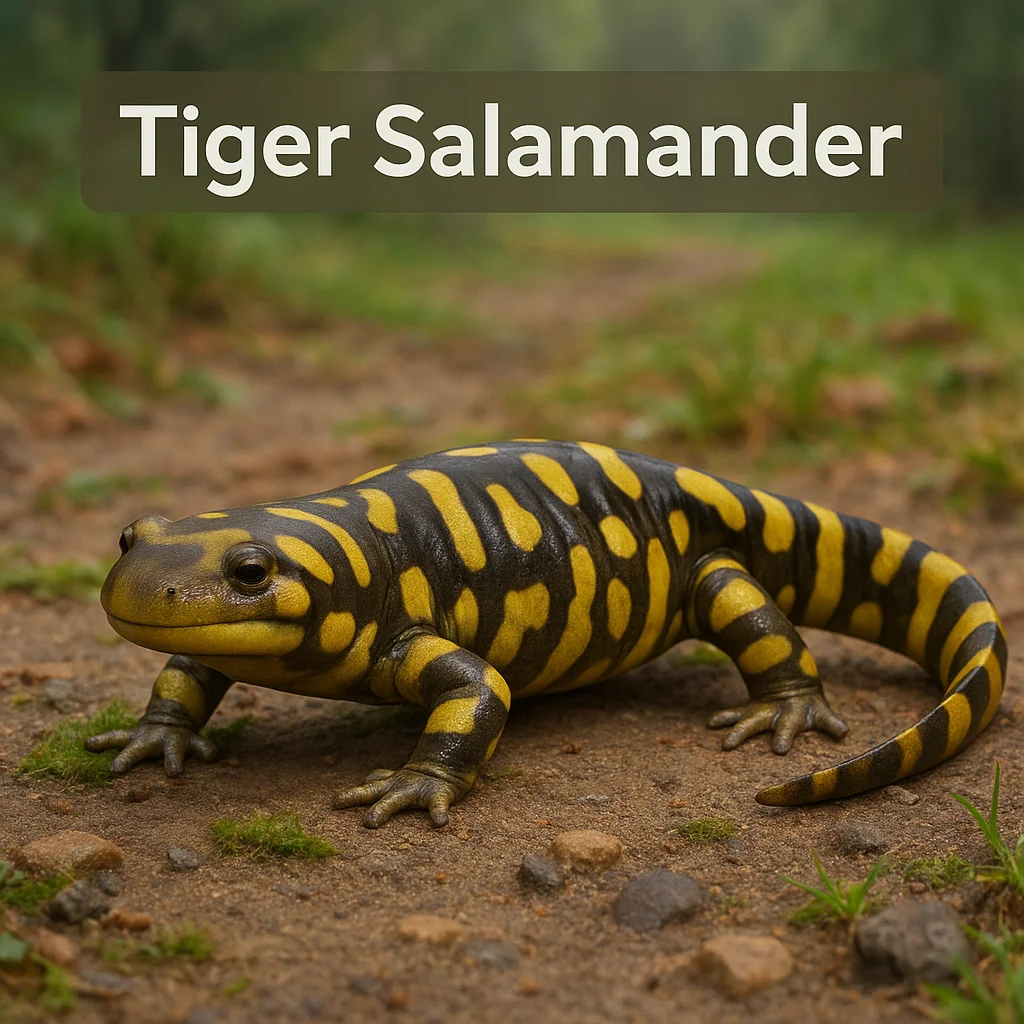
- Common name(s): Tiger Salamander
- Scientific name: Ambystoma tigrinum
- Animal type: Amphibian
- Typical adult size: 6 to 13 inches in length
- Typical lifespan: 10 to 15 years in the wild
- Diet type: Carnivore; feeds on insects, worms, and small invertebrates
- Activity pattern: Nocturnal
- Social structure: Mostly solitary
- Speed / movement highlights: Slow-moving with bursts of speed in short sprints
- Intelligence/learning: Basic problem-solving and navigation skills
- Primary habitats: Grasslands, forests, wetlands
- Geographic range: North America, from southern Canada to northern Mexico
- Predators/threats: Birds, snakes, fish, habitat loss
- Conservation status: Varies by region; generally not endangered but facing local threats
🔍 Identification & Appearance
The Tiger Salamander is easily recognized by its unique appearance, which includes a robust body and vibrant coloration. This species serves as a wonderful example of nature's diversity and adaptation in amphibians.
- Body shape and silhouette: Stout, cylindrical body with a wide head and long tail
- Key colors/patterns: Varied; often mottled with black, yellow, brown, or green bands
- Distinctive features: Broad smile-like mouth, prominent eyes, and smooth skin
- Tracks, scat, or other field signs: Not commonly tracked; often found near water bodies or burrows
- Common look-alikes: Confused with Spotted Salamanders; distinguishable by band patterns
- Top ID Tips
- Look for their distinct band patterns
- Identify by the broad, rounded head
- Recognize by their smooth, moist skin
- Notice their large, protruding eyes
- Check for a robust, long tail
- Observe their nocturnal activity
🧱 Body Structure & Physical Adaptations
Tiger Salamanders are equipped with numerous adaptations that allow them to thrive in diverse environments, from forests to grasslands, demonstrating a remarkable resilience and versatility in habitat utilization.
- Build and proportions: Stocky build with short legs adapted for digging
- Teeth/beak/jaw adaptations: Small teeth ideal for catching small prey
- Claws/hooves/wings/fins: Developed toes for burrowing and grasping
- Sensory strengths: Keen sense of smell and sight used primarily for hunting
- Key Adaptations
- Borrows efficiently due to its muscular body
- Camouflage patterns for predator avoidance
- Strong swimming capabilities for aquatic life
- Moist skin for aquatic and terrestrial respiration
- Nictitating membrane for eye protection
🌍 Range & Distribution
The Tiger Salamander occupies a vast range across North America. It can be found in varied environments, from woodlands to savannas, illustrating its adaptability to different ecological niches.
- Continents/regions and typical countries/biomes: Primarily found in North America, including the United States, Canada, and parts of Mexico
- Elevation range: Sea level up to 3,500 feet
- Seasonal movements or migration: Generally non-migratory, though some local movements towards breeding sites
- Where You Might Find It
- Shallow forest ponds during breeding
- Under fallen logs or moist leaf litter
- In temporary or seasonal wetlands
- Burrowing in moist soil during dry periods
- Grassland areas with access to water
🏞️ Habitat & Shelter
Tiger Salamanders favor habitats that offer moist conditions necessary for their survival, utilizing a range of microhabitats for shelter and breeding, and adjusting behavior based on weather and seasonality.
- Preferred habitats: Grasslands, forests, wetlands prone to seasonal flooding
- Microhabitats and shelter: Utilizes burrows and under debris as refuges
- How behavior changes with weather/season: Moves to water bodies during breeding season; more subterranean in dry conditions
🧭 Behavior & Ecology
The behavior of Tiger Salamanders is characterized by their nocturnal lifestyle and solitary nature. They play a critical ecological role as both predator and prey in their ecosystems, impacting the invertebrate species population.
- Daily routine: Active primarily at night, often retreating to moist shelter during the day
- Communication: Limited vocalizations; may use chemical cues
- Interactions with other species: Preys on small insects and worms, competing with similar-sized predatory species
- Role in the ecosystem: Acts as both predator and prey; important for regulating insect populations
- Behavior Highlights
- Nocturnal foraging habits
- Seasonal movements to breeding sites
- Use of burrows during extreme weather
- Chemical cue utilization for territory marking
- Moist skin reliance for hydration and respiration
- Prey on a variety of invertebrates, impacting populations
👥 Social Life & Group Dynamics
Though typically solitary, Tiger Salamanders exhibit specific social behaviors during breeding periods. They gather in significant numbers, leading to temporary aggregations around breeding habitats.
- Solitary vs social tendencies: Mostly solitary except during breeding season
- Group types: Temporary gatherings at breeding ponds
- Cooperation: Minimal; interactions are largely competitive
- Social Structure Notes
- Primarily solitary outside breeding periods
- Temporary gatherings for breeding
- Territorial during breeding season
- Limited cooperative behavior
- May exhibit minor aggression over territory
- Primarily engage with species when breeding
🍽️ Diet, Prey & Predators
Tiger Salamanders have a carnivorous diet, primarily consisting of small invertebrates. Despite being effective predators, they have their own predators to evade and employ effective anti-predation strategies.
- What it eats: Insects, earthworms, small crustaceans, spiders
- Main natural predators: Birds, snakes, small mammals
- Anti-predator defenses: Utilize camouflage and toxic skin secretions
- Feeding Notes
- Carnivorous diet focusing on insects and worms
- Nocturnal hunting adaptations
- Reluctant to pursue fast prey; ambush tactics
- Adequate scavenging in aquatic environments
- Skin secretions can deter some predators
- Camouflage to avoid detection
🦌 Hunting, Foraging & Movement
The Tiger Salamander exhibits a diverse array of movement strategies to forage and hunt efficiently. Its locomotion is adapted for both terrestrial and aquatic environments, demonstrating impressive versatility.
- Locomotion style: Ambush-style hunting and foraging
- Speed and endurance: Slow and methodical, capable of quick bursts
- Foraging times: Mostly nocturnal forays
- Navigation: Uses environmental cues and chemical signals for orientation
- Movement & Strategy
- Ambush predator
- Notable burrowing capability
- Nocturnal movement for stealth
- Adaptable to both land and water
- Responsive to moisture and temperature cues
🧠 Intelligence & Senses
Tiger Salamanders possess essential sensory adaptations that cater primarily to hunting and avoiding predators. Their intelligence and sensory prowess enable them to navigate complex environments and capture prey efficiently.
- Senses: Strong eyesight and smell for detecting prey
- Problem-solving: Basic ability to navigate obstacles
- Uncertainties: Variable learning capacity; further research needed
- Notable Abilities
- Exceptional sense of smell
- Adaptability to different environments
- Responsive to visual stimuli
- Ability to memorize local terrains
- Effective use of camouflage
🪺 Reproduction, Pregnancy & Parenting
Tiger Salamanders exhibit interesting reproductive behaviors, with a distinct breeding season that sees a temporary shift in social structure. Understanding these patterns is crucial to appreciating their life cycles.
- Breeding seasonality: Usually occurs in the spring
- Mating system: Generally promiscuous
- Egg incubation period: 20 to 45 days
- Litter/clutch size: Females lay hundreds of eggs in water
- Newborn development: Altricial; gilled larvae develop in water
- Reproduction Snapshot
- Males and females meet at water bodies for breeding
- Larvae undergo metamorphosis
- Females lay eggs in shallow waters
- Males exhibit courtship dances
- No parental care post-egg laying
- Breeding triggered by warm, rainy conditions
♀️♂️ Male vs Female Differences
In Tiger Salamanders, physical and behavioral differences between the sexes are subtle but present. These differences often become apparent during breeding seasons, underscoring the nuanced dynamics within the species.
- Size/weight differences: Males generally larger during breeding season
- Coloration differences: Males display brighter colors during mating
- Behavioral role differences: Males more active in courtship
- Sex Differences at a Glance
- Males tend to probe to a breeding pond before females
- Males perform elaborate courtship behaviors
- Females select breeding sites
- Females lay larger clutch sizes
- Males display vibrant colors during mating
🧬 Subspecies & Variation
There are multiple subspecies of Tiger Salamanders, each exhibiting unique adaptations tailored to their environment. This diversity highlights the evolutionary flexibility of the species across different habitats.
- Known subspecies: Includes the Eastern Tiger Salamander and the California Tiger Salamander
- Local adaptations: Size and coloration vary according to region
- Subspecies classification: Varies due to ongoing research and regional variations
- Variation Notes
- Eastern subspecies often larger
- Color intensity varies with environment
- Western populations more aquatic
- Isolated populations show unique dietary preferences
- Subspecies debated; taxonomy under review
⚠️ Threats, Conservation & Human Interaction
Tiger Salamanders face several threats despite their adaptability. Conservation efforts are crucial to mitigate these risks and facilitate coexistence between humans and salamanders in shared landscapes.
- Natural challenges: Predation, disease
- Human-related pressures: Habitat loss due to urbanization and agriculture
- Conservation measures: Habitat protection and restoration; monitoring of populations
- Responsible Notes
- Avoid interfering with natural habitats
- Report sightings to conservation organizations
- Support wetland conservation initiatives
- Minimize pesticide use near habitats
- Encourage educational programs highlighting their role in ecosystems
✨ Fun Facts & Unique Traits
- Tiger Salamanders can regenerate lost limbs.
- They are among the largest terrestrial salamanders in North America.
- Known for their distinctive larval stage with external gills.
- Play a pivotal role in controlling insect populations.
- Adopted in numerous children's books due to their striking appearance.
- Survive harsh conditions by burrowing underground.
- Exhibit a wide variety of color morphs.
- Serve as indicators of healthy ecosystems.
📌 Summary
- Identified by their striking band patterns and robust build.
- Found across diverse habitats in North America.
- Predominantly nocturnal with solitary tendencies.
- Diet consists mainly of small invertebrates.
- Faces threats from natural predators and habitat loss.
- Breeding involves temporary social aggregations.
- Key adaptations include burrowing and camouflage.
- Known for significant limb regeneration abilities.