🦁 Caracal
🧾 Quick Facts
The caracal is a captivating and agile feline, known for its distinctive ear tufts and prowess as a hunter. Often spotted in various habitats across Africa and parts of Asia, this solitary cat is both a testament to the adaptability and grace of the cat family, while maintaining a sense of mystery due to its secretive nature.
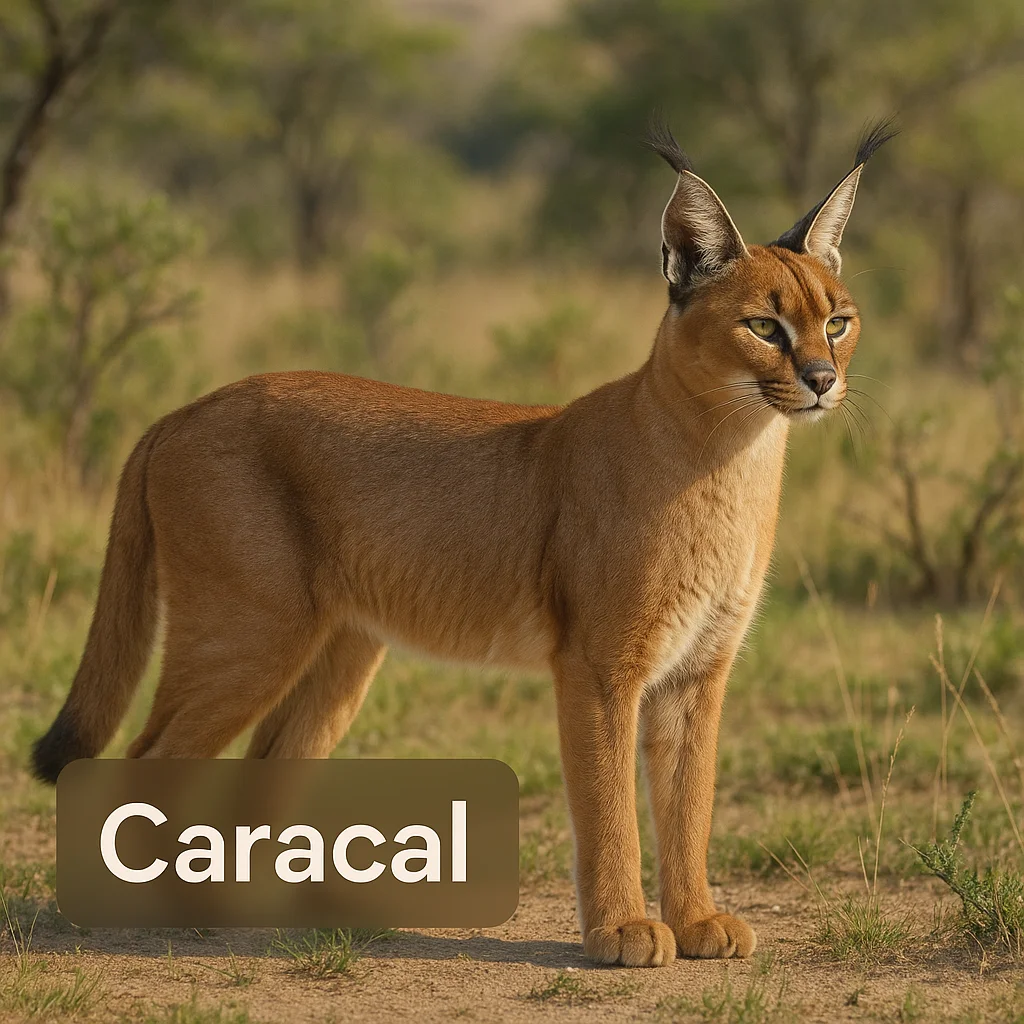
- Common name(s): Caracal
- Scientific name: Caracal caracal
- Animal type: Mammal
- Typical adult size: 70–100 cm (28–39 inches) in length, 40–45 cm (16–18 inches) at shoulder height; weighs 8–19 kg (18–42 pounds)
- Typical lifespan: 10–12 years in the wild; up to 17 years in captivity
- Diet type: Carnivore, primarily feeding on small mammals, birds, and reptiles
- Activity pattern: Nocturnal, occasionally crepuscular
- Social structure: Primarily solitary
- Speed / movement highlights: Can reach speeds up to 80 km/h (50 mph)
- Intelligence/learning: Demonstrates strong adaptability and hunting skills
- Primary habitats: Savannas, deserts, scrublands, forests
- Geographic range: Africa, Middle East, and parts of Central and South Asia
- Predators/threats: Lions, hyenas; human encroachment and habitat destruction
- Conservation status: Least Concern, though varies by region
🔍 Identification & Appearance
The caracal is easily recognized by its slender, athletic build, characterized by a reddish-brown coat that provides excellent camouflage in its natural habitat. Its most distinctive features are the long, black tufts on the tips of its ears, which enhance its hearing capabilities. These cats possess a robust yet elegant body, a short face with a distinctively pointed chin, and bright, captivating eyes.
Other identifying features include the black and white facial markings around the eyes and nose, and a relatively short tail compared to other wild cats. The caracal's tracks often display four round toes with retractable claws, similar to those of other medium-sized felines.
- Slender, athletic body
- Reddish-brown coat with slight variation in tone
- Distinctive long, black ear tufts
- Black and white facial markings
- Relatively short tail
- Round tracks with retractable claws
🧱 Body Structure & Physical Adaptations
Caracals exhibit a stocky yet sleek build, optimized for agility and speed. Their proportionate limbs enable swift and powerful leaps, perfect for catching airborne prey like birds. The caracal's jaw and sharp dentition are adapted for a carnivorous diet, allowing it to subdue larger prey efficiently.
Their retractable claws are ideal for gripping terrain and holding onto nimble prey, while their large ear surface area aids in acute hearing, crucial for detecting movement from afar. Vision is also a strong point, adapted to perform exceptionally well in low-light conditions common in their nocturnal hunting expeditions.
- Stocky build with proportionate limbs for agility
- Jaw and dentition suited for carnivorous diet
- Retractable claws for grip and control
- Large ears with tufts enhancing hearing
- Superior night vision
🌍 Range & Distribution
The caracal's broad range spans across Africa, the Middle East, and into parts of Central and South Asia. They are highly versatile, adapting to diverse environments ranging from arid landscapes to forested areas. While they predominantly occupy flat plains and open savannas, they can also be found at elevations up to 3,000 meters (9,843 feet).
Caracals are mostly resident, showing seasonal movements only in response to prey availability or extreme weather conditions. They thrive in habitats that offer sufficient cover for stalking prey yet provide wide expanses necessary for their high-speed pursuits.
- Sub-Saharan Africa
- Northwest Africa and Arabian Peninsula
- Central Asia, parts of India, and Pakistan
- Savannas, woodlands, and semi-deserts
- Highlands up to 3,000 meters
🏞️ Habitat & Shelter
Caracals prefer habitats with an abundance of cover, essential for effective hunting and protection from potential threats. Their favored environments include savannas, arid deserts, and dense scrublands, where they find ample prey and seclusion.
Shelter for these elusive cats is often in the form of dense vegetation, rocky outcrops, or abandoned burrows where they can lay low during the heat of the day. Seasonal changes can drive caracals to adjust their activity, concentrating more during cooler hours or shifting territories in drought periods. Understanding these habitat preferences is key to studying their behavior, as it influences hunting strategies and interactions within their ecosystem.
🧭 Behavior & Ecology
Caracals exhibit a robust daily routine centered around rest during daylight hours and activity at dusk and night. They maintain territories marked by scent and physical displays, often vocalizing to communicate with neighboring caracals. These cats groom extensively, keeping their coats in peak condition for camouflage and social signaling.
Remarkably, caracals play significant ecological roles as both predators and prey. They control populations of small rodents and birds, impacting the balance of their ecosystems. Their opportunistic hunting style also sees them occasionally scavenging, further showcasing their adaptability.
- Nocturnal resting and grooming habits
- Scent marking for territory delineation
- Occasional vocal interactions for communication
- Control prey population dynamics
- Opportunistic hunters and scavengers
- Contribute to ecosystem balance as mid-level predators
👥 Social Life & Group Dynamics
Predominantly solitary, caracals maintain individual territories which they defend from other cats. Encounters between adults typically involve brief and direct interactions, often centering around mating when males and females come together.
Females primarily raise young alone, with little to no input from males, which intensifies their solitary nature. While not known for forming large groups, temporary associations may occur between siblings or during mating periods.
- Solitary territorial behavior
- Minimal interactivity, mainly during mating
- Females exclusively rear offspring
- Rare temporary groups in certain conditions
- Males lack permanent group affiliations
🍽️ Diet, Prey & Predators
Caracals are skilled hunters, predominantly preying on small to medium-sized animals. Their diet comprises rodents, birds, hares, and occasionally, larger prey like antelope fawns. Caracals use stealth and power in their attacks, leaping high to snatch birds mid-flight or ambushing terrestrial creatures.
With few natural predators, lions and hyenas pose the most significant threats. Caracals employ speed and agility to evade these larger rivals, while human activities like habitat encroachment are a growing concern.
- Diverse diet of mammals and birds
- Utilize stealth and speed for hunting
- Predators include lions and hyenas
- Human-induced threats from habitat loss
- Scavenging occurs opportunistically
🦌 Hunting, Foraging & Movement
With their formidable speed, caracals exhibit remarkable sprinting capabilities ideal for chasing down prey. As ambush predators, they often stalk close to their target before executing an explosive leap or pursuit. Their foraging style is marked by opportunism, adaptable to available resources.
Caracals capably navigate varied terrains within their territories, which they scale deftly due to their muscular builds and keen spatial awareness, whether on the ground or through vegetation.
- Ambush hunting techniques
- High-speed chases effective for small prey
- Sprint up to 80 km/h
- Territorial navigation and boundary respect
- Focuses hunting during cooler temperatures
🧠 Intelligence & Senses
Caracals exhibit a high degree of intelligence, evidenced by their strategic hunting techniques and ability to adapt quickly to various environmental conditions. While specific studies on tool use are sparse, their problem-solving and learning capacities are demonstrated in their hunting successes.
Their senses are finely tuned, with acute hearing and excellent eyesight supporting their nocturnal lifestyle. Caracals are adept at interpreting environmental cues, essential for survival in competitive ecosystems.
- Strategic hunting and stealth
- High adaptability to environments
- Proficient problem-solving capabilities
- Acute auditory and visual senses
- Responsive to environmental cues
🪺 Reproduction, Pregnancy & Parenting
Caracals typically breed year-round, with peaks in certain regions reflecting prey availability. They engage in short term polygynous mating systems, with males mating with multiple females. Gestation lasts around 10–11 weeks, after which females bear litters ranging from one to six kittens.
Kittens are born in secluded dens and remain hidden until old enough to explore their surroundings. Mothers assume full responsibility for their young, nurturing them intensively until they can hunt independently.
- Year-round breeding with regional peaks
- Polygynous mating system
- Gestation period of 70–75 days
- Litter size varies, commonly 1-4 kittens
- Sheltering in dens during early months
- Maternal-exclusive caregiving
♀️♂️ Male vs Female Differences
Male and female caracals show subtle differences, with males generally being larger and heavier. While both sexes exhibit similar coloration and markings, behavioral roles vary, particularly around mating and territory defense. Females take on the crucial parenting role, raising young often without male participation.
- Males larger than females
- Coloration consistent across sexes
- Females solely care for young
- Males primarily defend and prolong gene pool
- Similar territorial behaviors
🧬 Subspecies & Variation
Several caracal subspecies have been identified, showing slight variations mainly in size and color. These differences often correlate with geographic distribution, where environments influence adaptation. There is some debate over subspecies classification, reflecting regional ecological diversity.
- Variations in size and coat
- Distinct regional adaptations
- Geographical influences on physical traits
- Subspecies classification under scientific review
- Distribution diversity among subspecies
⚠️ Threats, Conservation & Human Interaction
Caracals occupy a conservation status of least concern, but habitat loss and regional conflicts with humans pose growing threats. Agricultural expansion and retaliatory killings due to livestock predation exacerbate their vulnerability. Conservation efforts emphasize habitat protection and coexistence strategies.
Encouraging coexistence involves understanding caracal behaviors and promoting sustainable agricultural practices to mitigate conflict. Their presence in zoos serves educational purposes, highlighting the importance of conservation for species with such ecological value.
- Habitat destruction a primary threat
- Human-animal conflict over livestock
- Protective measures for habitat preservation
- Education and awareness through conservatories
- Cultivation of coexistence strategies necessary
✨ Fun Facts & Unique Traits
- Caracals can leap over 3 meters (10 feet) into the air to catch birds.
- Their name is derived from the Turkish word "karakulak," meaning "black ear."
- The caracal's ear tufts likely aid in communication or camouflage.
- They are one of the few cats that can live comfortably in arid desert environments.
- Despite often being solitary, caracals are known to be quite vocal.
- Caracals have been known to take down prey three times their size.
📌 Summary
- Medium-sized, agile feline with notable ear tufts.
- Adapts to diverse African and Asian habitats.
- Solo hunters; diet mainly small mammals and birds.
- Territorial yet elusive, primarily active at night.
- Distinctive appearance marked by black ear tufts.
- Maintains essential ecological roles as predator.
- Slight subspecies variations linked to geography.
- Conservation focus vital due to human-induced threats.