🦁 Cheetah
🧾 Quick Facts
The cheetah is a large cat known for its exceptional speed and distinctive spots. This speedy mammal ranks among the world's most fascinating creatures due to its unique adaptations and graceful presence in the wild.
- Common name(s): Cheetah
- Scientific name: Acinonyx jubatus
- Animal type: Mammal
- Typical adult size: 1.1 to 1.5 meters (3.6 to 4.9 feet) in length, excluding the tail
- Typical lifespan: 10 to 12 years in the wild; up to 17 years in captivity
- Diet type: Carnivore; primarily preys on small to medium-sized ungulates
- Activity pattern: Diurnal
- Social structure: Solitary or in small familial groups
- Speed / movement highlights: Up to 112 km/h (70 mph) for short bursts
- Intelligence/learning: Highly adaptive with problem-solving capabilities
- Primary habitats: Grasslands, savannas, open plains
- Geographic range: Sub-Saharan Africa, with a small population in Iran
- Predators/threats: Lions, hyenas, habitat destruction
- Conservation status: Vulnerable; varies by region
🔍 Identification & Appearance
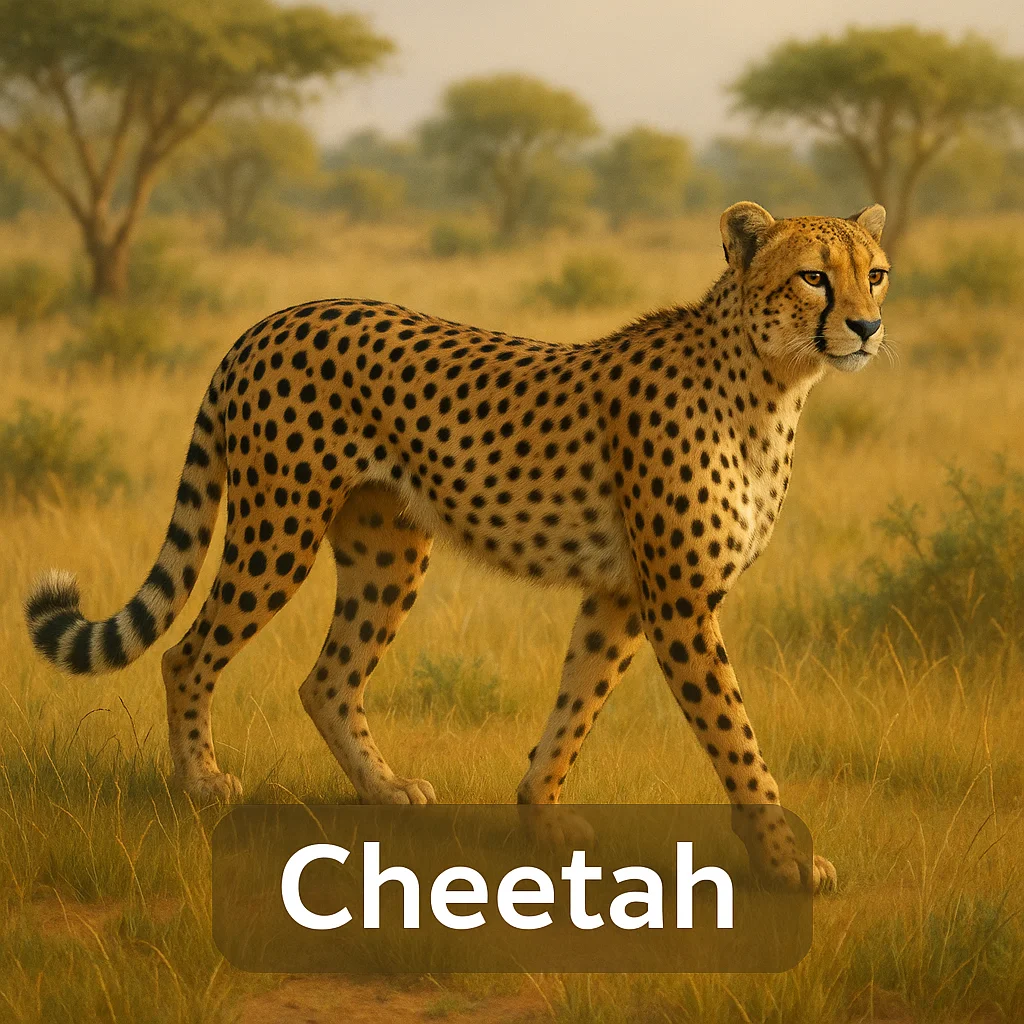
Cheetahs are recognized by their slender, agile build and distinctive black spots against a tawny background. A characteristic "tear stripe" runs from the corner of each eye to the mouth. These adaptations enhance their camouflage while hunting.
- Long, slender body with a deep chest
- Tawny coat with black spots throughout
- Black "tear stripes" under the eyes
- Small, rounded head with high-set eyes
- Long tail with black bands
- Distinctive tracks: non-retractable claws visible
- Common look-alikes: Leopards, distinguishable by rosettes rather than solid spots
- Cubs have a longer, fluffier mane
- No significant seasonal changes in coat
- Elegant running style with long stride
🧱 Body Structure & Physical Adaptations
The cheetah's body is exquisitely adapted for high-speed pursuits. Its lightweight structure, long legs, and large nasal passages allow for rapid acceleration and efficient oxygen intake during chases.
- Lightweight, slender frame optimized for speed
- Flexible spine for increased stride length
- Non-retractable claws provide traction
- Semi-retractable claws for better grip
- Enlarged adrenal glands support high burst energy
- Long tail aids in balance and steering
- Large nostrils and lungs enhance oxygen intake
- Relatively small canine teeth; broad carnassials for shearing flesh
- Excellent eyesight for spotting prey over distances
- Limited nighttime vision compared to other big cats
🌍 Range & Distribution
Cheetahs once roamed expansively across Africa and into India, but their range is now largely confined to sub-Saharan Africa, with an isolated population in Iran. Their preferred habitats offer vast open spaces that support high-speed chases.
- Predominantly in sub-Saharan Africa
- Small, endangered population in Iran
- Present in countries like Kenya, Tanzania, Namibia
- Open savannas, grasslands, and semi-desert regions
- Occasional presence in mountainous areas up to 2,000 meters
- Primarily resident, though some may move with prey availability
- Most effective in areas with tall grasses for stalking prey
- Habitat fragmentation poses significant challenges
🏞️ Habitat & Shelter
Cheetahs prefer habitats that offer both visibility and cover, typically grasslands and savannas. They require large territories due to their need for abundant prey and space for high-speed pursuits, utilizing tall grasses for concealment during hunts.
As nomadic predators, cheetahs do not construct permanent shelters, opting instead for resting spots under shaded trees or among tall grass to avoid the midday heat.
Understanding their habitat preferences is crucial for their conservation, as habitat loss and fragmentation are major threats to their survival.
🧭 Behavior & Ecology
Cheetahs are diurnal, preferring to hunt during daylight hours to utilize their exceptional eyesight. They rely on stealth and speed rather than strength, focusing on small ungulates. Cheetahs are generally solitary, but mothers will stay with their cubs until independence.
- Diurnal hunters, active primarily in the early morning and late afternoon
- Rest under the shade during the hottest parts of the day
- Use vocalizations like purrs, chirps, and hisses to communicate
- Scent marking delineates territory
- Play and social grooming observed in mother-cub interactions
- Function as apex predators, influencing prey populations
- Minimal scavenging, relying on fresh kills
- Faces competition with larger predators like lions and hyenas
- Serve as indicators of ecosystem health
- Capable of high-speed chases lasting up to 60 seconds
👥 Social Life & Group Dynamics
Cheetahs are predominantly solitary animals, with males sometimes forming small groups called coalitions. These coalitions, often consisting of brothers, collaborate for territorial defense and hunting efficiency.
- Males sometimes form coalitions of up to three or more
- Females generally solitary except when raising cubs
- Loose territoriality, allowing some overlap with other cheetahs
- Cooperate in hunting and territory defense within coalitions
- Mothers teach cubs hunting and survival skills
- Lack of a strict dominance hierarchy compared to other big cats
- Avoidance behavior towards larger predators
- Conflict resolution through displays rather than violence
🍽️ Diet, Prey & Predators
Cheetahs primarily hunt small to medium-sized ungulates, such as gazelles and impalas. Their diet may also include smaller mammals and birds. With few natural predators, they occasionally face threats from lions, hyenas, and leopards.
- Main prey includes gazelles, impalas, and springboks
- Hunting strategy relies on stealth followed by a swift chase
- Hunts primarily involve individuals or coalitions, not large groups
- Use surprise and speed to capture prey within minutes
- Face threats from larger predators who may steal kills
- Rare reports of scavenging, prefer fresh kills
- Prey selection can vary with local availability
- Effective hunters with a success rate of around 50%
- Utilize transitional times (dawn/dusk) to maximize hunting success
🦌 Hunting, Foraging & Movement
Cheetahs are the ultimate sprinters of the animal kingdom, reaching incredible speeds during hunts. They rely on quick bursts of speed and precision maneuvers to capture prey, typically bringing them down with a swift tackle.
- Sprinting runner with explosive acceleration
- Top speed around 70 mph, but sustained for only 20-30 seconds
- Prefers open areas to spot and pursue prey
- Stealthily approach prey up close before sprinting
- Strategic positioning of kills to avoid detection from scavengers
- Tactical use of sighting and heat during chases
- Field tracking reliant on claw marks and fur drag in prints
- Territory sizes range from 15 to 1500 square kilometers
🧠 Intelligence & Senses
Cheetahs possess keen eyesight crucial for identifying prey over long distances. Their learning and social behaviors demonstrate moderate intelligence, especially evident in group hunting dynamics and coalitional bonding.
- Excellent long-distance vision, especially in flat terrain
- Moderate learning abilities, adapt to new challenges
- Proficient in recognition and response to environmental signals
- Behavioral adjustments to avoid confrontation with larger predators
- Communication through a variety of vocalizations
- Limited evidence of problem-solving outside of hunting adaptations
- Interactive play among juveniles aids development
- Senses optimized for daylight hunting
🪺 Reproduction, Pregnancy & Parenting
Cheetah breeding tends to peak at varying times depending on the region, though it can occur year-round. After a gestation of about three months, females give birth to cubs in seclusion, nurturing them intensely until they can fend for themselves.
- Non-seasonal mating pattern, can occur anytime
- Typically polygynous mating system
- Average gestation period of 90 to 95 days
- Litter size ranges from 1 to 5 cubs
- Cubs are altricial, requiring maternal protection
- Mother provides all parental care; no male involvement
- Cubs grow rapidly, weaned at about 6 months
- Independence reached between 18-24 months
- Mother teaches hunting techniques crucial for survival
♀️♂️ Male vs Female Differences
While male and female cheetahs look similar, subtle differences can be observed, particularly in behavior and physical size. Males may form coalitions, while females are generally solitary apart from parenting periods.
- Males slightly larger and heavier than females
- Males more likely to form coalitions
- Females more solitary, except with cubs
- Both sexes have similar coat patterns
- Little variation in coloration between sexes
- Females take lead in parental care
- Males less likely to defend territories alone
- Playful behaviors more observed in males
🧬 Subspecies & Variation
The classification of cheetah subspecies has evolved, and debates continue. Notably, genetic studies have identified several subspecies that demonstrate slight variations in size, coat pattern, and habitat range.
- Acinonyx jubatus jubatus: Southern Africa
- Acinonyx jubatus soemmeringii: Northeast Africa
- Acinonyx jubatus hecki: Northwest Africa
- Acinonyx jubatus venaticus: Iran
- Subspecies show minor differences in coat color and density
- Genetic diversity is relatively low
- Conservation strategies are sometimes subspecies-specific
- Further genetic research continues to update classifications
⚠️ Threats, Conservation & Human Interaction
Cheetahs face significant threats, from habitat loss to human-wildlife conflict. Conservation efforts focus on habitat protection and mitigating interactions with humans. Their existence in zoos raises awareness but must ensure ethical treatment.
- Loss of habitat due to agriculture and urban expansion
- Conflicts with humans, particularly in farming areas
- Illegal pet trade and poaching for body parts
- Climate change altering prey availability
- Conservation efforts include protected areas and rewilding
- Education initiatives aimed at reducing human-wildlife conflict
- Zoos participate in breeding programs to help mutual conservation
- Transition strategies for livestock-raising communities
✨ Fun Facts & Unique Traits
- Cheetahs are the fastest land animals, capable of reaching speeds up to 70 mph.
- Unlike other big cats, cheetahs cannot roar.
- The “tear marks” under their eyes are thought to protect against sun glare.
- Cheetahs were once domesticated as hunting companions by ancient civilizations.
- Cubs are born with a fluffy mantle, which provides camouflage.
- The cheetah’s specialized tail helps with balance during rapid turns.
- They can accelerate from 0 to 60 mph in just a few seconds.
- Their inability to retract their claws gives them extra grip while running.
📌 Summary
- Slender body with distinctive black spots
- Found in African savannas and grasslands
- Feeds primarily on small to medium ungulates
- Faces threats from larger predators like lions and hyenas
- Mostly solitary, with occasional male coalitions
- Non-seasonal breeders with maternal childcare
- Adapted for speed with non-retractable claws
- Unique for its tear-stripe markings and elegant sprint