🦁 Dingo
🧾 Quick Facts
The dingo is a wild canid found primarily in Australia and distinguished by its connection to both wild and domestic dogs. The dingo, often referred to by its scientific designation, Canis lupus dingo, has significant cultural and ecological relevance in its habitat.
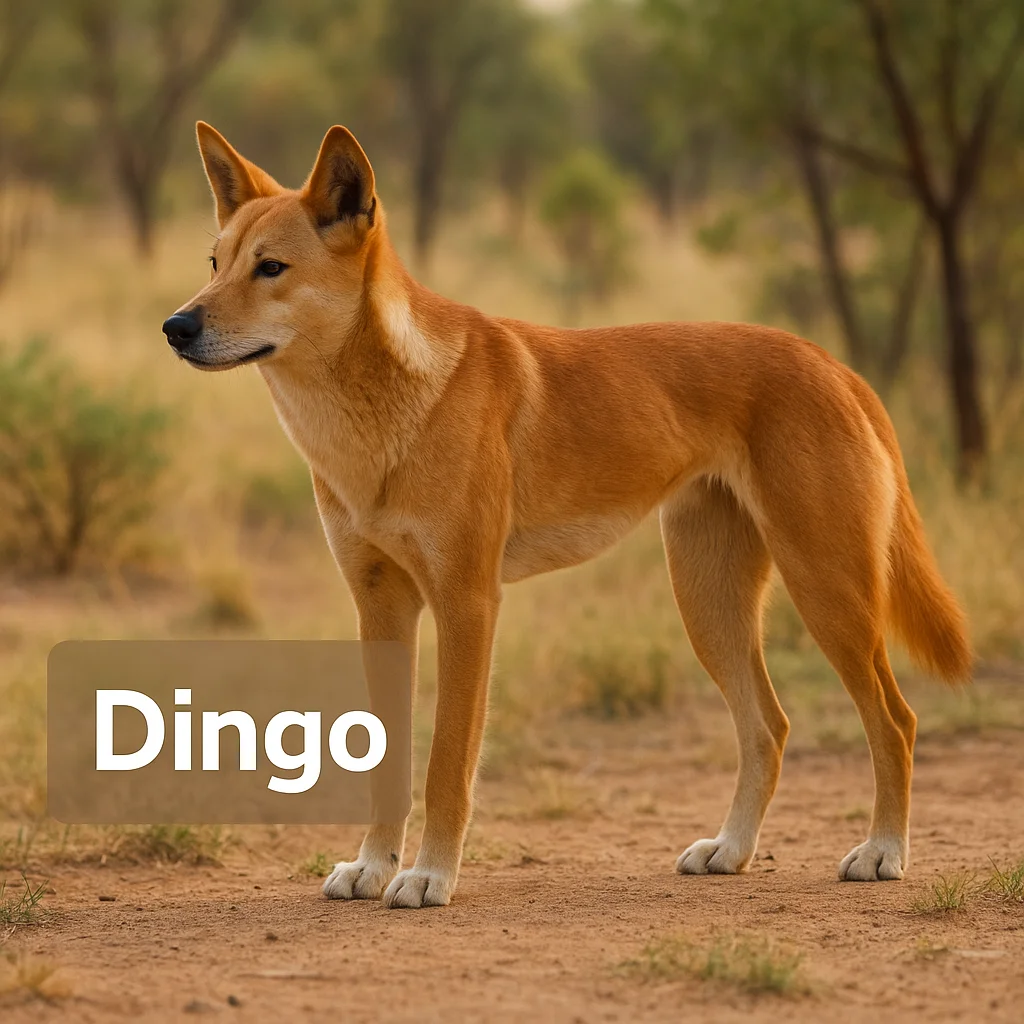
- Common name(s): Dingo
- Scientific name: Canis lupus dingo
- Animal type: Mammal
- Typical adult size: Approximately 48 to 58 centimeters (19 to 23 inches) at the shoulder, weighing 13 to 23 kilograms (29 to 50 pounds)
- Typical lifespan: 3 to 8 years in the wild, up to 13 years in captivity
- Diet type: Omnivore; primarily feeds on small mammals, birds, reptiles, and occasionally fruit and plants
- Activity pattern: Primarily nocturnal, though may be active at dawn and dusk
- Social structure: Typically solitary, but can form packs of up to 10 members
- Speed / movement highlights: Capable of running at speeds up to 48 km/h (30 mph)
- Intelligence/learning: Highly intelligent, capable of problem-solving and complex social interactions
- Primary habitats: Deserts, grasslands, forests
- Geographic range: Predominantly Australia, with some populations in Southeast Asia
- Predators/threats: Humans, habitat loss, and domestic dogs
- Conservation status: Not officially listed, but threats vary by region
🔍 Identification & Appearance
Recognizing the dingo involves understanding their lean, athletic build similar to medium-sized domestic dogs, but with distinct characteristics.
- Typically tan to ginger-colored coat, with some variation including black and tan or creamy white
- Their ears are prominent, erect, and pointed
- Tail is bushy, with a white tip often present
- Amber-colored eyes that contribute to a keen expression
- Elongated snout and robust jaw structure
- Paw prints are similar to domestic dogs but lack the 'hooking' of toes seen in domestic breeds
- Look for an athletic build with a bushy tail
- Note the coloration, especially tan or ginger hues
- Ear position: upright and alert
- Wild context often hints at a true dingo rather than a hybrid
- Observe social behavior: packs indicate pure dingos more often than solitary domestic dog behavior
- Top ID Tips
🧱 Body Structure & Physical Adaptations
Dingos have evolved physical traits that support their survival in various environments.
- Slim, agile frame well-suited for running and long-distance travel
- Strong jaws equipped with sharp teeth for capturing prey
- Paws adapted for varied terrain, providing traction for pursuit and movement
- Acute sense of hearing, vital for detecting prey and communicating within groups
- Enhanced sense of smell for tracking and identifying other animals or opportunities for feeding
- Adaptability to extreme environmental conditions, including sub-tropical heat or temperate zones
- Flexibility in feeding habits to adapt to prey availability
- Resilience to arid and semi-arid environments
- Efficient locomotion allows for extensive territory ranges
- Highly developed auditory skills for hunting efficiency
- Able to go extended periods without direct water sources
- Behavioral adaptabilities, such as nocturnal activity, to optimize survival
- Key Adaptations
🌍 Range & Distribution
Dingos are primarily found across various Australian landscapes, although their precise range and existence vary greatly.
- Mainland Australia, with the highest populations in Queensland and Northern Australia
- Present in the southeastern and central deserts
- Common in diverse biomes from arid regions to tropical forests
- Observed at elevations ranging from sea level to mountainous terrains
- Resident without evidence of significant, consistent migration patterns
- Australia-wide, except for Tasmania
- National parks and conservation areas
- Open woodlands or desert scrublands
- Rural and remote regions
- Occasionally near human settlements, primarily scavenging
- Where You Might Find It
🏞️ Habitat & Shelter
The dingo's adaptability allows it to thrive in a range of ecosystems.
- Primarily located in forests, savannas, scrublands, and deserts
- Dens located in rock crevices, hollow logs, or burrowed into earth
- Behaviorality shifts with seasons; more active during cooler parts of the day
- Their presence in an ecosystem can affect biodiversity and species population dynamics
🧭 Behavior & Ecology
Dingos exhibit complex behaviors that contribute significantly to their ecological niches.
- Frequently mark territory with scent and vocalizations
- Complex social structures, often with a dominant pair leading group dynamics
- Interactively playful, often learning through mimicking and environmental engagement
- Ecosystem role as primary predator, aiding in controlling prey populations
- White-tip tail communication as a signaling tool within packs
- Efficient use of vocalizations for pack organization and warnings
- Hunting strategies include cooperative efforts and ambush techniques
- Scavenging near settlements underlines opportunistic feeding behaviors
- Resting in shaded or concealed areas amidst hotter daylight hours
- Behavior Highlights
👥 Social Life & Group Dynamics
Dingo social structures are intricate, involving a mix of solitary habits and pack living.
- Packs resemble family units, usually led by a dominant alpha pair
- Typically 3 to 5 members in a pack, occasionally up to 10
- Cooperative hunting methods and complex social interactions
- Contests for dominance often resolved through posturing, not aggression
- Packs show intricate communication through body language and vocalizations
- Social hierarchies observed to stabilize pack dynamics
- Role differentiation within pack tasks and responsibilities
- Occasionally lone individuals noted, particularly dispersing juveniles
- Pack cohesion critical for survival in harsher environments
- Social Structure Notes
🍽️ Diet, Prey & Predators
The dingo's diet is opportunistic and diverse, reflecting their adaptable nature.
- Common prey include rabbits, kangaroos, wallabies, and birds
- Diet shifts with food availability, including fruit and insects when needed
- Humans are the primary threat through habitat destruction and potential hunting
- Dingos can consume up to several kilograms of meat a day
- Seen employing scavenging behavior along human habitation edges
- Prey is often targeted based on size and availability in environment
- Water sources are critical but infrequent in their natural habitats
- Seasonal dietary shifts observed along with availability in habitats
- Feeding Notes
🦌 Hunting, Foraging & Movement
Dingos are vital in their respective ecosystems due to their hunting acumen and strategic foraging habits.
- Noted for their endurance and stamina in pursuance of prey
- Employ ambush and pursuit tactics, adjusted based on prey type and environment
- Packs leverage cooperative strategies for hunting larger prey
- Agility integral to effective navigation of varied terrains
- Day-to-night shifts in activity levels based on temperature and prey availability
- Established territories are utilized to optimize prey access
- Capable of covering distances over extensive hunt quests
- Movement & Strategy
🧠 Intelligence & Senses
Dingos exhibit traits of intelligence, underlined by their adaptability to environmental changes and interactions.
- Possess cognitive abilities for problem-solving and social cohesion
- Strong memory facilitating survival strategies like navigation and prey recognition
- Senses of eyesight, smell, and hearing are developed for detecting prey
- Adaptation to thrive with limited water sources
- Iterative learning abilities observed in captive study environments
- Alerts others to danger through a range of vocal expressions
- Spatial awareness in line with pack dynamics and territorial demarcations
- Notable Abilities
🪺 Reproduction, Pregnancy & Parenting
The dingo's reproduction and social breeding systems are complex and culturally significant.
- Breeding peak during cooler seasons, typically mid-year
- Monogamous pairing is typical, with dominants doing most mating
- Gestation lasts about 61 to 69 days, resulting in 4-6 pups on average
- Pup-rearing involves the entire pack, a cooperative child-rearing system
- Pups emerge altricial and remain in maternal den for initial eight weeks
- Females primarily handle nursing, with pack protection shared
- Inter-pack dispersal common upon maturation, expanding genetic diversity
- Parental efforts distribution is shared more substantially among packs
- Reproduction Snapshot
♀️♂️ Male vs Female Differences
Sexual dimorphism in dingos is not pronounced but manifests in certain physical and behavioral traits.
- Males typically larger and heavier than females
- Male dingos often exhibit a larger head and broader snout
- Females might be more active in child-rearing tasks
- Social dominance within packs is equally shared, though male-biased in leadership position
- Head size variance: larger in males with correspondingly robust features
- Cooperative pack dynamic transcends size differences
- Field signs of size: track dimensions can occasionally highlight sex
- Sex Differences at a Glance
🧬 Subspecies & Variation
There is ongoing research into the diversity and classification of dingos and their hybrids.
- Regional variations exist, particularly influenced by ecological contexts
- Phenotypic differences might accrete through interactions and genetic drift
- Subspecies variance diluted by cross-breeding with domestic dogs in some areas
- Traditional dingos feature more consistent patterns before hybrid impact
- Regional isotypes exist but are heavily affected by settlement encroachments
- Adaptive divergence observed in isolated populations such as Fraser Island
- Variation Notes
⚠️ Threats, Conservation & Human Interaction
A myriad of pressures and challenges face dingos today, necessitating informed conservation efforts.
- Human expansion leads to habitat loss and indirect resource competition
- Possible hybridization impacting pure dingo gene pools
- Conservation varies greatly with legislation and local approaches
- Problematic interactions include livestock predation perceptions, heightening conflicts
- Awareness campaigns that bolster understanding are crucial
- Principle of coexistence emphasizes informed, non-lethal deterrence
- Wildlife corridors can enhance connectivity and reduce conflicts
- Research continues to be pivotal in understanding hybrid influences
- Responsible Notes
✨ Fun Facts & Unique Traits
- Dingos can rotate their heads nearly 180 degrees to maintain vigilance
- Historically, dingos have profound cultural significance among Indigenous Australians
- Their bushy tail is utilized for both balance and communication within packs
- Dingos often engage in play fighting to hone hunting techniques
- Capable of thriving over a large territory, dingos are emblematic wanderers of Australia
- Unlike domestic dogs, they do not typically bark but use howling more commonly
- Some dingos may shift coat color seasonally or with the environment
📌 Summary
- Dingos can be distinguished by their medium size, lean build, and ginger coat
- They thrive in diverse Australian environments, from deserts to forests
- Omnivorous diets emphasize small mammals and opportunistic scavenging
- Are key predators, exercising control over prey population dynamics
- Complex social structures and cooperative familial packs are essential
- Seasonal breeding necessitates a tightly connected community adaptive for pup-rearing
- Cultural significance profound with Indigenous Australians, tied closely to land stewardship
- Rhythmic howling embedded into essential communicative practices
- Continued demand for conservation centers on genetic purity preservation