🦁 Gray Wolf
🧾 Quick Facts
The gray wolf, often synonymous with wilderness and wild beauty, is one of the most iconic apex predators in the world's northern regions.
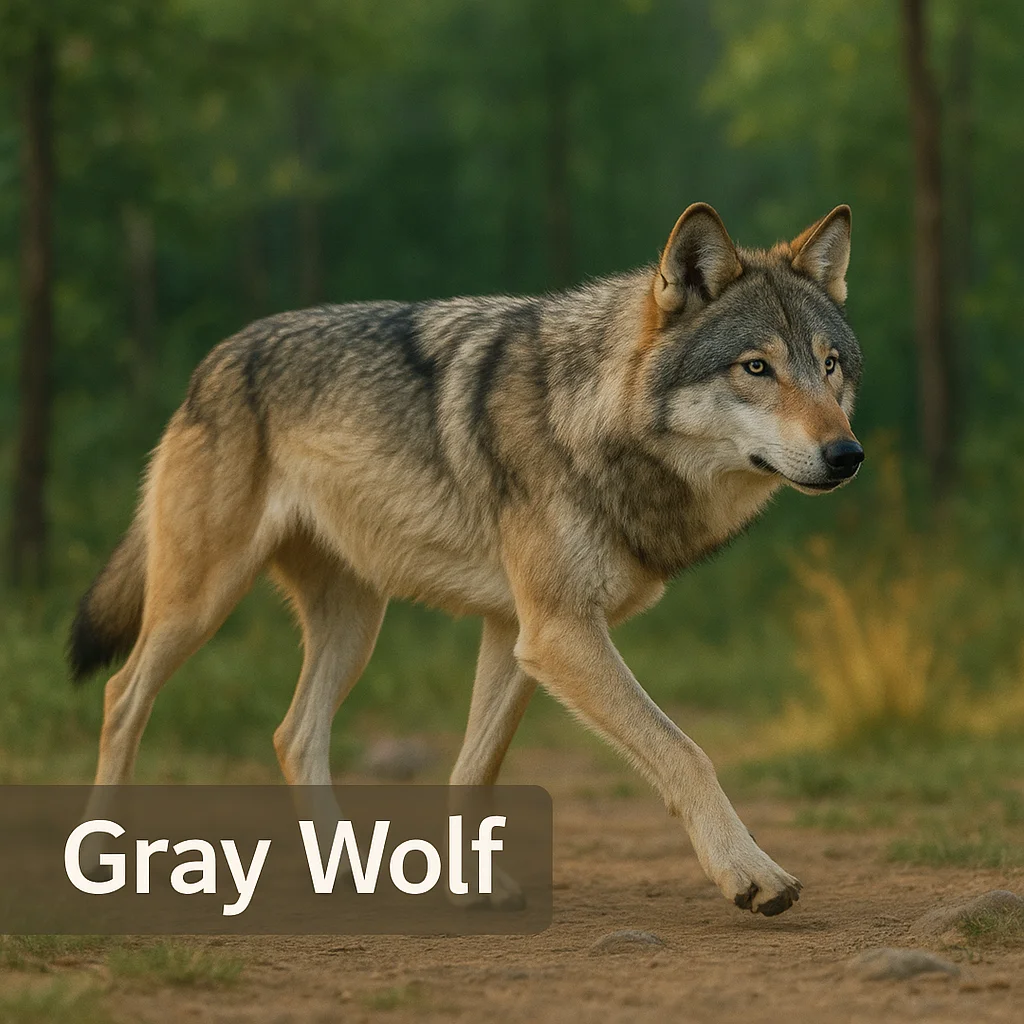
- Common name(s): Gray Wolf, Timber Wolf
- Scientific name: Canis lupus
- Animal type: Mammal
- Typical adult size: Length: 3.5-5 feet; Height at shoulder: 2.5-3 feet; Weight: 50-110 lbs (varies by subspecies)
- Typical lifespan: 6-8 years in the wild; up to 13+ years in captivity
- Diet type: Carnivore; primarily preys on ungulates like deer, moose, and elk
- Activity pattern: Primarily crepuscular; active during dawn and dusk
- Social structure: Highly social; lives in packs
- Speed / movement highlights: Can run up to 37 mph in short bursts
- Intelligence/learning: Known for problem-solving abilities and complex social structures
- Primary habitats: Forests, tundra, mountains, grasslands
- Geographic range: Across North America, Europe, Asia
- Predators/threats: Typically only affected by humans and environmental changes
- Conservation status: Varies by region; some populations are endangered
🔍 Identification & Appearance
Gray wolves are large canids with a distinctive silhouette characterized by their bushy tail, sturdy frame, and pronounced muzzle.
- Their fur varies from grizzled gray to white, black, and even brown hues
- Possess long legs and broad chest for endurance chasing
- Pointed ears and sharp eyes contribute to keen sensory abilities
- Tracks often display the classic four toes with claws visible
- Frequently mistaken for coyotes or domestic dogs but are usually larger with a bulkier build
- Top ID Tips:
- Look for bushy tail carried low
- Notice the large, round paws as part of tracks
- Observe the color and thickness of the coat
- Focus on the facial structure: larger snout than coyotes
- Verify size: typically larger than domestic dogs
- Watch for tail position: held straight and down
- Recognize the consistent rhythm in their gait
🧱 Body Structure & Physical Adaptations
The gray wolf's physical attributes make it perfectly adapted for hunting and survival in diverse and often challenging environments.
- Stocky build with powerful limbs for chasing prey over long distances
- Sharp, strong teeth and jaw for gripping and tearing flesh
- Padded paws for silent movement and traction
- Acute sense of smell to detect prey up to two miles away
- Exceptional hearing for detecting remote sounds
- Key Adaptations:
- Adapted skull shape for powerful bite force
- Specialized molars for crushing bones
- Retractable nails for better grip and attack
- Dense, warm coat adapted to cold climates
- Locomotion designed for extensive tracking
- Sensitive pads for different terrains
- Heightened olfactory bulb in the brain
🌍 Range & Distribution
Gray wolves are widely distributed but have been extirpated from parts of their historical range.
- Commonly found in remote wilderness areas of Northern Hemisphere
- Varied presence across North America, Europe, and Asia
- Inhabits several biomes, including forests, tundra, and mountain ranges
- Typically avoids areas heavily settled by humans
- Prefers areas with healthy ungulate populations
- Where You Might Find It:
- Northern US states like Minnesota, Montana, and Alaska
- Canadian wilderness and boreal forests
- European and Russian forests
- Parts of central and northern Asia
- Various national parks and reserves with reintroduction programs
🏞️ Habitat & Shelter
Gray wolves thrive in a variety of habitats provided there is ample prey and minimal human disturbance.
- Prefer dense forests, vast tundra, and rocky mountains for shelter
- Often use dens such as caves or burrows dug into hillsides during pup-rearing season
- Seasonal movements are sometimes noticed depending on prey migration patterns
- Habitat knowledge is crucial for conservation efforts and understanding human-wolf conflicts
🧭 Behavior & Ecology
Known for their complex social structures, gray wolves exhibit fascinating behaviors that sustain their packs and impact their ecosystems.
- Daily routine includes resting in shaded areas during the day
- Communication involves howling, body language, and scent marking
- Interactions with other species vary, from competing with bears to cooperating with ravens
- Serve as crucial top predators, managing prey populations and maintaining ecological balance
- Behavior Highlights:
- Howling varies for pack coordination, territory marking, or social bonding
- Express strong social bonds through mutual grooming
- Exhibit territoriality through urine and scats marking boundaries
- Engage in cooperative hunting tactics
- Show intricate pup-rearing with both parents and pack members
- Maintain relationships with non-pack species, like ravens
- Focus on pack unity for survival and hunting success
👥 Social Life & Group Dynamics
The social life of the gray wolf is highly organized around pack hierarchies and structured roles.
- Packs usually consist of an alpha pair, their offspring, and other subordinate individuals
- Pack sizes can range from 3-10 on average but can be larger
- Working together, wolves engage in coordinated hunts
- Dominance hierarchies dictate access to resources and mating privileges
- Social Structure Notes:
- Packs are led by an alpha male and female
- Subordinate members assist in pup-rearing and hunting
- Exhibit clear communication roles within the pack
- Hierarchical structure resolved mostly through posturing
- Sibling cooperation is crucial for hunting and territory guarding
- Packs can include non-relatives
🍽️ Diet, Prey & Predators
The gray wolf primarily hunts large ungulates and occasionally smaller mammals or opportunistic prey.
- Diet mainly consists of elk, deer, and moose
- Hunting strategies depend on prey type; hunts can be long pursuits or strategic ambushes
- Occasionally consume smaller animals such as rabbits or beavers
- Humans remain one of the main threats due to habitat encroachment and hunting
- Feeding Notes:
- Utilizes team hunting for larger prey
- Capable of consuming up to 20 pounds in one meal
- Exploits carrion when available
- Exhibits dominance feeding order within the pack
- Adapts diet seasonally based on available prey
🦌 Hunting, Foraging & Movement
Gray wolves are built for complex hunting and efficient long-distance travel.
- Primarily a pursuit predator, relying on stamina
- Can cover large territories daily while searching for prey
- Typically hunt at dawn or dusk when prey is most active
- Possesses excellent navigation skills within their home ranges
- Movement & Strategy:
- Endurance runners over sprinters
- Use terrain and wind direction for stealth hunting
- Migrate seasonally if prey is scarce
- Engage in strategic pack formation to encircle prey
- Utilize vocalizations for pack coordination during hunts
- Challenge prey stamina rather than speed
🧠 Intelligence & Senses
The gray wolf demonstrates high levels of intelligence, particularly in social contexts, learning, and sensory perception.
- Exhibits advanced problem-solving capabilities in foraging situations
- Uses a wide array of vocal sounds for communication within the pack
- Development of complex hunting strategies showcases cognitive skills
- Possesses acute sense of smell particularly useful for tracking
- Research on their intelligence in wild contexts is still developing
- Notable Abilities:
- Remember complex routes and landmarks
- Engage in effective pack hunting
- Use vocalizations to identify and coordinate with pack members
- Olfactory sense to determine food location and pack relations
- Quick adaptation to environmental changes and pressures
🪺 Reproduction, Pregnancy & Parenting
Gray wolves have clearly defined breeding seasons and demonstrate impressive cooperative parenting strategies.
- Breeding typically occurs once annually during late winter
- Primarily monogamous pairings; alpha pairs usually lead reproduction
- Gestation lasts around 63 days with pups born in spring
- Litters usually consist of 4-6 pups that are altricial at birth
- Pack involvement in nurturing and feeding pups through regurgitation
- Reproduction Snapshot:
- Alpha pair mates for life
- Subordinates typically do not breed
- Pups weaned around 6-8 weeks
- Den-building and security is a pack effort
- Integral role of alloparenting from siblings and subordinates
♀️♂️ Male vs Female Differences
While male and female gray wolves share many similarities, there are some distinctions, particularly in size and social roles.
- Males are generally larger and heavier than females
- Both sexes participate in hunting and territorial patrols
- Alpha females are key caregivers and play a role in teaching pups
- Sex Differences at a Glance:
- Male weight range typically exceeds female range
- Both genders have leadership potential within packs
- Females often prioritize pup development over pack activities
- Males may challenge hierarchy more frequently
- Subtle distinctions in role expression, influenced by pack dynamics
🧬 Subspecies & Variation
There are several recognized subspecies of gray wolves, each adapted to specific regional environments.
- Subspecies classification varies, common variants include the Arctic wolf and the Mexican wolf
- Size, coat color, and physical adaptations align with environmental needs
- Island dwarfism occurs in isolated populations, leading to smaller wolves
- Desert subspecies may have lighter coats for heat reflection
- Subspecies conversance remains debated among scientists
- Variation Notes:
- Notable size variation across different climates
- Distinctive fur thickness based on climate adaptation
- Regional hunting techniques due to diverse prey types
- Physical differentiation aids survival in local habitats
- Recognized by diverse physical and behavioral adaptation patterns
⚠️ Threats, Conservation & Human Interaction
Gray wolves face challenges both from natural environmental factors and increased human activities.
- Main threats include habitat destruction, hunting, and climate change
- Conservation efforts focus on population reintroduction and habitat protection
- Humans impact through urban expansion and livestock conflicts
- Coexistence requires understanding and managing negative-human impacts
- Ethically viewed as an essential part of biodiversity, not as pets
- Responsible Notes:
- Conservation success varies with legal protection and public perception
- Engagement in supervised wildlife viewing to avoid disturbance
- Adequate education on coexistence strategies is critical for success
- Wolves play an integral role in maintaining ecosystem health
- Sustainable practices and policies can support wolf populations
✨ Fun Facts & Unique Traits
- Wolves can run at speeds and maintain it over long distances
- Famed for their evocative howls, which can communicate over vast distances
- Wolf packs have territories that can span 30 to over 1,000 square miles
- Wolves play a key role in shaping entire ecosystems by managing prey populations
- The rank structure within a pack is typically stable yet complex and dynamic
- Wolves' adaptability allows them to survive in diverse ecosystems around the world
- Despite their reputation, wolves are often shy and elusive around humans
- A wolf's sense of smell is at least 100 times more acute than humans
📌 Summary
- The gray wolf is a large, socially complex carnivore
- Usuall inhabits a wide range of ecosystems, primarily in the Northern Hemisphere
- Gray wolves exhibit a preference for large ungulates but adapt their diet seasonally
- Humans pose the major threat due to various activities, yet wolves remain crucial for ecosystem health
- Typically live in sophisticated pack structures with clear hierarchies
- Reproduction is usually managed by an alpha pair within a pack
- Physical adaptations make them efficient hunters and survivors
- Remarkable for their adaptability, wolves have significant variations across subspecies