🦁 Honey Badger
🧾 Quick Facts
The honey badger, also known as the ratel, is a small but fierce member of the weasel family, known for its toughness and resilience. It has a strong reputation due to its fearless nature and ability to defend itself against much larger predators.
- Common name(s): Honey Badger, Ratel
- Scientific name: Mellivora capensis
- Animal type: Mammal
- Typical adult size: Length 55–77 cm (22–30 inches), Weight 9–16 kg (20–35 lbs)
- Typical lifespan: 7–10 years in the wild, up to 24 years in captivity
- Diet type: Omnivore; hunts insects, small mammals, birds, eggs, and fruits
- Activity pattern: Mostly nocturnal, but can be active in daylight
- Social structure: Mostly solitary; may pair during mating
- Speed / movement highlights: Capable of fast sprints; agile climber and digger
- Intelligence/learning: Known for problem-solving skills and escapism
- Primary habitats: Forests, grasslands, savannas
- Geographic range: Africa, Middle East, India
- Predators/threats: Lions, leopards, and humans
- Conservation status: Least Concern, but varies by region
🔍 Identification & Appearance
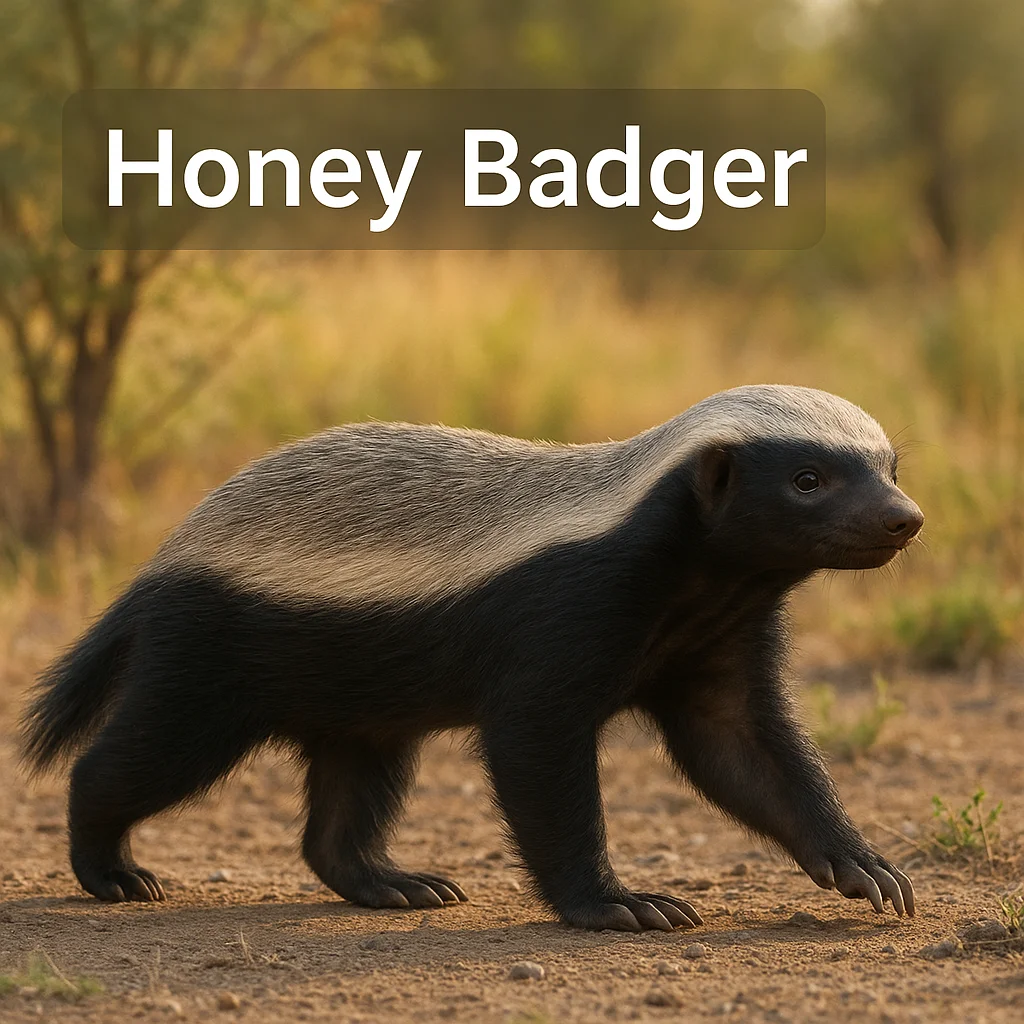
The honey badger is easily recognized by its stocky body and contrasting coloration. Its body is stout and broad, with a distinctive white or grayish band running from the top of its head down to the base of its tail.
- Body shape: Compact, stocky body with short legs
- Key colors/patterns: Black or dark brown body with a light-colored stripe on the back
- Distinctive features: Small eyes, strong claws, short tail
- Tracks/scat: Claw marks visible in tracks, scat often found near burrows
- Common look-alikes: Otters, though otters have sleeker bodies and no dorsal stripe
- Top ID Tips:
- Look for a distinctive wide stripe from head to tail.
- Note the strong, long claws on front paws.
- Check the robust, muscular build that's characteristic.
- Observe behavior; honey badgers are fearless and bold.
- Listen for their distinctive, growling call.
- Spot their small, but broad, heads and sturdy stature.
🧱 Body Structure & Physical Adaptations
The honey badger's body is designed for toughness, quick movement, and digging. Its thick skin and muscle make it hard to capture and injure, while its strong claws and teeth aid in both defense and foraging.
- Build and proportions: Stocky, muscular build with broad shoulders
- Teeth/jaw adaptations: Powerful jaws and sharp teeth ideal for crushing and tearing
- Claws: Long, strong claws for digging and climbing
- Sensory strengths: Excellent sense of smell; good hearing; limited eyesight
- Key Adaptations:
- Thick, loose skin allows wriggling when grabbed.
- Strong claws enable digging for burrows and food.
- Powerful jaws can bite through tough animal hides.
- Developed sense of smell for detecting food underground.
- Robust physiology to withstand bee stings and bites.
- Agile and capable of climbing trees when necessary.
🌍 Range & Distribution
Honey badgers are found predominantly across Africa, the Middle East, and parts of India, thriving in a variety of environments from dry scrublands to moist savannas.
- Regions: Predominantly sub-Saharan Africa, with populations in the Middle East and India
- Typical biomes: Forests, grasslands, deserts, and savannas
- Elevation range: Sea level to mountain regions
- Seasonal movements: Generally non-migratory, staying within home ranges year-round
- Where You Might Find It:
- Grasslands of Eastern and Southern Africa.
- Dense forests in Western Africa.
- Deserts in Northern Africa and the Middle East.
- Mountainous regions of Southern Africa.
- Woodlands in Central and Western India.
🏞️ Habitat & Shelter
The honey badger prefers a variety of habitats, often found in areas with abundant food sources. Its shelters often include burrows, which it can dig using its strong claws, providing refuge from predators and extreme weather.
- Preferred habitats: Savannas, woodlands, grasslands, and semi-deserts
- Microhabitats: Uses burrows as shelters, either dug by themselves or taken over from other animals
- Weather adaptation: Adjusts activity based on temperature, seeking shade or shelter during the hottest parts of the day
- Habitat knowledge significance: Understanding habitat use helps in conservation and management, highlighting the importance of protecting varied landscapes
🧭 Behavior & Ecology
Honey badgers are known for their bold and resourceful behavior. Their ecological role is significant due to their omnivorous diet and ability to control pest populations.
- Daily routine: Typically forages at night; rests and shelters in burrows during the day
- Communication: Growls, whines, and scent marking are common for communication
- Interactions with other species: Predatory behavior aids in pest control; often encounters bees when foraging for honey
- Role in ecosystem: Predator of small mammals; aids in seed dispersal through fruit consumption
- Behavior Highlights:
- Notorious for fierce defensive behavior.
- Uses intelligence and strength to escape enclosures.
- Exhibits solitary behavior except for mating times.
- Known to raid beehives despite bee stings.
- May live in close proximity to other honey badgers without social bonding.
👥 Social Life & Group Dynamics
Honey badgers are primarily solitary animals, coming together briefly for mating purposes. These independent creatures are known for their lack of fear and fierce behaviors.
- Social tendencies: Strongly solitary, except during mating season
- Group type: If grouped, it's typically a mating pair or mother with young
- Cooperation: Minimal; known for individualistic behaviors
- Dominance hierarchies: Not observed outside of maternal interactions
- Social Structure Notes:
- Encounter others mainly during feeding or mating.
- Exhibit solitary hunting and foraging.
- Female is sole caregiver for young.
- Displays territorial aggression when confronted.
- Brief physical interaction during mating season.
🍽️ Diet, Prey & Predators
As opportunistic feeders, honey badgers have an extensive diet primarily consisting of small mammals, reptiles, and vegetation. Predators like lions and leopards occasionally threaten them, but their ferocity often deters attacks.
- Diet: Diverse; includes rodents, birds, reptiles, insects, plants, and honey
- Predator strategy: Predominantly an ambush hunter
- Natural predators: Larger carnivores, mainly lions and leopards, though rarely successful
- Scavenging behavior: Will scavenge remains when available
- Feeding Notes:
- Eats a variety of prey, showing dietary flexibility.
- Reputation for raiding honeybee nests.
- Employs burrowing skills to access hidden prey.
- Uses acute sense of smell for locating food.
- Opportunist, utilizing various temporary food sources.
🦌 Hunting, Foraging & Movement
The honey badger is built for efficient hunting and foraging, showcasing remarkable endurance and agility. It tends to hunt alone, relying on its keen sense of smell and powerful digging abilities.
- Locomotion style: Fast runner, agile climber, proficient digger
- Speed and endurance: Capable of quick bursts of speed; able to cover long distances when foraging
- Hunting/foraging tactics: Relies on smell to locate prey; digs and ambushes
- Navigation: Establishes a home range but not strictly territorial
- Movement & Strategy:
- Adjusts activity levels based on environmental conditions.
- Efficient digger, capable of excavating burrows quickly.
- Primarily nocturnal forager.
- Can climb trees to escape predators or catch evasive prey.
- Adapts hunting tactics to specific prey species.
🧠 Intelligence & Senses
Renowned for its cunning, the honey badger displays problem-solving abilities and remarkable sensory acuity. Its keen sense of smell supports efficient food location and territory exploration.
- Problem-solving: Highly adept at escaping confinement and finding food through strategic methods
- Learning and memory: Exhibits learning capabilities, quickly adapting to avoid previous threats
- Sensory use: Relies heavily on smell; keen hearing aids in detecting threats
- Notable Abilities:
- Excellent memory for locations of food sources.
- Capable of complex escape strategies from traps.
- Adapts quickly to changing environmental challenges.
- Uses tools and objects to assist in stealing food.
- Strategizes during sparring encounters with predators.
🪺 Reproduction, Pregnancy & Parenting
The honey badger's solitary nature extends into its reproductive behaviors. These animals have a specific breeding season, during which they briefly pair. Females are responsible for the care and nurturing of the young.
- Breeding season: Varies by region; often connected to seasonal food availability
- Mating system: Generally polygynous
- Gestation period: Approximately 6–8 weeks
- Litter size: Typically 1–2 young
- Parenting roles: Female undertakes all parental care
- Reproduction Snapshot:
- Mating driven by female receptivity.
- Pregnant females build secluded burrows for birth.
- Young are altricial, needing extended maternal care.
- Fierce protection of offspring by mother.
- Juveniles follow mothers until independence.
♀️♂️ Male vs Female Differences
Males tend to be larger and more robust than females, but otherwise, the sexual dimorphism is limited, with both sexes displaying similar coloration and body structure.
- Size/weight differences: Males larger and heavier than females
- Behavioral differences: Males may have larger territories
- Role differences: Females more involved in rearing young
- Sex Differences at a Glance:
- Males have more mass and strength.
- Females are primary providers and protectors of young.
- Similar coloration between sexes.
- Slightly larger territory range for males.
- Mating initiated by female receptivity.
🧬 Subspecies & Variation
While variations are noted across their range, the honey badger is generally uniform in appearance. Some regional differences exist, primarily due to environmental adaptations.
- Known subspecies: Variations exist, but classifications are debated
- Local adaptations: Vary by habitat, such as size changes related to climate
- Variation Notes:
- Some adaptation in size due to environmental factors.
- Coat coloration can vary slightly between regions.
- Debates on true subspecies exist in scientific community.
- No major externally evident subspecies differentiation.
- Consistency in behavior despite range variations.
⚠️ Threats, Conservation & Human Interaction
The honey badger, although resilient, faces threats from habitat loss and human conflict. Their survival is supported by conservation programs focusing on habitat preservation and reducing human-wildlife conflict.
- Natural challenges: Predation by large carnivores
- Human-related pressures: Habitat destruction due to agriculture and settlement expansion
- Coexistence tips: Avoid confrontation; secure food sources to prevent foraging in human areas
- Responsible Notes:
- Encourage habitat protection to aid species survival.
- Minimize habitat disruption from human expansion.
- Educate locals on coexistence strategies.
- Support guard animal programs in farming regions.
- Observe wildlife interactions from a safe distance.
✨ Fun Facts & Unique Traits
- Honey badgers have been documented using tools, such as sticks, to extract honey.
- They possess a reversible anal pouch that releases a suffocating scent for defense.
- Their thick skin provides substantial protection against bites and stings.
- Despite their name, honey badgers don't just consume honey; they raid bee larvae and nests for sustenance.
- These animals have a mutualistic relationship with the greater honeyguide bird, which leads them to beehives.
- Honey badgers can sleep almost anywhere, even in the dens of their prey.
- They are known to feign death to escape predators in desperate situations.
📌 Summary
- Recognizable by their distinctive contrasting stripe across the back.
- Habitat includes forests, grasslands, and deserts across Africa and parts of Asia.
- Omnivorous diet, feeding on a variety of meats and some plant materials.
- Major natural predators include large carnivores like lions and leopards.
- Mostly solitary animals, occasionally observed in pairs during mating.
- Females care for offspring, providing high parental investment.
- Known for their boldness and problem-solving skills.
- Tough skin and powerful jaws contribute to their defense and hunting success.
- Durable creatures capable of withstanding a wide range of adverse conditions.