🦁 Lion
The lion, often referred to as the "king of the jungle," is a majestic apex predator recognized worldwide. Known for its powerful physique and iconic mane, the lion is a central figure in African and some Asian ecosystems. Lions are sociable, living in groups known as prides, and are one of the few big cats that exhibit such a structured social system. This guide provides a comprehensive look at the lion's life, behavior, and significance in the natural world.
🧾 Quick Facts
A quick reference to some of the most intriguing aspects of lions:
- Common name(s): Lion
- Scientific name: Panthera leo
- Animal type: Mammal
- Typical adult size: 4.5 to 6.5 feet in length; 300 to 500 pounds
- Typical lifespan: 10 to 14 years in the wild; up to 20 years in captivity
- Diet type: Carnivore; typically consumes large ungulates
- Activity pattern: Primarily nocturnal with some daytime activity
- Social structure: Group living (prides)
- Speed / movement highlights: Capable of running up to 50 miles per hour for short bursts
- Intelligence/learning: High adaptability and social learning, particularly in hunting tactics
- Primary habitats: Savannas, grasslands, open woodlands
- Geographic range: Sub-Saharan Africa and a small population in India
- Predators/threats: Few natural predators; threats from humans include habitat loss and hunting
- Conservation status: Vulnerable; varies by region
🔍 Identification & Appearance
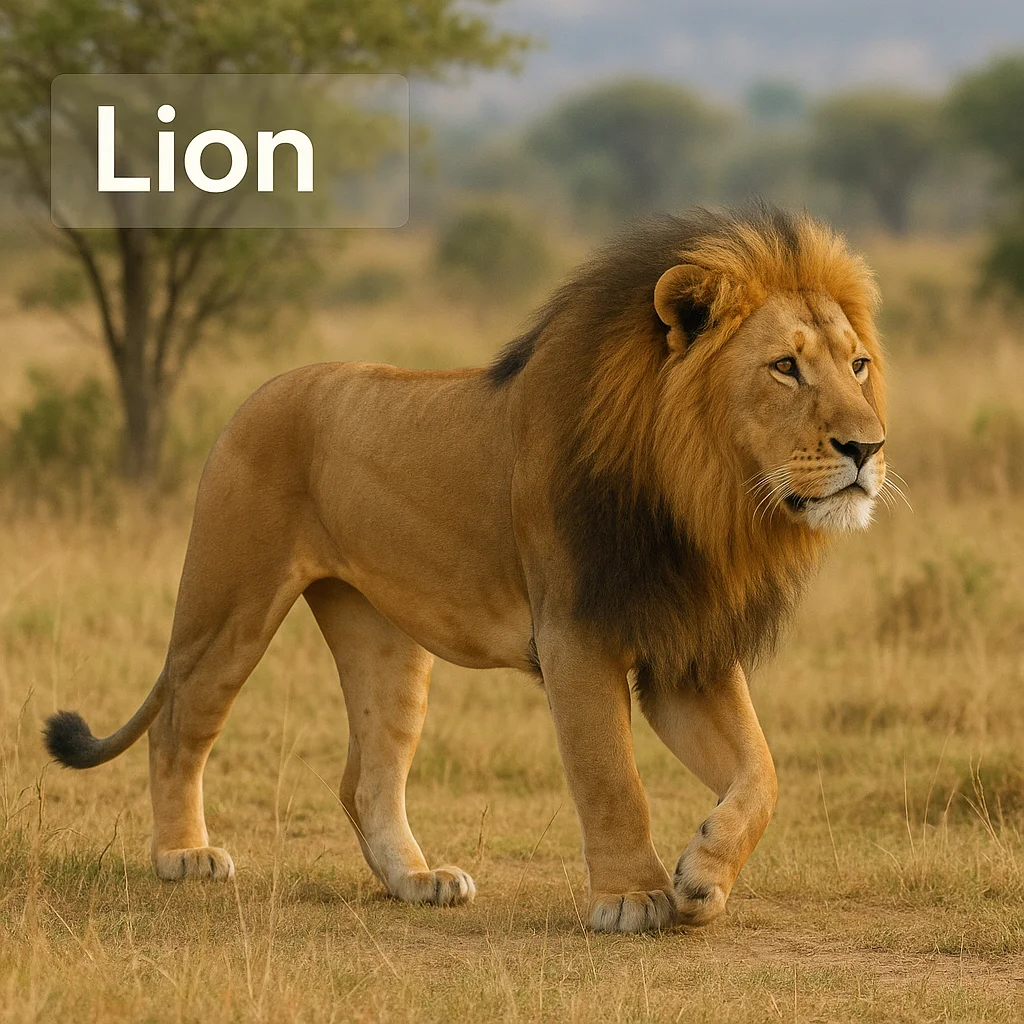
Lions are one of the most easily recognized animals due to their unique physical characteristics. Adult males are known for their thick, dark manes which provide both protection and an appealing visual display. Females, lack manes, but both sexes share a sandy or tawny coat that provides camouflage in their natural habitat.
Lions have a muscular build with long bodies, relatively short legs, and a tail tipped with a tuft of hair. The lion's face is broad with round ears, and its golden, often intense eyes are a distinctive feature.
- Top ID Tips:
- Look for the characteristic mane on males
- Check for a tawny coat with no spots or stripes
- Note the large, padded paws which leave rounded tracks
- Listen for the distinctive roar, heard up to 5 miles away
- Spot the tufted tail, a unique feature among large cats
- Observe family groups, as lions are the only social big cats
- Identify the confident, slow gait typical of lions
- Compare size differences; males are generally larger and heavier
🧱 Body Structure & Physical Adaptations
The lion's physique is optimized for power and some degree of speed, making it effective at capturing prey. Its jaw structure and sharp, retractable claws are adapted for gripping and tearing flesh. The muscular build, particularly powerful forelimbs, helps subdue large prey efficiently.
Lions have excellent night vision provided by a high number of rod cells in their eyes, enabling them to hunt at night. Their hearing is acute, allowing them to detect prey easily.
- Key Adaptations:
- Strong and muscular build for taking down large prey
- Powerful jaw and teeth for tearing through tough hides
- Retractable claws aid in hunting and climbing
- Enhanced night vision for nocturnal hunting
- Acute sense of hearing for locating prey
- Tail with a tuft for communication and balance
- Mane in males for protection during fights
- High adaptability to various prey in different ecosystems
🌍 Range & Distribution
Lions once inhabited much of Africa and parts of Europe and Asia, but now they primarily reside in Sub-Saharan Africa, with a small population in the Gir Forest of India. These environments provide the grasslands, savannas, shrublands, and open woodlands essential for their hunting style.
- Where You Might Find It:
- National parks and reserves in Sub-Saharan Africa
- Grasslands and savannas with ample prey availability
- Gir Forest National Park in India
- Near water sources frequented by herbivores
- Regions with reduced human activity and intervention
- Conservation areas implementing anti-poaching measures
🏞️ Habitat & Shelter
Lions thrive in grassland ecosystems, including vast savannas and open woodlands where prey is abundant. While not typically associated with dense forests or deserts, lions can adapt to various landscapes if sufficient prey and water are available.
They often rest under the shade of trees or in rocky outcrops to avoid the midday heat. During wet seasons, lions may move towards higher grounds to avoid flooding, while in dry seasons, nearby water sources are crucial.
🧭 Behavior & Ecology
Lions are predominantly nocturnal, resting by day and becoming active around dusk. They engage in grooming and social interactions within prides during the day, establishing strong social bonds and hierarchies.
Vocalizations are crucial for communication, with their resonant roar serving both territorial and social functions. Scent markings also play a key role in delineating territory.
- Behavior Highlights:
- Live in prides, which help in cooperative hunting
- Tend to groom each other, strengthening social bonds
- Roaring is a key form of long-distance communication
- Pride territory is marked with scent markings
- Sneak up on prey, covering ground silently
- Young cubs play, developing hunting skills
- Nighttime is often spent patrolling territories
- High degree of adaptability to available prey and conditions
👥 Social Life & Group Dynamics
Lions are unique among wild felines for their structured social groups, known as prides. A pride usually consists of several related females, their offspring, and a coalition of males. This social structure allows for cooperative living, shared duties of protection and hunting, and collective care of young.
- Social Structure Notes:
- Females often stay in natal prides for life
- Males defend the pride from rival lions
- Cooperative hunting leads to higher success rates
- Dominance hierarchies usually subtle among females
- Cubs nursed communally within the pride
- Territorial disputes sometimes arise with neighboring prides
- Male coalitions often contain brothers or related males
- Females lead hunting parties in many cases
🍽️ Diet, Prey & Predators
As obligate carnivores, lions primarily hunt large herbivores such as zebras, wildebeests, and antelopes. They may resort to scavenging when conditions demand, capitalizing on their sheer strength to displace other predators from kills.
Lions rarely face predators due to their apex status, but humans, whether through direct conflict or habitat encroachment, pose the greatest threat to their survival.
- Feeding Notes:
- Adapt to available prey, shifting focus seasonally
- Hunt in groups to take down larger animals
- Scavenge if the opportunity arises
- Specifically target the weak and young of large herds
- Water sources are key, where prey often gather
- Cubs rely exclusively on milk for the first few months
- Resource conflicts possible near human settlements
- Use stealth and proximity before charging at prey
🦌 Hunting, Foraging & Movement
Lions are ambush predators, utilizing a stealthy approach to get close to prey before bursting into a rapid, short chase. They rely heavily on teamwork in hunts, with certain prides developing specialized strategies based on experience and available prey.
- Movement & Strategy:
- Short, explosive bursts of speed
- Typically hunt during dusk or dawn
- Stalk close in tall grasses
- Focus on well-worn animal paths near water
- Rest during the hot midday sun to conserve energy
- Young lions learn hunting skills through play
- Resourceful in utilizing landscape features
- Navigation through scent trails and territorial markers
🧠 Intelligence & Senses
Lions display remarkable intelligence, particularly in social organization and hunting strategies. Their ability to adapt tactics and learn in group settings highlights both social intelligence and cooperation. They possess keen senses, with exceptional night vision aiding their nocturnal hunting expeditions.
- Notable Abilities:
- Sophisticated social maneuvering within prides
- Advanced teamwork in hunting scenarios
- Conceptual understanding of territory boundaries
- Acute sense of hearing integral for locating prey
- Ability to discern mood and intentions of pride members
- Environmental adaptability based on resource availability
- Observant and mindful of human presence
🪺 Reproduction, Pregnancy & Parenting
Lions typically mate year-round, but successful reproduction depends on environmental conditions and pride dynamics. Female lions experience a gestation period of around 100-110 days, giving birth to litters averaging three cubs, which are initially blind and helpless.
Female lions bear the primary role of raising cubs, with all nursing females cooperating to provide milk and protection.
- Reproduction Snapshot:
- Mating can occur at any time of year
- Gestation lasts approximately 3.5 months
- Cub mortality can be high due to predation or takeover
- Mothers frequently move cubs to protect from predators
- Cubs weaned at around six months but remain dependent
- Lions achieve maturity at 2-3 years for females and later for males
- New males often kill existing cubs to bring females into estrus
- Individual pride strategies contribute to cub survival
♀️♂️ Male vs Female Differences
Notable sexual dimorphism exists between male and female lions, most prominently seen in the male's mane. Males are generally larger and heavier, with distinct roles in pride dynamics focused on territory defense.
- Sex Differences at a Glance:
- Males are larger and more robust
- Only males have manes, varying in color and extent
- Females primarily undertake hunting responsibilities
- Male roles centered around protection and territory marking
- Males may temporarily form coalitions with other males
- Cubs may face risk of infanticide from incoming males
🧬 Subspecies & Variation
While primarily divided into the African and the Asian lion, there is debate among scientists regarding more detailed subspecies differentiation. Possible variations include coat color, size, and mane extent, often reflecting local environmental conditions.
- Variation Notes:
- African and Asian lions often cited subspecies
- Mane size can vary with temperature and habitat
- Potential for genetic divergence in isolated populations
- Island variations have been noted but can be disputed
- Subspecies classification often debated
⚠️ Threats, Conservation & Human Interaction
Lion populations face several threats, most significantly from habitat destruction, human-lion conflicts, and illegal hunting. Conservation efforts include establishing protected areas, promoting human-wildlife coexistence, and mitigating conflict scenarios sensitively.
- Responsible Notes:
- Habitat preservation is critical for long-term survival
- Efforts aim at enhancing human-lion coexistence
- Sustainable tourism can support conservation
- Monitoring populations through scientific research
- Education campaigns can reduce human-lion projects
- Zoological institutions play a role in genetic diversity preservation
✨ Fun Facts & Unique Traits
- Lions are the only cats known to roar together in a chorus
- Lion manes may darken with age
- Lions are the second largest big cat, with tigers being larger
- Fossil records indicate lions once roamed much of Europe and Asia
- Captive environments extend lions' lives significantly
- Nomadic males often travel great distances to find prides
- Lions occasionally climb trees to escape heat or annoyance
- Juvenile lions often leave for new prides as they mature
📌 Summary
- Lions are social, family-oriented big cats with distinct gender roles within prides
- They inhabit primarily Sub-Saharan Africa, with scattered populations in India
- Diet consists mostly of large ungulates; lions are skilled hunters
- Endangered status due primarily to human interactions and habitat loss
- The males are distinct for their manes, while females are the primary hunters
- Lions play a significant ecological role, influencing prey populations
- Conservation efforts focus on habitat restoration and human-lion coexistence