🦁 Red Fox
🧾 Quick Facts
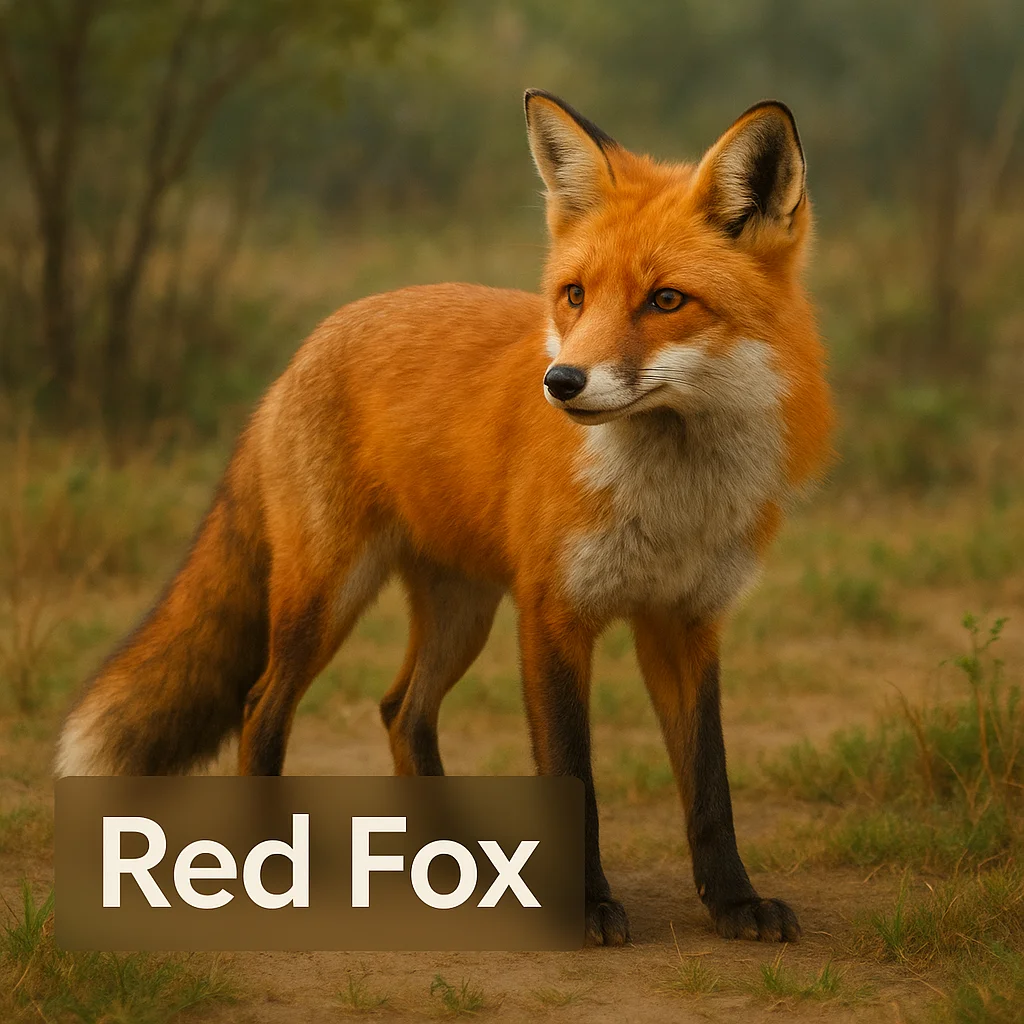
The Red Fox, often recognized by its striking reddish-orange coat, is a versatile and adaptable mammal found across various habitats in the Northern Hemisphere. Its scientific name, Vulpes vulpes, is known for its cunning behavior and adaptability in diverse environments.
- Common name(s): Red Fox
- Scientific name: Vulpes vulpes
- Animal type: Mammal
- Typical adult size: 45 to 90 cm in body length, plus a tail of 30 to 55 cm
- Typical lifespan: 3 to 4 years in the wild; up to 14 years in captivity
- Diet type: Omnivore; includes small mammals, birds, fruits, and insects
- Activity pattern: Primarily nocturnal, but can be seen during the day
- Social structure: Solitary, but pair up for breeding
- Speed / movement highlights: Capable of running up to 48 km/h
- Intelligence/learning: High adaptability and skill in problem-solving
- Primary habitats: Forests, grasslands, and urban areas
- Geographic range: North America, Europe, Asia, Northern Africa
- Predators/threats: Eagles, wolves, humans; subject to habitat destruction
- Conservation status: Least Concern, although varies by region
🔍 Identification & Appearance
Red Foxes have a distinctive appearance with their bushy tails and bright fur. Their moderate size and elongated bodies make them recognizable. The coat color may change slightly with seasons, ranging from bright reddish-orange to a duller grayish tone during winter.
- Body shape and silhouette: Slender, elongated body with a bushy tail
- Key colors/patterns: Reddish-orange coat with white underparts and black markings on legs and ears
- Distinctive features: Large ears, slender snout, bushy tail with a white tip
- Tracks: Pointed footprints with a chevron pattern
- Common look-alikes: Gray fox; distinguished by the latter’s shorter legs and grayer tone
- Look for a characteristic bushy, white-tipped tail.
- Note the triangular face with a narrow snout and large ears.
- Reddish fur stands out among other fox species.
- Dark markings on legs and ears help in identification.
- The silhouette is lean, not stocky.
- Fur color varies subtly by season; bright in summer, muted in winter.
🧱 Body Structure & Physical Adaptations
Red Foxes possess a slender build with long limbs allowing fast and agile movement. Their sharp, retractable claws enable climbing and gripping prey. The strong jaw and sharp teeth are efficient for catching and consuming varied prey types. They have acute senses, particularly excellent hearing and smell, aiding in hunting.
- Build and proportions: Slender with long legs, well-adapted for running
- Teeth/jaw adaptations: Strong jaws with sharp teeth for omnivorous diet
- Claws: Retractable, used for climbing and catching prey
- Sensory strengths: Excellent hearing and smell; vision less acute in low light
- Elongated body and limbs aid in high-speed chases.
- Sharp teeth for grasping prey and consuming varied diet.
- Agile with retractable claws for stealthy movement.
- Keen hearing to detect faint sounds from a distance.
- Excellent olfactory senses for tracking food.
- Bushy tail used for balance and warmth.
🌍 Range & Distribution
The Red Fox is among the most widely distributed wild carnivores. Found across the entire Northern Hemisphere, they inhabit various regions from the Arctic Circle to North Africa, Central America, and Asia. The species demonstrates remarkable adaptability to diverse climates and altitudes, reflecting its broad ecological niche.
- Regions and typical biomes: Covers forests, grasslands, mountains, and urban areas globally
- Elevation range: Sea level to alpine regions
- Seasonal movements: Mostly resident with minor local migrations
- Present across Europe and most of Asia.
- Occupies much of North America.
- Resides in both natural and urban environments.
- Found in both coastal regions and interior lands.
- Spotted from dense forests to open tundra.
🏞️ Habitat & Shelter
Red Foxes are highly adaptable and can live in varied environments, from tundras to urban settings. They often choose to create dens in secluded, secure spots, which can be burrows inherited from other animals or constructed anew. Seasonal weather changes influence shelter use, with foxes often seeking denser cover or suburban areas during harsh winters.
Understanding the habitat preferences of Red Foxes provides insight into their behavior patterns and survival strategies. Knowledge of seasonal variations in their habitat use is crucial for sound conservation and management practices.
🧭 Behavior & Ecology
Red Foxes exhibit fascinating behaviors that enhance their survival. Typically solitary, they maintain individual territories through scent marking and vocalizations. Communication among foxes involves diverse calls, body language, and facial expressions. They play a key role in controlling small mammal populations, acting as both predators and occasional scavengers, contributing significantly to ecosystem balance.
- Daily routine: Active during twilight hours, resting in dens during the day
- Communication: Various vocalizations, scent marking, body language
- Interactions: Competitive with other fox species; mutualistic with certain bird species by reducing prey competition
- Ecosystem role: Predator and scavenger, control small mammal populations
- Utilize scent markings to demarcate territory.
- Vocal repertoire includes barks, screams, and whines.
- Playful behavior seen in juveniles and during social interactions.
- Efficient in controlling rodent populations.
- Occasional scavenger, enhances nutrient recycling.
- Observe keen situational awareness during foraging.
👥 Social Life & Group Dynamics
Despite their reputation for independence, Red Foxes exhibit complex social structures, especially during the breeding season. While primarily solitary, foxes have been observed forming monogamous pairs or small family groups. Cooperation in rearing offspring is noted in some populations, although territorial disputes can occur, usually resolved through displays rather than conflict.
- Social tendencies: More solitary, pairing during breeding; flexible social dynamics
- Group types: Monogamous pairs or small family groups
- Cooperation: Limited to parenting and territory defense during breeding
- Conflict resolution: Dominance displays rather than physical conflict
- Primarily solitary outside of breeding season.
- Form pair bonds for breeding and raising young.
- Territorial but tolerate overlap in abundant resource areas.
- Occasional helpers among siblings in rearing pups.
- Disputes handled mostly through non-violent displays.
🍽️ Diet, Prey & Predators
As opportunistic omnivores, Red Foxes have a varied diet, feeding on small mammals, birds, insects, and fruits. They adapt their diet based on seasonal availability, showcasing impressive dietary flexibility. Natural predators include larger carnivores and birds of prey. Their keen senses and agility are primary defenses, aiding in evasion of threats.
- Diet: Small mammals, birds, insects, fruits, and occasionally carrion
- Hunting strategies: Stalking and pouncing on live prey
- Natural predators: Eagles, wolves, humans
- Anti-predator defenses: Evasive agility, keen senses
- Versatile diet adapts with seasonal changes.
- Skilled hunters, specialize in stalking and pouncing.
- Evade larger predators with speed and strategy.
- Consume a variety of food types, enhancing survival.
- Fruit consumption highlights their omnivorous nature.
🦌 Hunting, Foraging & Movement
The Red Fox is a dynamic forager, showcasing varied hunting and foraging strategies. Primarily a runner, the fox employs speed and agility to capture prey, often pouncing from a stalking position. Nocturnal habits align hunting with peak activity times of prey, displaying great skill in navigating terrain and seeking resources.
- Locomotion style: Agile runner; adept at silent movement
- Speed and endurance: Bursts of high speed, energy-efficient
- Foraging tactics: Stalking and pouncing; opportunistic scavenging
- Navigation: Well-defined home ranges, minimal long migrations
- Exhibits swift, agile movement across varied landscapes.
- Silent stalker, pounces with precision.
- Adapts foraging to seasonal prey availability.
- Uses established paths within home range.
- Employs a mixture of speed and stealth for hunting.
🧠 Intelligence & Senses
Renowned for its cunning, the Red Fox displays notable problem-solving abilities and adaptable learning behavior. Limited evidence of tool use is offset by sophisticated predator evasion strategies. Exceptional olfactory and auditory senses aid in tracking prey and avoiding danger, crucial for survival in diverse territories.
- Problem-solving: Demonstrates strong learning and adaptability
- Senses: Acute smell and hearing guide effective predation
- Uncertainties: Limited research on regional intelligence variability
- Exhibits sophisticated problem-solving skills.
- Adaptive learning enhances survival tactics.
- Relies heavily on incredible sense of smell.
- Comprehensive auditory abilities aid in prey location.
- Capable of subtle communication through body language.
🪺 Reproduction, Pregnancy & Parenting
Red Foxes breed annually, with Courtship usually occurring in winter. As monogamous, they form pairs, with gestation lasting approximately 49 to 58 days, resulting in a litter of 4 to 6 kits. Offspring are altricial, requiring parental care, primarily from the mother, though males assist with provisioning.
- Breeding seasonality: Occurs in winter; synchronized with environmental cues
- Mating system: Primarily monogamous
- Gestation period: 49 to 58 days
- Litter size: Typically 4 to 6 kits
- Parenting roles: Female leads care; male supports by providing food
- Breeds during late winter months.
- Kits are born blind and develop rapidly.
- Males deliver food to nursing females and their young.
- Offspring leave the den at about 4 weeks old.
- Social play is crucial for kit development.
♀️♂️ Male vs Female Differences
Physical and behavioral differences between male and female Red Foxes are generally subtle. Males are slightly larger, aiding territorial defense and provisioning. Both sexes share parenting responsibilities, but females are more involved in direct care of the young.
- Size differences: Males slightly larger than females
- Behavioral roles: Males primarily in provisioning; females in nurturing
- Subtle/variable traits: Often indistinguishable in color and overall appearance
- Males tend to be slightly bulkier.
- Females are more nurturing, especially post-birth.
- Primary color markings are consistent across sexes.
- Behavioral roles align with nurturing vs. provisioning.
🧬 Subspecies & Variation
There are several recognized subspecies of the Red Fox, differentiated by size, coat color, and geographical distribution. Subspecies variations can arise from climatic adaptations, with certain populations exhibiting unique traits such as smaller size in island environments or thicker pelage in colder climates. However, classifications can vary, under debate among scientists.
- Known subspecies: Vary in size, coat density, and range
- Local adaptations: Traits like fur density and color can adapt to environment
- Debated classifications: Subspecies categorization not uniform
- Subspecies adapted to diverse environments.
- Certain groups exhibit region-specific coat variations.
- Classification of subspecies is under constant review.
- Insular subpopulations may have reduced size.
⚠️ Threats, Conservation & Human Interaction
Red Foxes face several challenges, including habitat loss, hunting, and vehicle collisions in urban areas. Sustainable populations are maintained through their adaptability, yet human interactions pose significant risks and opportunities. Ethical coexistence involves understanding their ecological role without promoting harm or domestication.
- Challenges: Habitat destruction, urban encroachment, and human-wildlife conflict
- Conservation efforts: Focus on habitat preservation and reducing human conflict
- Coexistence tips: Secure food waste, understand ecological importance
- Adaptation to urban expansion can lead to conflicts.
- Conserved habitat ensures coexistence and ecological balance.
- Promote awareness of their ecological roles.
✨ Fun Facts & Unique Traits
- Red Foxes have a distinctive "mouse pounce" technique for catching prey.
- Capable swimmers, though they rarely take to water.
- Known for playful behavior, both in the wild and captivity.
- Red Foxes can identify and differentiate the sound of prey beneath snow.
- Their tails, known as "brushes," are used for balance and warmth.
- Resilient to varied climates due to their diverse genetic makeup.
- Occasionally, individuals are found with unusual fur colors due to genetic variation, known as "cross foxes" and "silver foxes."
📌 Summary
- Distinctive reddish-orange fur with white-tipped tail.
- Inhabits diverse environments from forests to urban areas.
- Diet varies; includes small mammals, birds, fruits, and insects.
- Predators include eagles and wolves; face threats from humans.
- Mainly solitary; forms pair bonds for breeding.
- Exhibits highly adaptive hunting techniques.
- Breeds annually; pair-bond cooperation in raising young.
- Multiple subspecies based on region and adaptation.
- Conservation status is least concern, but regional variations exist.
- Recognized for intelligence, adaptability, and ecological role.