🦁 Tiger
🧾 Quick Facts
Known for their majestic appearance and status as one of the most recognizable and powerful wild cats, tigers are the biggest species of the cat family. They exhibit fascinating behavior and have distinct characteristics, making them a subject of admiration and study in wildlife biology.
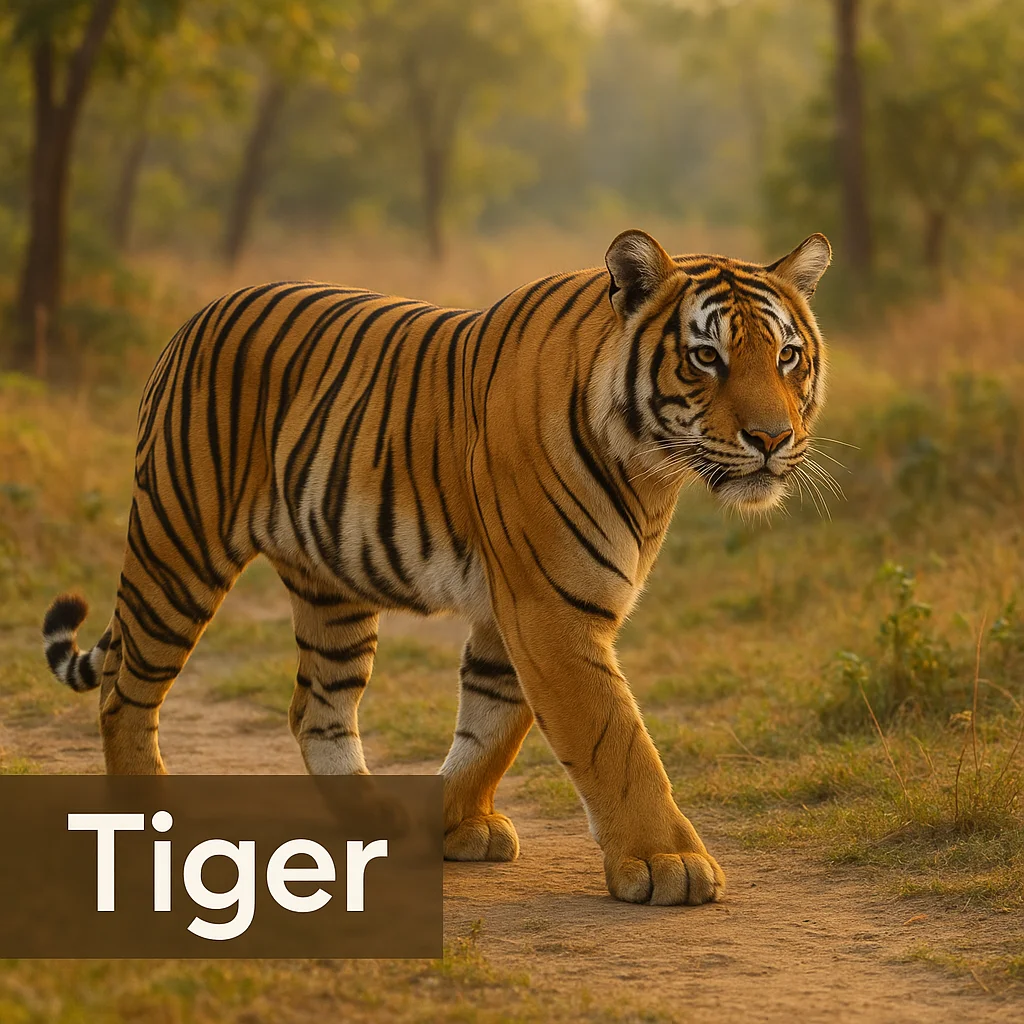
- Common name(s): Tiger
- Scientific name: Panthera tigris
- Animal type: Mammal
- Typical adult size: Length 2.5 to 3.9 meters, including tail; weight 90 to 310 kg
- Typical lifespan: 10 to 15 years in the wild; up to 20 years in captivity
- Diet type: Carnivore; primarily medium to large prey such as deer, wild boar, and sometimes domestic livestock
- Activity pattern: Mostly nocturnal, but can be crepuscular
- Social structure: Generally solitary apart from mothers with cubs
- Speed / movement highlights: Can reach speeds of 49-65 km/h in short bursts
- Intelligence/learning: Known for complex problem-solving and good memory
- Primary habitats: Dense forests, mangrove swamps, and grasslands
- Geographic range: South and Southeast Asia, including India, China, and Russia
- Predators/threats: Humans, habitat destruction, poaching
- Conservation status: Endangered, varies by region
🔍 Identification & Appearance
Tigers are large, muscular cats with a robust build. They have a distinctive orange coat with black stripes, which differ individually and are unique to each tiger. The stripes are more than just a pretty pattern; they help camouflage the animal in its natural environment.
- Body shape and silhouette: Muscular build with a long, powerful body
- Key colors/patterns: Orange coat with black stripes, white underbelly and facial highlights
- Distinctive features: Forward-facing eyes for depth perception, large paws
- Tracks: Large, round paw prints with no visible claw marks due to retractable claws
- Common look-alikes: Jaguars can look similar but have rosettes instead of stripes, and are located in different geographic regions
- Top ID Tips:
- Look for the characteristic striping
- Shaped like large domestic cats, but far more robust
- Powerful, padded paws
- They tend to stay near water sources
- Tail is long and used for balance
- Facial structure is rounded, with strong jaws
🧱 Body Structure & Physical Adaptations
Tigers are built for strength and agility. Their strong shoulder and leg muscles enable them to take down large prey, while their retractable claws and specialized teeth make them efficient hunters.
- Build and proportions: Robust with strong limbs for tackling prey
- Teeth adaptations: Large canines, adapted for delivering fatal bites
- Claws: Retractable, used for gripping prey and climbing
- Sensory strengths: Excellent night vision, acute hearing, and sense of smell
- Key Adaptations:
- Strong jaw muscles for powerful bites
- Flexible spines for fast turning while running
- Whiskers aid in spatial awareness
- Sharp retractable claws for hunting and climbing
- Stealthy movement to approach prey silently
- Large paws to distribute weight and improve stealth
🌍 Range & Distribution
Tigers are native to Asia, and their range once covered a vast region across the continent. Today, their population is fragmented due to habitat loss and other threats.
- Regions: Found primarily in Asia
- Countries: India, China, Russia, Indonesia, and others throughout Southeast Asia
- Habitats: Dense forests to open grasslands and mangrove swamps
- Elevation range: Sea level to mountainous regions
- Mostly resident, with occasional wandering by solitary individuals
- Where You Might Find It:
- Dense jungles of India
- Russian taiga forests
- Mangrove forests of the Sundarbans
- Southeast Asian tropical rainforests
- Protected reserves and national parks
- Grasslands and river valleys
🏞️ Habitat & Shelter
Preferring environments with dense vegetation and ample prey, tigers rely on these habitats for hunting and raising cubs. Their choice of habitat is also influenced by the availability of water sources.
- Preferred habitats: Tropical forests, temperate forests, and some grasslands
- Microhabitats: Use dense thickets and caves for resting and sheltering young
- Seasonal behavior: Wet monsoons may alter movements and hunting strategies
- Vital role in ecosystem: As apex predators, they help control the populations of prey species
🧭 Behavior & Ecology
Tigers are solitary animals with a well-defined territory. They are primarily nocturnal and are territorial, marking their ranges with scent marks and vocalizations. They also play crucial roles in maintaining the ecological balance by being top predators.
- Daily routine: Mostly active at dusk and dawn; rest during the day
- Communication: Roaring, scent marking, body language
- Interactions: Keep a solitary existence, with brief interactions during mating
- Role in ecosystem: Controls prey species; can influence forest composition
- Behavior Highlights:
- Territorial and solitary
- Vocal communication includes roaring
- Scent marking for territory
- Play a role in prey population control
- Occasional interaction with other predators
👥 Social Life & Group Dynamics
Tigers are largely solitary creatures, and the most prominent social unit is that of a mother with her cubs. However, they do recognize and establish territories which might overlap slightly.
- Solitary tendencies: Predominantly solitary except during mating or mothering
- Group size: Primarily alone, except for females with cubs
- Cooperation: Mothers teach cubs to hunt
- Conflict resolution: Dominance is typically established through size rather than combat
- Social Structure Notes:
- Primarily solitary
- Female-cub groups common
- Transient males roam
- Social interaction rare outside reproductive period
- Territorial disputes resolved with vocalizations
🍽️ Diet, Prey & Predators
Tigers are apex predators and their diet primarily includes large ungulates. They can also be opportunistic feeders. They employ stealth and power to capture prey, relying on their stripes for camouflage.
- Diet: Deer, wild boar, water buffalo, some monkeys, and even smaller species like rabbits
- Hunting strategy: Ambush predators, taking advantage of vegetation for cover
- Predators: Humans pose the most significant threat
- Scavenging: Occasional, especially in poor conditions
- Feeding Notes:
- Primary predators of large ungulates
- Ambush strategy reduces energy expenditure
- Few natural enemies apart from humans
- They play a role in scavenging when prey is scarce
🦌 Hunting, Foraging & Movement
Tigers are known for their stealth and strength in hunting large prey. Adapted for short burst speeds, they rely on surprise in their hunting strategies. Their strong movement pattern is essential for engaging and taking down their prey.
- Locomotion style: Ambush predators, precise and silent movers
- Speed and endurance: Short bursts of high speed, not long-distance runners
- Typical hunting times: Preferring twilight and nighttime hunts
- Navigation: Use well-defined territories to track prey
- Movement & Strategy:
- Capable of leaping great distances
- Uses underbrush for stealth
- Occasionally freshwater swimmers
- Ambush prey utilizing landscape
- Nocturnal hunters for diminished visibility
🧠 Intelligence & Senses
Tigers are intelligent and cunning predators, well-adapted to their environment. Their cognitive skills are evident in their ability to navigate and successfully hunt or avoid potential threats in their habitats.
- Problem-solving: Able to adapt hunting strategies based on prey behavior and landscape
- Social intelligence: Limited due to solitary lifestyle
- Senses: Superior night vision, wide range of hearing
- Notable Abilities:
- High auditory sensitivity for detecting prey
- Excellent camouflaging with their environment
- High capacity for learning hunting tactics
- Strong memory retained over time
🪺 Reproduction, Pregnancy & Parenting
Tigers have seasonal breeding patterns, with offspring that rely heavily on mothers for care through their early developmental stages. Females generally take on the primary parenting roles.
- Breeding seasonality: Typically in cooler parts of the year
- Mating system: Polygynous; males may mate with multiple females
- Gestation period: Around 3.5 months
- Litter size: Usually 2 to 4 cubs
- Infant development: Cubs are altricial, relying on mothers for survival
- Reproduction Snapshot:
- Breeding influenced by climate
- Caretaking roles by the female
- Rapid growth in early life stages
- Cubs learn hunting from mothers
♀️♂️ Male vs Female Differences
Differences between male and female tigers can include slight size and role variations, primarily related to territorial behavior and breeding duties. Overall, the species exhibits few obvious sexual dimorphic traits.
- Size/weight differences: Males are generally larger than females
- Behavioral roles: Males more territorial, females focus on cub-rearing
- Subtle differences in territorial aggression
- Sex Differences at a Glance:
- Males larger and heavier
- Males often roam larger territories
- Females involved in nurturing young
- Occasional males raising young if needed
🧬 Subspecies & Variation
Tigers have several recognized subspecies, each with distinct adaptations based on their geographic locations. These subspecies exhibit variations in size, coat thickness, and behaviors suited to their environments.
- Subspecies: Bengal tiger, Siberian tiger, Sumatran tiger, South China tiger, among others
- Size and color variations exist among subspecies
- Adaptations: Siberian tigers have thicker fur for cold climates
- Variation Notes:
- Bengal and Siberian most populous
- Sumatran tigers smaller and more adapted to dense forests
- Range-specific adaptations include camouflage pattern adjustments
⚠️ Threats, Conservation & Human Interaction
Human activities pose the most significant threat to tiger populations, including habitat destruction and poaching. Conservation efforts focus on habitat preservation and legal protection, emphasizing coexistence and education.
- Natural challenges: Habitat fragmentation
- Human-related pressures: Poaching, illegal trade, deforestation
- Conservation efforts: Protected reserves, anti-poaching regulations
- Responsible Notes:
- Support protective legislation
- Awareness on sustainable practices helps conservation
- Importance of legal wildlife trade enforcement
✨ Fun Facts & Unique Traits
- A tiger's roar can be heard up to 3 kilometers away
- Tigers are excellent swimmers and enjoy water
- Each tiger's stripe pattern is unique, much like a human fingerprint
- They have antiseptic saliva that can clean wounds
- Tigers occasionally capture prey double their size
- The world's largest big cat species
📌 Summary
- Tigers are large, powerful wild cats with striking orange and black stripes
- They inhabit a range of environments, from dense forests to open grasslands
- Most active during the twilight periods of dawn and dusk
- Solitary predators that play a substantial role in controlling prey populations
- Use stealth and power for hunting a diverse range of prey
- Pregnant for nearly 3.5 months, with mothers solely responsible for initial cub upbringing
- Experience various pressures due to human encroachment and poaching
- Adaptations include retractable claws, strong limbs, keen senses, and specialized canine teeth