🦜 Canary
🧾 Quick Facts
The canary is a small songbird beloved for its beautiful singing and bright plumage. Often kept as pets, these birds are also found in the wild across several regions and come in various colors and subspecies.
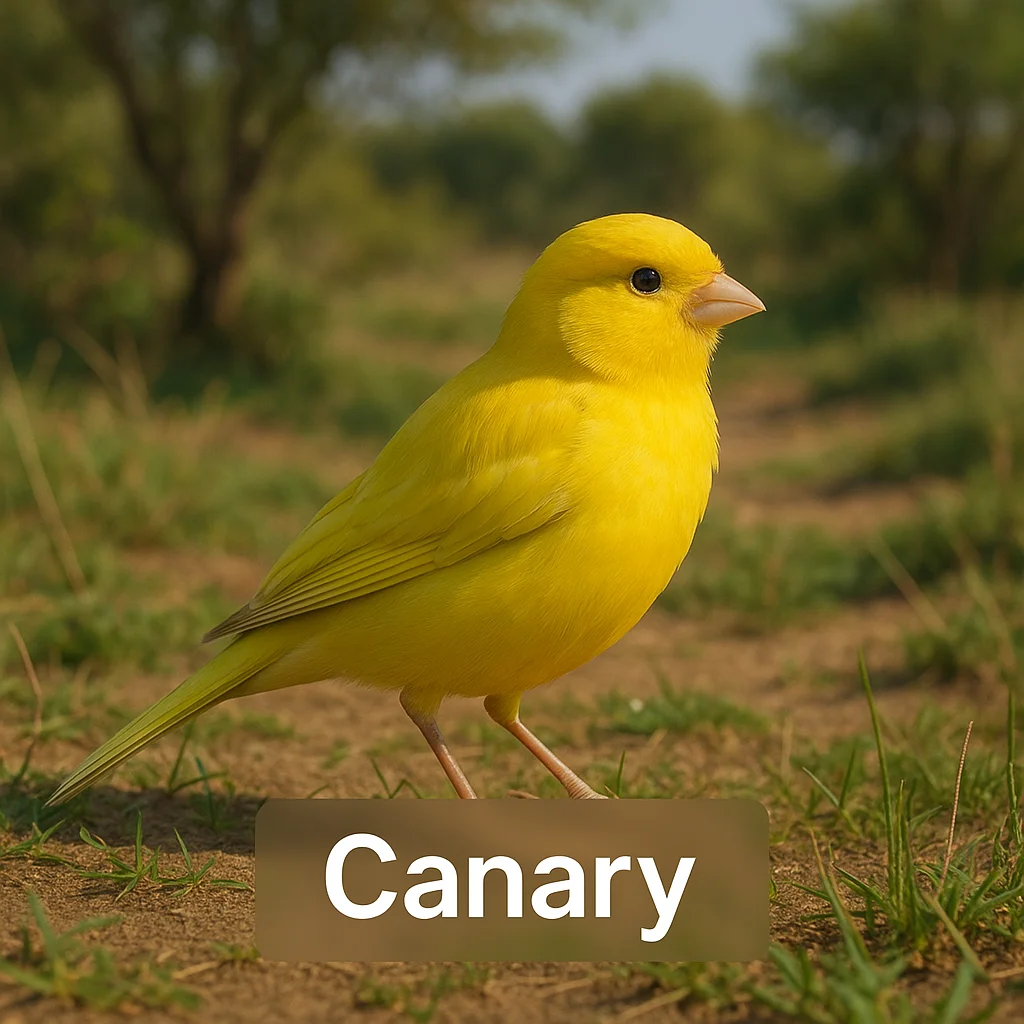
- Common name(s): Canary, Atlantic Canary
- Scientific name: Serinus canaria
- Animal type: Bird
- Typical adult size: 10-12 cm in length, weighing about 12-15 grams
- Typical lifespan: 5-10 years in the wild; up to 15 years in captivity
- Diet type: Herbivore; primarily seeds, fruits, and occasionally insects
- Activity pattern: Diurnal
- Social structure: Often seen in pairs or small flocks
- Speed / movement highlights: Agile flyers, capable of swift aerial maneuvers
- Intelligence/learning: Capable of complex songs and learning new tunes
- Primary habitats: Forests, scrublands, gardens, and urban areas
- Geographic range: Native to the Canary Islands, Madeira, and the Azores; introduced to many other regions
- Predators/threats: Birds of prey, domestic cats, human habitat disruption
- Conservation status: Generally stable, but varies by region
🔍 Identification & Appearance
Canaries are small birds with a compact body and short wings. They are most noted for their vibrant yellow plumage, although colors can vary widely, including greens, browns, and whites due to extensive breeding. Adult males are typically more colorful than females. Their beaks are small, conical, and well-suited for seed eating.
- Small, compact body with a proportionate head
- Bright yellow color is most common; variations include greens and browns
- Short, blunt beak optimal for cracking seeds
- Sleek, pointed wings facilitating agile flight
- Distinctive melodic song, primarily by males
- Short, forked tail aiding in flight maneuverability
- No significant seasonal color change
- Often mistaken for finches; distinguishable by song and coloration
- Top ID Tips
- Look for the bright yellow or green color
- Listen for their distinctive melodious song
- Note the small, conical beak for seed eating
- Check for a short, forked tail
- Observe size and compact shape
- Watch their agile flight patterns
🧱 Body Structure & Physical Adaptations
Canaries boast a slender yet robust build ideal for efficient seed-eating and song production. Their beaks are adapted to crack open various seeds, and their wings are tailored for quick, agile movement. Their keen hearing and eyesight are critical for communication and survival.
- Slender yet sturdy build; aids in agility
- Short, strong beak for efficient seed consumption
- Pointed wings designed for swift, nimble flight
- Acute auditory senses improve song learning and response
- Colorful plumage used for camouflage among flowering vegetation
- Adaptation to diverse environments, from scrublands to urban settings
- Key Adaptations
- Optimized beak for seed eating
- Sleek wings for agile flight
- Keen auditory senses for complex vocalizations
- Vibrant plumage for display and camouflage
- Excellent vision aids in foraging
- Social adaptability in various environments
🌍 Range & Distribution
Native to the Canary Islands, the Azores, and Madeira, canaries have been introduced to the mainland in Europe and North America. Found in a variety of habitats, these birds display remarkable adaptability.
- The Canary Islands, Azores, and Madeira are native regions
- Introduced populations in Europe and North America
- Preferred biomes include cultivated lands and gardens
- Can be found at various altitudes not exceeding tree line
- Permanent resident; no significant migratory patterns
- Where You Might Find It
- Subtropical and Temperate regions
- Urban parks and gardens
- Wooded and scrubland areas
- Rural farmlands
- Island environments
🏞️ Habitat & Shelter
Canaries inhabit a range of territories from natural forests to urban areas. They are highly adaptable and can be found nesting in trees, bushes, and even in urban environments. Their choice of habitat is critical for protection from predators and foraging.
A songbird’s vigorous response to changing weather patterns often includes foraging during cooler parts of the day and seeking shelter in foliage during intense heat or rain.
🧭 Behavior & Ecology
Canaries are generally active during daylight and sing complex songs to communicate and establish territory. They play a significant role in the ecosystem by dispersing seeds and providing prey for various predators.
- Active throughout the day; peak activity during morning and evening
- Vocalizations are rich, with variations among males for territory and mating
- Singing indicates strength, and attracts mates
- Non-aggressive; competes for resources primarily with other small songbirds
- Contributes to seed dispersal, promoting plant diversity
- Preyed upon by raptors; provides a crucial link in food chains
- Behavior Highlights
- Territorial singing
- Seed dispersal by eating and excreting
- Daytime foraging activity
- Adaptable within human-altered ecosystems
- Social behaviors in groups or pairs
- Non-aggressive interactions
👥 Social Life & Group Dynamics
Canaries exhibit flexible social behaviors, often seen either alone or in small flocks. Their interactions can be observed during foraging or singing, with males typically more vocal during the breeding season to attract mates.
- Generally social, found in pairs or small flocks
- Male canaries may compete vocally during mating season
- Cooperation evident in alarm calling at predators
- Mutual grooming in bonded pairs
- Subtle dominance in foraging order, often led by experienced individuals
- Social Structure Notes
- Forming pair bonds
- Vocal communication in flocks
- Alarm calling to warn of predators
- Cooperative interactions at feeding sites
- Relaxed social interactions within flocks
🍽️ Diet, Prey & Predators
Canaries mainly consume seeds, fruits, and occasionally small invertebrates. They utilize their short, strong beaks to crack seeds. Predation risks from larger birds and domestic cats are common, and anti-predator strategies include rapid flight.
- Primary diet: variety of seeds
- Fruits provide supplemental nutrients
- Occasional consumption of small insects
- Predators include falcons and domestic cats
- Quick flight patterns serve as a primary defense mechanism
- No significant scavenging behavior
- Feeding Notes
- Seed specialist
- Occasional fruit eater
- Safe spaces utilized during foraging
- Vigilant of predators while feeding
- Prefers fresh over processed food sources
🦌 Hunting, Foraging & Movement
Canaries are agile fliers and foragers, thriving in diverse environments. Their detailed knowledge of territory aids effective foraging, primarily at dawn and dusk.
- Agile fliers; short, quickly maneuvering flights
- Primarily ground and low vegetation foragers
- Swift movements decrease predation risk
- Home range includes proximity to dense cover
- No migratory behavior; known for sedentary habits
- Movement & Strategy
- Quick, agile fliers
- Strategic use of cover while foraging
- Ground and low vegetation feeding
- Foraging predominately at dawn and dusk
- Resident; does not migrate
🧠 Intelligence & Senses
Canaries are known for their impressive singing abilities and capacity to learn new songs. They have sharp vision and hearing, essential tools for environmental awareness and communication.
- Exhibit significant capacity for learning and mimicking complex songs
- Keen hearing essential for song differentiation and territorial behavior
- Strong vision aids in detecting food and predators
- Social intelligence observed in group dynamics and flock management
- Research is limited on cognitive problem-solving abilities
- Notable Abilities
- Complex vocalization capacities
- Precise hearing for nuanced communication
- Adaptability to varied environments
- Sharp eyesight ensures survival
- Subtle understanding of group hierarchies
🪺 Reproduction, Pregnancy & Parenting
Canaries typically breed in the spring. They exhibit monogamous pair bonds and engage in mutual nest-building activities. Females usually incubate eggs, while both parents feed the young.
- Breeding season begins in spring
- Monogamous pair bonding
- Incubation period of around 13-14 days
- Clutch size ranges from 3-5 eggs
- Offspring are altricial, requiring extensive parental care
- Both parents involved in feeding chicks
- Reproduction Snapshot
- Spring breeding season
- Monogamous pair formation
- Joint nest-building efforts
- Female incubation chiefly responsible
- Both genders provision young
♀️♂️ Male vs Female Differences
Male canaries are generally more vibrant and vocal than females, especially during the breeding season. Sexual dimorphism is subtle, with variations primarily in behavior and song rather than size.
- Male plumage usually brighter, especially during breeding season
- Males exhibit more intensive singing
- Behavioral differences include female nesting diligence
- Size difference is negligible
- Both sexes participate in offspring feeding
- Sex Differences at a Glance
- Brighter male plumage
- Greater singing in males
- Females more diligent nesters
- Minor size variations
- Shared parental responsibilities
🧬 Subspecies & Variation
Various canary breeds and subspecies exist due to selective breeding and regional adaptations. Differences include plumage color and song patterns. Classification remains under discussion among ornithologists due to extensive hybridization.
- Several subspecies influenced by selective breeding
- Color variations from yellow to red, or even white
- Song variations distinct among regions or isolated populations
- Breeds often named after breeders or regions
- Hybridization blurs subspecies classification
- Variation Notes
- Breed-specific color traits
- Notable song pattern distinctions
- Color variety includes red canaries
- Subspecies classification debated
- Regional adaptations visible in wild types
⚠️ Threats, Conservation & Human Interaction
The canary, while not at immediate risk, faces challenges from habitat loss and human interaction. Conservation measures are crucial to prevent decline in native populations, particularly in isolated ecosystems like islands.
- Primary threats include habitat destruction and domestic animal predation
- Ecosystem importance as seed dispersers
- Conservation status generally stable, but varies locally
- Captive keeping widespread, ensuring population stability
- Ensure ethical treatment and responsible pet ownership practices
- Responsible Notes
- Promote habitat conservation
- Encourage responsible pet care
- Avoid purchasing wild-caught individuals
- Support conservation initiatives
- Minimize habitat disruption activities
✨ Fun Facts & Unique Traits
- The canary’s song plays a critical role in pair bonding and territory marking.
- The name “canary” derives from their native habitat—the Canary Islands.
- Selective breeding has produced canaries with diverse colors and song capabilities.
- In the 19th century, miners used canaries to detect toxic gases due to their sensitive respiratory systems.
- Their vibrant color and joyful song have made them popular pets worldwide.
- Canaries can mimic environmental sounds such as telephones or doorbells.
📌 Summary
- Canaries are small, vibrant songbirds originating from islands like the Canaries and Madeira.
- They thrive in varied habitats, from forests to urban areas.
- Canaries primarily eat seeds, fruits, and occasionally insects.
- They are agile fliers with excellent song-learning capabilities.
- Canaries reproduce seasonally in spring, forming monogamous pairs.
- Males and females both play roles in offspring care.
- Their songs are key for social bonding and territory management.
- Unique adaptations for song and flight make them distinctive birds.