🦁 Helmeted Hornbill
🧾 Quick Facts
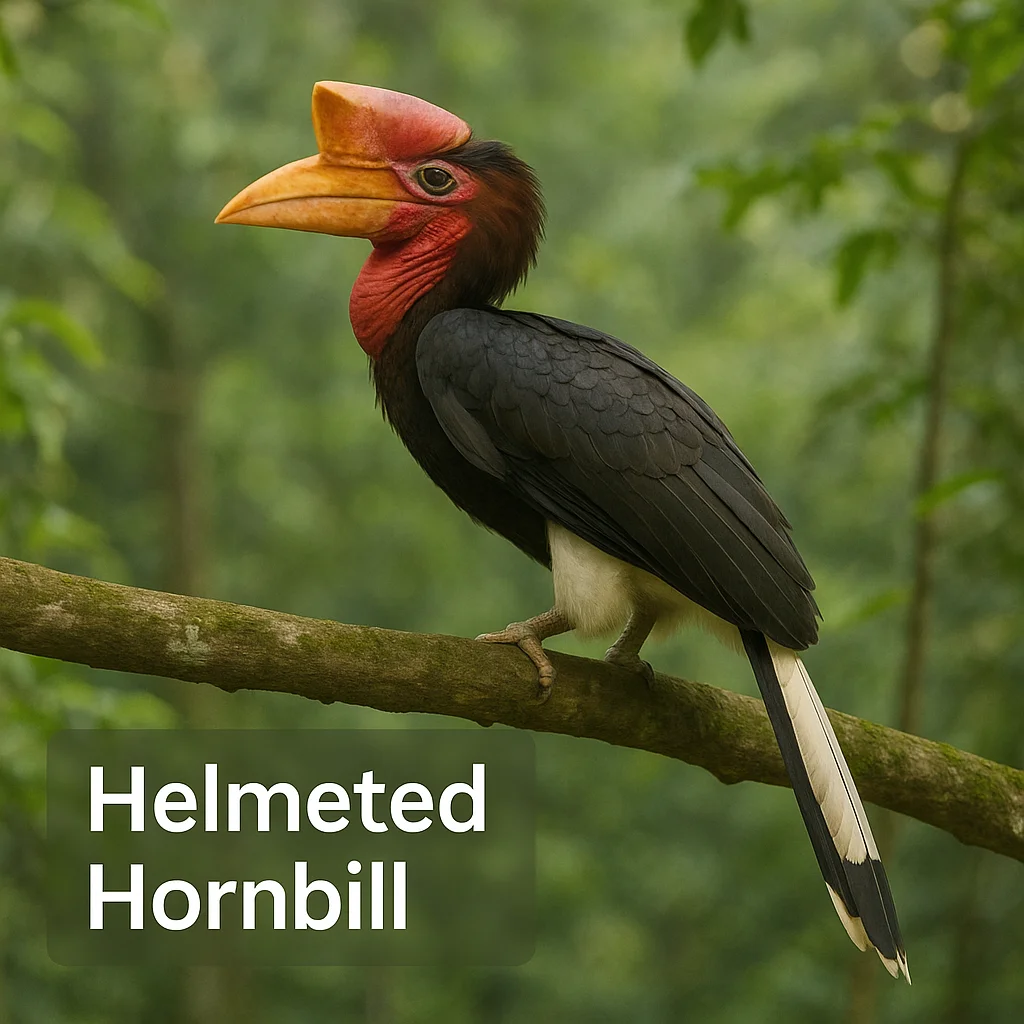
The Helmeted Hornbill (Rhinoplax vigil) is a unique bird known for its distinct casque, part of its skull that is highly sought after. Native to parts of Southeast Asia, this species plays an important role in its ecosystem as a seed disperser but faces numerous threats, particularly from illegal poaching.
- Common name(s): Helmeted Hornbill
- Scientific name: Rhinoplax vigil
- Animal type: Bird
- Typical adult size: 110–120 cm in length
- Typical lifespan: 35–40 years in the wild
- Diet type: Omnivore; fruits, insects, small animals
- Activity pattern: Diurnal
- Social structure: Primarily solitary or in pairs
- Speed / movement highlights: Strong flier
- Intelligence/learning: Known for solving simple problems; limited research on learning
- Primary habitats: Tropical and subtropical rainforests
- Geographic range: South Thailand, Malaysia, Sumatra, Borneo
- Predators/threats: Primarily human-related pressures such as poaching
- Conservation status: Critically Endangered
🔍 Identification & Appearance
The Helmeted Hornbill is easily recognizable by its large, solid casque which is a deep red color and occupies much of its head. This casque is unique among hornbills, as it is solid, unlike others which have a hollow structure. Their bodies feature a contrasting black-and-white plumage, with black wings and tail feathers tipped with white. The species also has brightly colored skin around its eyes and throat.
- Body shape and silhouette: Large and robust with a significant casque
- Key colors/patterns: Black and white plumage; red casque
- Distinctive features: Heavy casque; long tail with white tips
- Tracks, scat, or other field signs: Often heard rather than seen; deep, unique calls
- Common look-alikes: Other hornbill species with smaller or absent casques
- Look for a large, solid casque on the head
- Listen for distinctive, long calls
- Spot the long black-and-white tail feathers
- Notice the bright skin around the eyes and throat
- Observe in dense rainforest habitats
- Typically seen alone or in pairs
- Top ID Tips:
🧱 Body Structure & Physical Adaptations
The Helmeted Hornbill has a robust build, adapted to a life in dense forest canopies. Its casque, while heavy, aids in producing loud calls that carry over long distances. The strong beak and casque also assist in cracking open hard fruit. Its wings are broad, enabling sustained flight through the forest, while its long tail aids in balance and maneuvering among trees.
- Build and proportions: Robust build with a large head and strong neck
- Teeth/beak/jaw adaptations: Large, strong beak capable of cracking hard fruits
- Claws/hooves/wings/fins: Broad wings adapted for forest flight
- Sensory strengths: Great sight and acute hearing
- Large casque for sound production and dominance displays
- Strong beak for dietary variety
- Broad wings for navigating dense forests
- Long tail for balance
- Colorful skin for visual display
- Key Adaptations:
🌍 Range & Distribution
The Helmeted Hornbill is primarily found in the lowland forests of Southeast Asia, with its range encompassing parts of Thailand, Malaysia, Sumatra, and Borneo. It prefers dense canopy regions and is not typically migratory, generally residing permanently within its range unless influenced by severe habitat disturbance.
- Continents/regions: Southeast Asia
- Typical countries: Thailand, Malaysia, Indonesia (Sumatra, Borneo)
- Elevation range: Prefers lowland forests but can inhabit up to 1,500 meters
- Seasonal movements: Mostly resident within home ranges
- Dense tropical rainforests
- Lowland regions
- Regions with abundant fruit trees
- Protected forest reserves
- Along rivers or forest edges
- National parks in Southeast Asia
- Where You Might Find It:
🏞️ Habitat & Shelter
The Helmeted Hornbill's preferred habitat is dense tropical and subtropical rainforests where it can find ample food and nesting sites. It often nests in large tree hollows high up in the canopy. Due to its size and flight capability, the hornbill requires substantial forest cover for movement and protection. Seasonal changes in fruit availability influence its movement within the forest.
Habitat knowledge is crucial for understanding the Helmeted Hornbill's survival since its dependence on specific tree species for nesting and feeding makes it vulnerable to habitat loss.
🧭 Behavior & Ecology
This hornbill is known for its daily activities of foraging for fruits and small animals. It communicates using a deep, resonating "laughing" call that can be heard over long distances. The Helmeted Hornbill plays a significant ecological role as a seed disperser. It often interacts with other species through mutualistic relationships, especially those involving fruit trees.
- Daily routine: Active during daylight; foraging and resting
- Communication: Uses distinctive calls; visual displays with casque
- Interactions with other species: Vital seed disperser
- Role in the ecosystem: Seed disperser and predator of small animals
- Forages in pairs for fruit and prey
- Seeds dispersed aid forest regeneration
- Calls carry long distances
- Complex social interactions observed
- Aggressive displays with casque
- Behavior Highlights:
👥 Social Life & Group Dynamics
The Helmeted Hornbill is generally solitary or found in pairs, especially during the breeding season. These pairs often defend specific territories and nesting sites. Although primarily solitary, there can be interactions with others around rich food sources. Dominance hierarchies or complex social structures are not well-documented.
- Solitary vs social tendencies: Primarily solitary or in pairs
- Group types: Temporary groupings around food sources
- Cooperation: Feeding in pairs
- Dominance hierarchies: Largely unknown; speculative
- Pair bonding during breeding
- Minimal social grouping outside breeding
- Occasional group feeding areas
- Territorial during breeding
- Nesting sites often reused
- Social Structure Notes:
🍽️ Diet, Prey & Predators
Helmeted Hornbills are omnivores with a diet comprising mainly fruits, insects, and small animals. They prefer figs and have been observed catching small prey using their powerful beaks. Natural predators include large birds of prey and, occasionally, monitor lizards, although their most significant threat is from human activity such as poaching.
- What it eats: Primarily fruits; insects and small animals when available
- Hunting targets and strategies: Forages through trees; picks fruits and insects
- Main natural predators: Large birds of prey, monitor lizards
- Anti-predator defenses: Alertness and flight
- Prefers figs and certain tropical fruits
- Catches insects in flight
- Occasionally captures small vertebrates
- Forages alone or in pairs
- Relies heavily on fruiting trees
- Feeding Notes:
🦌 Hunting, Foraging & Movement
The Helmeted Hornbill is a diurnal forager, flying from tree to tree in search of fruits and small animals. It navigates dense forests using its skillful flight and long tail for balance, allowing it to reach inaccessible fruits. Its foraging is often methodical, as it picks fruits with its strong beak and listens for other wildlife that might indicate the presence of food.
- Locomotion style: Strong flier
- Speed and endurance: Capable of sustained flying
- Hunting/foraging tactics: Forages for fruits; uses sight and hearing
- Efficient forager
- Effective navigator of dense canopies
- Methodical in movement
- Relies on visual cues from other animals
- Movement & Strategy:
🧠 Intelligence & Senses
The Helmeted Hornbill is known for its robust memory and ability to return to the same nesting sites each year. It appears to have good problem-solving abilities, particularly when faced with obstacles in reaching food sources. Its senses, especially hearing and vision, are well-developed, which aid in communication and food detection.
- Good memory for nesting sites
- Problem-solving strategies for accessing food
- Developed hearing for communication
- Keen eyesight
- Notable Abilities:
🪺 Reproduction, Pregnancy & Parenting
The breeding season for Helmeted Hornbills varies based on regional climate conditions but often peaks during times of abundant food availability. It is a monogamous species, typically forming long-term pair bonds. Females lay a single egg, which undergoes an incubation period of about 90 days. Parental care is significant, with both parents involved in nurturing the chick until it is ready to fledge.
- Breeding season: Climate-dependent; often during food abundance
- Mating system: Monogamous
- Gestation/incubation period: Around 90 days
- Litter/clutch size: Typically a single egg
- Monogamous pairs bond for life
- Incubation period requires extensive care
- Reproduction Snapshot:
♀️♂️ Male vs Female Differences
There are subtle differences between male and female Helmeted Hornbills, primarily in size, with males generally being larger. Both sexes have similar plumage coloration, though slight differences in casque size might be observed. Behavioral roles during breeding are somewhat shared, though females invest heavily in incubating and initial chick care.
- Males typically larger
- Both sexes similar in coloration
- Casque size can vary between genders
- Sex Differences at a Glance:
🧬 Subspecies & Variation
Currently, there are no officially recognized subspecies of the Helmeted Hornbill; however, some regional variations in casque size and body proportions have been observed. These variations are likely due to differences in environmental factors and pressures. Further research is needed to clarify these differences.
- Some regional size variations
- Potential for local adaptations
- Variation Notes:
⚠️ Threats, Conservation & Human Interaction
The Helmeted Hornbill faces significant threats from illegal poaching, primarily for its casque, which is used in sculptures and traditional medicine. Habitat loss due to deforestation further exacerbates its decline. Public awareness campaigns and stricter international regulations are essential for its conservation. Coexistence emphasizes the importance of protecting rainforest ecosystems and reducing hunting pressures.
- Strict conservation measures needed
- Responsible Notes:
✨ Fun Facts & Unique Traits
- The Helmeted Hornbill's casque is solid and heavy, unlike other hornbills.
📌 Summary
- Helmeted Hornbill: Recognizable by its large size and casque