🦁 House Sparrow
🧾 Quick Facts
The House Sparrow (often listed as Passer domesticus) is one of the most widespread and recognized bird species in the world. It thrives in urban and rural environments and is known for its adaptability to human-altered landscapes.
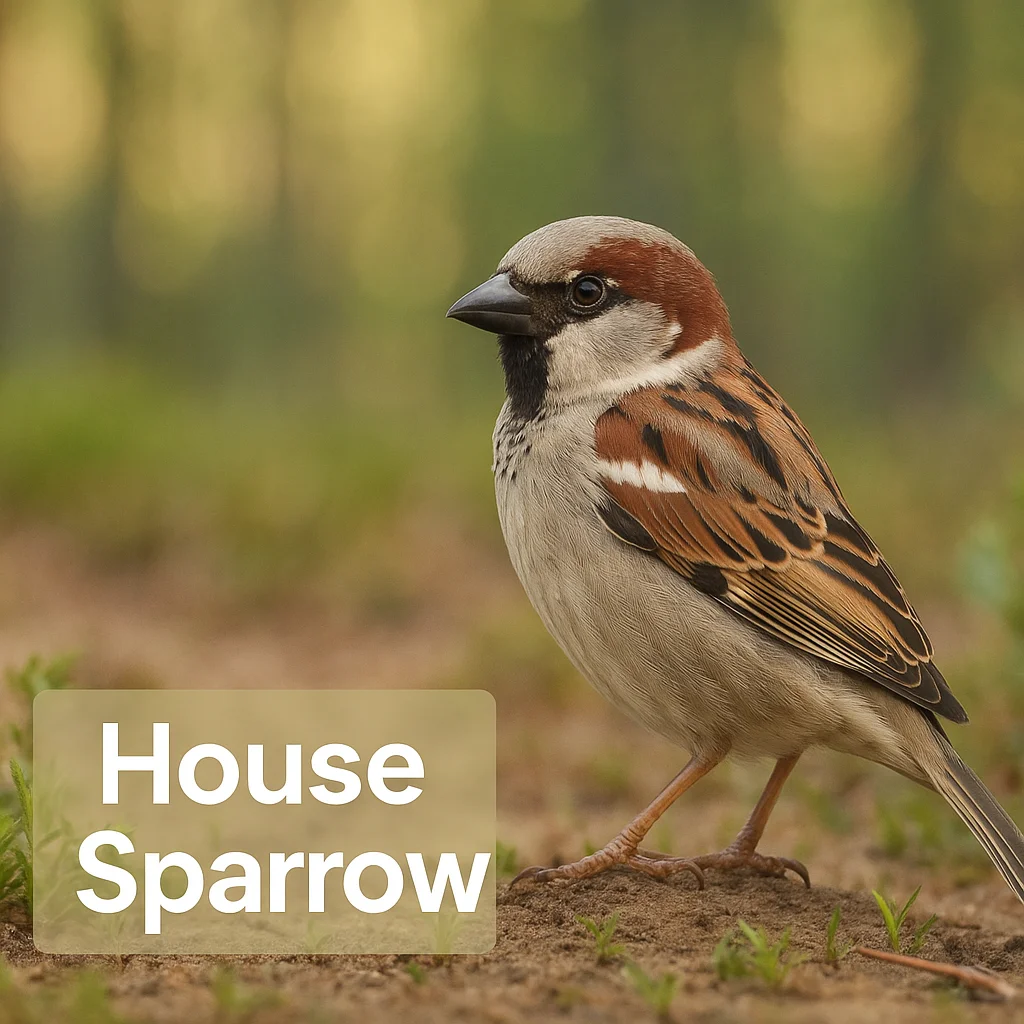
- Common name(s): House Sparrow
- Scientific name: Passer domesticus
- Animal type: Bird
- Typical adult size: 14 to 18 cm (5.5 to 7 inches) in length
- Typical lifespan: 3 to 5 years in the wild
- Diet type: Omnivore; commonly feeds on seeds, grains, and insects
- Activity pattern: Diurnal
- Social structure: Typically found in flocks
- Speed / movement highlights: Agile flyer with short, direct flights
- Intelligence/learning: Known for adaptability and learning behaviors in urban settings
- Primary habitats: Urban areas, farms, and open countryside
- Geographic range: Native to Eurasia but now found on all continents except Antarctica
- Predators/threats: Predation by cats, hawks; human-related impacts like habitat change
- Conservation status: Least Concern
🔍 Identification & Appearance
The House Sparrow is a small, stocky bird, easily recognizable by its robust, round body and thick bill. Males and females exhibit some differences in plumage. Males often show brighter patterns with a distinctive grey crown and black bib, while females are generally more subdued in coloration, with brown and grey streaks.
- Body shape: Compact and plump
- Color: Males have a grey crown, black streak across the eyes, and chestnut nape; females are more uniformly brownish
- Seasonal/age-related changes: Little variation; juveniles resemble females
- Distinctive features: Short, thick bill adapted for seed eating
- Common look-alikes: Similar to other sparrow species; males distinguished by black bib
- Field signs: Often found in urban settings; chirping noisy flocks
🧱 Body Structure & Physical Adaptations
The House Sparrow exhibits several adaptations that support its urban and rural lifestyle. Its stocky build is optimized for quick short flights, while its strong beak enables it to crack open seeds and catch insects. Its senses, particularly sight and hearing, are well-developed, aiding in foraging and predator avoidance.
- Build: Compact and robust with a short tail
- Beak: Conical and strong for seed-eating
- Wings: Short and broad for agile flight in cluttered environments
- Sensory strengths: Good eyesight and hearing for foraging and communication
🌍 Range & Distribution
The House Sparrow has a remarkable range, owing to its adaptability and close association with human environments. Originally native to Eurasia, it has been introduced to many parts of the world, thriving in both urban environments and rural areas.
- Native regions: Eurasia
- Introduced regions: North America, Australia, Africa, South America
- Biomes: Common in cities and suburban areas, farms, and open fields
- Elevation range: Found from lowland to upland areas
- Mostly resident; does not migrate
🏞️ Habitat & Shelter
House Sparrows are highly adaptable and can live in a wide range of habitats. They are most commonly found in urban settings, utilizing buildings and other structures for nesting. They rely on these environments to provide food and shelter, showcasing their ability to thrive alongside human development.
Weather and seasonal changes have minimal effect on their behavior, given their capability to adapt to various conditions and find shelter in buildings and managed landscapes.
🧭 Behavior & Ecology
House Sparrows are social birds, often seen in bustling flocks. Their daily activities include foraging for food, grooming, and engaging in communication through vocalizations and body language. They play a role in urban ecosystems as seed dispersers and also as prey for local predators.
- Daily routine: Active during daylight; foraging and social interactions
- Communication: Vocalizations include chirps and calls used for social interaction
- Interactions with other species: Competes with native birds for food resources
- Ecological role: Acts as seed disperser and a prey item in food webs
👥 Social Life & Group Dynamics
House Sparrows are gregarious, typically found in flocks that can vary in size. They show a preference for staying close to other sparrows, particularly during foraging and roosting. Hierarchies can exist within these groups but are not rigidly maintained.
- Group type: Flocks
- Typical group size: From a few individuals to large congregations
- Cooperation: Engage in communal feeding and alarm calling
- Conflict resolution: Mild aggression, such as chasing and vocal protest, for resources
🍽️ Diet, Prey & Predators
The diet of House Sparrows is varied, including grains, seeds, and insects, which makes them highly adaptable to different environments. They forage primarily on the ground. While they have a broad diet, they sometimes compete with other bird species for resources. In urban environments, they are often seen scavenging for human food waste.
- Diet: Seeds, grains, insects, food scraps
- Feeding habits: Ground foragers, often in groups
- Main predators: Cats, hawks, and occasionally snakes
- Anti-predator behavior: Quick flight and alarm calls in groups
🦌 Hunting, Foraging & Movement
House Sparrows exhibit resourceful foraging tactics, exploring various food sources within their habitat. Their small, agile wings allow swift flight, making them quick and unpredictable flyers. They typically forage during the day, when they can capitalize on both natural and human-provided food sources.
- Locomotion: Agile flyers and ground foragers
- Typical foraging times: Daylight, especially morning and late afternoon
- Navigation: Limited territorial behavior; local navigators
🧠 Intelligence & Senses
House Sparrows are intelligent birds, exhibiting problem-solving skills and adaptability, particularly within urban settings where resources vary. They have keen senses of sight and hearing, which aid in communication and predator detection.
- Problem-solving: Demonstrates adaptability in urban environments
- Sensory use: Relies on sight and sound for foraging and avoiding predators
- Behavioral learning: Can learn new foraging strategies by observing others
🪺 Reproduction, Pregnancy & Parenting
House Sparrows are monogamous, typically forming long-lasting pair bonds. Breeding primarily occurs in the spring and summer, with multiple broods possible in a single season. Nests are usually built in cavities or crevices, and both parents participate in rearing the young, which are altricial at birth.
- Breeding season: Spring and summer
- Mating system: Monogamous with some lifelong pair bonds
- Clutch size: Typically 3 to 5 eggs
- Parenting roles: Both parents involved in incubation and feeding
♀️♂️ Male vs Female Differences
House Sparrows show sexual dimorphism with males being more colorful than females. This includes the noticeable black bib in males and the more muted, streaked appearance in females.
- Size: Males slightly larger than females
- Coloration: Males possess brighter patterns with grey and black markings
- Behavior: No significant behavioral differences related to sex
🧬 Subspecies & Variation
Several subspecies of House Sparrows exist, with minor variations primarily in plumage and body size. These variations are usually adaptations to different environmental conditions across regions.
- Known subspecies: Include minor plumage and size variations
- Adaptations: Some regional differences based on local climate patterns
⚠️ Threats, Conservation & Human Interaction
While House Sparrows are currently listed as species of Least Concern, they face threats from habitat loss and competition for resources, particularly in urban areas where green spaces are declining. Human influence, including urbanization and pollution, presents challenges, but they are also benefiting from human-made structures for nesting.
- Natural threats: Predation by larger birds and mammals
- Human impacts: Habitat alteration and pollution
- Coexistence: Utilizes human structures for shelter
- Ethical considerations: Ensure responsible urban wildlife coexistence practices
✨ Fun Facts & Unique Traits
- House Sparrows are one of the few bird species known to thrive in highly urbanized environments worldwide.
- They can produce more than one brood each breeding season, which helps maintain their population numbers.
- House Sparrows have been associated with humans since the advent of agriculture.
- Their first recorded introduction to North America was in New York City around 1851.
- These sparrows are non-migratory, staying year-round in their chosen habitat area.
- House Sparrows have a highly developed pecking order that influences their social interactions within flocks.
- They are adept at taking advantage of human food sources, such as crumbs from outdoor eateries.
- Their nests are often made of various materials, including feathers, paper, and twigs, reflecting their urban adaptability.
📌 Summary
- Identification: Small, stocky with short tail; males distinct with grey and black markings.
- Habitat: Widespread in urban, suburban, and rural areas; uses human structures for nesting.
- Distribution: Found worldwide except Antarctica due to introductions and adaptability.
- Diet: Omnivorous, eating seeds, grains, insects, and human food scraps.
- Predators: Targets for cats, hawks; use quick flight and flock behavior for defense.
- Social life: Highly social, often seen in flocks of various sizes.
- Reproduction: Monogamous, with spring and summer nesting seasons.
- Key adaptations: Strong beak for seed eating; short, agile wings for urban flight.
- Unique traits: Highly adaptable to various human environments.