🦁 Resplendent Quetzal
🧾 Quick Facts
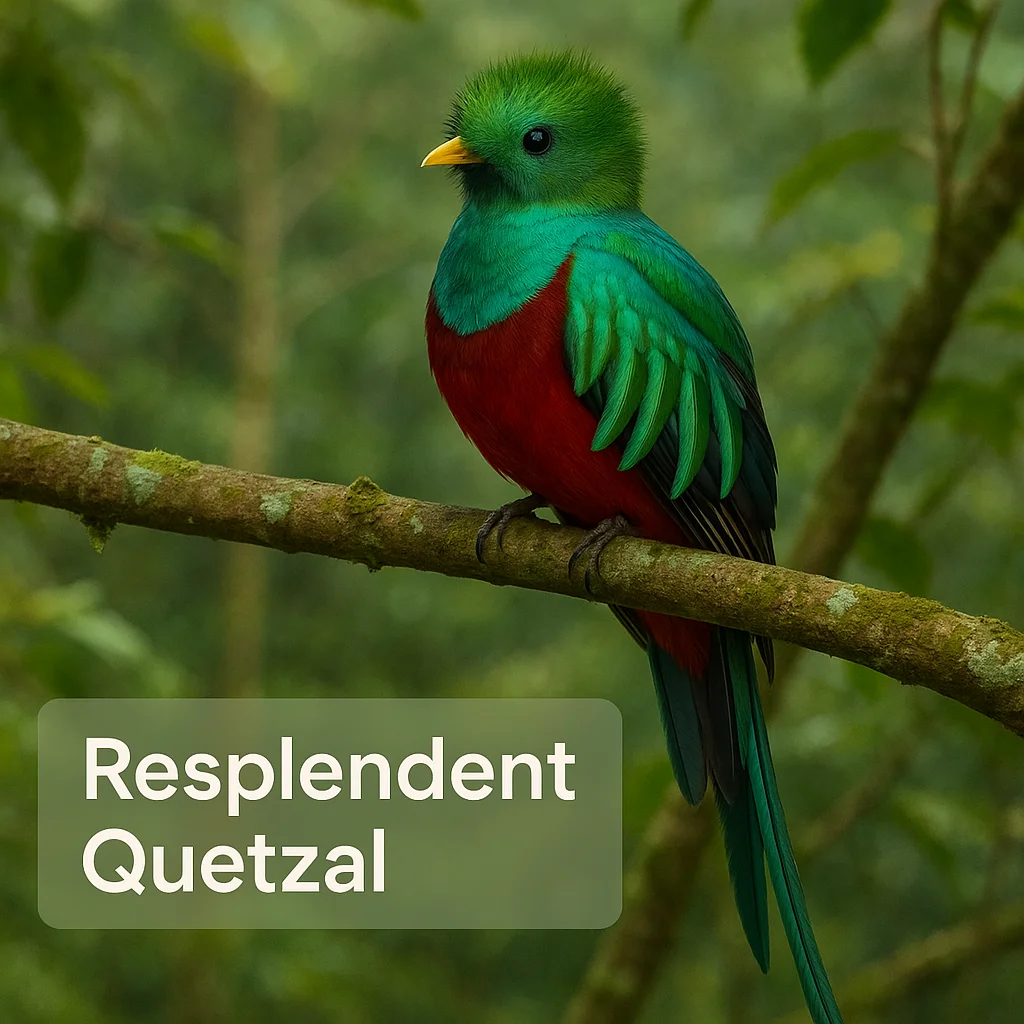
The Resplendent Quetzal, known for its vibrant plumage and long tail feathers, is one of the most striking birds found in the cloud forests of Central America. It holds significant cultural importance in many indigenous cultures and is often considered a symbol of freedom and beauty.
- Common name(s): Resplendent Quetzal
- Scientific name: Pharomachrus mocinno
- Animal type: Bird
- Typical adult size: Length 36-40 cm (14-16 in); males have additional tail feathers that can add up to 65 cm (25 in)
- Typical lifespan: 3-7 years in the wild; varies in captivity
- Diet type: Omnivore; primarily fruit, insects, and small vertebrates
- Activity pattern: Diurnal
- Social structure: Often seen in pairs, occasionally solitary
- Speed/movement highlights: Capable of nimble, agile flight through dense forests
- Intelligence/learning: Known for complex call sequences; learning and communication important
- Primary habitats: Cloud forests
- Geographic range: Central America; primarily Costa Rica, Guatemala, Panama
- Predators/threats: Snakes, hawks; habitat destruction by humans
- Conservation status: Near Threatened
🔍 Identification & Appearance
The Resplendent Quetzal is distinguished by its vibrant iridescent green body contrasted with a crimson-red breast. Males are particularly notable for their elongated tail feathers, which can be more than twice their body length. The head is crowned with a distinct helmet-like crest, and the beak is short and yellow.
- The bright green plumage can appear to change to blue hues depending on the light
- Females are more muted in color, lacking the long tail feathers
- Their eyes are large and prominent, aiding their vision in dense forests
- Their tracks are not often found as they are primarily arboreal
- Often confused with the Eared Quetzal, but lacks the ear tufts
- Top ID Tips
- Look for the striking combination of iridescent green and crimson-red
- Watch for the long, flowing tail feathers of males
- Note the crest atop the head
- Red belly contrasts sharply with the green of the rest of the body
- Females' tail feathers and overall coloration are shorter and duller
- Males are bright and more conspicuous during courtship displays
🧱 Body Structure & Physical Adaptations
The Resplendent Quetzal is built for life in the treetops. With a relatively small and lightweight body, it maneuvers with ease through the dense forest canopies.
- Their beaks are specialized for eating a diet rich in fruits and small creatures
- Strong, zygodactyl feet (two fingers forward and two backward) for gripping branches securely
- Large eyes help in low light conditions of dense forests
- The iridescent plumage provides excellent camouflage among the forest canopy
- Use their long tail feathers in courtship, though they are not used for flight
- Key Adaptations
- Long tail feathers for mating displays
- Zygodactyl feet for superior tree-climbing ability
- Iridescent green feathers for camouflage and mating attraction
- Sharp beak for consuming a varied diet
- Helmet-like crest aids in identification and may play a role in mating
- Agile flyers for navigating through thick forests
🌍 Range & Distribution
The Resplendent Quetzal is predominantly found within the cloud forests of Central America, thriving in humid, high-elevation areas where mist and fog are common.
- Primarily seen in central mountain ranges of Costa Rica and the Sierra Madre de Chiapas
- Occasionally spotted in the highlands of Guatemala and Panama
- Prefers elevations of 1000 to 3000 meters (3280 to 9843 feet)
- Resident species with little migratory behavior
- Inhabits areas characterized by dense vegetation
- Where You Might Find It
- Montverde Cloud Forest, Costa Rica
- Sierra de Las Minas, Guatemala
- Chiriquí Highlands, Panama
- La Amistad International Park
- Bajos del Toro, Costa Rica
- Cerro de la Muerte
- Coraque National Park, Honduras
- Quetzaltenango, Guatemala
🏞️ Habitat & Shelter
Thriving in the lush, damp cloud forests, Resplendent Quetzals are dependent on such specific environments for food, nesting, and shelter. Here, they occupy layers of the dense canopy, taking advantage of the varied microhabitats available.
They use natural cavities found in trees for nesting, preferring those in decaying wood, which are easier to shape with their beaks. Seasonal changes in weather significantly impact their activity levels, with more vocalizations and displays often observed during the breeding season.
🧭 Behavior & Ecology
Resplendent Quetzals are known for their variable calls and songs, used primarily in defending their territory and during mating displays. These birds are largely solitary or form temporary pair bonds during the breeding season. By feeding on a wide range of fruits, they act as important seed dispersers within their ecosystems.
- Daily patterns involve feeding in the early morning and late afternoon
- Quiet and elusive, often seen only when flushed out
- Practices scent-marking in dens and other strategic points for territory marking
- Predominantly arboreal, tending to stay above the ground
- Rarely seen interacting with other bird species
- Behavior Highlights
- Territorial singing and calling
- Fruit-based seed dispersal
- Shy and reclusive nature, aiding in evading predators
- Strong pair bonding during breeding season
- Infrequent human interaction due to remote habitat preference
- Use of distinct vocalizations for mating and territory
👥 Social Life & Group Dynamics
While Resplendent Quetzals are often seen alone or with a mate, they maintain broad territories in dense forests where resources are plentiful and shared with minimal conflict in pair bonds.
- Primarily solitary or in pairs
- Form temporary pair bonds for breeding purposes
- No strictly observed hierarchy
- Lack of cooperative behaviors, except during parenting
- Commonly exhibit conflict avoidance rather than territorial aggression
- Social Structure Notes
- Pairs during breeding season
- Basic tolerance of conspecifics
- Lack of herd or flock behavior
- Non-territorial outside of the breeding period
- Brief and specific communicative interactions
- Parental cooperation noted during infancy
🍽️ Diet, Prey & Predators
The quetzal primarily feeds on fruits from trees such as wild avocado, contributing significantly to seed dispersal in their habitat. Insects and small vertebrates are also consumed opportunistically, especially during the breeding season when additional protein is required for offspring care.
Natural predators include large raptors such as hawks and eagles. To avoid predation, these birds rely on their camouflaged plumage and tend toward quiet, inconspicuous behavior.
- Herbivorous diet focused on tropical fruits
- Increased insect consumption during chick-rearing
- Anti-predator defenses include remaining still and quiet
- Commonly found near fruiting trees
- Total reliance on arboreal feeding
- Feeding Notes
- Primarily frugivorous
- High reliance on Lauraceae family fruits
- Occasional insect and small vertebrate intake
- An important role as a seed disperser
- Predation pressure primarily from raptors
- Utilize terrain for feeding stealth and safety
🦌 Hunting, Foraging & Movement
Resplendent Quetzals are agile fliers, adapted for a life spent flitting between tree canopies. Their movement is primarily dictated by fruit availability, leading them to cover substantial vertical and horizontal space while foraging.
- Primarily foragers, seldom participate in active hunting
- Fly through forest with precision to navigate dense canopy
- High-energy times tie closely to fruiting seasons
- Deficiencies in terrestrial movement compensated by aerial skills
- Lack migratory behaviors
- Movement & Strategy
- Canopy-focused foraging and navigation
- Precision flight and adeptness in maneuvering
- Seasonally variable activity levels tied to food abundance
- Minimal ground activity due to elevated diet sources
- Migrate locally following fruiting tree cycles
🧠 Intelligence & Senses
Resplendent Quetzals exhibit advanced problem-solving abilities for foraging and possess refined communication skills for mating. Highly adaptable senses allow them to thrive in deep forest environments.
- Clear vocal communication demonstrates basic learning capacity
- Intelligence evidenced through problem-solving in food acquisition
- Stereoscopic vision aids in precise navigation
- Limited knowledge on complex tool use
- Auditory and visual recognition of threats enables rapid escape
- Notable Abilities
- Proficient in recognizing vocalizations
- Capable of deciphering complex food-obtaining tasks
- Rapid learning of local food patterns
- Adept at sensory adaptation in dim canopy light
- Able to sense and respond to high-frequency sound
🪺 Reproduction, Pregnancy & Parenting
Breeding for Resplendent Quetzals is heavily seasonal and marked by elaborate courtship rituals wherein males display their vibrant plumage. Monogamous pair bonds are usually formed for the duration of the breeding season.
- Nesting primarily in tree hollows high up
- Monogamous during the breeding period
- Incubation period approximately 17-20 days
- Clutch size typically 2-3 eggs
- Young are altricial and require significant parental investment
- Both males and females partake in raising fledglings
- Reproduction Snapshot
- Breeding season: March to June
- Extensive courtship displays
- Average incubation of 17-20 days
- Nests in forest canopy tree hollows
- Pairs share equal roles in chick-rearing
- Clutches usually 2-3 eggs
♀️♂️ Male vs Female Differences
The startling difference between male and female Resplendent Quetzals is most notable in their coloration and tail length. Males feature longer tails and more vibrant coloring, making them an attraction for potential mates during courtship displays.
- Males possess longer tail feathers used in displays
- Females are more muted in coloration for camouflage
- Males perform flamboyant flights to attract females
- Coloration differences promote mate choice behaviors
- Both sexes contribute to rearing the young but males often start courtship rituals
- Sex Differences at a Glance
- Males have bright, iridescent plumage
- Female plumage is shorter and duller
- Length difference due to males' tail feathers
- Sexual dimorphism linked to mating display
- Males are typically larger with enhanced visual appeal
🧬 Subspecies & Variation
The Resplendent Quetzal is often divided into subspecies, with variations most visible in plumage brightness and minor differences in range. There are ongoing debates about the boundaries of these subspecies due to overlapping territories.
- P. m. costaricensis: Found in Costa Rica and western Panama, known for slightly smaller size
- P. m. mocinno: Inhabiting Central America north of Costa Rica
- Adornment differences in tail feather length
- Gradient of plumage hue and wear through range
- Clinal variation in size from north to south
- Variation Notes
- Potential for genetic diversity within localized groups
- Seminal clade depends on region
- Similar range barring”, elusive identification exacerbated
- Tail feather lengths vary depending on location
⚠️ Threats, Conservation & Human Interaction
Challenges facing the Resplendent Quetzal include habitat destruction due to deforestation, climate change implications, and limited safe migration corridors. Conservation efforts are focused on habitat preservation and rebuilding forest corridors to maintain viable population levels.
- Habitat destruction from agriculture leads to critical losses
- Increasing climate-induced storm severity disrupts nest security
- Fragmentation from urban development challenges migratory corridors
- Ecosystem preservation critical to maintaining balanced numbers
- Captive reproduction programs help sustain genetic diversity
- Responsible Notes
- Conservation efforts encourage sustainable tourism
- Support local conservation organizations
- Involve community education about species importance
- Understand the importance of biotic balance in cloud forests
- Respect protected areas and avoid disturbance
✨ Fun Facts & Unique Traits
- Resplendent Quetzals have tail feathers that inspired the headdresses of Mayan gods
- Their scientific name, Pharomachrus, means "magnificent cloak"
- The Aztec and Maya considered them symbols of goodness and light
- Tend to only vocalize during specific times, like dawn and dusk
- Their feeding habits help facilitate plant community dynamics
- They seldom fly great distances but are efficient tree hoppers
- The quetzal can often be elusive, eluding photographers for hours in the foliage
📌 Summary
- The Resplendent Quetzal is a vibrant bird prized for its long tail feathers
- Inhabits cloud forests, primarily in Central America
- Primarily frugivorous, disperses seeds, with minimal migratory behavior
- Prey to raptors, and unknown sustenance in captivity longer
- Lives predominantly in pairs or alone
- Seasonal breeders with shared parental responsibilities
- Distinct adaptations for arboreal and canopy life
- Conservation status is near threatened due to habitat loss
- Adapted for a niche environment, emphasizing conservation needs