🦁 Arapaima
🧾 Quick Facts
The Arapaima, often referred to as "pirarucu" or "paiche," is a remarkable group of large freshwater fish found in South America's Amazon River basin. These fish are known for their massive size, unique feeding habits, and distinctive biological adaptations that make them one of the most fascinating species of tropical freshwater fish.
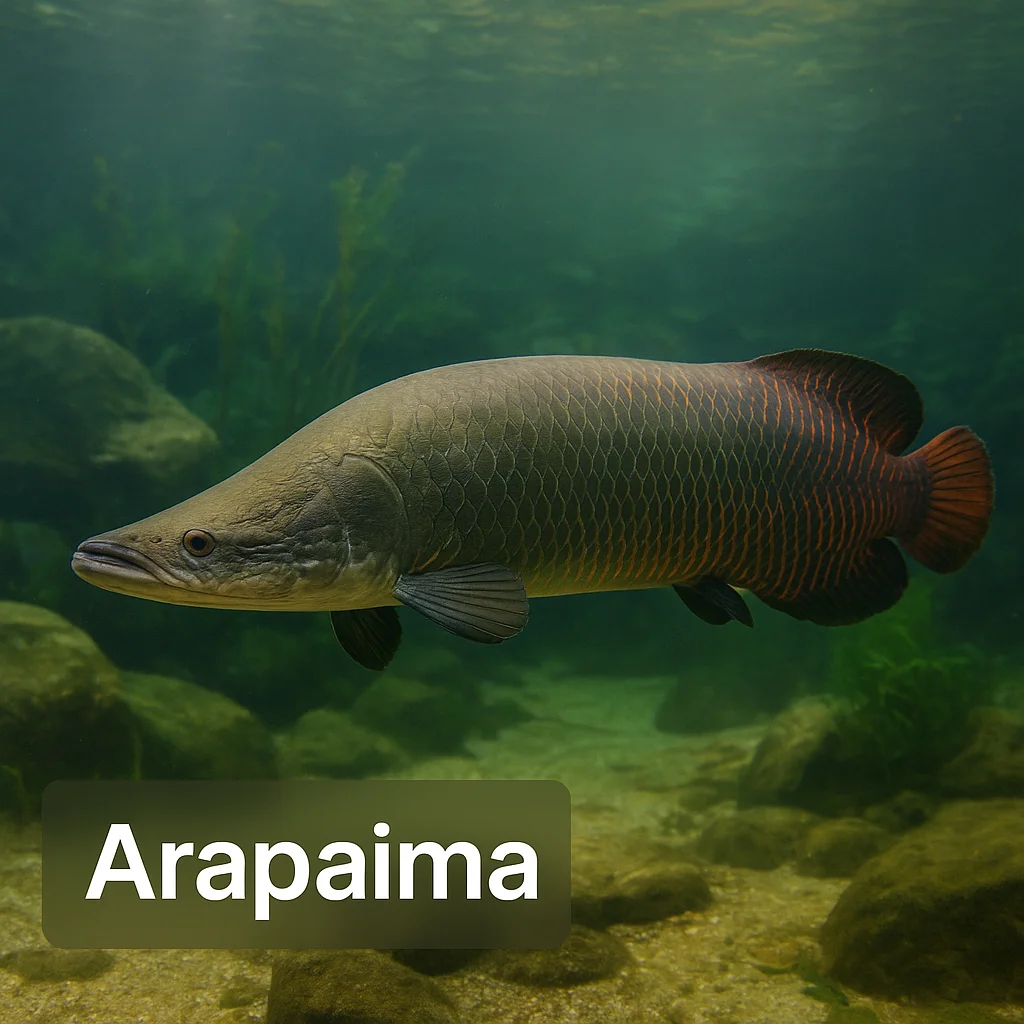
- Common name(s): Arapaima, Pirarucu, Paiche
- Scientific name: Arapaima gigas (with debates on potential subspecies)
- Animal type: Fish
- Typical adult size: Up to 3 meters (about 10 feet) in length; can weigh over 200 kg (440 lbs)
- Typical lifespan: 15–20 years in the wild; longer in captivity
- Diet type: Carnivore; mainly feeds on fish, crustaceans, and occasionally small land animals
- Activity pattern: Primarily diurnal, with peaks during dawn and dusk
- Social structure: Generally solitary; sometimes found in pairs or small groups
- Speed / movement highlights: Known for powerful swimming
- Intelligence/learning: Capable of learning and adapting; potential for basic problem solving
- Primary habitats: River and floodplain ecosystems within tropical rainforests
- Geographic range: Amazon River Basin, including parts of Brazil, Peru, and Colombia
- Predators/threats: Adult arapaima have few natural predators; however, juveniles face threats from birds and larger fish; human pressures include overfishing
- Conservation status: Varies by region; generally considered under pressure from overfishing and habitat loss
🔍 Identification & Appearance
To recognize an Arapaima, one should look for its torpedo-shaped body and distinct color pattern. These fish exhibit a streamlined body that is ideal for swift movement in water. Typically, arapaimas have dark olive-green bodies with reddish hues on their fins, which can become more pronounced as they age. This coloration helps them camouflage in the murky waters of their habitat. Their scales are large, thick, and bony, providing protection against predators.
Arapaimas have a distinctive, upturned snout and a wide, gaping mouth that assists them in catching prey. In terms of size, arapaimas are one of the largest freshwater fish in the world, making them relatively easy to identify once in their natural environment.
- Top ID Tips:
- Look for olive-green coloration with reddish fins
- Torpedo-shaped body
- Large, bony scales
- Prominent upturned snout
- Wide mouths designed for gulp feeding
- Massive size; often visible from a distance
- Often surface to take air; creating a telltale splash
🧱 Body Structure & Physical Adaptations
Arapaimas have adapted superbly to their environment. Their elongated, streamlined bodies allow for efficient swimming in the dense and murky waters of the Amazon. Despite their size, their body structure enables quick and agile movements. Their jaw and mouth are structured for rapid opening, allowing them to capture prey with a sudden gulp. Moreover, their tongue is studded with teeth, which helps in manipulating and processing food.
These fish possess a modified swim bladder that acts like a lung, enabling them to breathe atmospheric air, an essential adaptation for surviving in oxygen-poor waters. This adaptation necessitates regular surfacing to breathe, a behavior that also makes them vulnerable to human hunters.
- Key Adaptations:
- Strong elongated body for agile swimming
- Tongue with teeth for processing prey
- Modified swim bladder for breathing air
- Thick scales for predator protection
- Quick mouth opening for capturing prey
- Efficient respiratory system for low-oxygen environments
- Eye position aids in prey detection
🌍 Range & Distribution
The Arapaima is native to tropical South America, particularly within the Amazon River Basin. Their distribution spans several countries, including Brazil, Peru, and Colombia, where they inhabit river systems, floodplains, and lakes. The vast floodplain forests provide ample feeding opportunities and breeding grounds for arapaimas. While historically widespread, their range has been impacted by overfishing and habitat alterations, leading to variances in local populations.
- Where You Might Find It:
- Amazon River and its tributaries
- Large floodplain lakes in the Amazon
- Shallow, slow-moving rivers
- Flooded forest areas during wet season
- Rainforest rivers in Brazil, Peru, Colombia
🏞️ Habitat & Shelter
Arapaimas thrive in the rich and diverse habitats of the Amazon Basin. They favor slow-moving rivers, lakes, and flooded forests, which are abundant with food resources and suitable breeding conditions. The seasonal flooding of the Amazon basin creates a dynamic environment that the arapaima exploits for feeding and reproduction.
During the dry season, arapaimas are often found in main river channels and permanent lakes. As the rainy season begins and water levels rise, they can disperse into newly available flooded forest areas. Understanding these habitat preferences is crucial for conserving arapaima populations, as it highlights the importance of protecting the entire floodplain ecosystem.
🧭 Behavior & Ecology
Arapaimas are largely solitary but come together in shallow waters to breed. Their daily life is closely tied to their need to surface for air every 15 to 20 minutes, which is both a critical adaptation and a vulnerability. They communicate by making low-frequency sounds, and during the breeding season, males may form small groups to guard nests. As top predators in their ecosystem, arapaimas regulate fish populations and help maintain healthy aquatic environments.
As part of the ecosystem, arapaimas play a multi-faceted role. They function as predators by keeping fish populations in check and as prey to human fishers. Their large size and air-breathing behavior make them key indicators of ecosystem health.
- Behavior Highlights:
- Surface to breathe every 15-20 minutes
- Solitary but may form pairs during breeding
- Utilize low-frequency sounds for communication
- Top-level predators in their ecosystem
- Help regulate prey fish populations
- Males may guard nests during breeding season
👥 Social Life & Group Dynamics
Although arapaimas are generally solitary, they occasionally form pairs or small groups, particularly during the breeding season. When they do form groups, it is often for reproductive purposes, where pairs may work together to create and defend nests from other fish and predators. There isn't a clear dominance hierarchy, but competition for mating opportunities can lead to physical exchanges.
Their social behavior is primarily driven by reproductive needs, with little evidence of social cooperation outside of mating and rearing young.
- Social Structure Notes:
- Primarily solitary
- Form pairs during breeding
- No prominent dominance hierarchy
- Show cooperative nest guarding
- Occasionally observed in small groups
- Interactions driven by reproduction
🍽️ Diet, Prey & Predators
The Arapaima's diet is mainly composed of fish and crustaceans, but they are also known to consume birds and small mammals if the opportunity arises. They employ a gulp-feeding strategy, swiftly opening their mouths to create a vacuum that draws in water and prey. This technique is highly effective in their murky habitat.
Despite their size, adult arapaimas face few natural predators. The greatest threat to their survival comes from humans, who fish them both for food and sport. Juveniles are more vulnerable and may be preyed upon by large birds or aquatic predators.
- Feeding Notes:
- Primarily piscivorous (fish-eating)
- Gulp-feeding technique
- Opportunistic feeders on crustaceans
- Occasionally consume birds and small animals
- Pressure from human fishing activities
🦌 Hunting, Foraging & Movement
As ambush predators, arapaimas rely on stealth and patience for catching prey. Their ability to swim silently and burst quickly towards prey is key to their hunting success. Generally, arapaimas hunt during the day, particularly in the early morning or late afternoon. Due to their need to surface for air, they travel through familiar routes susceptible to human observation and capture.
In terms of movement, their swimming is powerful but not necessarily fast over long distances, favoring short, rapid bursts of speed when seizing prey or evading threats.
- Movement & Strategy:
- Ambush-style predator
- Efficient quick bursts for capturing prey
- Diurnal foraging and hunting activity
- Regularly traverse familiar routes when surfacing
- Strong swimmers despite massive size
🧠 Intelligence & Senses
Though specific research on arapaima intelligence is limited, they display signs of basic learning and problem solving, particularly in navigating their dynamic environments. Since they rely heavily on their modified swim bladder for breathing, they have an acute sense of pressure changes which aids in detecting nearby movements. Additionally, their sensory lateral line along their bodies is highly attuned to vibrations in the water, which assists in both hunting and navigation.
- Notable Abilities:
- Pressure sensitivity through swim bladder
- Sensory lateral line detects water changes
- Basic problem-solving skills evident
- Adept navigation in dynamic habitats
- Air breathing allows survival in low-oxygen areas
🪺 Reproduction, Pregnancy & Parenting
Arapaimas typically breed during the onset of the rainy season, when rising water levels create ideal conditions for spawning. They form monogamous pairs for the breeding season and engage in cooperative nest building, which involves creating shallow depressions in the substrate where eggs are laid.
The incubation period can range from several days to a couple of weeks, depending on environmental conditions. Males often take a significant role in guarding the nest and newly hatched fry. The young are vulnerable and require significant parental involvement for survival during their early life stages.
- Reproduction Snapshot:
- Breeding linked to rainy season
- Monogamous pair bonds during breeding
- Cooperative nest building and guarding
- Males actively guard nests and fry
- Egg incubation varies with environment
- High parental involvement in early stages
♀️♂️ Male vs Female Differences
Arapaima males and females are generally similar in size and appearance, with no extreme sexual dimorphism evident. However, during the breeding season, males might exhibit slight behavioral changes such as increased territoriality and aggression when guarding nests. Female arapaimas can sometimes be seen nearby guarding the periphery, but overall, distinguishing males from females based on appearance alone can be challenging.
- Sex Differences at a Glance:
- Minimal size or coloration difference
- Behavioral cues more evident during breeding
- Males more territorial in breeding season
- Sex identification challenging by appearance alone
🧬 Subspecies & Variation
There is some debate among scientists regarding possible subspecies of the Arapaima, stemming from variations in size, color, and minor morphological features across its distribution range. These differences are often attributed to local environmental conditions or isolated populations but have not been rigorously defined into distinct subspecies classifications.
- Variation Notes:
- Potential for subspecies based on regional variations
- Size differences potentially linked to habitat conditions
- Color intensity may vary across regions
- Behavioral variations observed in isolated populations
- Taxonomic classification still under study
⚠️ Threats, Conservation & Human Interaction
Arapaimas face several threats, primarily from human activities such as overfishing and habitat loss due to deforestation and pollution. These factors have significantly impacted local populations and their natural habitats. Conservation efforts are crucial, as they depend on large, intact floodplain ecosystems for survival. Sustainable fishing practices and habitat protection are pivotal for the conservation of this species.
While they are sometimes kept in large aquaria or zoos, their care requires specialized conditions that mimic their natural environments. Mismanagement can lead to ethical concerns, highlighting the importance of informed and responsible interaction with these remarkable fish.
- Responsible Notes:
- Sensitive to overfishing pressures
- Habitat loss due to human activities
- Conservation dependent on floodplain protection
- Sustainable practices needed for fishing
- Require specialized care in captivity
- Importance of awareness and responsible interaction
✨ Fun Facts & Unique Traits
- Arapaimas have relic scales with bony layers providing defense.
- Known for the ability to breathe air and extract oxygen from water.
- Some arapaimas exhibit the capability to "talk" with low frequency sounds.
- They are part of folklore in several Amazonian cultures.
- Arapaimas grow rapidly, nearly reaching adult size in just a few years.
- They help control invasive fish populations by predation.
- Their distinctive splash often signals presence to fishermen.
📌 Summary
- Recognized for torpedo-shaped, olive-green bodies with reddish fins.
- Found in Amazon River Basin; face threats from overfishing.
- Primarily piscivores, opportunistic feeders; exhibit unique breathing adaptations.
- Surface breathing patterns make them vulnerable to hunting.
- Solitary but pair during breeding; males guard nests.
- Able to "breathe" atmospheric air and detect water vibrations.
- Show basic learning abilities and problem-solving skills.
- Conservation efforts focus on habitat protection and sustainable fishing practices.