🦁 Arowana
🧾 Quick Facts
Arowanas are a fascinating group of freshwater fish known for their distinctive appearance and broad distribution across tropical regions. They play a significant role in their ecosystems and are popular among aquarium enthusiasts.
- Common name(s): Arowana, Dragon Fish, Bonytongue
- Scientific name: Often listed under the family Osteoglossidae
- Animal type: Fish
- Typical adult size: 2 to 3 feet in length
- Typical lifespan: 10 to 20 years in the wild; can exceed 20 years in captivity
- Diet type: Carnivore; eats insects, smaller fish, and crustaceans
- Activity pattern: Diurnal
- Social structure: Generally solitary
- Speed / movement highlights: Slow swimmer, capable of powerful bursts to capture prey
- Intelligence/learning: Capable of learning to recognize owners; engaged in interactive feeding in captivity
- Primary habitats: Freshwater rivers and lakes
- Geographic range: South America, Southeast Asia, Australia, Africa
- Predators/threats: Larger fish, birds, and reptiles; human threats include habitat loss and overfishing
- Conservation status: Varies by region
🔍 Identification & Appearance
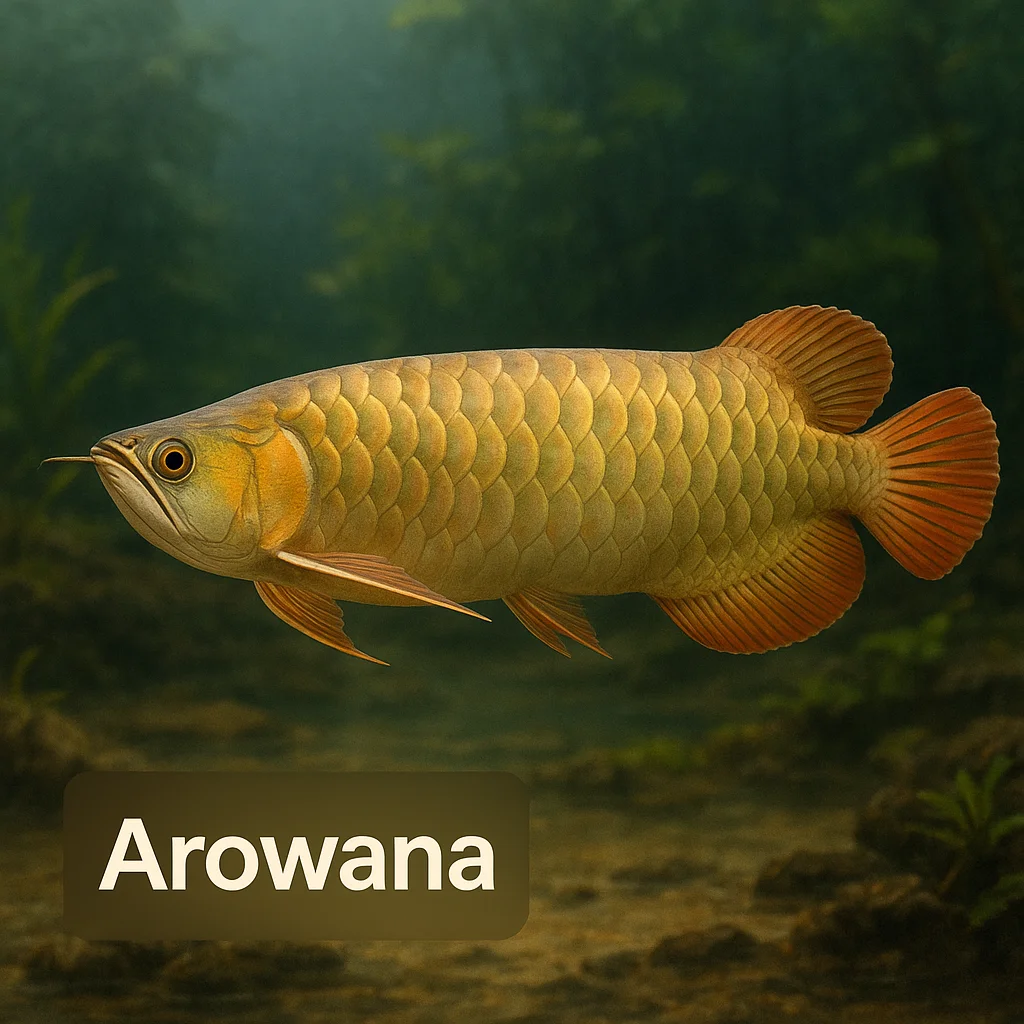
Arowanas are easily recognizable by their elongated bodies and large scales that give them a dragon-like appearance. They often have metallic hues, ranging from silver and gold to vibrant red and green. The mouth is large and upturned, suited for surface feeding.
- Top ID Tips:
- Long, slender body shape
- Prominent, metallic scales
- Large, upturned mouth
- Color varies by species, includes silver, red, green
- Barbels extending from their lower jaw
- Powerful, wavy swimming motion
- Fins mostly located towards the back
- Distinctive head shape, often compared to a dragon's
- Presence of knob at the base of the tail in some species
- Often confused with snakeheads or gars but can be distinguished by scale size and mouth shape
🧱 Body Structure & Physical Adaptations
The arowana is adapted for surface feeding with its large mouth set at an upward angle. Their elongated bodies and extensive, pectoral fins help them glide smoothly through the water. Arowanas have excellent eyesight, crucial for hunting in the dimly lit waters of tropical rivers.
- Key Adaptations:
- Elongated body for agile swimming
- Large, powerful mouth for capturing surface prey
- Dorsally compressed body helps in swift turning
- Barbels for detecting surface vibrations
- Highly developed vision for spotting prey
- Large, overlapping scales offer protection
- Pectoral and anal fins for maneuverability
- Osteoglossids' specialized tongue bones with teeth
- Gill rakers for sifting small prey
🌍 Range & Distribution
Arowanas inhabit freshwater regions across several continents. They can be found in the Amazon basin in South America, throughout Southeast Asia in countries like Thailand and Malaysia, and even as far as Northern Australia and parts of Africa.
- Where You Might Find It:
- Amazon River Basin, South America
- Mekong River, Southeast Asia
- Rivers of Northern Australia
- Freshwater areas in Western Africa
- Rainforest rivers and floodplains
- Seasonally flooded forests
- Slow-moving water bodies
- Freshwater lakes and swamps
🏞️ Habitat & Shelter
Arowanas prefer still or slow-moving waters, a common trait of tropical freshwater fish. These habitats often include rivers, lakes, and flooded forests. The fish use overhanging vegetation and submerged structures as shelter from predators and places to hunt for prey.
Understanding the habitat is crucial as these environments provide necessary resources for arowanas' survival, including hiding spots and abundant prey. During dry seasons, some species may move to deeper waters to avoid shrinking water levels.
🧭 Behavior & Ecology
Arowanas are opportunistic feeders, primarily hunting at the water's surface. They may also jump out of the water to catch insects and other small animals. While generally solitary, they can tolerate the presence of others, especially during mating seasons.
- Behavior Highlights:
- Surface hunters using eyesight and stealth
- Jumping ability to catch arboreal prey
- Diurnal, with peak activity during daybreak and dusk
- Highly territorial; aggressively defends space
- Employs body language for communication
- Mutualistic relationships with certain fish, such as feeders on parasites
- Preyed upon by birds and larger fish
- Contributes to population control of smaller aquatic organisms
👥 Social Life & Group Dynamics
Arowanas show largely solitary behavior but are known to congregate during breeding or when food is abundant. In captivity, they may cohabitate with enough space to establish individual territories.
- Social Structure Notes:
- Primarily solitary in wild conditions
- Rarely forms shoals, except during youth
- Breeding pairs form bonds during spawning
- Able to tolerate fellows during feeding frenzies
- Defensive behaviors against intruders
- Young arowanas may travel closely with parents
- No established hierarchy due to solitary nature
🍽️ Diet, Prey & Predators
Arowanas are carnivorous, favoring a diet rich in protein. They consume insects, smaller fish, and crustaceans. Primarily surface feeders, arowanas may also perform impressive acrobatic jumps to snatch prey from low-hanging branches.
Natural predators include larger fish, birds, and reptiles. Their defensive strategies include powerful jaw snaps and making use of their scale armor.
- Feeding Notes:
- Diet includes small fish, birds, and amphibians
- Known to consume fruit and land insects
- Active predation skills; rarely scavenge
- Predators include herons and large aquatic reptiles
- Relies on speed and camouflage for defense
- Juveniles may fall prey to catfish and snakes
- Occasionally seen hunting in pairs or groups
🦌 Hunting, Foraging & Movement
Arowanas are excellent swimmers, utilizing slow and deliberate movements to stalk prey. Their hunting times often coincide with dawn and dusk when prey visibility is optimal. Jumping techniques are employed to access hard-to-reach prey on overhanging vegetation.
- Movement & Strategy:
- Slow and stealthy swimming style
- Observes and assesses prey from water surface
- Uses sudden bursts of speed to secure prey
- Jumps up to 3 feet to capture above-water insects
- Maps territory using vision and water currents
- Non-migratory, maintains a defined home range
🧠 Intelligence & Senses
Recognized for above-average fish intelligence, arowanas can learn and remember feeding schedules and recognize familiar humans in captivity. They're equipped with acute vision, essential for hunting, and simple problem-solving abilities to capture tricky prey.
- Notable Abilities:
- Recognizes caregivers in aquaria settings
- Exhibits learned feeding behaviors
- Problem-solving when faced with complex prey
- Highly developed binocular vision
- More responsive to visual stimuli than auditory
- Engages in social interaction in captivity
🪺 Reproduction, Pregnancy & Parenting
Arowanas breed seasonally, with males taking a significant role in the incubation process. Following courtship, females lay eggs that males will then collect in their mouths for protection, heating, and incubation.
- Reproduction Snapshot:
- Breeding often occurs during high waters
- Monogamous pairs during reproductive period
- Mouthbrooding behavior; males incubate eggs
- Incubation may last 50 to 60 days
- Juveniles are carried in mouths post-hatching
- Families stay close near nesting areas
- Offspring independent after first few months
♀️♂️ Male vs Female Differences
Male and female arowanas generally exhibit similar sizes but may differ slightly in head shape and fin length. During breeding seasons, males might appear slimmer due to mouthbrooding duties.
- Sex Differences at a Glance:
- Males may have broader mouths for brooding
- Females often have plumper abdominal regions
- Subtle fin length variations during maturity
- Males might be more territorial
- Visual differences usually more evident during breeding
🧬 Subspecies & Variation
Arowanas exhibit a degree of variation regarding coloration and size, primarily depending on their region of origin. The Asian arowana is particularly noted for its vibrant colors while its South American counterpart tends to be more muted and silver-toned.
- Variation Notes:
- Asian arowana known for its vivid color range
- South American arowana generally silver-bodied
- African arowana displays muted earth tones
- Australian arowanas generally olive-green
- Size discrepancy depending on habitat resources
⚠️ Threats, Conservation & Human Interaction
Arowanas face threats from habitat degradation, overfishing, and the aquarium trade. Conservation efforts vary across regions, with some areas putting bans on capture to prevent population decline.
For hobbyists, it is crucial to source from ethical breeders to prevent wild capture impacts. Enthusiasts should ensure sufficient space and enriched environments in captivity to promote natural behavior.
- Responsible Notes:
- Suffer from habitat loss due to deforestation
- Aquarium trade pressures wild populations
- Overfishing concerns in native habitats
- Various countries enforce capture bans
- Best kept by experienced aquarists
- Requires large aquariums with capacity for growth
- Contributes to local conservation partnerships
✨ Fun Facts & Unique Traits
- Arowanas can leap out of water to catch low-flying insects.
- Known as "dragon fish" due to their scaled appearance.
- They possess a primitive structure called a suprabranchial organ, aiding in aerial respiration.
- Mouthbrooding causes males not to eat during incubation.
- In some cultures, they are believed to bring good luck.
- They have one of the largest genomes among fish.
- Arowanas communicate visually, often expressing aggression or readiness to mate through fin display.
📌 Summary
- Arowanas have elongated, metallic bodies with large scales and upturned mouths.
- They inhabit slow-moving waters across South America, Asia, Australia, and Africa.
- Primarily carnivorous, their diet includes insects, fish, and crustaceans.
- Natural predators comprise large fish and birds, while human threats are overfishing and habitat loss.
- Arowanas are generally solitary and territorial but form pairs during breeding.
- Reproduction involves males mouthbrooding eggs and young.
- Adaptations include keen eyesight, surface feeding tactics, and powerful jumps.
- Distinctive for their dragon-like appearance and cultural association with luck.