🦁 Common Carp
🧾 Quick Facts
The Common Carp, a widespread species of fish, is appreciated for its adaptability and resilience in various environments. Often seen in freshwater bodies across the world, this fish is known for its significant role in both its native and introduced habitats.
- Common name(s): Common Carp
- Scientific name: Cyprinus carpio
- Animal type: Fish
- Typical adult size: 40-100 cm in length and can weigh between 2-14 kg
- Typical lifespan: 15-20 years in the wild, up to 40 years in captivity
- Diet type: Omnivore; consumes algae, plant matter, insects, crustaceans
- Activity pattern: Primarily diurnal
- Social structure: Often found in groups called schools
- Speed / movement highlights: Swim at moderate speeds, capable of short bursts when threatened
- Intelligence/learning: Capable of associative learning and recognizing stimuli
- Primary habitats: Freshwater lakes, rivers, ponds
- Geographic range: Europe, Asia, North America, Australia (introduced)
- Predators/threats: Birds of prey, larger fish, human fishing activities
- Conservation status: Not generally at risk; varies regionally
🔍 Identification & Appearance
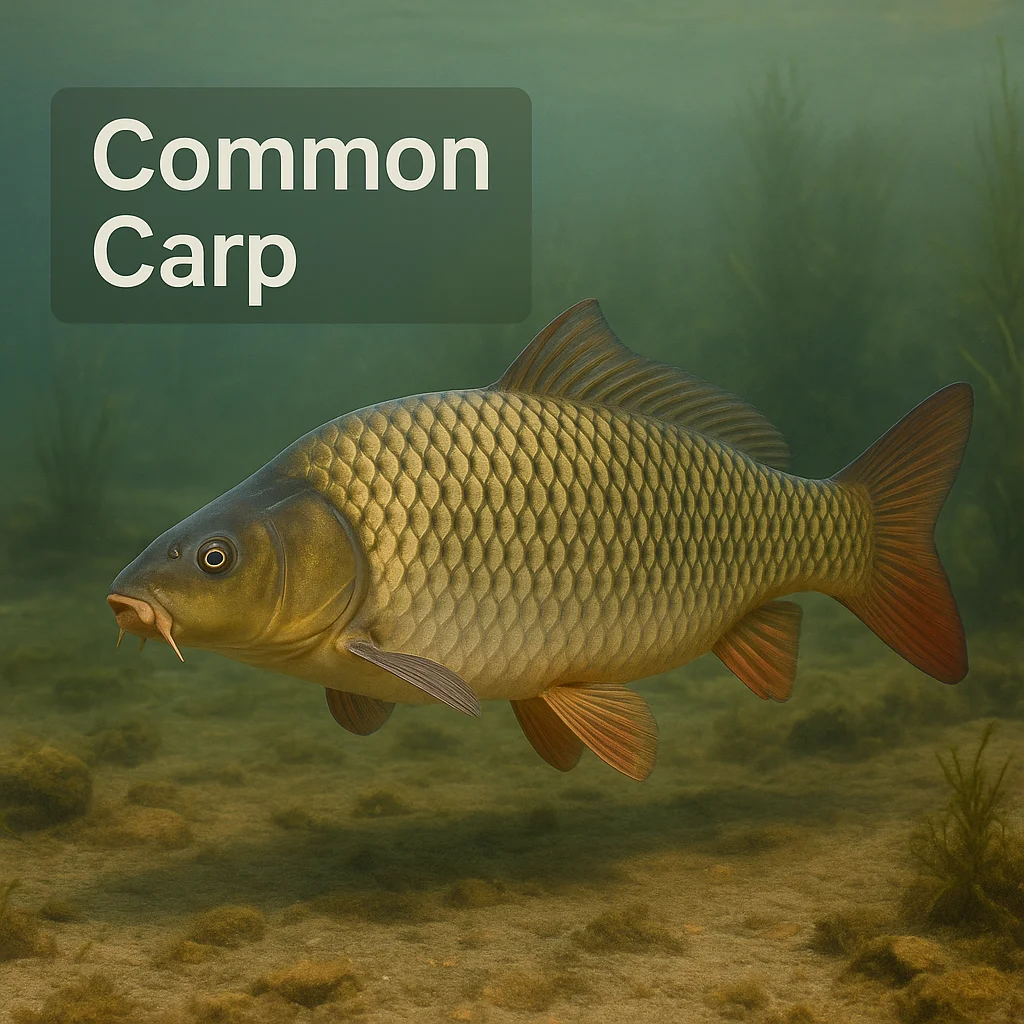
The Common Carp can be identified by its robust body, which is characterized by a slightly elongated shape and large, overlapping scales. The coloration varies from golden-yellow to olive on the dorsal side and lighter shades underneath. Young carp may have a more muted coloration.
- Thick, elongated body
- Large, prominent scales
- Barbels on either side of the upper jaw
- Dorsal fin with a serrated spine
- Color ranges from gold to olive
- Tail fin forked distinctly
- Eyes often have a golden tint
- Pairs of barbels near the mouth for sensing food
🧱 Body Structure & Physical Adaptations
The Common Carp is built for stable and efficient swimming in diverse aquatic environments. Its body has a stocky build with a powerful tail fin that aids in propulsion. The scales offer protection, while its mouth, equipped with pharyngeal teeth, is ideal for crushing and grinding food.
- Scales provide protection from minor injuries
- Pharyngeal teeth for grinding tough plant material
- Fins optimized for stability in flowing water
- Enhanced olfactory senses for detecting food
- Barbels are sensitive to touch and taste
- Serrated dorsal fin spine for defense
🌍 Range & Distribution
Originally from Europe and Asia, the Common Carp has been introduced to many regions worldwide due to its adaptability and value in aquaculture. It thrives in warm, slow-moving, or still waters.
- Native to Europe and Asia
- Introduced populations are found in North America and Australia
- Generally inhabits lowland rivers and lakes
- Capable of thriving in a range of water temperatures
- Often found at elevations ranging from sea level to mid-altitude
🏞️ Habitat & Shelter
The Common Carp favors various freshwater habitats, including lakes, rivers, and ponds. These habitats provide abundant resources and protection from predators. Carp often find shelter among aquatic vegetation and submerged structures, offering cover from threats and spaces for foraging.
During colder months, carp may seek deeper water to avoid freezing temperatures. Understanding their habitat preferences helps in conserving suitable environments and managing their populations effectively.
🧭 Behavior & Ecology
Common Carp exhibit a range of behaviors that allow them to thrive in various environments. They are generally active during the day and spend much of their time foraging. Carp communicate through chemical signals and subtle movements, and they play essential roles as both grazers and prey in their ecosystems.
- Foraging occurs during the day, often in shallow waters
- Communicates using pheromones and subtle body movements
- Provides food for larger predators and scavengers
- Helps control aquatic weed growth
- Disturbs sediment when feeding, influencing water clarity
- Acts as a key prey species in various ecosystems
👥 Social Life & Group Dynamics
The Common Carp is often seen in schools, which offer protection through numbers and increase foraging efficiency. These groups can vary in size but usually comprise a few to several dozen individuals.
- Tends to form schools, especially when young
- Schooling behavior enhances defense against predators
- Loose social structures, no strict hierarchy
- Adults may be more solitary during spawning
- Cooperative feeding can improve access to food resources
🍽️ Diet, Prey & Predators
The Common Carp's diet includes both plant and animal matter, showcasing its adaptability. It feeds on algae, detritus, small invertebrates, and aquatic plants. Its natural predators include birds of prey, larger fish, and humans.
- Omnivorous diet – plants, insects, and crustaceans
- Uses pharyngeal teeth to crush food
- Feeds mainly on benthic (bottom-dwelling) prey
- Birds and larger fish pose significant predation threats
- Adaptable to seasonal changes in food availability
🦌 Hunting, Foraging & Movement
As a swimmer, the Common Carp uses its powerful muscles and streamlined body to navigate and forage efficiently in its aquatic environment. It often searches through sediment for food, creating turbid areas as a byproduct of foraging.
- Efficient swimmer; uses body and fin movements strategically
- Often seen searching through mud and sand for food
- Can swim at moderate speeds; bursts of speed when threatened
- Primarily forages during daylight hours
- Remains in home ranges but may wander for resources
🧠 Intelligence & Senses
Common Carp have demonstrated a degree of learning and problem-solving ability, with a strong focus on their sensory capabilities. Their sense of smell is particularly keen, helping them detect food and navigate their environment.
- Capable of learning simple tasks and associations
- Uses olfactory senses for finding food and communicating
- Visual acuity aids in spotting threats
- Barbels play a role in tactile sensing
- Memory used to recognize safe versus unsafe areas
🪺 Reproduction, Pregnancy & Parenting
Common Carp reproduce through a process known as spawning, usually occurring when water temperatures rise in spring. Females lay large numbers of eggs, which are fertilized externally by males. Parental care is minimal, though the high egg production helps ensure survival of some offspring.
- Breeding season typically in spring
- Spawns in shallow waters with abundant vegetation
- Females can lay eggs numbering in thousands
- External fertilization performed by multiple males
- No parental care post-spawning
♀️♂️ Male vs Female Differences
There are subtle distinctions between male and female Common Carp, often noticeable during the breeding season. Males may develop small, rough breeding tubercles on their head and pectoral fins.
- Males develop spawning tubercles
- Females generally larger when mature
- Coloration differences are subtle
- Both sexes contribute gametes for fertilization
🧬 Subspecies & Variation
While known as the Common Carp, several subspecies exist, exhibiting subtle variations in size, shape, and coloration based on their environment. Some debates persist concerning the classification of its subspecies.
- Koi carp are a domesticated variety with vibrant colors
- Variations in size often due to environmental conditions
- Scalation patterns can differ regionally
- Some geographic variations exist in body form
⚠️ Threats, Conservation & Human Interaction
The main threats to Common Carp include habitat destruction and pollution. Although widely spread and resilient, pressures from overfishing and competition with invasive species in introduced areas can pose significant threats.
- Habitat alteration and pollution impact survival
- Overfishing in some regions a concern
- Generally stable, but localized threats exist
- Often sought for angling due to large size
- Introduced populations can disrupt local ecosystems
✨ Fun Facts & Unique Traits
- Common Carp have been cultivated since Roman times
- Koi are a variety of the Common Carp, bred for ornamental purposes
- Carp can survive in low-oxygen environments better than many fish
- They use their barbels to sense food in murky waters
- Common Carp are one of the most invasive species worldwide
- Have been known to jump out of the water when scared
📌 Summary
- Robust body suitable for various freshwater habitats
- Omnivorous diet includes plants and small invertebrates
- Widespread, found on multiple continents
- Predators include birds of prey, larger fish, and humans
- Forms schools, enhancing safety and foraging
- Breeds through external fertilization with minimal parental care
- Designed for efficient swimming and foraging
- Adaptable to diverse environments
- Koi are a notable domesticated variety