🦁 Guppy
🧾 Quick Facts
The guppy, a vibrant and lively freshwater fish, is celebrated for its kaleidoscope of colors and adaptability to various environments. This small fish is a favorite among aquarium enthusiasts and researchers alike, offering both visual delight and ecological insights.
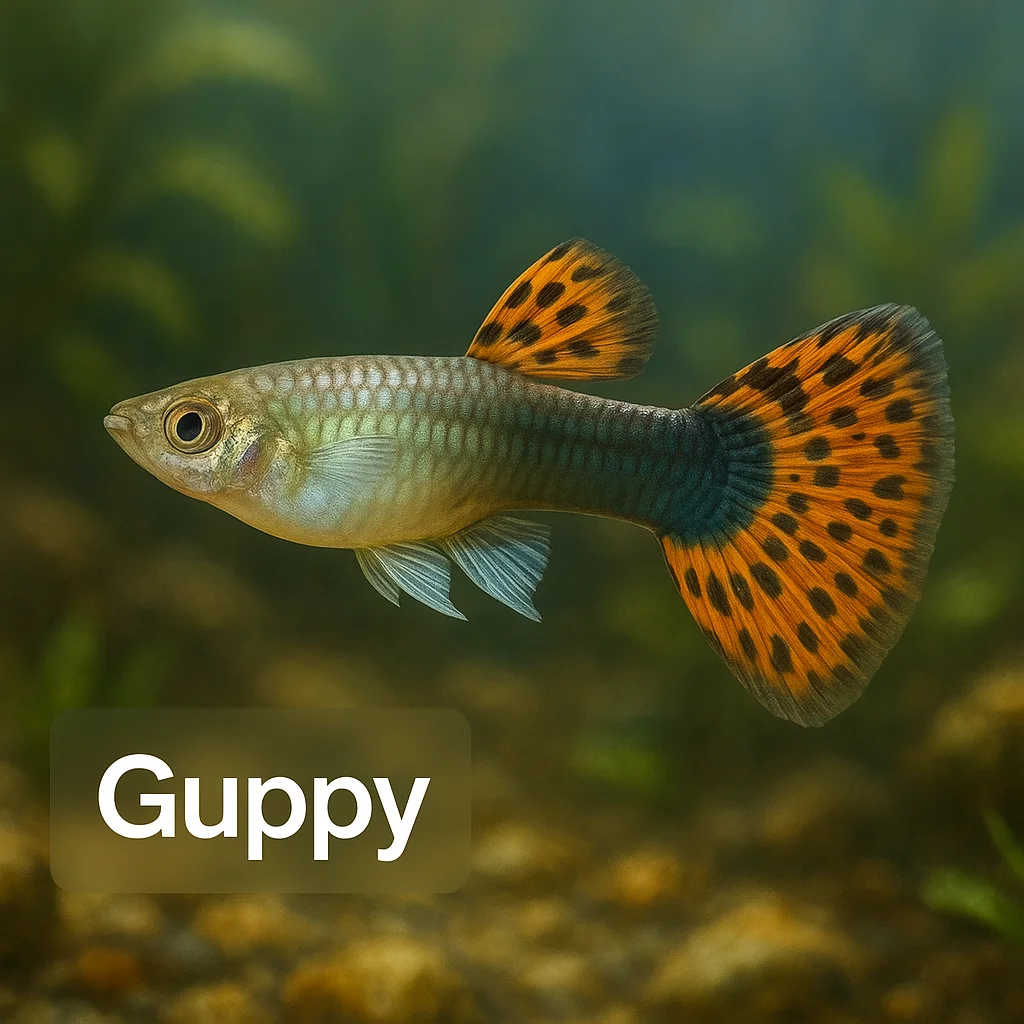
- Common name(s): Guppy, Millionfish
- Scientific name: Poecilia reticulata
- Animal type: Fish
- Typical adult size: 2.5-6 cm (1-2.4 inches)
- Typical lifespan: 2-3 years (may vary in captivity vs. wild)
- Diet type: Omnivore; eats algae, plant matter, and small invertebrates
- Activity pattern: Diurnal
- Social structure: Group; often seen in schools
- Speed / movement highlights: Swift swimmer; agile and quick
- Intelligence/learning: Known for learning feeding routines and responding to environmental cues
- Primary habitats: Freshwater streams, ponds, and rivers
- Geographic range: Native to northeastern South America, but introduced globally
- Predators/threats: Larger fish, birds, and human-induced habitat changes
- Conservation status: Not endangered; varies by region
🔍 Identification & Appearance
Guppies are small, slender fish with a distinctive fan-shaped tail, often manifesting in a dazzling array of colors and patterns. Their body colors can include shades of blue, green, red, and gold, with males typically exhibiting more vivid hues than females. Guppies frequently display spots, stripes, or fin patterns that can change with age or environmental conditions.
While guppies are easily distinguished by their vibrant colors and unique fin shapes, similar small fish like endlers and platies can occasionally be confused with them. However, guppies can be distinguished by their larger and more flowing fins.
- Long, fan-shaped caudal fin
- Vivid, often multi-colored scales
- Slender, streamlined body
- Small head with protruding eyes
- Males more colorful than females
- Frequent color/pattern variations among individuals
- Mobility in schools, with smooth collective movements
- Size makes them less intimidating to larger fish species
- Tail and fin patterns can be slight identifiers of subspecies
🧱 Body Structure & Physical Adaptations
Guppies are built for agility and quick movements in water, with a streamlined body aiding efficient swimming. Their fin structure allows them to make swift, darting movements to evade predators or capture food. The teeth of guppies are adapted for omnivorous eating habits, where they can graze on algae or small insects with ease. Guppies possess an advanced lateral line system, enhancing their ability to detect movements and vibrations in water, a crucial adaptation for predator evasion.
- Streamlined for rapid swimming
- Flexible body assists in evading predators
- Prominent fins aid in maneuverability
- Lateral line heightens sensory perception
- Teeth structure accommodates varied diet
- Coloration can provide some camouflaging in clear waters
- Developed visual acuity for detecting threats and food
- Scales provide protection from minor injuries
- Ventral fins help in stabilization and direction
- Small size facilitates living in dense plant life
🌍 Range & Distribution
Originally native to the clear shallow waters of northeastern South America, guppies have been widely distributed across the globe due to human activity. They can now be found in all major continents where conditions support freshwater ecosystems, particularly in tropical and subtropical regions. Guppies thrive in a variety of water bodies, from slow-flowing rivers to ponds and lakes.
- Native to South America
- Introduced to multiple continents for mosquito control
- Found in areas with suitable freshwater conditions
- Prevalent in both natural and artificial aquatic environments
- Adaptable to a range of water temperatures and qualities
- Present in both rural and urban water bodies
- Some populations found in brackish water
- Extensive geographic spread due to environmental resilience
- Can occupy waters from sea level to higher altitudes
🏞️ Habitat & Shelter
Guppies prefer calm, shallow freshwater environments with abundant plant life, such as ponds, streams, and rivers. The vegetation provides them with shelter and breeding grounds, as well as a foraging ground for food. Guppies are also capable of surviving in brackish waters and can adapt to varying environmental conditions. During seasons of adverse weather, such as strong rains, guppies may seek refuge in denser vegetative areas or move to deeper waters if available.
🧭 Behavior & Ecology
Guppies are diurnal, primarily active during the day, and rest during nightfall in secure plant-covered areas. They communicate using body movements and color displays, often used in courtship or to signal threats. In their natural ecosystem, guppies play a vital role as both prey and predator, consuming algae and invertebrates, while providing a food source for larger species. Their interaction with other fish species can either be competitive, especially for resources, or neutral.
- Active during the daytime; retreat during nightfall
- Color displays for communication and courtship
- Forms schools, increasing survival odds against predators
- Significant role in controlling mosquito populations
- Facilitates nutrient cycling in aquatic habitats
- Exhibits flexible feeding strategies based on resource availability
- Adapts well to environmental fluctuations
- Displays agile avoidance maneuvers against threats
- Engages in mutualistic relationships with aquatic plants
- Important study subject in evolutionary biology
👥 Social Life & Group Dynamics
Guppies are social creatures that thrive in groups, known as schools. This behavior enhances their chances of survival by allowing vigilance sharing and reducing individual predation risk through dilution effects. Schools typically consist of multiple individuals with varying numbers, although larger schools provide greater protection. Guppies exhibit a pecking order within these groups, where dominant fish can often gain better feeding grounds or breeding opportunities. Despite occasional skirmishes, guppies largely cooperate to avoid predator threats.
- Prefer living in schools for safety
- School size can vary significantly based on habitat
- Displays social order within groups
- Cooperation enhances predator detection
- Laboratory studies provide insights into social behavior
- Brief territorial displays during feeding
- Females often dominate schools
- Frequent shifts in group composition
🍽️ Diet, Prey & Predators
Guppies are omnivores with a diet that varies seasonally. They primarily consume algae, detritus, and small invertebrates such as mosquito larvae. Their feeding strategies shift according to food availability, making them adaptable to changing environments. Guppies are prey to larger fish, birds, and occasionally aquatic mammals. To evade predators, guppies tend to stay close to vegetation, use rapid darting movements, and blend into the background with their adaptive color changes.
- Eats both plant matter and animal prey
- Prefers small insects and larvae
- Has a taste for algae found in their habitat
- Adopts flexible feeding habits in lean times
- Larger fish are primary predators
- Also prey to aquatic birds
- Employs rapid movements to dodge predators
- Takes advantage of dense vegetation for cover
- Feeding routines influence social dynamics
- Plays a role in pest control for ecosystems
🦌 Hunting, Foraging & Movement
Guppies utilize their quick and nimble swimming abilities for both foraging and predator evasion. As agile swimmers, they forage continuously throughout the day, seeking algae and small creatures. Their movement styles involve exploring shallow waters and seagrass areas, often in search of new food sources. Guppy schools move cohesively, utilizing spatial awareness to explore new regions of their habitat while keeping an eye out for potential threats. These movements also facilitate the spreading of their population over larger areas.
- Efficient and swift swimmers
- Forages in groups to maximize protection
- Engages in continuous food-seeking activity
- Capable of quick, evasive maneuvers
- Exploits varied aquatic layers for food
- Exhibits extensive exploration behavior
- Use spatial memory to navigate habitat
- Ideal mobility for resource-rich environments
🧠 Intelligence & Senses
Guppies exhibit significant cognitive capabilities, capable of simple problem-solving and associative learning. Their perceptual abilities enable them to respond to environmental cues and adjust behaviors for increased survival odds. Although not as advanced as some vertebrates, guppies can learn feeding schedules and recognize friendly from hostile species in shared environments. Their acute sense of sight and adaptability to light changes allow them to detect predators swiftly. Guppies also employ lateral line sensing, crucial for detecting water motion, further enhancing their environmental awareness.
- Demonstrates associative learning
- Recognizes specific environmental cues
- Visual acuity aids in predator detection
- Responds adaptively to habitat changes
- Cognitive flexibility observed in feeding routines
- Social learning is prominent within schools
- Lateral line provides additional sensory input
- Exhibits basic memory recall abilities
- Uncertainty exists on the extent of individual intelligence
🪺 Reproduction, Pregnancy & Parenting
Guppies are known for their prolific breeding capabilities, making them a subject of interest for both amateur aquarium keepers and scientists. They are livebearers, with females capable of giving birth multiple times after a single mating event due to stored sperm. Mating typically occurs year-round in warm water environments, but may lessen in cooler conditions. Females are the primary caregivers, providing no direct parental involvement post-birth, as the fry are relatively developed and can fend for themselves. They give birth to broods ranging from a few dozen to over a hundred fry, with abortion common as a response to stress or environmental shifts.
- Livebearers with continuous birth cycles
- Mating typically happens in warm environments
- Females can store sperm for future reproduction
- Birth hundreds of self-sufficient fry over their lifetime
- No post-natal care; fry rely on instinctive behaviors
- Courtship involves colorful displays by males
- Pregnancy duration varies by environmental conditions
- Females often choose mates based on coloration and vigor
- Temperature shifts can influence reproductive rates
♀️♂️ Male vs Female Differences
Male guppies are generally smaller, more colorful, and possess elongated fins compared to females. Males use their vibrant colors and elaborate dances to attract mates. Females, however, are typically larger and have a more muted coloration, which provides better camouflage and protection against predators during pregnancy.
- Males smaller and more colorful
- Male fin shapes often more exaggerated
- Females larger with rounded bodies
- Females tend to be drabber for camouflage
- Males demonstrate elaborate courtship displays
- Females prioritize resource gathering over displays
- Male and female fin proportions differ
- Mating behavior largely initiated by males
🧬 Subspecies & Variation
The guppy Poecilia reticulata encompasses several varietal subspecies, differing principally in coloration and pattern. Such variability is particularly pronounced in populations subject to captive breeding, contributing to the array of fancy and ornamental guppies available today. Observed regional subspecies may adapt slight changes in size and coloration, facilitating better survival according to local environmental conditions. The diversity within guppy populations in the wild supports adaptive strategies against predation and fluctuating conditions.
- Color pattern variation a hallmark of guppy diversity
- Regional adaptations to water temperature, salinity
- Numerous ornamental varieties bred for aquariums
- Subspecies classification often debated within scientific circles
- Genetic variation bolsters adaptive behaviors
- Specimens may exhibit island dwarfism in isolated areas
- Wild populations show unique pigmentation morphs
⚠️ Threats, Conservation & Human Interaction
While guppies do not face significant conservation threats globally due to their widespread distribution and adaptability, certain pressures such as water pollution, habitat destruction, and climate change could affect local populations. Guppies contribute significantly to mosquito control, leading to their intentional introduction to non-native habitats, sometimes with unanticipated ecological consequences. In aquarium trade, ethical considerations regarding breeding and proper care are essential to ensure the well-being of captive guppies and to prevent invasive tendencies when released into the wild.
- Adaptable to changes in environment stressors
- Human-related habitat alterations pose a risk
- Conduct regular environmental monitoring
- Ethical care for aquarium specimens expressly required
- Risk of invasive population establishment in new areas
- Climate shifts affect local population dynamics
- Contribute to ecosystem services like pest control
- Coexistence requires thoughtful management of introduced populations
✨ Fun Facts & Unique Traits
- Guppies can give birth to a live brood every 30 days under optimal conditions.
- Their coloration functions in both attracting mates and camouflage when needed.
- They are known for their ability to adapt to a variety of environmental conditions.
- Due to their ease of care, guppies are among the most popular fish for beginners.
- An ongoing subject in evolutionary studies due to rapid generational shifts.
- Capable of remarkable recolonization ability when dwelling in disturbed environments.
- Guppies have been successfully used in controlling mosquito larvae.
- Scientific studies have identified guppies’ involvement in learning and memorization behavior.
- The diverse population provides endless morphological diversity globally.
📌 Summary
- The guppy is a small, adaptable, and colorful freshwater fish.
- Thrives in various freshwater habitats, both natural and manmade.
- Its global distribution results from human activity and natural adaptability.
- Diet is varied; includes algae, plant material, and small insects.
- Predators include larger fish and birds.
- Social species that live in schools for protection and cooperation.
- Reproductive strategies include live birth with no parental care post-birth.
- Male vs female distinctions predominately involve color and size differences.
- Evolutionary studies highlight its rapid adaptability, providing insights into genetic diversity.