🦁 Northern Pike
🧾 Quick Facts
The Northern Pike, often recognized for its ferocious appetite and impressive size, is a key predator in freshwater ecosystems. This fish is revered by anglers for its aggressive nature and thrilling battle. However, beyond fishing, the species plays an important ecological role in maintaining balanced aquatic communities.
- Common name(s): Northern Pike
- Scientific name: Esox lucius
- Animal type: Fish
- Typical adult size: 60–150 cm in length; up to 25 kg in weight
- Typical lifespan: 7–15 years in the wild
- Diet type: Carnivore; feeds on fish, amphibians, and small mammals
- Activity pattern: Primarily diurnal
- Social structure: Solitary
- Speed / movement highlights: Capable of rapid bursts of speed for ambushing prey
- Intelligence/learning: Known for strategic hunting tactics
- Primary habitats: Freshwater rivers, lakes, and ponds
- Geographic range: North America, Europe, and Asia
- Predators/threats: Larger fish, birds of prey, humans
- Conservation status: Varies by region
🔍 Identification & Appearance
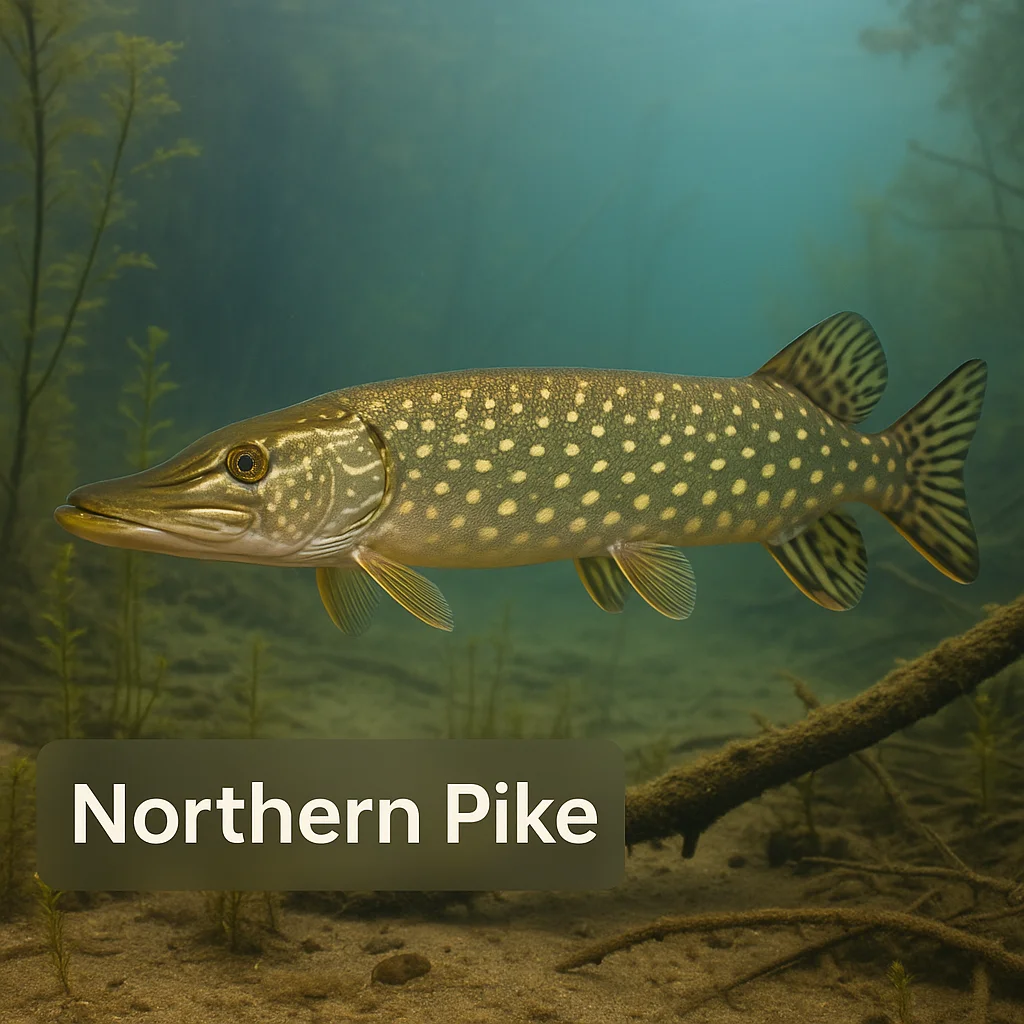
The Northern Pike is easily identified by its elongated body and pointed snout. Its bright coloration, featuring a greenish hue with distinctive lighter spots, camouflages it among aquatic vegetation. Despite variations by age and region, the Northern Pike maintains a recognizable silhouette that features long jaws filled with sharp teeth. Its fin placement and body streamlining are optimized for burst swimming, enhancing its ability to ambush prey.
- Long, slender body shape
- Greenish coloration with yellow-white spots
- Flattened, duckbill-like snout
- Sharp, backward-facing teeth for gripping prey
- Lateral line: Detects movement and vibrations
- Lacks distinctive scales on cheek near the eye
- Dorsal fins positioned near the tail
- No defined neck; head transitions smoothly to body
🧱 Body Structure & Physical Adaptations
Northern Pike boast a hydrodynamic build that facilitates stealth and speed. Their powerful jaws and sharp teeth are adept at gripping slippery prey, while their broad, pointed snouts enhance their ambushing precision. Physiologically, they possess strong lateral lines for detecting aquatic vibrations, critical for locating prey. Their fins are optimized for stabilization and swift directional changes, allowing them to maintain balance in vegetated environments.
- Elongated, streamlined body for rapid swimming
- Large mouth with formidable teeth for seizing prey
- Adapted fins for swift maneuvers
- Strong lateral line for detecting movements
- Camouflaged skin aids stealth hunting
- Broad spectral vision; sensitive to motion
- Muscular tail provides powerful thrust
🌍 Range & Distribution
The Northern Pike is distributed widely across freshwater systems in Northern Hemisphere continents, favoring temperate regions. They thrive in varying aquatic environments ranging from shallow marshes to deep lakes, provided there is abundant vegetation and prey availability. They are predominantly resident within specific water bodies, with minimal seasonal migration observed.
- North America, particularly in Canada and Northern USA
- Europe, predominantly in Scandinavia and Eastern Europe
- Asia, including parts of Russia
- Thrives in temperate freshwater systems
- Common in lakes, rivers, marshes, and ponds
- Inhabits waters with thick vegetation
- Less common in fast-flowing streams
🏞️ Habitat & Shelter
Preferring freshwater habitats rich in vegetation, the Northern Pike is typically found in lakes, ponds, slow-moving rivers, and marshes. The plant life provides crucial cover for both hunting and protection from predators. During cold months, they may move to deeper waters where temperatures are more stable. Habitat knowledge is essential in understanding pike anchoring behavior, population dynamics, and local ecosystem impacts.
🧭 Behavior & Ecology
The Northern Pike exemplifies a sit-and-wait predator strategy, often remaining still for long periods before rapidly lunging at prey. This behavior relies heavily on camouflage and precise timing. Communication occurs mainly through displays when establishing territory or during courtship. Northern Pike play a vital ecological role as apex predators, regulating prey populations and maintaining a balanced aquatic community.
- Ambush predator: Relies on surprise attacks
- Solitary: Minimal social interaction outside breeding
- Territorial displays during mating
- Contributes to fish population control
- Occasional cannibalism prevents overpopulation
👥 Social Life & Group Dynamics
Typically solitary, the Northern Pike exhibits minimal social structures. Most interactions are confined to breeding seasons or competitive spacing for food and habitat. While generally solitary hunters, encounters with other pike are marked by displays or fights, particularly during territorial claims or mating pursuits.
- Predominantly solitary lifestyle
- Breeding season initiates temporary pairing
- Aggressive territorial behavior
- Occasional encounters with juvenile groups
- No complex social hierarchies
🍽️ Diet, Prey & Predators
Northern Pike are opportunistic carnivores, primarily preying on fish but occasionally eating amphibians, insects, small mammals, and birds when available. They utilize ambush tactics, relying on vegetation for concealment. Predation threats include larger predatory fish, birds of prey, and humans, though adult pike face fewer natural threats due to their size and aggression.
- Primarily piscivorous diet
- Feeds on insects and amphibians in lean times
- Migrating ducklings occasionally targeted
- Ambush foraging strategy
- Scavenges from carcasses when available
🦌 Hunting, Foraging & Movement
As efficient swimmers, Northern Pike use their powerful builds to achieve quick bursts of speed, making them effective ambush hunters. They exhibit patience, often remaining stationary until an unsuspecting prey nears. Their capacity for rapid sprints allows them to catch agile fish and other moving targets. Northern Pike do not migrate extensively, usually remaining within a familiar home range year-round.
- Uses burst movements for catching prey
- Ambush hunting with precision strikes
- Stable home ranges; minimal long-distance movement
- Prefers vegetated areas for foraging
🧠 Intelligence & Senses
Northern Pike exhibit strategic hunting behaviors, utilizing their lateral lines and acute vision to analyze and respond to prey movements quickly. Though not known for complex problem-solving or learning behaviors, they demonstrate adaptability in changing environments and prey abundance. Their sensory adaptations are fine-tuned for detecting movement in turbid waters and among flora.
- Strategic ambush hunter
- Lateral line detects water vibrations
- Capable of sudden, unexpected movements
- Limited problem-solving behaviors observed
🪺 Reproduction, Pregnancy & Parenting
Breeding occurs in spring, synchronized with warming water temperatures. Northern Pike are promiscuous, with both sexes participating in spawning multiple times. After spawning in shallow waters rich in vegetation, eggs are left in aquatic environments with no paternal care observed. The hatching period and subsequent juvenile development are rapid, relying heavily on available resources for protection and growth.
- Spring breeding season
- Promiscuous spawning behaviors
- Mature at 2-3 years of age
- No parental care post-spawning
- Eggs deposited in dense vegetation
♀️♂️ Male vs Female Differences
Female Northern Pike typically surpass males in size and weight, offering advantages in reproduction through greater egg production capacity. Visual differentiation in coloration or markings is minimal, underscoring their similar requirements for camouflage and feeding strategies. Both sexes exhibit similar aggressive hunting behaviors, illustrated most prominently during the breeding season.
- Females generally larger and heavier
- Males participate minimally in breeding display
- Size difference advantageous for increased fecundity
- Similar coloration between sexes
🧬 Subspecies & Variation
While the Northern Pike, Esox lucius, is dominant across its range, subspecies or regional variations are not extensively documented. However, geographic distribution impacts size potential and coloration nuances. These adaptations are reflective of local environmental pressures, thermal conditions, and prey availability, potentially offering micro-evolutionary insights into their diverse habitats.
- Size differences in northern vs southern habitats
- Coloration may vary with water clarity and vegetation
- No officially recognized subspecies
⚠️ Threats, Conservation & Human Interaction
Despite stable populations globally, Northern Pike face challenges from habitat disruption, water pollution, and improper fishing practices. Their role in recreation and local economies highlights the need for sustainable management practices. Positive human interaction involves maintaining healthy habitats and promoting responsible angling to ensure their ecological contributions remain steady.
- Susceptible to habitat alterations
- Affected by water pollution levels
- Overfishing poses localized risks
- Maintain ecological balance as apex predators
✨ Fun Facts & Unique Traits
- The Northern Pike is known for its lightning-fast attacks.
- They can remain motionless for extensive periods, awaiting prey.
- Young pike, or 'fingerlings,' are highly cannibalistic.
- Pike have been historically referred to as "water wolves."
- Caught northern pike have made headlines for the size battles they present to anglers.
- They possess an impressive immune system, tolerating varied water conditions.
📌 Summary
- Identified by their long, slender bodies and sharp teeth.
- Widely distributed across the Northern Hemisphere's freshwater systems.
- Carnivorous diet, mainly feeding on fish.
- Apex predators with few threats apart from humans.
- Primarily solitary outside of breeding seasons.
- Spring breeders that lay eggs without subsequent parental care.
- Key adaptations include lateral lines and swift swimming capabilities.
- Minimal sexual dimorphism beyond size variations.
- Vital roles in supporting balanced aquatic ecosystems.