🦁 Oscar
🧾 Quick Facts
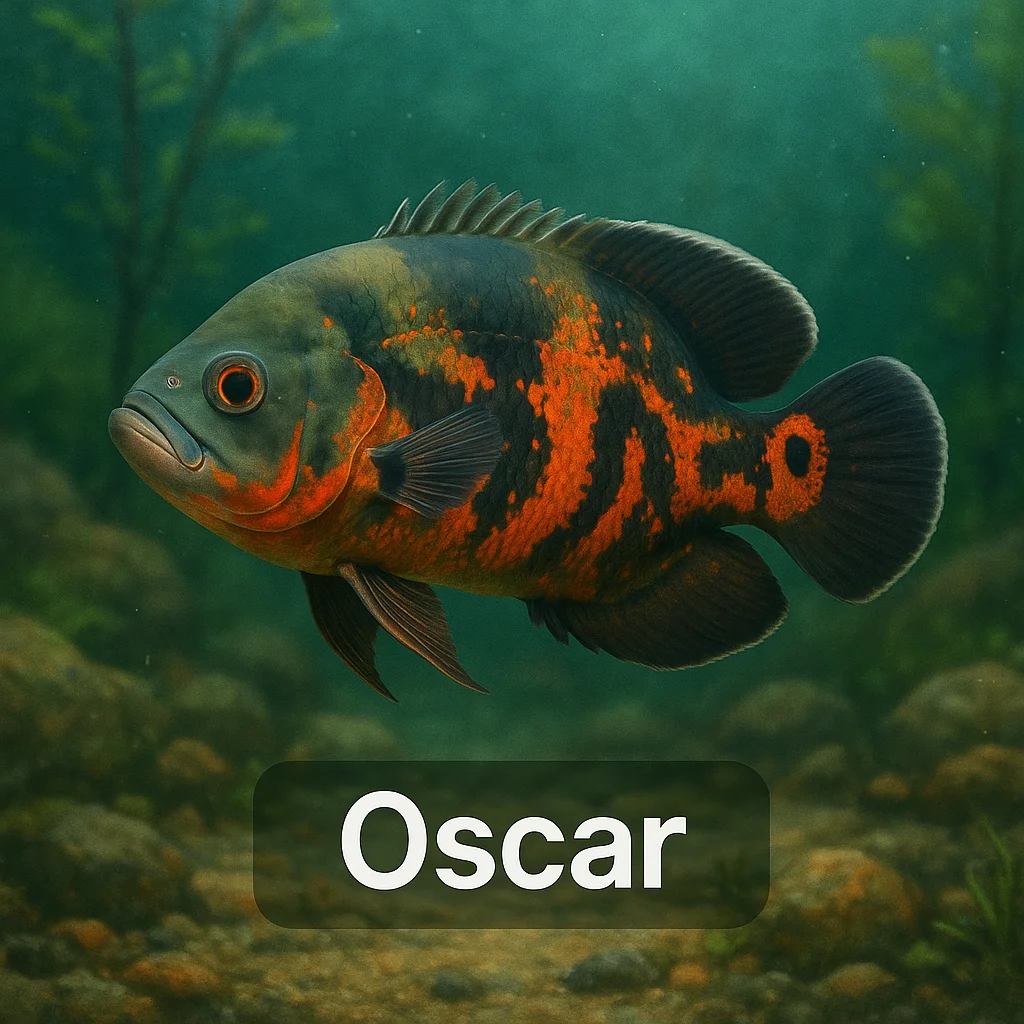
The Oscar, also known commonly as the Tiger Oscar or Velvet Cichlid, is a popular freshwater fish admired for its striking appearance and interactive behavior. It's a favored choice among aquarium enthusiasts and has a reputation for being intelligent and exhibiting unique personalities.
- Common name(s): Oscar, Tiger Oscar, Velvet Cichlid
- Scientific name: Astronotus ocellatus
- Animal type: Fish
- Typical adult size: 10–16 inches (25–40 cm)
- Typical lifespan: 10–15 years in captivity
- Diet type: Omnivore; plants, insects, and small fish
- Activity pattern: Diurnal
- Social structure: Often found in pairs or small groups
- Speed / movement highlights: Moderate swimmer
- Intelligence/learning: Known for recognizing owners
- Primary habitats: Freshwater rivers and lakes
- Geographic range: Native to South America; Amazon basin
- Predators/threats: Larger fish, birds; pollution and habitat loss
- Conservation status: Not currently threatened
🔍 Identification & Appearance
The Oscar is a well-known tropical freshwater fish from South America. Its body is oval and slightly compressed, showcasing a wide and rounded dorsal fin. Known for a brilliant and diverse coloration, Oscars often display a mix of black, orange, and red hues, sometimes exhibiting intricate patterns of spots or lines. Juvenile Oscars may appear more uniformly colored, often dark with small white spots.
Adult Oscars can be recognized by their prominent eyes and trademark ocelli, or eye spots, located at the base of their tails. These spots are thought to help deter predators by mimicking the appearance of eyes.
- Oval, laterally compressed body shape
- Color patterns vary: black, orange, red, with unique markings
- Prominent dorsal fin; rounded and long
- Distinctive eye spots near tail base
- Juveniles may display spangled white spots
- Smooth, broad tail fin
- Large mouth and rounded head
- Thick scales, providing a glossy appearance
- Typical "cichlid" body structure with robust build
- May flex fins in territorial displays
🧱 Body Structure & Physical Adaptations
Oscars have a robust physical build that supports their semi-aggressive tendencies. Their powerful jaws are adapted for preying on smaller fish and insects, while their lateral line system aids in detecting movements in the water. This sensory adaptation is essential for their survival, helping them navigate turbid river environments.
The fish's fins are highly developed, providing swift propulsion and maneuverability. Oscars can exhibit impressive bursts of speed when necessary, though they typically prefer a more sedate, cruising style of swimming.
- Short, robust body providing strength
- Powerful jaws with conical teeth
- Smooth, flexible scales and skin
- Highly developed dorsal and pectoral fins for maneuvering
- Lateral line detects vibrations and movements
- Eyes adept at low-light vision
- Large gills for efficient oxygen intake
- Adaptive coloration for camouflage
- Strong, broad tail for propulsion
- Ample swim bladder maintaining buoyancy
🌍 Range & Distribution
Oscars are native to the slow-moving waters of South America's river systems, particularly the Amazon, Orinoco, and Paraguay basins. Though they are primarily found in freshwater ecosystems, they can also thrive in various tropical habitats, including river drainages and floodplains.
There is no specific migratory behavior associated with Oscars, as they typically remain resident within their preferred aquatic environments year-round.
- Native to the Amazon basin
- Found in Brazil, Peru, Colombia, and Paraguay
- Inhabit slow to moderately flowing rivers
- Present in large, still waters like lakes and ponds
- Flourish in warm, tropical climates
- Established populations in various regions due to introductions
- Prefers freshwater environments
- Can inhabit flooded wetlands seasonally
- Remain within localized territories
🏞️ Habitat & Shelter
Oscars favor warm freshwater habitats that provide abundant food and shelter opportunities. Their natural environments include slow-moving rivers, backwaters, and floodplains, where dense vegetation and submerged roots or logs offer suitable hiding spots.
They typically reside in areas with relatively stable temperatures and sufficient oxygen levels. Shelter plays a critical role in their life, offering protection from predators and a site for spawning. Understanding the habitat preferences of Oscars is essential in ensuring their well-being within aquariums and in the wild.
🧭 Behavior & Ecology
Oscars are known for their territorial behavior, often staking out and defending specific areas within their habitat. They are diurnal, conducting most of their feeding and social activities during daylight hours. Communication among Oscars involves a combination of body postures, fin displays, and coloration changes, which signal territorial dominance or readiness to mate.
In the wild, Oscars play a role as both predator and prey within their ecosystems. They control populations of smaller fish and insects, contributing to the ecological balance. Conversely, they serve as prey for larger fish and wading birds.
- Highly territorial; defend selected areas
- Active primarily during the day
- Communicate using fin displays and body coloring
- Recognize and interact with regular keepers
- Engage in face-offs through posturing or skirmishes
- Contribute to control of fish and invertebrate populations
- Display courtship behaviors during breeding
- Play a promotional role in ecosystem inhabitation
- Symbiosis with cleaner fish at times
- Respond to stimuli and show learned behaviors
👥 Social Life & Group Dynamics
In terms of social structure, Oscars can exhibit a range of behaviors from solitary to paired or small group associations. Fish kept in pairs often exhibit strong bonds and collaboration, especially when rearing young. Dominance hierarchies can emerge when multiple Oscars cohabit, leading to conflict or cooperative behaviors.
Cooperative behaviors may include collaborative defense of territories or synchronized movement patterns. Individuals known to each other establish preference or aversion through previous interactions.
- Tend to be solitary but may form pairs
- Strong bonds in pairs, especially during breeding
- Exhibit dominance hierarchies in groups
- Collaborate for territory protection
- Demonstrate established social familiarity
- Show reciprocal partnerships during defense
- Exhibit synchronized behaviors
- Preference for known individuals over strangers
- Display social signals for conflict resolution
- Social intelligence shown in group dynamics
🍽️ Diet, Prey & Predators
Oscars have an omnivorous diet that consists mainly of smaller fish, insects, and various aquatic plants. They are opportunistic feeders, modifying their diet based on availability and environmental conditions. Their feeding strategy can be characterized as both active hunting and passive foraging, depending on the prey type.
In terms of predation, Oscars are susceptible to larger fish and wading birds. They adopt defensive behaviors, such as hiding among submerged structures and utilizing rapid escape maneuvers, to avoid being captured.
- Omnivorous diet: insects, small fish, plant material
- Opportunistic and adaptive feeding habits
- Active predators; ambush tactics
- Forage on available resources in diverse habitats
- Display rapid movements to catch prey
- Defensive behaviors mitigate predation risk
- Occasionally ingest detritus or plant debris
- Cooperate with conspecifics when hunting
- Watchful of potential predators during feeding
- Scavenging occurs when primary food is scarce
🦌 Hunting, Foraging & Movement
Oscars are known for their versatility in movement, adapting their swimming styles to suit various activities such as hunting and explorative foraging. They exhibit a gentle, cruising swimming pattern during routine activities but can display sudden bursts of speed when striking at prey.
Their foraging method is predominantly sight and vibration-based, owing to their keen eye and lateral line sensory system. Oscars use keen navigation skills to patrol familiar territories, showing preference for well-established feeding routes.
- Predominantly visual hunters
- Capable of fast acceleration from stationary
- Ambush and pursuit document their strategies
- Exercise caution when approaching prey
- Swift strikes enabled by muscular physiology
- Employed body choreography for food capture
- Explore shelters with familiar spatial awareness
- Defend learned routes from intruders
- Adapt daytime foraging in favor of least resistant paths
- Maintain loose territories with regular movement
🧠 Intelligence & Senses
Oscars are celebrated for their apparent intelligence, demonstrating the ability to recognize handlers and respond to their presence. Their learning behavior is exhibited through reward associations, tapping into their perceptual ability to detect changes and novelty in their environment.
Known sensory strengths include acute eyesight for discerning prey and movement in water, alongside robust smell and touch senses appropriate for foraging and environmental interpretation.
- Recognize regular handlers; develop habits
- Visible response to external stimuli in environment
- Acute vision for prey detection and interaction
- Learning ability through positive reinforcement
- Strong tactile perception via lateral line
- Smell involved in environmental awareness
- Exhibit play-like behavior with familiar objects
- Sensory adaptation to habitat fluctuations
- Research notes variation in individual abilities
🪺 Reproduction, Pregnancy & Parenting
Oscars exhibit elaborate courtship rituals during their breeding season, usually occurring in warmer months when conditions are optimal. They are monogamous, forming dedicated pair bonds that endure even outside of breeding periods.
The female Oscar lays a clutch of eggs, often between 100 to 1,000, which both parents will aggressively guard. They are attentive caregivers, with the young being altricial and relying heavily on parental care until they become more independent.
- Courtship includes fin displays and body undulations
- Monogamous and form strong pair bonds
- Breeding usually during warmer temperatures
- Egg clutches range widely in size; effective brood care
- Parents actively defend offspring against threats
- Both parents share responsibilities of offspring care
- Preference for laying eggs on flat, pre-cleansed surfaces
- Juvenile stage lasts several months
- High parental investment in egg and larval stages
- Environmental changes periodically affect breeding
♀️♂️ Male vs Female Differences
Male and female Oscars can be challenging to differentiate, especially by those unfamiliar with the species. Subtle differences include slight variations in size and body build. Males may sometimes exhibit more pronounced body size, while females are often more rounded, particularly during breeding times.
Behaviorally, males are typically more aggressive and territorial, while females might show increased protectiveness during the breeding season.
- Slight size differences, males potentially larger
- Females more rounded when carrying eggs
- Behaviors as primary differentiation; not physical features
- Increased male aggression during territorial defense
- Females display parental diligence in egg guarding
- Subtle head shape distinction in some specimens
- Size of mature oscilli could vary periodically
- Ventral profile possibly smoother in females during egg bearing
- Both exhibit bright coloration when courting
🧬 Subspecies & Variation
While Astonotus ocellatus is the widely recognized species name for the Oscar, there are notable color morphs and variations among the species due to selective breeding. Common morphs include long-finned varities and color types displaying albino or vivid red and orange.-
Different populations in their native range may exhibit adaptations unique to specific environments, like variations in coloration intensity and pattern detailing to enhance camouflage in local aquatic habitats.
- Morphs: Albino Oscar with white or yellow colors
- Color intensity can vary between native populations
- Environment shapes Oscar patterns and coloration
- Debate applicable around captive vs wild traits
- Limited scientific classification extension on variation
- Artificial selection impacts in color divergence evident
- Slightly divergent size metrics among populations recorded
- Depth influence manifested in skin tone variations
- Local habitat factors shape minute adaptation specifics
⚠️ Threats, Conservation & Human Interaction
Oscars face threats in the wild primarily from habitat degradation, including pollution and deforestation impacting their native waterways. Despite their popularity in the pet trade, responsible care guides should be emphasized to avoid unwanted ecological impacts from introduced populations.
On a general scale, Oscars are not currently listed as threatened, thriving in both natural habitats and controlled aquarium settings. Enthusiasts should ensure that habitat requirements are met consistently to maintain health and vitality.
- Habitat loss from deforestation and waterway changes
- Risks from pollution and chemical exposure
- Encouraged ethical pet-keeping practices
- Adapt well to captivity with proper care
- Unfavorable releases in non-native areas pose ecological risks
- Educate on prey-predator balance in ecosystems
- Awareness of habitat requirements enhances care
- Potential escapee risks into local countrysides noted
- Manage tank companions to reduce stress
✨ Fun Facts & Unique Traits
- Oscars can be trained to take food from their owners' hands.
- They have been observed displaying remarkable memory, recognizing feeders.
- Oscars can exhibit color changes as forms of communication or stress response.
- They have a reputation for rearranging aquarium decor to suit their preferences.
- The species showcases a fascinating range of morphs such as Albinos and Red Tigers.
- Oscars contribute significantly to controlling populations of insects within waterways.
- Interaction with humans sparks natural inquisitiveness amongst common pets.
- Oscars utilize their rapid lateral line for environmental awareness.
- They enjoy a faithful following within the aquarium hobby due to engaging displays.
- Wild Oscars forage in complex environments like submerged roots and plants.
📌 Summary
- Recognized for striking appearance with intricate color patterns.
- Native to slow-moving, warm freshwater river environments in South America.
- Omnivores with adaptable feeding habits across plants, smaller fish, and insects.
- Displayed territorial, diurnal activity patterns, useful for ecological roles.
- Susceptible to predators like larger fish and habitat degradation from human influences.
- Exhibit strong pair bonds maintained even beyond reproductive periods.
- Notable for intelligence, capable of learning to recognize human behavior.
- Fish demonstrate remarkable reproductive parentage with intimate care of offspring.
- Range differences illustrated in morphs like Albino and Red Tiger variations.
- Reputation for interactive behavior that appeals to aquarists globally.
- Fascinating pet beyond its visual appeal due to enriching social dynamics.
- Oscars present rewarding challenges for responsible fish keeping.