🦁 Tilapia
🧾 Quick Facts
Tilapia are a diverse group of fish commonly found in freshwater environments across the globe. Known for their adaptability and rapid growth, they play a significant role in aquaculture and natural ecosystems.
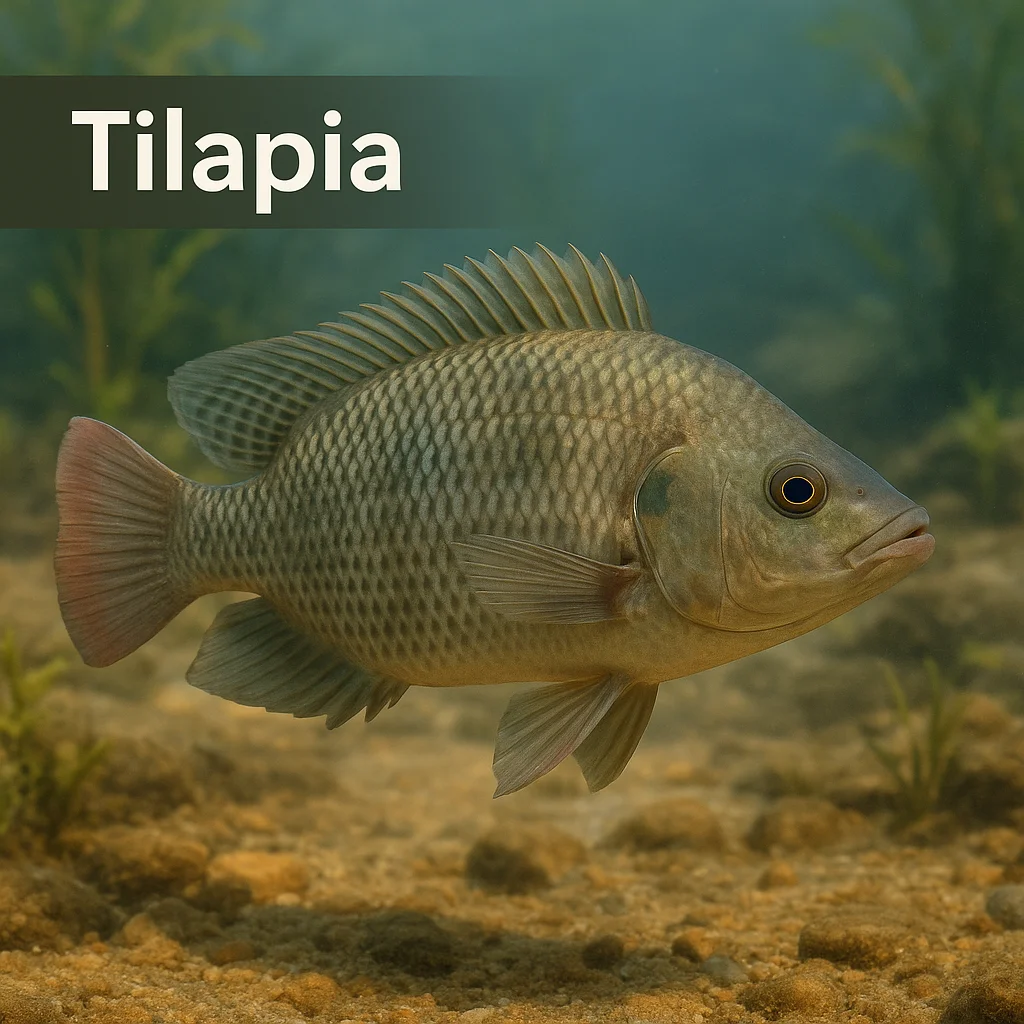
- Common name(s): Tilapia
- Scientific name: Varies, including Oreochromis, Sarotherodon, Tilapia genera
- Animal type: Fish
- Typical adult size: 20–50 cm (8–20 inches) in length
- Typical lifespan: 5–10 years in the wild
- Diet type: Omnivore; feeds on algae, plant matter, small invertebrates
- Activity pattern: Diurnal
- Social structure: Usually found in groups
- Speed/movement highlights: Moderate swimmers, agile in dense vegetation
- Intelligence/learning: Responsive to environmental changes, capable of recognizing familiar individuals
- Primary habitats: Freshwater lakes, rivers, ponds
- Geographic range: Native to Africa; introduced worldwide
- Predators/threats: Larger fish, birds, habitat loss
- Conservation status: Varies by region
🔍 Identification & Appearance
Tilapia can be recognized by their compressed, laterally flattened bodies and relatively small heads. Their scales are often gray to olive, with some species exhibiting colorful patterns. These fish have long dorsal fins and rounded tail fins.
- Top ID Tips:
- Look for the characteristic body shape: flattened with a small head
- Color ranges from gray to olive; some have vibrant hues
- Distinctive long dorsal fin with spiny rays
- Round, fan-shaped tail fin
- Commonly found in freshwater environments
- May be confused with cichlids; body shape is a key differentiator
- Juveniles are similar in appearance to adults, just smaller
- No distinctive seasonal variation in appearance
🧱 Body Structure & Physical Adaptations
The body of a tilapia is well-suited for its habitat. Its relatively slender shape allows it to navigate in vegetation-dense waters. With strong jaws and specialized teeth, tilapia can easily scrape algae and plant matter from surfaces.
- Key Adaptations:
- Streamlined, laterally compressed body for efficient swimming
- Dorsal fins with spiny rays provide protection and stability
- Strong jaw muscles and specialized teeth for scraping algae
- Rounded tail fin aids in agile maneuvers
- Developed gills for extracting oxygen from water
- High adaptability to varying water conditions
- Moderate vision supported by good lateral line sensitivity
🌍 Range & Distribution
Originally native to Africa, tilapia have been introduced to many countries worldwide due to their value in aquaculture. They are adaptable fish and can thrive in a wide range of freshwater bodies including lakes, rivers, and ponds.
- Where You Might Find It:
- Sub-Saharan Africa (native range)
- Introduced in the Americas, Asia, and Europe
- Common in tropical to temperate freshwater environments
- Often found in aquaculture systems globally
- Prefers warm waters, but can survive in cooler climates with acclimation
- Non-migratory, tends to remain in one region
- Not typically found in high altitudes
🏞️ Habitat & Shelter
Tilapia are primarily found in freshwater environments such as lakes, rivers, and ponds. They prefer warm waters but can adapt to various conditions. Shelter often consists of underwater structures like rocks, vegetation, or man-made objects.
Their behavior can be affected by seasonal changes, with increased activity during warmer periods. Understanding their habitat is crucial for aquaculture and conservation efforts.
🧭 Behavior & Ecology
Tilapia display intriguing behaviors, from their diurnal activity patterns to their group living tendencies. They are known to defend territories, particularly during breeding season.
Interactions include competition for resources, mutualistic relationships with plants, and serving as prey for larger species. Their role as grazers helps control algae growth in ecosystems.
- Behavior Highlights:
- Tend to graze on algae during daylight hours
- Form schools as a defense mechanism
- Exhibit territoriality, especially in males during breeding
- Respond to environmental changes (e.g., water quality)
- Vocalizations are rare; communicate through body language
- Important prey species for larger aquatic animals
- Contribute to nutrient cycling in aquatic habitats
- Interact with human activities through aquaculture practices
👥 Social Life & Group Dynamics
Tilapia are generally social fish, often forming schools that can vary greatly in size. These groups provide safety through numbers. Cooperation in defense and breeding activities can be observed.
Dominance is usually established among territories during breeding times, often resolved through non-lethal displays rather than aggression.
- Social Structure Notes:
- Commonly found in small to large schools
- Breeding males may become aggressive protectors of territories
- Role differentiation observed, primarily among breeding fish
- Communication mainly through visual displays
- Hierarchies can form during competitive interactions
- Tend to scatter in response to threats
- Juvenile schooling provides protection from predators
🍽️ Diet, Prey & Predators
As omnivores, tilapia have a varied diet depending on their developmental stage. They consume algae, plant matter, plankton, and small invertebrates. Their natural predators include larger fish species and birds that prey on smaller fish.
Tilapia employ several defenses against predators, such as schooling and quick swimming. They can also take advantage of murky waters to hide.
- Feeding Notes:
- Graze on algae from rocks and substrate
- Consume small invertebrates, especially at a juvenile stage
- Adults are more plant-focused, eating aquatic vegetation
- Sensitive to shifts in food availability and can modify diet
- Helps control algae levels in their environment
- Schooling acts as a defense against larger predators
- Prefer foraging during daylight hours
🦌 Hunting, Foraging & Movement
Tilapia show flexibility in their foraging techniques, mostly employing grazing strategies that match their omnivorous diet. While they are moderate swimmers, their capabilities allow effective navigation through vegetation and aquatic structures.
These fish usually forage throughout the day, adjusting locations based on food availability.
- Movement & Strategy:
- Primarily grazers, feeding on algae as a main strategy
- Perform short bursts of speed to avoid predators
- Move through dense vegetation with agility
- Tend to maintain small home ranges, focusing food-rich areas
- Visible foraging patterns shift with water conditions
🧠 Intelligence & Senses
Tilapia exhibit notable adaptive behavior, being able to learn and adjust their feeding habits based on environmental changes. Their grounding sense is their lateral line system, which helps detect water movements and vibrations.
Research on their cognitive abilities suggests they can recognize familiar individuals and recall learned behaviors to some extent.
- Notable Abilities:
- Responsive to changes in local water conditions
- Ability to learn from repeated visual cues
- Good sense of their environment through lateral line sensitivity
- Moderate problem-solving capabilities (basic environmental interaction)
- Potential recognition of schooling members
🪺 Reproduction, Pregnancy & Parenting
Tilapia are known for their reproductive efficiency. Breeding often occurs in warmer waters; males establish territories for spawning. Courtship involves vibrant color displays and body movements.
The parental behavior in tilapia is noteworthy, with different species exhibiting varying degrees of maternal or paternal care, such as mouthbrooding.
- Reproduction Snapshot:
- Breeding varies, usually peaks in warmer months
- Displays of color and dance are part of courting behavior
- Females lay eggs in nests; solar buoyancy assists in incubation
- Some species practice mouthbrooding, keeping young safe
- Opportunity for multiple breeding cycles annually
- Typically high hatch success rate under optimal conditions
♀️♂️ Male vs Female Differences
Generally, male tilapia display more pronounced coloring and have greater body size compared to females. During the breeding season, males may develop more vibrant colors as part of courtship displays.
Behavioral differences include males being more territorial and involved in the defense of spawning territories.
- Sex Differences at a Glance:
- Males usually larger and more vibrantly colored
- Territorial behavior more pronounced in males
- Females might contribute more to parental care
- Sexual dimorphism is more evident during breeding
- Both sexes participate in group schooling
🧬 Subspecies & Variation
The tilapia group includes a number of species with some level of variation depending on environmental factors. Different subspecies have adapted to specific regions, displaying unique physical and behavioral characteristics.
The classification of subspecies often requires further scientific research, as variations can overlap.
- Variation Notes:
- Significant diversity among subspecies, particularly in size
- Local adaptations to water chemistry and temperature
- Color variations common across different ecosystems
- Potential for hybrid forms in environments with multiple species
- Selective breeding has impacted genetic diversity in aquaculture
⚠️ Threats, Conservation & Human Interaction
Tilapia are affected by natural predators and habitat changes due to human activities. They are heavily farmed for food, causing potential ecological impacts when individuals escape into wild environments.
While they play an important role in aquaculture, ensuring sustainable practices is critical. Local regulations often determine their conservation status.
- Responsible Notes:
- Habitat modification due to human development
- Competition and ecological disruption from escapees
- Regulation of aquaculture essential to maintaining balance
- Potential risk from pollution in freshwater habitats
- Non-native populations may harm local ecosystems
- Farm-raised tilapia often used as a sustainable food source
✨ Fun Facts & Unique Traits
- Tilapia are among the most widely cultured fish species globally.
- They have a high tolerance for varying water conditions, including salinity and temperature.
- Some species of tilapia practice "mouthbrooding," where eggs and fry are carried in the parent's mouth for protection.
- Tilapia have been used in aquaponics systems due to their ability to convert food efficiently.
- They were depicted in ancient Egyptian art, illustrating their long association with human civilization.
- The fish's role in controlling algae makes them useful in maintaining clear water in aquaculture systems.
- Tilapia are capable of reversing genders, adapting to environmental needs.
📌 Summary
- Tilapia are freshwater fish recognized for their laterally flattened, compressed bodies and muted gray to olive colors.
- They inhabit a range of freshwater environments worldwide, primarily due to their adaptability.
- Tilapia form social groups and exhibit interesting breeding behaviors like parental mouthbrooding.
- Their diet consists of plant matter, algae, and small invertebrates.
- Natural predators include larger fish and birds, while human impacts involve aquaculture pressures.
- Adaptations such as strong jaws and efficient swimming help in survival and ecological roles.
- Playing a dual role in aquaculture and natural ecosystems, they contribute significantly to nutrient cycling.
- Despite their ecological importance, tilapia face threats from habitat changes and invasive competition.
- Their social tendencies, reproductive efficiency, and ecological versatility make them a species of interest both scientifically and commercially.