🦁 Trout
🧾 Quick Facts
Trout are a group of freshwater fish belonging to the Salmonidae family and are frequently found in cold water streams and lakes across the globe. Known for their economic and ecological importance, trout provide both ecological benefits and recreational fishing opportunities.
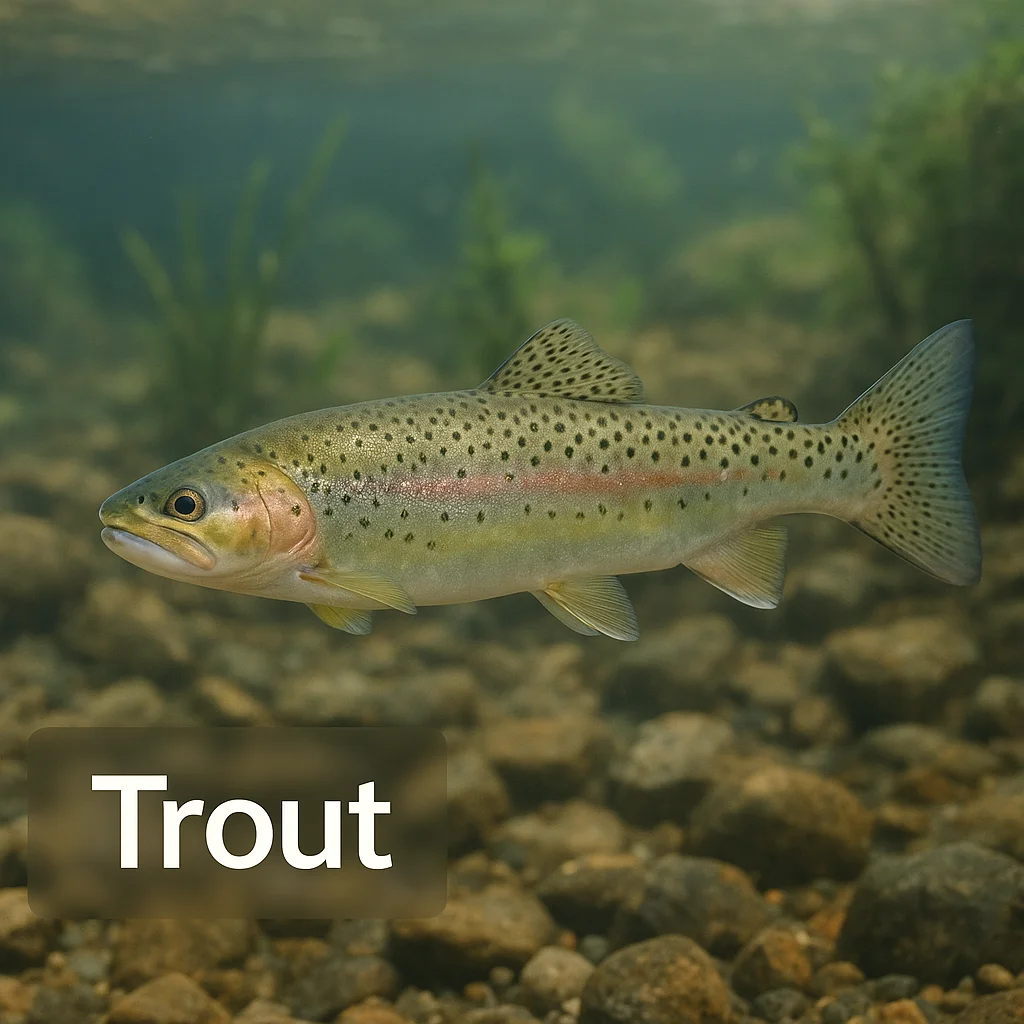
- Common Name(s): Trout
- Scientific Name: Varies (includes genera such as Salmo, Oncorhynchus, and Salvelinus)
- Animal Type: Fish
- Typical Adult Size: 20–80 cm (8–31 inches) in length
- Typical Lifespan: 4–11 years (varies by species)
- Diet Type: Carnivore; common foods include insects, smaller fish, and aquatic invertebrates
- Activity Pattern: Diurnal
- Social Structure: Mostly solitary, though some may form loose groups
- Speed / Movement Highlights: Known for swift, agile swimming
- Intelligence/Learning: Capable of learning and adapting to environmental changes
- Primary Habitats: Freshwater lakes and streams
- Geographic Range: North America, Europe, and Asia
- Predators/Threats: Birds, larger fish; human-induced threats include pollution and overfishing
- Conservation Status: Varies by region and species; some are threatened or endangered
🔍 Identification & Appearance
Trout can be identified by their slender, elongated bodies equipped with small scales. Their color and patterns can vary widely, but often include hues of brown, green, and blue, along with speckles and spots. Seasonal changes or age can lead to variations in their appearance.
- Body Shape and Silhouette: Slender and streamlined
- Key Colors/Patterns: Varies, often includes spots and speckles
- Distinctive Features: Adipose fin between dorsal and tail fin
- Tracks, Scat, or Other Field Signs: Generally not applicable for aquatic species
- Common Look-alikes: Salmon; distinguished by color and size
- Top ID Tips:
- Look for elongated, streamlined bodies
- Identify by the distinct adipose fin
- Spotting and coloration can provide clues
- Typically found in clear, cold freshwater
- Breeding males may exhibit brighter coloration
🧱 Body Structure & Physical Adaptations
Trout have a body structure that supports swift swimming and agile movements in water. Their slender bodies and powerful tails allow for quick, sharp turns and sprints to evade predators or catch prey.
- Build and Proportions: Slender, streamlined with powerful tail
- Teeth/Beak/Jaw Adaptations: Sharp teeth for grasping prey
- Fins: Strong tail fin for swift movement; pectoral fins for stabilization
- Sensory Strengths: Excellent vision; sensitive lateral line for detecting vibrations
- Key Adaptations:
- Streamlined body for swift swimming
- Sharp, conical teeth for gripping prey
- Sensitive lateral line detects water movements
- Powerful caudal fin for agility
- Adaptations allow for survival in cold water
🌍 Range & Distribution
Trout are primarily found in the freshwater habitats of the Northern Hemisphere. Their presence spans from the cold-water streams of North America to the rivers of Europe and Asia.
- Continents/Regions: North America, Europe, Asia
- Elevation Range: From sea level up to mountainous streams
- Seasonal Movements or Migration: Generally residential, some species migrate for spawning
- Where You Might Find It:
- Clear, cold freshwater streams
- Mountain lakes
- Rivers with heavy flow
- Coastal streams
- Glacial-fed lakes in colder climates
🏞️ Habitat & Shelter
Trout species are commonly found in clear, high-oxygen waters such as rivers, streams, and lakes, especially in regions that maintain consistent, cold temperatures. The water quality and flow play crucial roles in their ability to thrive, as trout rely on specific microhabitats like undercut banks, rocky crevices, and submerged vegetation for protection from predators and for spawning.
🧭 Behavior & Ecology
Trout exhibit a range of behaviors tied to their environmental conditions. They are diurnal and primarily feed during daylight hours, actively hunting for insects and other aquatic organisms. Territoriality can be observed in some species, particularly during the spawning season.
- Behavior Highlights:
- Territorial during spawning
- Learn environmental cues
- Use cover for ambush hunting
- Feeding varies with water temperature
- Responsive to seasonal water changes
👥 Social Life & Group Dynamics
Trout tend to be solitary creatures, with interactions mostly occurring during breeding seasons or in favored feeding areas. Hierarchical structures are less observed, as trout do not form stable social groups but rather transient aggregations based on availability of resources.
- Social Structure Notes:
- Primarily solitary
- Some form temporary feeding groups
- Transient aggregations during spawning
- Limited social hierarchy
- Interactions mostly competitive
🍽️ Diet, Prey & Predators
As opportunistic carnivores, trout feed on a variety of prey throughout their life stages. They primarily consume aquatic insects, small fish, and insect larvae. Seasonal shifts can influence their diet significantly. Natural predators consist of birds, mammals, and larger fish.
- Feeding Notes:
- Aquatic insects form diet staple
- Seasonal diet changes with availability
- Feed near surface or underwater structures
- Quick and efficient hunters
- Vulnerable to aerial and aquatic predators
🦌 Hunting, Foraging & Movement
Trout are agile swimmers, equipped for both rapid sprints and steady endurance swimming. Their foraging is often dictated by water temperature, flow rate, and prey availability, with trout employing a mix of ambush and pursuit strategies in hunting.
- Movement & Strategy:
- Swift, agile swimmers
- Ambush tactics behind cover
- Feed during daylight hours
- Utilize currents for navigation
- Responsive to water levels and flow
🧠 Intelligence & Senses
Trout have developed advanced senses, particularly eyesight and their lateral line, which helps them detect movement and vibration in water. They are capable learners, often adapting to new environments and understanding novel threats, though they are not known for complex problem-solving.
- Notable Abilities:
- Good memory for spatial navigation
- Adapt quickly to new dangers
- Use visual cues for mate selection
- Excellent eyesight aids in hunting
- Sensitive to vibrations via lateral line
🪺 Reproduction, Pregnancy & Parenting
The breeding of trout typically occurs in freshwater streams and rivers with gravel substrates. They often exhibit complex courtship behaviors and are promiscuous. Females lay eggs in shallow nests called redds, made in gravel beds where males fertilize them externally.
- Reproduction Snapshot:
- Spawning influenced by water temperature
- Females create gravel nests (redds)
- Eggs fertilized externally
- Larger trout tend to have more offspring
- No parental care post-fertilization
♀️♂️ Male vs Female Differences
Sexual dimorphism in trout may be observed, particularly during the breeding season. Males often develop more vibrant colors and sometimes exhibit changes in body structure like a hooked lower jaw known as a kype. However, these differences can vary based on species and environmental conditions.
- Sex Differences at a Glance:
- Males often larger than females
- Brighter colors during spawning
- Males may grow a kype during mating
- Females are more robust in body shape
- Females focus on egg production
🧬 Subspecies & Variation
Trout species exhibit significant variation based on geography and habitat. Notable groups include rainbow trout (Oncorhynchus mykiss), brown trout (Salmo trutta), and brook trout (Salvelinus fontinalis). Each has adapted to specific environmental conditions, displaying variations in color, pattern, and size.
- Variation Notes:
- Many species are region-specific
- Coloration varies with water quality
- Adapts to local food availability
- Size differences linked to habitat
- Genus Oncorhynchus often migratory
⚠️ Threats, Conservation & Human Interaction
Trout face numerous threats due to habitat destruction, pollution, and overfishing. Conservation programs often focus on maintaining water quality and habitat restoration. Fishery management aims to balance ecological interests with recreational use. Anglers are encouraged to follow catch-and-release practices where possible to sustain populations.
- Responsible Notes:
- Ensure water bodies remain pollution-free
- Participate in local conservation efforts
- Practice sustainable fishing techniques
- Catch-and-release where feasible
- Be mindful of trout populations during breeding
✨ Fun Facts & Unique Traits
- Trout can change color based on surroundings
- Known for acrobatic jumps during fights
- Some species, like rainbow trout, migrate
- Trout have been introduced worldwide for fishing
- Well-distributed in fly-fishing communities
- Trout are delicate indicators of ecosystem health
📌 Summary
- Slender, streamlined fish often found in cold freshwater
- Found across North America, Europe, and Asia
- Primarily carnivorous, prey on insects and small fish
- Important prey for birds and larger fish
- Mostly solitary, though some form loose groups
- Spawn in gravel nests, laying eggs externally
- Adaptable to varied Environmental conditions
- Face threats from habitat loss and pollution