🦁 Yellow Perch
🧾 Quick Facts
The Yellow Perch, known for its vibrant coloration and widespread distribution, is a common freshwater fish species in North America. It plays a significant role in aquatic ecosystems and is a popular target for recreational fishing.
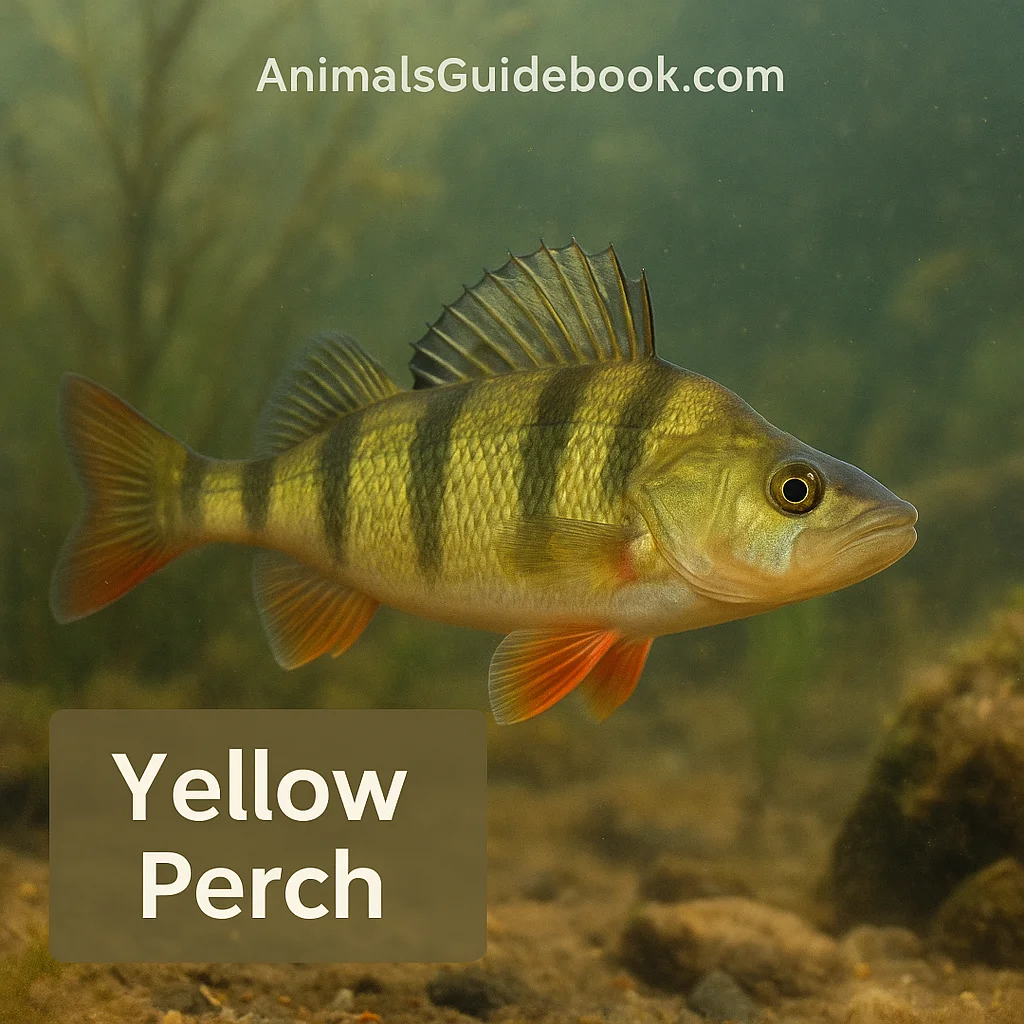
- Common name(s): Yellow Perch
- Scientific name: Perca flavescens
- Animal type: Fish
- Typical adult size: 15-30 cm (6-12 inches) in length
- Typical lifespan: 9-10 years in the wild
- Diet type: Carnivore; feeds on insects, smaller fish, and aquatic invertebrates
- Activity pattern: Diurnal
- Social structure: Schooling fish, especially younger individuals
- Speed / movement highlights: Agile swimmers with short bursts of speed
- Intelligence/learning: Exhibits simple learning and memory capacities
- Primary habitats: Lakes, ponds, streams, and rivers
- Geographic range: North America, primarily in the United States and Canada
- Predators/threats: Larger fish, birds, and human fishing activities
- Conservation status: Common and not threatened
🔍 Identification & Appearance
The Yellow Perch is easily recognizable by its distinct body shape and vivid coloration. It has an elongated, somewhat compressed body with a slight hump near the head. The back is olive to golden brown, fading to yellow/golden sides with dark vertical bands. Its fins are slightly transparent and the dorsal fin has a spiny anterior.
- Body shape: Elongated with a slight arch behind the head
- Key colors/patterns: Olive to yellow with dark vertical bands
- Distinctive features: Spiny dorsal fin and yellow-colored flanks
- Tracks, scat, or other field signs: N/A
- Common look-alikes: White Perch, distinguishable by smoother scale texture and coloration
- Top ID Tips:
- Look for bright yellow bodies
- Identify by the dark vertical stripes
- Check for spiny anterior dorsal fin
- Note the streamlined, yet slightly arched body
- Compare hues with similar species
- Observe schooling behavior in young individuals
🧱 Body Structure & Physical Adaptations
The Yellow Perch has evolved several adaptations that allow it to thrive in its environment. Its streamlined body is optimized for swimming at moderate depths, while its spiny dorsal fin provides defense against predators.
- Build and proportions: Streamlined and slightly arched for agile swimming
- Teeth/beak/jaw adaptations: Small, pointed teeth for capturing prey
- Fins: Pectoral and pelvic fins aid in maneuverability
- Sensory strengths: Acute sense of sight and lateral line for detecting water vibrations
- Key Adaptations:
- Streamlined body for efficient swimming
- Spiny dorsal fin for predator deterrence
- Small, pointed teeth for grasping prey
- Coloration providing camouflage among aquatic vegetation
- Advanced visual acuity in clear waters
- Lateral line system to sense water movement
🌍 Range & Distribution
Yellow Perch are primarily found across the United States and Canada, notably in the Great Lakes region, as well as in numerous freshwater bodies in surrounding areas.
- Continents/regions: North America
- Typical countries/biomes: United States, Canada
- Elevation range: More common in lowland freshwater habitats
- Seasonal movements: Mostly resident, with some local migrations to spawning grounds
- Where You Might Find It:
- The Great Lakes
- Inland lakes and ponds
- Slow-moving rivers
- Shallow, vegetated bays
- Reservoirs with aquatic vegetation
🏞️ Habitat & Shelter
Yellow Perch thrive in a variety of freshwater environments, particularly those with abundant vegetation that offers shelter and abundant prey. They prefer cooler waters and are often found near the shorelines of lakes and streams.
Habitat knowledge helps in understanding the ecological role of Yellow Perch, particularly as both predator and prey, thereby influencing aquatic food chains.
🧭 Behavior & Ecology
Yellow Perch display distinct behavioral patterns related to feeding and social interactions. They are commonly seen in schools, particularly during their juvenile stages, which may offer protection from predators.
- Daily routine: Mostly active during daylight hours
- Communication: Limited to schooling signals
- Typical interactions: Compete with other fish for food; preyed upon by larger fish
- Role in the ecosystem: Act as both predators of small aquatic organisms and prey for larger species
- Behavior Highlights:
- Schooling behavior for predator avoidance
- Daytime feeding activity
- Predator-prey dynamics within aquatic systems
- Contribution to nutrient cycling
- Impact on invertebrate population control
- Seasonal movements to optimal feeding areas
👥 Social Life & Group Dynamics
Yellow Perch often form schools, particularly when young, as a defense mechanism against predators. Adult perch may become more independent or form smaller schools depending on food availability and environmental conditions.
- Solitary vs social tendencies: Highly social, especially when young
- Group types: Schools; size varies with age and ecosystem
- Cooperation: Limited to schooling purposes
- Dominance hierarchies: Not well-defined
- Social Structure Notes:
- Young form large schools for protection
- Adults may display more solitary behavior
- School size can vary with environmental factors
- Limited social interaction beyond schooling
- Schooling reduces individual predation risk
🍽️ Diet, Prey & Predators
Yellow Perch are primarily carnivorous, feeding on a variety of aquatic organisms. Their diet typically consists of insects, small crustaceans, and smaller fish. In turn, they are preyed upon by larger fish species and birds.
- Cross-season diet: Diet remains consistent across life stages but prey size varies
- Main natural predators: Pike, Walleye, and fish-eating birds like herons
- Anti-predator defenses: Schooling and camouflage in vegetation
- Feeding Notes:
- Varieties include insects and small fish
- Prey selection adapts as they grow
- Diet influences perch health and behavior
- Mainly feeds during the day
🦌 Hunting, Foraging & Movement
Yellow Perch are active foragers, often seen swimming in schools. They use visual cues to locate prey and rely on short bursts of speed to capture it.
- Locomotion style: Agile swimmers with bursts of speed
- Speed and endurance: Capable of swift short-distance chases
- Typical foraging times: Daytime feeders
- Movement & Strategy:
- School formation aids in foraging efficiency
- Able to move quickly to ambush prey
- Favor structured environments for ambush
- Good navigators in complex aquatic habitats
🧠 Intelligence & Senses
Yellow Perch possess a reasonably developed sense of sight and a lateral line system, which provides spatial awareness and helps in detecting nearby movement. While not known for advanced problem-solving, they can learn basic patterns and routines.
- Problem-solving: Limited; adaptable within familiar environments
- Senses: Visual acuity for hunting and a lateral line for sensing vibrations
- Notable Abilities:
- Acute vision aids in spotting prey
- Lateral line for detecting vibrations
- Basic pattern recognition in feeding
- Adaptable to varying water conditions
🪺 Reproduction, Pregnancy & Parenting
The breeding season of the Yellow Perch occurs in spring, often triggered by increasing water temperatures. Spawning involves releasing eggs near vegetation, which hatch independently without parental care.
- Breeding seasonality: Spring, influenced by water temperature
- Mating system: Promiscuous; no long-term pair bonds
- Spawning behavior: Females lay adhesive eggs on aquatic plants
- Parenting roles: No parental care post-spawning
- Reproduction Snapshot:
- Springtime spawners
- Releases eggs among vegetation
- No parental involvement post-hatching
- High egg production compensates for no parental care
♀️♂️ Male vs Female Differences
In Yellow Perch, size can differ slightly between males and females, with females generally larger. During spawning, males develop a rougher texture on the underside from breeding tubercles.
- Size/weight differences: Females tend to be larger
- Breeding decorations: Males develop breeding tubercles
- Sex Differences at a Glance:
- Males smaller but equally colored
- Breeding males show rougher texture
- Females larger during the spawn
🧬 Subspecies & Variation
There are no widely recognized subspecies of Yellow Perch, but they can exhibit regional color variations based on water clarity and habitat.
- Overall variation: Color intensity can vary geographically
- Variation Notes:
- Coloration may vary with water conditions
- Temperature influences spawning behavior
- Some local adaptations across its range
- No formal subspecies classification
⚠️ Threats, Conservation & Human Interaction
Yellow Perch face threats from habitat destruction, pollution, and overfishing. However, they remain abundant and largely adaptable. Conservation efforts focus on sustainable fishing practices and maintaining healthy freshwater ecosystems.
- Natural challenges: Habitat loss and pollution
- Human-related pressures: Overfishing
- Coexistence tips: Support sustainable fishing practices
- Responsible Notes:
- Encourage catch-and-release fishing
- Promote healthy water habitats
- Raise awareness on habitat conservation
✨ Fun Facts & Unique Traits
- Yellow Perch are a popular target for ice fishing.
- Females can produce up to 40,000 eggs in a single spawn.
- They are known for their tasty, white flesh, making them a favorite among anglers.
- In some areas, Yellow Perch are stocked to enhance recreational fishing.
- They can survive in a wide range of water temperatures, showing significant adaptability.
- Yellow Perch can act as bioindicators due to their sensitivity to water quality changes.
📌 Summary
- Yellow Perch are easily identified by their yellow bodies and dark stripes.
- Found chiefly across North America in freshwater habitats.
- Thrive in lakes, ponds, and slow-moving streams.
- Carnivorous with a diverse diet of aquatic prey.
- Significant role in the food chain as both predator and prey.
- Highly social when young, forming protective schools.
- Spawning occurs in spring with no parental care post-spawn.
- Adaptations include spiny fins and acute vision for varied aquatic environments.
- Continue to be a focus of conservation due to overfishing pressures.