🦁 Giant Pacific Octopus
🧾 Quick Facts
The Giant Pacific Octopus, a fascinating and highly intelligent creature, is known for its impressive size and complex behaviors. This remarkable animal resides in the cold waters of the North Pacific and is often celebrated for its ability to camouflage and its potent memory.
- Common name(s): Giant Pacific Octopus
- Scientific name: Enteroctopus dofleini
- Animal type: Invertebrate
- Typical adult size: 3 to 5 meters (10 to 16 feet) arm span; 15 to 50 kg (33 to 110 lbs)
- Typical lifespan: 3 to 5 years in the wild
- Diet type: Carnivore; primarily crabs, clams, small fishes
- Activity pattern: Primarily nocturnal
- Social structure: Solitary
- Speed / movement highlights: Swims by jet propulsion; can crawl along ocean floor
- Intelligence / learning: High; can solve puzzles and remember complex tasks
- Primary habitats: Coastal areas, ocean floor, coral reefs
- Geographic range: North Pacific Ocean, from Japan to Alaska and down to California
- Predators/threats: Sharks, sea otters, human fishing practices
- Conservation status: Not a concern; varies by region
🔍 Identification & Appearance
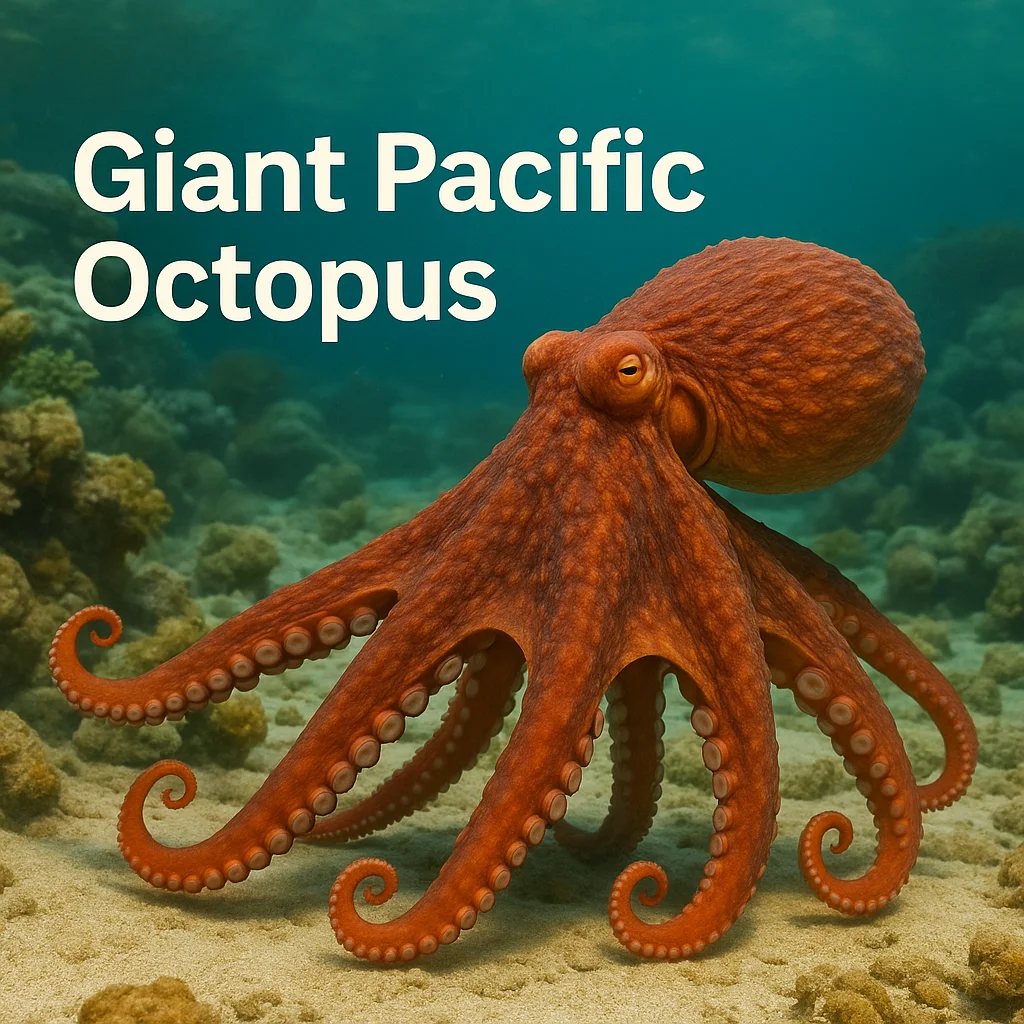
The Giant Pacific Octopus is recognized for its substantial size and striking appearance. With eight robust arms radiating from a central body, it presents a distinctive silhouette against its ocean backdrop. Predominantly reddish-brown, its skin can also change textures and colors for camouflage or communication, showing an impressive ability to blend seamlessly into its environment.
Identifying this octopus can be straightforward due to its sheer scale, however, it can be confused with other octopus species. It does not leave tracks as terrestrial animals do, but the Giant Pacific Octopus is known for creating dens where remnants of meals might be found.
- Bulky head with large eyes and a muscular mantle
- Eight arms with a total of approximately 2,000 suckers
- Color: typically reddish-brown, but variable due to chromatophores
- Skin texture change for camouflage
- No distinct tentacle pattern or markings
- Large eye spots (ocelli) mimic vertebrate eyes
- Arm span creates a rounded shape when swimming
- Distinct beak located centrally beneath the head
🧱 Body Structure & Physical Adaptations
The Giant Pacific Octopus showcases several unique adaptations that enhance its predatory efficiency and survival in deep oceanic environments. Its robust body structure includes a large, rounded mantle where the organs are housed, and long, muscular arms primed for capturing prey.
The beak, made of chitin, is powerful enough to crack hard-shelled prey like crabs. Additionally, the octopus's sensory organs are finely tuned; it can taste with its arms and has highly developed eyes, which help it hunt in low-light conditions.
- Soft, pliable body for squeezing into tight spaces
- Powerful beak for breaking shells
- Highly dexterous arms with suckers for manipulation and adhesion
- Three hearts; two pump blood to the gills, and one to the rest of the body
- Large eyes for excellent low-light vision
- Ability to change skin color and texture for camouflage
- Jet propulsion via muscular mantle used for quick retreats
🌍 Range & Distribution
The Giant Pacific Octopus primarily inhabits the northern reaches of the Pacific Ocean. It can be found in coastal waters from Japan across to the Aleutian Islands in Alaska and down to the Northwestern coast of the United States, making it one of the most widely distributed octopus species.
It prefers the cool, oxygen-rich waters of the ocean depths but can also be found in tide pools and among reefs, often at depths ranging between 20 and 1,500 meters (65 to 4,920 feet).
- North American Pacific coast: Alaska to California
- Found in Japan's coastal waters
- Occurs across the Bering Sea
- Inhabitants of deep oceanic trenches
- Prefers stable underwater environments with abundant shelters
- Resides mainly in temperate ocean zones
🏞️ Habitat & Shelter
The Giant Pacific Octopus thrives in diverse coastal and open ocean habitats. It commonly inhabits rocky crevices, kelp forests, and sandy ocean floors. Its ability to squeeze into tight places allows it to thrive in underwater caves and among reefs, where it is obscured from larger predators.
Seasonal changes in water temperature and food availability can influence movement and behavior, but overall the Giant Pacific Octopus is primarily sedentary, selecting long-term dens where they can hoard food remains. Understanding their habitat is crucial for comprehending behavioral patterns and ensuring their conservation.
🧭 Behavior & Ecology
The Giant Pacific Octopus is most active during the night when it hunts and explores its surroundings. It is known for its solitary nature, spending most of its life alone except during mating. The octopus communicates with colors and textures, utilizing its skin's chromatophores to send signals to other octopuses or predators.
This species plays a vital role in its ecosystem as both a predator and prey. It helps control populations of various smaller marine creatures and provides sustenance for animals like sharks and other large fish.
- Nocturnal hunting and foraging
- Solitary lifestyle outside of mating
- Use of chromatophores for communication
- Den-building with recognizable midden piles
- Acts as both predator and prey in its ecosystem
- Seasonal movement influenced by prey availability
- Beneficial prey species for larger marine predators
👥 Social Life & Group Dynamics
As inherently solitary animals, Giant Pacific Octopuses do not form groups or packs. They exhibit territorial behaviors and use visual displays to ward off potential competitors or threats. Interaction with other octopuses primarily occurs during mating seasons when individuals may be observed in temporary pairs.
These octopuses demonstrate complex social signals, primarily through changes in skin color and texture, emphasizing aggression or submission. There is little cooperation among individuals, and conflicts are resolved through displays of size and strength, rather than direct combat.
- Primarily solitary
- Temporary pair formation during mating
- Displays of color for communication
- Territorial behaviors and distancing displays
- Complex signaling without vocalizations
🍽️ Diet, Prey & Predators
The carnivorous Giant Pacific Octopus primarily feeds on a diet of crabs, mollusks, and small fish. It utilizes its highly sensitive arms to detect and capture prey, employing a range of strategies from ambush to stalking. The octopus can also use its venomous saliva to paralyze prey before consuming it.
Natural predators include sharks, sea otters, and larger fish species. The octopus uses its camouflage abilities and jet propulsion to evade these threats. Scavenging is also a part of its feeding behavior, often finding food remains left by other marine animals.
- Consumes crabs and prawns as primary prey
- Hunts clams and mussels among reefs
- Occasionally eats smaller fish
- Uses beak to crack open shells
- Employs venom to immobilize prey
- Preyed upon by sharks and sea otters
- Camouflage to avoid detection by predators
🦌 Hunting, Foraging & Movement
The Giant Pacific Octopus's typical hunting style involves ambush tactics, lying in wait for unsuspecting prey to pass nearby. Its keen senses help detect subtle water movements and chemical cues, guiding the octopus to its next meal. For movement, the octopus uses two primary methods: crawling along the ocean floor using its arms and utilizing jet propulsion to swiftly navigate through the water.
This flexibility in movement allows it to adapt to various environments, from bustling coral reefs to deep ocean floors. When actively hunting, it relies on strategy and stealth, maintaining low visibility until it's ready to strike.
- Utilizes ambush tactics for prey capture
- Skilled crawler along oceanic substrates
- Jet propulsion for rapid movement
- Explores during nighttime hours
- Cleverly uses environment for stalking
🧠 Intelligence & Senses
The Giant Pacific Octopus is renowned for its intelligence, evidenced by its problem-solving abilities and advanced learning skills. These octopuses have shown memory retention in laboratory settings and can navigate complex mazes. They use observational learning to mimic behaviors of other octopuses or explore novel solutions to obstacles.
Their senses are highly evolved, with acute vision that allows detection of polarized light and chemosensory capabilities that let them "taste" through their arms. Despite these abilities, academic research on their cognitive processes remains an area of growing interest.
- High problem-solving capabilities
- Excellent long-term memory
- Uses observational learning
- Vision for recognizing prey and predators
- Mimics colors and textures
- Research on sense limitations or cognitive reach varies
🪺 Reproduction, Pregnancy & Parenting
The breeding season for the Giant Pacific Octopus is not strictly seasonal but does tend to peak during colder months. They utilize a polygynous mating system, with males seeking multiple female partners over their lifespan. After a successful courtship, females lay thousands of eggs and spend months tending to them, generally not leaving the eggs until they hatch.
Parental care is entirely maternal, with females engaging in egg aeration and protection. After the eggs hatch, females generally die, having completed their life cycle without feeding during the brooding period.
- Polygynous mating patterns
- Extended egg incubation of 5 to 7 months
- Female protects and aerates eggs
- Up to 74,000 eggs laid per clutch
♀️♂️ Male vs Female Differences
Males and females of the Giant Pacific Octopus exhibit some differences in size, with females often being larger than males. Males possess a distinctive arm known as the hectocotylus, used in the transfer of sperm to the female.
Behaviorally, the primary distinction arises during the breeding season, as females will focus entirely on preparing for eggs and constructing a suitable den. Both sexes exhibit similar camouflaging and prey capture techniques.
- Larger females than males
- Hectocotylus arm in males for reproduction
- Females concentrate on egg care
🧬 Subspecies & Variation
Currently, there is no officially recognized subspecies of the Giant Pacific Octopus. The species shows regional variations in size and coloration, which may reflect localized adaptation to particular environmental conditions, such as water temperature and prey availability.
Debate exists about potential cryptic species within the general classification, leading to ongoing research into genetic differences between populations.
- No subspecies formally recognized
- Regional color and size variation
- Genetic studies for cryptic species ongoing
⚠️ Threats, Conservation & Human Interaction
The Giant Pacific Octopus faces threats from natural predators as well as human-induced pressures such as overfishing, bycatch, and habitat degradation due to pollution. However, due to its widespread range and rapid reproduction rate, it is not currently listed as threatened.
Coexistence with humans includes ethical considerations for research and handling. When interacting with wild octopuses, it is important to respect their habitat and not interfere with their natural behaviors.
- Subject to bycatch in fishing industries
- Habitat loss from ocean pollution
- No immediate conservation concern
- Responsible viewing practices for divers
✨ Fun Facts & Unique Traits
- The Giant Pacific Octopus can fit its body through openings as small as its beak.
- Despite having a relatively short life, they can grow rapidly, achieving their giant size within just a few years.
- Each arm can have up to 240 independently controlled suckers.
- Their arms are highly regenerative and can regrow if lost or injured.
- Octopuses have three hearts, and their blood is copper-based, which gives it a blue color.
- They are known for complex problem-solving and escape artistry in captivity.
📌 Summary
- Recognizable by its massive size and distinctive reddish-brown color.
- Predominantly nocturnal and solitary.
- Found in the North Pacific Ocean across various coastal regions.
- Feeds mainly on crab and shellfish, using a powerful beak.
- Contributes significantly to marine ecosystems as both predator and prey.
- Exhibits advanced intelligence and problem-solving skills.
- Reproduces with extensive maternal care of eggs.
- Challenges include habitat change and fishing practices.
- Known for its ability to camouflage and squeeze through small spaces.