🦑 Giant Squid
🧾 Quick Facts
The giant squid is a deep-ocean dwelling creature, belonging to the family Architeuthidae. Notoriously elusive, these fascinating invertebrates are often surrounded by mystery, making them an intriguing subject for marine biologists and ocean enthusiasts alike.
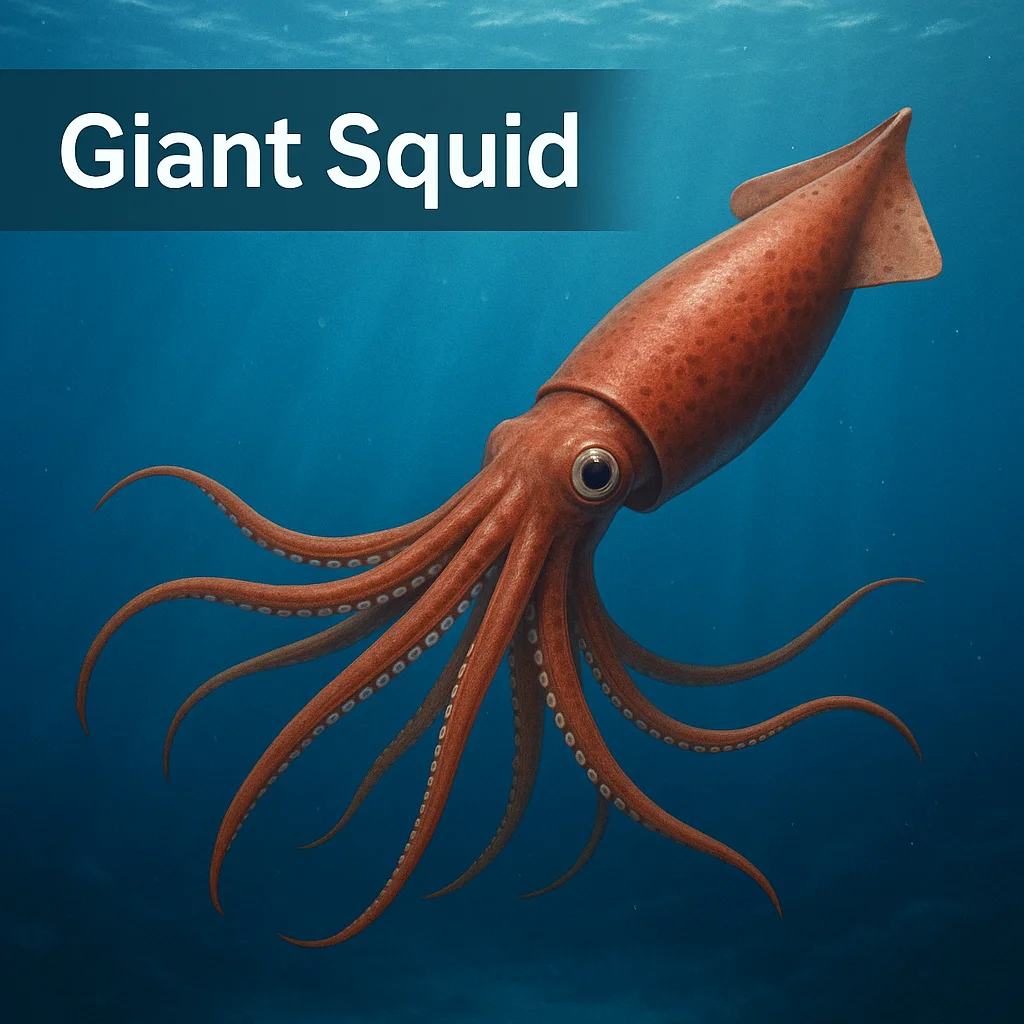
- Common name: Giant Squid
- Scientific name: Architeuthis dux
- Animal type: Invertebrate
- Typical adult size: Up to 12-13 meters (39-43 feet) in total length for females; slightly smaller for males
- Typical lifespan: Often unclear, but believed to be up to 5 years in the wild
- Diet type: Carnivore, typically consuming fish and other squid
- Activity pattern: Largely nocturnal, with peak activity at night
- Social structure: Primarily solitary
- Speed / movement highlights: Powerful swimmers capable of moderate speeds over short distances with jet propulsion
- Intelligence/learning: Limited direct study, but displays complex behaviors typical of cephalopods
- Primary habitats: Deep ocean waters
- Geographic range: Found in deep ocean waters worldwide
- Predators/threats: Natural predators include sperm whales; human threats include deep-sea fishing bycatch
- Conservation status: Not enough data for a clear status, varies by region
🔍 Identification & Appearance
The giant squid is easily recognizable by its long, torpedo-shaped body and extended pair of tentacles. Its coloration can vary from translucent white to reddish-brown, often reflecting ambient light due to chromatophores in the skin. The creature has large eyes, which are amongst the largest in the animal kingdom, crucial for spotting prey in the deep dark ocean.
- Distinct, elongated body
- Eight arms and two longer tentacles
- Reddish or whitish hues depending on light conditions
- Enormous, highly sensitive eyes
- Powerful, beak-like jaws
- Fins located towards the rear of the body
- Smooth, slippery skin texture
- Top ID Tips:
- Look for the large, cylindrical mantle
- Note the two extended, feeding tentacles
- Identify the large size - reaching impressive lengths
- Observe the colossal eyes
- Check for the smooth texture of the skin
- Observe coloration that varies in different lighting
🧱 Body Structure & Physical Adaptations
The giant squid's body is streamlined for swift movement through water by means of jet propulsion, propelling itself by expelling water through its siphon. Its arms and tentacles are lined with powerful suckers featuring sharp rings for grip and prey capture. The squid's beak is used to slice through the flesh of prey, enabling it to consume a variety of marine organisms.
- Key Adaptations:
- Streamlined, hydrodynamic body shape
- Suckers with sharp rings for strong grip
- Powerful jet propulsion system
- Large eyes for low-light vision
- Camouflaging ability due to skin chromatophores
- Strong, chitinous beak adapted for cutting
- Flexible siphon for directional movement
- Elastic mantle for water jet propulsion
🌍 Range & Distribution
The giant squid inhabits deep ocean waters where sunlight barely penetrates, from temperate to subpolar regions. They are distributed across all the world's oceans, often leaning towards the Atlantic and Pacific oceans. Although their full range is unclear due to the depths at which they live, these behemoths are notable in mythology and modern tales alike.
- Where You Might Find It:
- Deep Atlantic currents
- Pacific Ocean depths
- Subpolar to temperate oceanic zones
- Bottom ocean layers
- Areas around deep-sea trenches
- Near continental slopes away from shorelines
- Regions frequented by sperm whales
- Mesopelagic to bathypelagic zones
🏞️ Habitat & Shelter
Preferring the cold, high-pressure conditions of the ocean's depths, giant squids make their home in the remote and expansive deep sea. They typically remain in waters ranging from 300 to 1,000 meters deep but may venture closer to the surface under specific conditions, such as chasing prey. The intricacies of their habitat knowledge are essential for understanding their elusive nature and survival strategies.
🧭 Behavior & Ecology
In their twilight world, giant squids are stealthy predators, using their specialized adaptations to locate prey in low-light environments. They exhibit crepuscular activity with heightened movements during dusk and dawn. Interactions with other marine species usually involve their role as both predator and prey in the food chain, showcasing the balance they maintain in their ecosystem.
- Behavior Highlights:
- Ambush predator tactics
- Solitary hunters by nature
- Prey includes fish and other cephalopods
- Utilization of bioluminescence for communication
- Displays wary, non-confrontational behaviors unless threatened
- Key biological player in the deep-sea food web
- Mostly silent movers with minimal impact noise
- Feeding at various ocean depths
👥 Social Life & Group Dynamics
Giant squids are solitary creatures, rarely observed in groups. They do not form schools or pods, which is common among other squid species. Instead, these squids focus on individual survival and reproduction. Their lives are marked by independence, and group dynamics are minimal and perhaps limited to opportunistic encounters.
- Social Structure Notes:
- Primarily solitary
- No significant social hierarchy
- Barely form groups
- Independence in hunting and foraging
- Mystery remains in interactions among each other
🍽️ Diet, Prey & Predators
Their diet predominantly comprises deep-sea fish and other squids, utilizing their long tentacles and powerful suckers to secure their prey. Natural predators include sperm whales and some shark species, with whom they engage in complex predatory and defensive interactions.
- Feeding Notes:
- Feeds on deep-sea fish and squids
- Employ tentacles for capturing prey
- It's a primary food source for sperm whales
- Shows opportunistic feeding behavior
- Prey is swallowed whole or in large pieces
- Razor-sharp beaks used for tearing prey
🦌 Hunting, Foraging & Movement
The giant squid's main mode of locomotion is swimming, facilitated by jet propulsion using their siphon and fin movements. These squids are agile and capable of making swift, powerful movements to catch prey or evade predators. They are elusive hunters, predominantly active at night, possibly venturing into shallower waters under the cover of darkness.
- Movement & Strategy:
- Swims by jet propulsion
- Nighttime hunters
- Capable of quick, plausible escape maneuvers
- Can hover motionless in water when needed
- Skillfully steers using fins for direction
🧠 Intelligence & Senses
Giant squids have a complex nervous system and are assumed to have considerable intelligence, as seen in other cephalopod species. Their fascinatingly large eyes are adapted for low-light vision, allowing them to detect the faintest bioluminescence of potential prey or the approach of predators in the dark ocean depths.
- Notable Abilities:
- Keen low-light vision for hunting
- Complex nervous system indicative of intelligence
- Sensitive to pressure changes in water
- May use tentacles for tactile exploration
- Ability to rapidly learn from environment
🪺 Reproduction, Pregnancy & Parenting
Little is known about the reproductive habits of giant squids. However, like many cephalopods, it's believed they reproduce in deep waters with a potential spawning strategy that ensures offspring survival. Females are thought to lay thousands of eggs, which are left to develop independently of adult care.
- Reproduction Snapshot:
- Reproduction primarily occurs in deep waters
- Believed female lays thousands of eggs
- Eggs develop without parental care
- Mating potentially involves complex courtship
♀️♂️ Male vs Female Differences
Common sexual dimorphism is seen in size differences, where females grow slightly larger than males. There's minimal visible differentiation elsewise; behaviors between the sexes may vary but are primarily enigmatic due to elusive observation opportunities.
- Sex Differences at a Glance:
- Females generally larger than males
- Subtle behavioral distinctions not well documented
🧬 Subspecies & Variation
Current classification knowledge doesn't widely recognize specific subspecies of giant squid, but some variations in size and coloration might occur across different oceanic populations. Given their deep-sea habitat, these variations might relate to local adaptations for surviving specific environmental conditions.
- Variation Notes:
- Potential size and coloration variations in different regions
- Subspecies classification remains debated
⚠️ Threats, Conservation & Human Interaction
Despite their mythical reputation, giant squids face several natural and human-induced threats. Natural predation by large oceanic mammals, like sperm whales, and human activities, such as deep-sea fishing and bycatch, contribute to potential declines. Their enigmatic nature suppresses the full extent of how human interaction impacts their populations.
- Responsible Notes:
- Predated by sperm whales
- Susceptible to deep-sea fishing bycatch
- Impacted by habitat changes
✨ Fun Facts & Unique Traits
- Giant squid eyes are among the largest in the animal kingdom
- Capable of bioluminescent communication
- Said to have inspired ancient sea monster legends
- Possesses a unique, flexible mantle for dynamic swimming
- Highly elastic skin withstands ocean pressure
- One behemoth predator yet 'invisible' in the vast ocean
📌 Summary
- The giant squid is a formidable denizen of the deep, elusive and rarely seen in its natural habitat.
- This invertebrate can grow up to 13 meters, with flexible, jet-propulsion enabling swift movement.
- Primarily residing in the deep seas, this carnivore preys upon fish and other squid.
- Giant squids employ their tentacles and sharp beak to capture and consume their prey.
- Natural predators like sperm whales maintain ecological balance, showcasing their role as both predator and prey.
- Reproduction involves laying thousands of eggs deep in the ocean, with minimal parental involvement post-spawning.
- Little is known about their social workings, mostly solitary in lifestyle.
- Rates of interaction with humans are low but influenced by bycatch and oceanic activity.
- Their adaptation skills ensure survival in various marine environments, despite threats.