🦗 Grasshopper
🧾 Quick Facts
Grasshoppers are fascinating invertebrates found in nearly every part of the world. Known for their powerful hind legs and characteristic jumping ability, these insects provide important ecological functions, such as serving as prey for many animals and aiding in plant population control.
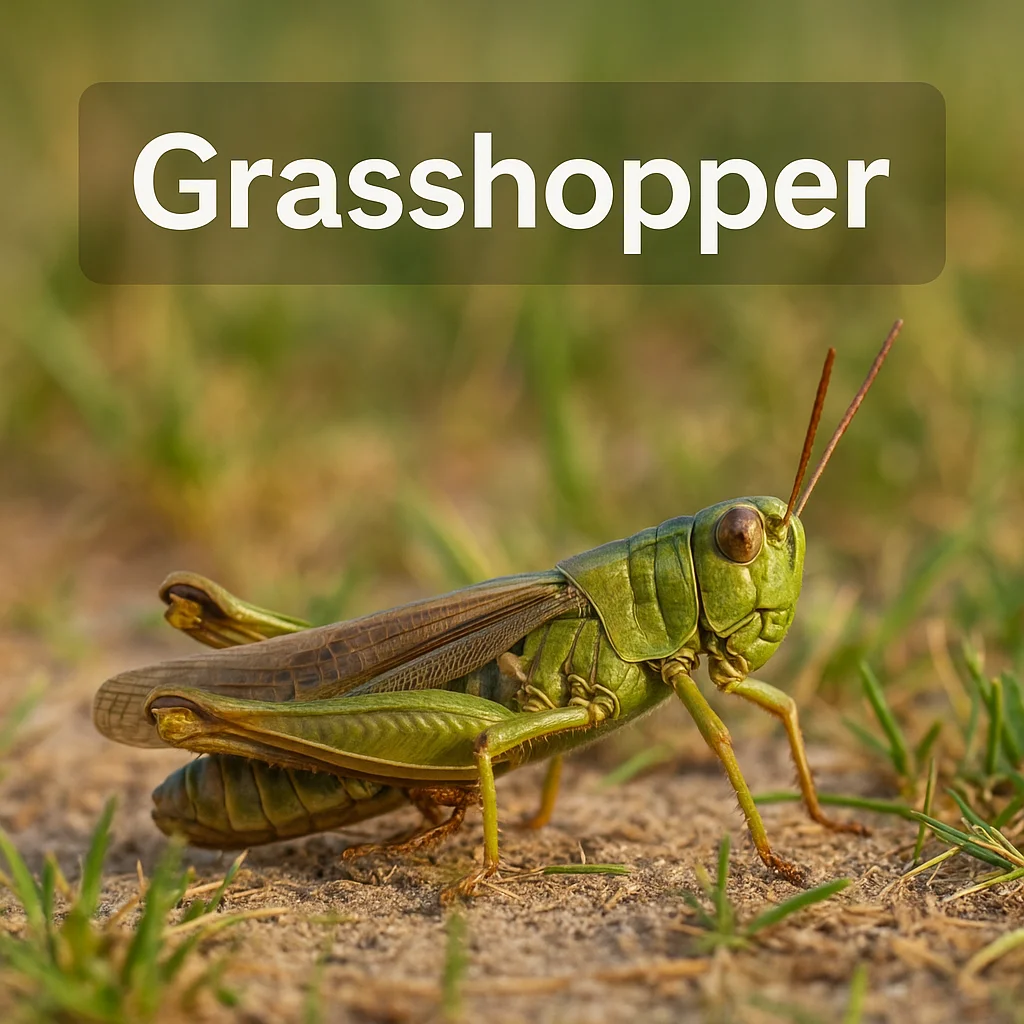
- Common name(s): Grasshopper
- Scientific name: Varies by species; commonly from the family Acrididae
- Animal type: Invertebrate
- Typical adult size: 1 to 7 cm depending on species
- Typical lifespan: Several months; varies between wild and captive
- Diet type: Herbivore; primarily leaves, stems, flowers, and seeds
- Activity pattern: Mostly diurnal, but some are crepuscular
- Social structure: Mostly solitary, but can form large swarms
- Speed/movement highlights: Excellent jumpers; capable fliers in some species
- Intelligence/learning: Basic; capable of simple learning and adaptation
- Primary habitats: Grasslands, meadows, fields, forests, deserts
- Geographic range: Found globally except in extremely cold regions
- Predators/threats: Birds, reptiles, mammals, and human agricultural practices
- Conservation status: Generally stable; varies by region and species
🔍 Identification & Appearance
Grasshoppers are identified by their distinct elongated bodies, powerful hind legs designed for jumping, and short antennae. Their coloration varies widely among species, ranging from green and brown to bright, warning colors like yellow and red. Some species exhibit unique patterns suited for camouflage in their natural habitat. Adult grasshoppers have wings, though their flying abilities differ significantly by species. Often mistaken for locusts, grasshoppers can be differentiated by their behavior and habitat preferences.
- Elongated bodies with a distinct head, thorax, and abdomen
- Variable colors, often camouflaged or boldly patterned
- Short, robust antennae
- Powerful hind legs adapted for leaping
- Wings present in adults; wing length varies
- Look-alikes include locusts and crickets, but note differences in behavior and habitat
- Fecal pellets are small, dry, and uniform, indicating presence
- Typically produces a soft, rustling sound while moving
🧱 Body Structure & Physical Adaptations
Grasshoppers possess a robust body optimized for jumping and, in some species, short bouts of flying. Their powerful hind legs allow for impressive leaps relative to body size. Although not all grasshoppers excel in flight, those that can usually have well-developed forewings and hindwings. Their mandibles are adapted for chewing plant material, and their sensory organs, including simple eyes and antennae, provide basic navigation abilities essential for survival in diverse environments.
- Compact body with strong, muscular hind legs
- Mandibles adapted for efficient plant chewing
- Short antennae aid in sensory perception
- Simple eyes (ocelli) and compound eyes for general vision
- Wings varying in size by species; not all are proficient fliers
- Exoskeleton provides protection against predators
- Built for quick, energetic escape responses
- Coloration aids in camouflage or warning signals
🌍 Range & Distribution
Grasshoppers inhabit a wide range of environments across all continents except Antarctica. They thrive particularly in grasslands and open fields but can also be found in forests and deserts depending on the species. While most grasshoppers are non-migratory, certain species can form large migratory swarms under particular conditions, which distinguishes them from locusts.
- Common in temperate and tropical climates
- Thrives in grasslands, meadows, and open areas
- Also found in forests and deserts
- Elevation range from sea level to mountains
- Mostly resident, though some exhibit minor local movements
- Adaptable to a variety of climatic zones
- Distribution includes North and South America, Africa, Eurasia, Australia
- More scarce in colder and polar regions
🏞️ Habitat & Shelter
Grasshoppers prefer habitats that support their herbivorous feeding habits, such as grasslands, meadows, and fields. These environments provide abundant vegetation for food and cover from predators. They often rest and hide in tall grasses and vegetation during the hottest parts of the day and are more active during cooler morning and late afternoon hours. Understanding the grasshopper's habitat is crucial for appreciating their behavioral ecology and role in the ecosystem.
- Often found in grassy and open areas
- Can inhabit forests and desert margins
- Use tall grass and vegetation for shelter and feeding
- Limited activity during harsh weather; more in temperate conditions
- Depend on sufficient plant cover for protection
- Play a significant role in nutrient cycling and plant population control
🧭 Behavior & Ecology
Grasshoppers display a variety of behaviors that are essential to their survival and ecological interactions. Mostly solitary, they become more social under conditions that lead to swarming, a behavior more common among certain species. Communication primarily involves sound production (stridulation), used for attracting mates or signaling territory. They play a critical ecological role as both primary consumers, reducing plant biomass, and prey for various predators.
- Primarily solitary, except during swarm conditions
- Employ sound (stridulation) for communication
- Influence plant community dynamics through grazing
- Serve as a vital food source for numerous predators
- Can impact human agriculture significantly
- Exhibit basic territorial behavior
- Active less during extreme weather; behavior varies with climate
- Ecologically important for nutrient cycling
👥 Social Life & Group Dynamics
Grasshoppers are generally solitary creatures, with social interactions minimal except during reproduction or when environmental conditions prompt swarming behavior. In such instances, population density increases and behaviors align more closely with those of locusts. However, these events are species-specific and vary greatly across different grasshopper groups. Cooperation and social structures are not prominent features of grasshopper societies.
- Primarily solitary outside of mating and swarm events
- No fixed group hierarchy
- Swarm behavior rare and species-specific
- Minimal cooperative behavior observed
- Interaction mostly limited to mating contexts
- Density-induced behavior changes under certain conditions
- Occasional mass movements in search of resources
🍽️ Diet, Prey & Predators
Grasshoppers are primarily herbivores, feeding on a variety of plant materials. Their diet includes leaves, flowers, stems, and seeds, which they chew using their well-adapted mandibles. During periods of scarcity, they may diversify their diet to include more resistant plant species. Grasshoppers face predation from birds, small mammals, reptiles, and even other insects, utilizing their powerful jumping ability and often cryptic coloration as means of escape from predators.
- Consumes a wide range of herbaceous plants
- Prefers lush vegetation; can eat tougher plants if needed
- Birds and rodents are significant predators
- Possesses limited defensive mechanisms
- No known scavenging behavior
- Chemical defenses present in few species
- May impact crop production in agricultural settings
🦌 Hunting, Foraging & Movement
Grasshoppers primarily forage during daylight hours, moving slowly and steadily through vegetation to feed. Their movement is characterized by high levels of jumping activity, enhanced by their well-developed hind legs. Though relatively slow when walking, they can achieve quick escapes by leaping and, in some species, flying over short distances. Navigation relies on vision and basic sensory inputs, with most species exhibiting defined home ranges.
- Forages during daytime; increased activity in the morning and evening
- Adapted to moving through dense grass and shrubbery
- Capable of rapid jumps to escape threats
- Limited flight capability in most species
- Spatial behavior based around known feeding areas
- Displays territoriality in some crowded situations
🧠 Intelligence & Senses
Grasshoppers have a basic level of intelligence, enabling them to learn from simple stimuli and interact with their environment effectively to avoid threats. They utilize compound eyes for wide-angle vision, although their sight is better attuned to detecting movement than fine detail. Their antennae are sensitive to touch and smell, while sound detection is carried out via specialized structures located on their legs.
- Capable of simple associative learning
- Uses vision primarily for detecting motion
- Relies on sound for environmental cues
- Limited problem-solving abilities observed
- Antennae critical for interpreting chemical signals
- Sensory adaptations suit their ecological role
- Research on cognitive abilities is limited
🪺 Reproduction, Pregnancy & Parenting
Grasshoppers are typically seasonal breeders, with activity peaking during warmer months. Mating involves elaborate courtship displays, often with males producing specific sounds to attract females. Most follow a polygamous system where males mate with multiple females. After mating, females lay eggs in the soil, with embryonic development occurring over several weeks to months depending on temperature and moisture conditions. There is no parental care, with young grasshoppers, or nymphs, hatching fully equipped for an independent life.
- Breeding generally seasonal, aligning with summer months
- Involves courtship rituals comprised of sound production
- Females can lay hundreds of eggs
- Incubation period dependent on climate
- No parental investment post-laying
- Young are precocial, requiring no care beyond laying site
- Mating system polygamous
- Embryonic diapause possible under adverse conditions
♀️♂️ Male vs Female Differences
In grasshoppers, sexual dimorphism is often subtle but sometimes evident in size and coloration, with females generally larger due to their reproductive role. Males frequently have more prominent or vibrant patterns, serving a role in courtship and display. Differences in behavior during the breeding season may also provide cues regarding sex, as males actively engage in displays and sound production while females select mates and lay eggs.
- Females typically larger than males
- Males sometimes display more vibrant color patterns
- Behavioral differences prominent in mating context
- Male sound production crucial for attracting females
- Subtle morphological differences in antennae and wing shapes
- Sexual dimorphism supports reproductive strategies
🧬 Subspecies & Variation
Grasshoppers encompass a tremendously diverse range of species, often showing significant variation in size, color, and behavior across different environments. Some species adapt to specific habitats, resulting in distinct genetic variations commonly grouped into subspecies. In regions with diversified microhabitats, local adaptations can result in variations that complicate taxonomic classification.
- Diverse family with numerous species across multiple genera
- Size and color variation linked to habitat and survival needs
- Subspecies classification may vary by region
- Island and isolated populations exhibit unique traits
- Potential for hybridization among closely related specie
- Coloration can vary significantly in response to predators
⚠️ Threats, Conservation & Human Interaction
Grasshoppers face numerous natural threats, including predation and environmental changes. Human activity also impacts their populations through habitat destruction, pesticide use, and climate change. While generally not considered endangered, the conservation of grasshopper species often depends on sustainable agricultural practices and habitat preservation efforts. Some species play significant roles in agriculture, causing economic damage during population booms, creating a need for balanced ecosystem management.
- Habitat loss impacts populations negatively
- Climate shifts alter breeding and foraging patterns
- Pesticides pose significant mortality risks
- Acts as a notable agricultural pest in large numbers
- Sustainable agriculture benefits grasshopper conservation
- Role in ecosystems highlights importance of natural balance
- Local conservation efforts can stabilize populations
✨ Fun Facts & Unique Traits
- Grasshoppers have been around for over 250 million years!
- Capable of jumping up to 20 times their body length
- Some can produce sounds by rubbing their legs against their wings
- Only a small portion of grasshopper species can form swarms
- Females lay eggs that can overwinter in colder climates
- A grasshopper's eardrum is located on its abdomen
- Essential pollinators for certain plant species
- Vital in controlling plant growth and composition
📌 Summary
- Identified by elongated bodies, powerful hind legs, and diverse coloration
- Found in grasslands, fields, and adaptable to forests and deserts
- Inhabit all continents except extreme cold regions
- Herbivorous diet impacts plant populations
- Predators include birds, mammals, and reptiles
- Primarily solitary, exhibiting social behavior under certain conditions
- Reproduce seasonally with basic courtship and no parental care
- Sexes exhibit subtle differences, often size or color-related
- Adaptations include jumping ability and sound production
- Unique role in ecosystems as prey and plant regulators