🦁 Ladybug
🧾 Quick Facts
Ladybugs, often referred to as "ladybirds" in certain regions, belong to the family Coccinellidae. These charming and beneficial insects are known for their vibrant colors and aphid-eating habits, which make them valuable allies in gardens and agriculture.
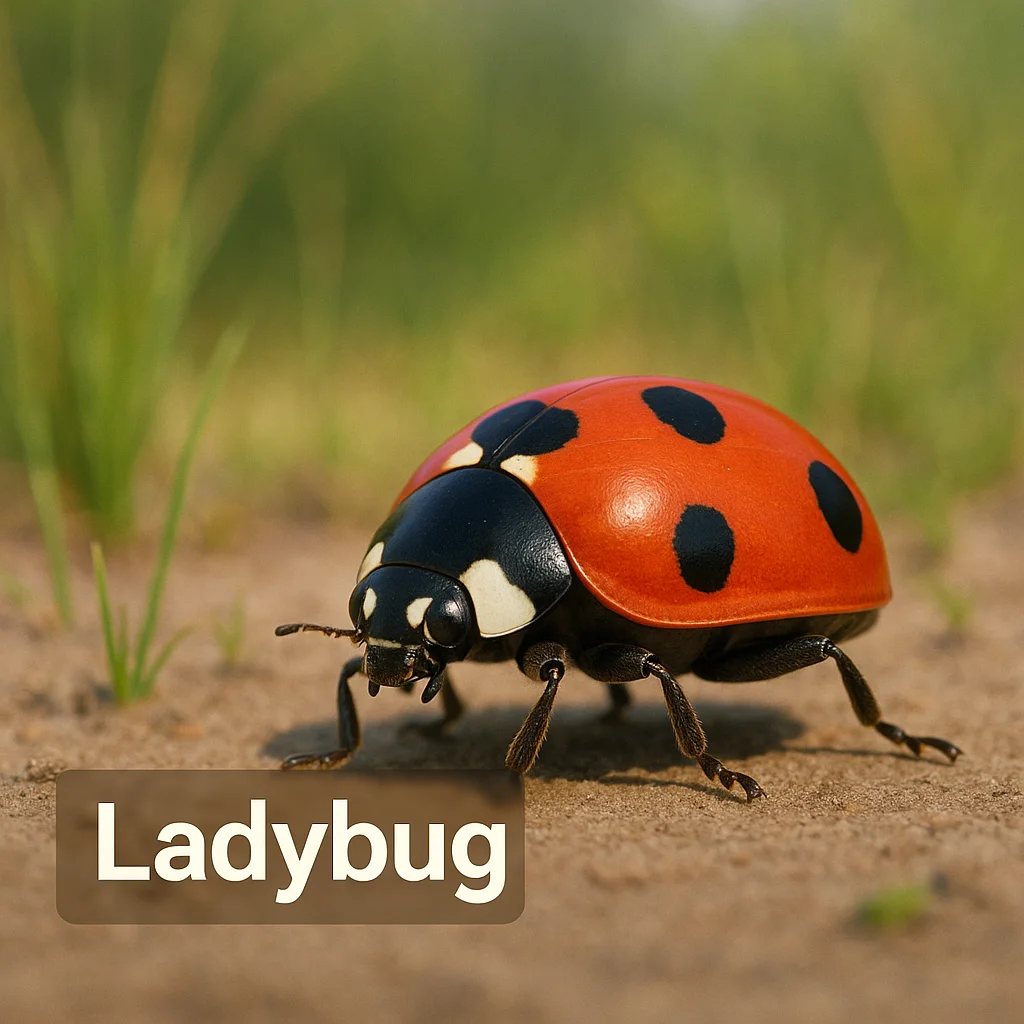
- Common name(s): Ladybug, Ladybird, Lady Beetle
- Scientific name: Varies (commonly Coccinellidae family)
- Animal type: Invertebrate
- Typical adult size: 1-10 mm in length
- Typical lifespan: 1-2 years
- Diet type: Carnivore (primarily aphids and other pests)
- Activity pattern: Diurnal
- Social structure: Solitary but can aggregate in large groups
- Speed / movement highlights: Can fly short distances; primarily walk
- Intelligence/learning: Basic problem-solving; relies on instincts
- Primary habitats: Gardens, fields, forests, grasslands
- Geographic range: Found worldwide except Antarctica
- Predators/threats: Birds, frogs, wasps; affected by habitat loss and pesticides
- Conservation status: Generally stable, varies by region
🔍 Identification & Appearance
Ladybugs are small, dome-shaped beetles with brightly colored wings, usually red or orange with black spots. Their body is round and smooth, making them easily recognizable. Ladybugs can vary in color and pattern depending on the species, some having black, yellow, or even spotless variations.
- Body shape: Round and dome-shaped
- Key colors: Red, orange, yellow with black spots
- Distinctive features: Black spots, hard shiny elytra (wing covers)
- Tracks and signs: No significant tracks or signs
- Look-alikes: Asian lady beetles; distinguished by their slightly larger size and M-shaped mark on the pronotum
- Top ID Tips
- Look for round, dome-shaped body
- Identify bright wing colors with distinct black spots
- Note the smooth texture of the wings
- Check for black head with white patches
- Observe for potential color variations within the same species
🧱 Body Structure & Physical Adaptations
Ladybugs have a compact and robust body with the characteristic hard forewings called elytra, which protect their more delicate hindwings. The dexterous legs allow them to crawl in tight spaces. Equipped with mandibles, ladybugs are effective at catching and consuming small prey.
- Key Adaptations
- Compact, round shape for protection
- Hard elytra that cover and protect the wings
- Mandibles for capturing prey
- Bright coloration as a warning sign to predators
- Ability to secrete chemicals to deter predators
🌍 Range & Distribution
Ladybugs are globally distributed, being found in a wide array of habitats except for Antarctica. They thrive in temperate and tropical regions, frequenting grasslands, gardens, forests, and agricultural fields.
- Where You Might Find It
- Across North America in gardens and parks
- Common throughout Europe in forests and fields
- Present in various habitats in Asia and Africa
- In agricultural areas worldwide
- Seen in urban green spaces
🏞️ Habitat & Shelter
Ladybugs favor environments rich in vegetation, where their prey, such as aphids, is abundant. During cooler months, they seek shelter under rocks, bark, or leaf litter and can hibernate in large groups to conserve warmth.
Their habitat preference for gardens and fields not only provides food but also an opportunity to control pest populations naturally. Understanding their habitat helps in promoting their presence in pest management.
🧭 Behavior & Ecology
Ladybugs are active hunters during the day, actively searching for aphids and other pests. They play a crucial role in ecosystems as natural pest controllers. Communicating through pheromones, ladybugs can aggregate in large numbers, especially when preparing for hibernation.
- Behavior Highlights
- Diurnal activity pattern aligned with prey availability
- Congregation in large groups for overwintering
- Chemical defense mechanism when threatened
- Pheromone signaling for aggregation
- Subtle role as pollinators while moving from plant to plant
👥 Social Life & Group Dynamics
Solitary by nature, ladybugs may occasionally be found in groups, especially during migration or hibernation periods. While they do not form traditional colonies, their aggregating behavior is a response to environmental challenges, such as cold weather.
- Social Structure Notes
- Tends to live alone outside hibernation periods
- Non-territorial and rarely exhibit dominance behaviors
- Minimal parental care as larvae are independent
- Utilize aggregative behavior for winter survival
🍽️ Diet, Prey & Predators
Ladybugs primarily feed on aphids, which are their favorite prey. They also consume other small insects and larvae. Natural predators include birds, lizards, and other insectivores. Their aposematic coloration and ability to emit a foul-tasting fluid serve as primary defenses.
- Feeding Notes
- Aphids are the main prey item
- Diet includes mites, insect eggs, small caterpillars
- Known to practice cannibalism in scarcity
- Aposematic coloration deters many predators
🦌 Hunting, Foraging & Movement
Ladybugs are flagbearers of efficient foraging. Moving both on plants and via short flights, they thoroughly explore vegetation to find aphid colonies. Cooler weather may limit their movement, prompting survival strategies such as overwintering in groups.
- Movement & Strategy
- Flies short distances to locate more aphid colonies
- Efficient crawler on various plant surfaces
- Relies on visual cues to locate prey
- Aggregation indicates strategic response to environmental cues
🧠 Intelligence & Senses
Ladybugs demonstrate basic problem-solving skills, particularly related to prey capture. Their senses primarily rely on vision to detect prey and environmental cues. The ability to secrete yellowish fluid as a defense mechanism is also critical for survival.
- Notable Abilities
- Highly effective vision for prey detection
- Secretion of deterrent chemicals under threat
- Use of coloration as a defense strategy
- Basic problem-solving instincts
🪺 Reproduction, Pregnancy & Parenting
These beetles are typically promiscuous with mating occurring in spring when temperatures rise. Females lay eggs in clusters on the underside of leaves, often near aphid colonies. The larvae, emerging after a few days to weeks, are independent and voracious predators themselves.
- Reproduction Snapshot
- Breeding in spring, linked to temperature rise
- Females lay clusters of eggs on vegetation
- Larvae are mainly black with orange markings
- No parental care; larvae fend for themselves
♀️♂️ Male vs Female Differences
Differences between male and female ladybugs are subtle, typically involving size, with females generally being slightly larger. Both possess similar coloration and patterning. Behavioral roles do not significantly differ, with both sexes participating in voracious feeding on pests.
- Sex Differences at a Glance
- Females marginally larger than males
- Both genders share similar feeding behaviors
- No substantial differences in coloration
🧬 Subspecies & Variation
The specificity of ladybug subspecies is subject to regional diversity, with variations in color and spot patterns being common. Species like the seven-spotted ladybug (Coccinella septempunctata) are widely recognized, but many others vary greatly across their range.
- Variation Notes
- Coloration varies by species and region
- Spot patterns differ among species
- Adaptations to local environments are common
⚠️ Threats, Conservation & Human Interaction
While ladybug populations are generally stable, localized threats include pesticide use and habitat destruction, impacting their prey availability. Conservation efforts focus on maintaining natural habitats and reducing chemical use in agriculture. Ladybugs are welcomed in gardens and farms for pest control but should be introduced responsibly.
- Responsible Notes
- Minimize pesticide usage to protect populations
- Encourage natural habitats in gardens
- Acknowledge their pest control role in agriculture
✨ Fun Facts & Unique Traits
- Ladybugs can eat up to 5,000 aphids in their lifetime
- Known for their ability to play dead to escape predators
- Can emit a defensive odor to deter enemies
- Ancient cultures considered them symbols of luck
- Their bright coloring is a warning for predators
📌 Summary
- Vibrant beetles often recognized by their red and black coloration
- Found worldwide, favoring temperate and tropical regions
- Predominantly feed on aphids, serving as natural pest control agents
- Solitary creatures, yet they aggregate for hibernation
- Promiscuous reproduction with independent larvae
- Subtle sexual dimorphism, with females being slightly larger
- Local variations in appearance due to wide range distribution
- Pesticide and habitat loss pose threats, though populations are stable
- Integration into agricultural practices supports pest management