🦁 Moon Jellyfish
🧾 Quick Facts
Moon jellyfish, also known by their scientific name often listed as Aurelia aurita, are among the most recognized and widespread jellyfish species encountered across the world's oceans.
- Common name(s): Moon Jellyfish, Common Jellyfish
- Scientific name: Often listed as Aurelia aurita, but varies
- Animal type: Invertebrate
- Typical adult size: Diameter ranges from 25 to 40 cm
- Typical lifespan: Up to 1 year in the wild
- Diet type: Carnivore, feeding on small plankton, including mollusks and crustaceans
- Activity pattern: Mostly passive drifters, influenced by tidal currents
- Social structure: Generally found in groups known as smacks
- Speed / movement highlights: Moves with a gentle pulsation; not fast swimmers
- Intelligence/learning: Limited to basic responses to stimuli
- Primary habitats: Coastal waters and estuaries
- Geographic range: Found in most of the oceans worldwide
- Predators/threats: Natural predators include sea turtles and larger fish; human activities like pollution also pose threats
- Conservation status: Not currently at risk, status varies by region
🔍 Identification & Appearance
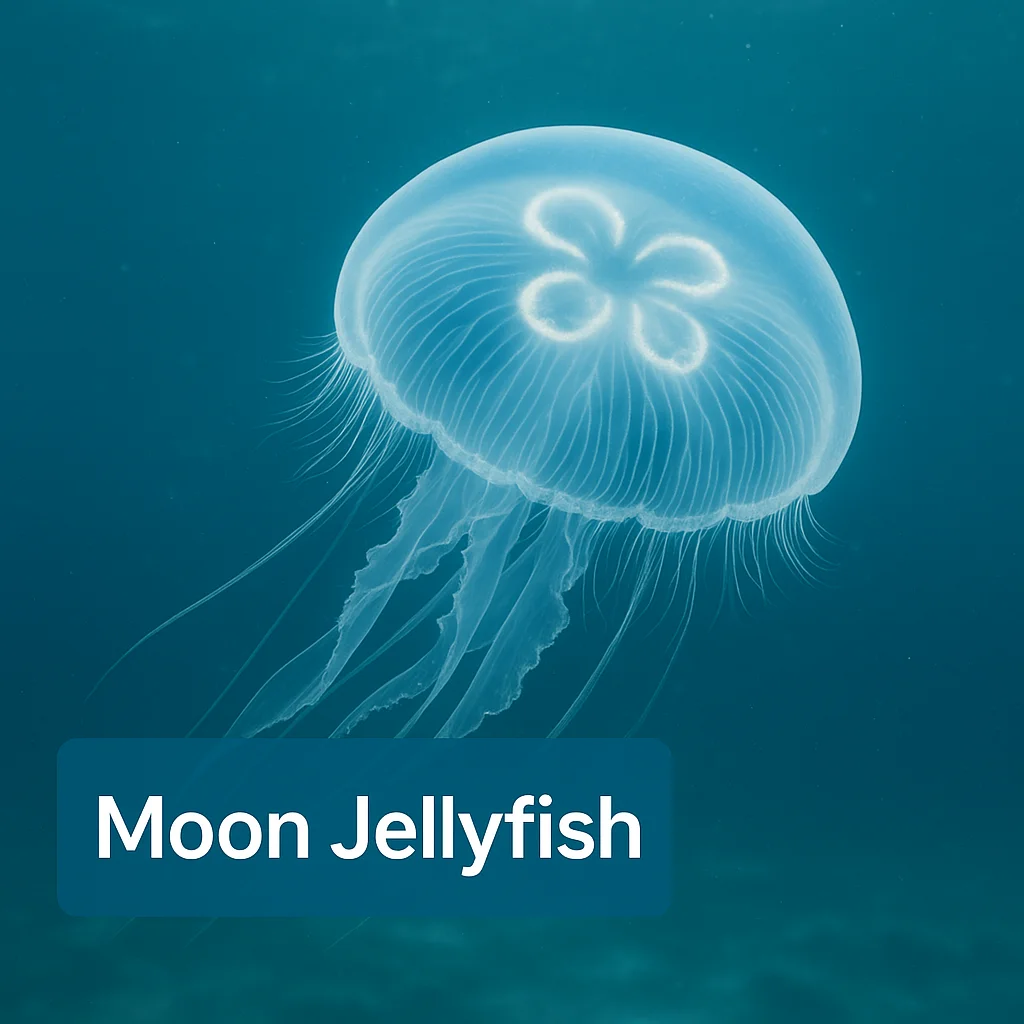
The moon jellyfish can be easily identified by its translucent bell and visible gonads, which are typically arranged in a four-leaf clover pattern. Their pale, milky-white appearance can sometimes display a hint of pink or blue, depending on their diet.
- Body shape and silhouette: Circular, dome-like bell
- Key colors/patterns: Transparent with slight hues
- Distinctive features: Four-petaled gonads visible through the bell
- Tracks, scat, or other field signs: Does not leave tracks; floating at the mercy of currents
- Common look-alikes: Can be confused with other jellyfish species, but distinguished by their unique bell pattern
- Top ID Tips:
- Look for the four-leaf clover-shaped gonads
- Notice the translucent, gelatinous bell
- Observe the slow pulsing motion in the water
- Avoid confusion with similar species by size and bell patterns
- Check for the presence in coastal, low-salinity waters
- Observe in groups or smacks that are often seen floating together
🧱 Body Structure & Physical Adaptations
The moon jellyfish has evolved a simple yet effective design as a passive drifter. Its gelatinous umbrella-like body aids in buoyancy, while its tentacles are used to capture prey.
- Build and proportions: Round, symmetrical body with a soft, flexible structure
- Teeth/beak/jaw adaptations: Lack teeth; digest food by using enzymes
- Claws/hooves/wings/fins adaptation: Tentacles are adapted to incapacitate prey before it is guided to the mouth
- Sensory strengths: Sensitive to light changes, which helps in orienting in the water column
- Key Adaptations:
- Translucent body for predator evasion
- Radial symmetry for uniform swimming
- Simple digestive cavity
- Tentacles with stinging cells for prey capture
- Semi-rigid mesoglea providing buoyancy
- Adaptation for low energy consumption lifestyles
🌍 Range & Distribution
Moon jellyfish are cosmopolitan, meaning they occur throughout the world's oceans except for the most extreme polar regions. They thrive in temperate and tropical waters, usually favoring estuaries and coastal areas where tidal currents can support their passive drifting lifestyle.
- Where You Might Find It:
- Coastal regions of the Atlantic and Pacific Oceans
- Southern Indian Ocean zones
- Gulf of Mexico
- Southern Japanese waters
- North and Baltic Seas
- Sub-tropical and temperate seas
- Areas with nutrient upwellings
- Protected bays and inlets
- Regions with substantial plankton concentration
🏞️ Habitat & Shelter
Moon jellyfish prefer the upper layers of the water column where sunlight penetrates and where microscopic plankton can be abundant. They are often found in slightly brackish waters like estuaries, where they can better regulate salinity levels, a crucial factor in their development and survival.
🧭 Behavior & Ecology
Moon jellyfish exhibit a unique passive lifestyle, floating with the currents and pulsating their bodies as a movement method. Their ecological role predominantly involves controlling zooplankton populations, serving as prey for larger marine species, and indirectly influencing fishery dynamics.
- Behavior Highlights:
- Exhibited drifting throughout various water currents
- Pulsating, gentle jelly movements for navigation
- Low aggression, avoiding active hunting
- Influencing plankton population dynamics
- Playing a role in the food web as prey
- Interacting with environmental factors like tides and seasons
- Seasonally abundant in specific regions
- Primarily a food source for sea turtles
- Nocturnal surfacing, influenced by plankton availability
👥 Social Life & Group Dynamics
Moon jellyfish often aggregate in large groups, known as smacks, especially during breeding and feeding times. These clusters help them remain stable in current flows while maximizing feeding success.
- Social Structure Notes:
- Not territorially-driven
- Non-competitive feeding strategy
- Swarm behavior in nutrient-rich areas
- No defined hierarchies or social roles
- Non-cooperative yet solitarily surviving
- Seasonally affected aggregated habits
- Spawning often synchronized within groups
- Inhabiting similar zones with other invertebrate species
- No complex social bonds or structures
🍽️ Diet, Prey & Predators
Moon jellyfish primarily feed on planktonic crustaceans and mollusks, capturing them with their tentacles. They play a significant role in controlling zooplankton populations. Natural predators include sea turtles, larger fish, and other jellies, while human activities pose additional threats.
- Feeding Notes:
- Feeding through passive filtration
- Sustained by tidal plankton abundance
- Stunning prey with specialized stinging tentacles
- Preyed upon by sea turtles
- Vulnerable to larger fish species
- No active pursuit feeding strategy
- Significant presence in nutrient-rich upwellings
- Occasional scavenging of dead organisms
- Incidental ingestion of microplastics noted
🦌 Hunting, Foraging & Movement
Moon jellyfish are characterized by their drifting movement facilitated by minimal pulsations of their bell, with hunting confined to capturing plankton as it drifts into their tentacles. They lack active predatory behavior but continue their approach to utilize water currents for transportation and feeding.
- Movement & Strategy:
- Drifting alongside currents and tides
- Utilizing minimal energy through pulsation
- Accumulating in nutrient-rich upwellings
- Feeding predominantly at tide shifts
- Vertically migrating for plankton availability
- Ability to subsist without active predation
- Conservation of energy in passive existence
- Presence driven by environmental cue responses
🧠 Intelligence & Senses
Moon jellyfish possess basic nervous systems, receiving and responding to changes in environmental stimuli. They lack advanced problem-solving skills or social intelligence, relying primarily on their ability to sense physical stimuli such as light and pressure changes in their environment.
- Notable Abilities:
- Responding to light changes
- Orientation with environmental shifting
- Basic nervous system responses
- Absence of the centralized brain structure
- Lack of complex social interaction
- Environmental dependency on survival triggers
- Limited adaptive behavior capabilities
🪺 Reproduction, Pregnancy & Parenting
Moon jellyfish reproduce through a mechanism called "strobilation," involving asexual and sexual reproduction phases. Planula larvae develop into polyps, which later become mature jellyfish. Parental roles are non-existent, as larvae develop independently.
- Reproduction Snapshot:
- Synchronous spawning cycles
- Asexual polyp budding
- Larvae called planula
- Transitions through polyp and medusa stages
- External fertilization system
- Synchronized environmental cues
- Spawning triggered seasonally
- No parental care involved
♀️♂️ Male vs Female Differences
Moon jellyfish exhibit minimal sexual dimorphism, with males and females being structurally indistinct except for reproductive organs.
- Sex Differences at a Glance:
- Distinct by reproductive organ structure
- Visual identification of sex is challenging
- Males release sperm into water column
- Females carry planula larvae internally
- Main difference lies within reproductive system
🧬 Subspecies & Variation
The subspecies classification of moon jellyfish can vary as they adapt locally to different environmental conditions. These variations mostly involve size and reproductive traits but are not distinctly separated at the taxonomic level.
- Variation Notes:
- Localized size variation due to resource access
- Diet-driven coloration differences
- Marginal reproductive trait variation
- Adaptations to local salinity levels
- Geographic distribution drives genetic diversity
⚠️ Threats, Conservation & Human Interaction
Moon jellyfish face natural predation from larger marine species, while human-induced threats such as pollution, habitat destruction, and climate change represent additional challenges. Efforts focus on ecological balance and habitat protection, avoiding direct handling or interference.
- Responsible Notes:
- Sensitive to water pollution and habitat loss
- Beneficial to the marine food chain
- Informs biodiversity conservation strategies
- Interaction with jellyfish blooms varies
- Climatic shifts impact jellyfish distribution
- Minimal direct human economic impact
- Encourage respectful biodiversity coexistence
✨ Fun Facts & Unique Traits
- Moon jellyfish can glow under sunlight due to shimmery tissues.
- They primarily feed through passive capture of plankton.
- Their name comes from the moon-like translucent appearance.
- They lack a centralized nervous system.
- Moon jellyfish are significant in controlling zooplankton populations.
- Their stinging cells are often harmless to humans due to weak venom.
- Able to survive in low-oxygen environments.
- Adaptation to various salinity levels ensures widespread distribution.
- They serve as a food resource for endangered sea turtles.
📌 Summary
- Moon jellyfish are easily recognized by their translucent bell and four-leaf clover gonads.
- Thriving in coastal and estuary waters globally.
- Ecologically important as zooplankton predators.
- Drifting movement with currents, using minimal energy.
- Primarily feed on small plankton, exerting influence over marine populations.
- Group tendencies include forming smacks, aiding survival.
- Reproduction includes both asexual and sexual phases with no parenting.
- Limited sexual dimorphism with primary external similarity between genders.
- Adaptive features allow survival in varied marine environments.
- Subspecies classification is debated, showing some local variations.