🦁 Sea Star
🧾 Quick Facts
Sea stars, often referred to as starfish, are marine invertebrates belonging to the class Asteroidea. They are known for their star-shaped appearance, and despite their name, they are not actually fish. Sea stars are fascinating components of marine ecosystems and come in various forms and colors.
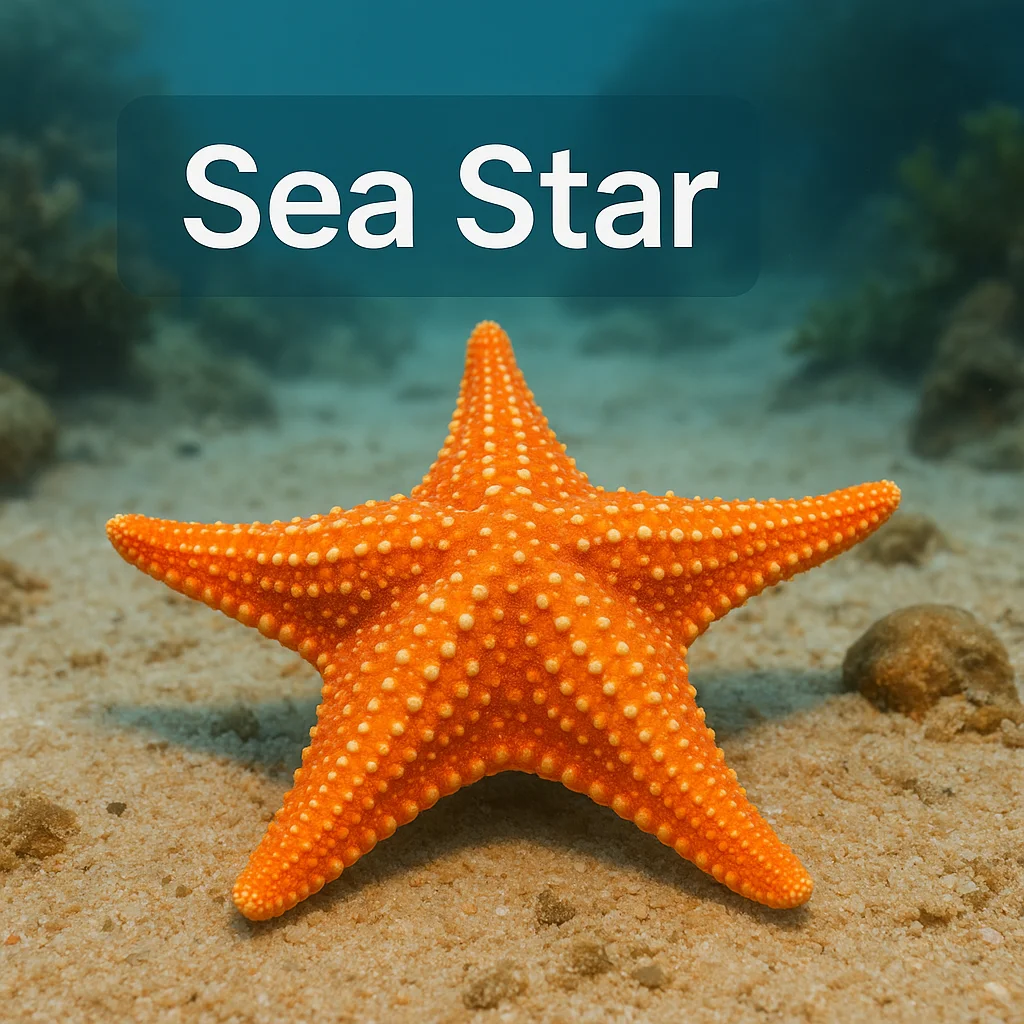
- Common name: Sea Star, Starfish
- Scientific name: Varies (classified under class Asteroidea)
- Animal type: Invertebrate
- Typical adult size: 5 cm to 40 cm across arm span
- Typical lifespan: 5 to 35 years
- Diet type: Carnivore; feeds mainly on mollusks and small fish
- Activity pattern: Mostly diurnal but varies by species
- Social structure: Solitary or loosely aggregated in suitable habitats
- Speed: Moves slowly using tube feet
- Intelligence: Simple nervous system, capable of basic responses to environmental stimuli
- Primary habitats: Ocean floors, coral reefs, rocky shores
- Geographic range: Found in oceans worldwide, from the tropics to polar regions
- Predators/threats: Fish, sea otters, birds, and human activities like pollution and collection
- Conservation status: Varies by species; some are impacted by habitat loss and climate change
🔍 Identification & Appearance
Sea stars can be easily identified by their radially symmetrical, star-like shape, typically featuring five arms, although some species can have more. Their skin texture and coloration may vary significantly, displaying a palette of vibrant reds, oranges, blues, and purples, often with patterned designs.
- Body shape resembling a star, typically with five arms
- Color variations include bright reds, oranges, blues, and purples
- Distinctive, spiny or smooth surface depending on species
- Small, tube-like feet located on the underside of the arms
- Ambulacral grooves visible on the ventral side
- Some species may have a central disk that is distinct from the arms
- Common look-alikes include brittle stars, which have slenderer arms and more flexible movement
- No tracks or scat, but remnants of prey (like shells) may indicate presence
🧱 Body Structure & Physical Adaptations
Sea stars have a unique body structure that supports their oceanic lifestyle. Their arms are equipped with hundreds of tube feet, which function through a hydraulic water vascular system, allowing them to adhere to surfaces and manipulate objects.
- Radial symmetry centered around a central disc
- Tube feet with suction capability for movement and prey capture
- Calcareous plates under the skin provide structural support
- Eye spots at the end of each arm can detect changes in light
- Simple nerve ring coordinates responses without a brain
- Capability to regenerate lost arms
- Spines and skin patterns serve as protection and camouflage
🌍 Range & Distribution
Sea stars inhabit diverse marine environments around the world, from the shallow tide pools to the deep-sea floors. They exhibit a broad range of geographic distribution, adapting to various climates and oceanic conditions.
- Present in all major oceans
- Common in both tropical and temperate regions
- Found in intertidal zones and deep-sea environments
- Commonly seen on coral reefs and rocky substrates
- Some species prefer sandy or muddy ocean floors
- Not found in freshwater systems
- Adapt to various depths and water temperatures
- Range includes areas from polar seas to tropical waters
🏞️ Habitat & Shelter
Sea stars often habitat environments rich in biodiversity, such as coral reefs, rocky shores, and the ocean floor. They are specially adapted to cling to substrates, allowing them to withstand currents and tides.
- Prefer hard substrates like rocks and corals
- Occasionally found on sandy or muddy bottoms
- Shelter under rocks and within crevices during harsh conditions
- Weather and tidal changes influence activity levels
- Adaptations for variable salinity and temperature changes
- Key component of reef and intertidal zone ecosystems
🧭 Behavior & Ecology
Sea stars play a crucial role in marine ecosystems, often serving as predators and influencing the population dynamics of their prey. They exhibit behaviors such as feeding through everting their stomachs and using chemical cues to locate prey.
- Exhibit a slow, gliding movement
- Use tube feet for sensory exploration and locomotion
- Feed by extending the stomach out of the body
- Able to detect food and mates through water-borne signals
- Important predators of shellfish and coral reef inhabitants
- Contribute to marine biodiversity through predation
- Solitary but sometimes seen congregating for feeding or reproduction
👥 Social Life & Group Dynamics
Typically solitary, sea stars do not form tight social bonds. However, they can be found in groups under conditions that are favorable for feeding or breeding.
- Generally solitary creatures
- Not structured into social hierarchies
- Groups often form around abundant food sources
- Interacting more during breeding seasons
- No evidence of cooperative behavior
- Loosely aggregated rather than forming structured groups
🍽️ Diet, Prey & Predators
Sea stars are carnivorous, feeding primarily on mollusks, bivalves, and occasionally small fish. They play a vital role in controlling prey populations, although they themselves are preyed upon by various marine animals.
- Consumes clams, oysters, and other shellfish
- Diet includes dying or dead fish opportunistically
- Uses tube feet to pry open shellfish and evert stomach to feed
- Preyed upon by larger fish, birds, and marine mammals
- Coloration can offer some protection from predators
- Rely on camouflage and armor-like skin for defense
🦌 Hunting, Foraging & Movement
With inherent slow movement across the sea floor, sea stars utilize their tube feet for foraging and capturing prey. Their moves are deliberate and efficient, using both chemical and tactile senses to locate food.
- Move using a water-based vascular system
- Apply slow yet exertive force to capture prey
- Can detect food through environmental chemical cues
- Occur both during day and night
- Some species exhibit migratory behavior linked to tidal movements
🧠 Intelligence & Senses
Though sea stars lack complex brains, their nerve ring allows basic processing of sensory information. They effectively use chemoreceptors for locating food, mates, and interacting with their environment.
- Total absence of centralized nervous system
- Respond to changes in light and touch
- Excellent capability to regenerate lost limbs
- Eye spots detect changes in light intensity
- Simple nerve networks facilitate movement and feeding
- Chemoreception helps locate prey and mates
🪺 Reproduction, Pregnancy & Parenting
Sea stars reproduce both sexually and asexually. They release eggs and sperm into the water column during breeding seasons, relying on external fertilization. Some species are capable of regenerating whole new individuals from a single lost limb.
- Breeding mostly occurs during warmer months
- Capable of both sexual and asexual reproduction
- External fertilization in water column
- Larvae develop in plankton before settling
- No parental care post-fertilization
- Regeneration from a single limb under the right conditions
♀️♂️ Male vs Female Differences
In sea stars, sexual dimorphism is subtle, and externally differentiating males from females is challenging without carefully examining reproductive organs.
- No obvious size or color differences between sexes
- Males and females release sperm and eggs into the water
- Genders difficult to distinguish without dissection
- Reproductive organs similar in appearance
- Behavioral differences between sexes minimal
🧬 Subspecies & Variation
With over 1,500 species of sea stars, they show a tremendous diversity in form, color, and habitat preferences. Some variation occurs at the level of individual species, often driven by different environmental pressures.
- Wide variance in size and coloration
- Species adapted to specific marine biomes
- Discrepancies in arm number, from 5 to 40
- Diversity not fully documented in some remote habitats
- Challenges in classification due to overlapping morphological traits
⚠️ Threats, Conservation & Human Interaction
While sea stars are resilient, they face numerous threats from environmental changes and human activities. Conservation efforts focus on addressing habitat destruction, climate change, and pollution impacts.
- Impacted by pollution and shoreline development
- Climate change affects ocean temperature, altering habitats
- Popularity in the pet and souvenir trade threatens wild populations
- Marine protected areas work to conserve sea star habitats
- Studying ecosystem roles contributes to conservation strategies
✨ Fun Facts & Unique Traits
- Capable of regenerating entire bodies from a fragment
- Digest prey by everting stomachs outside their bodies
- Equipped with hydrodynamic vascular systems for movement
- Ancient lineage dating back over 450 million years
- Can be vital indicators of ocean health and environmental change
- Some sea stars can tolerate a wide range of salinities
📌 Summary
- Sea stars are found in oceans worldwide
- Easily recognized by their star-like shape and vibrant colors
- Play a critical role in marine ecosystem dynamics
- Feed primarily on mollusks, using tube feet for movement and feeding
- Face threats from pollution and climate change
- Exhibit remarkable abilities like regeneration and environmental adaptation
- Exhibit minor sexual dimorphism, generally requiring dissection to differentiate
- Reproduction includes both sexual and asexual methods