🦁 Stick Insect
🧾 Quick Facts
The stick insect, also known as a walking stick, is a fascinating group of insects known for their incredible camouflage abilities. These insects are spread across various regions and possess unique adaptations that allow them to blend seamlessly into their surroundings.
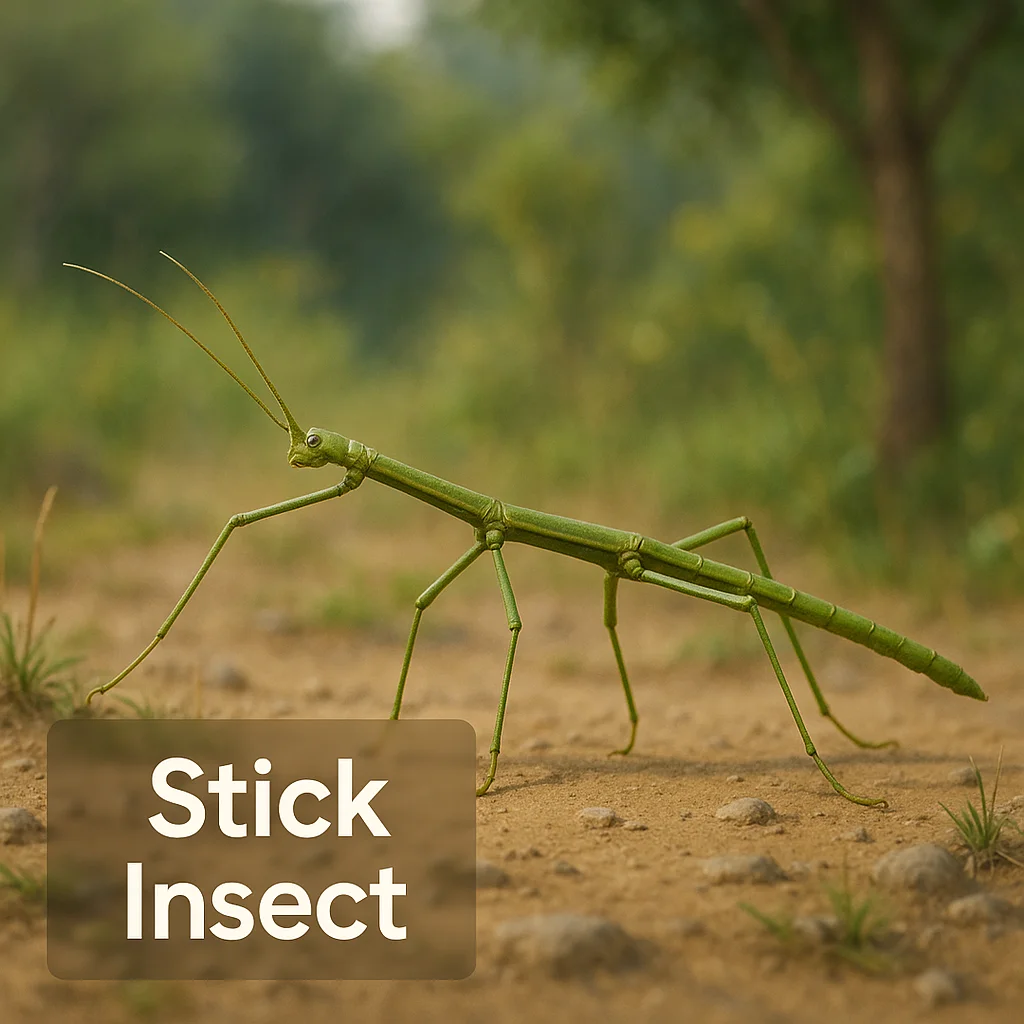
- Common name(s): Stick Insect, Walking Stick
- Scientific name: Phasmatodea (order)
- Animal type: Invertebrate
- Typical adult size: 1-13 inches (2.5-33 cm) in length
- Typical lifespan: 1-2 years
- Diet type: Herbivore; primarily feeds on leaves
- Activity pattern: Mainly nocturnal
- Social structure: Solitary
- Speed / movement highlights: Slow moving; primarily walking
- Intelligence/learning: Basic survival instincts; relies on camouflage
- Primary habitats: Forests, grasslands
- Geographic range: Worldwide in tropical and subtropical regions
- Predators/threats: Birds, small mammals, habitat loss due to human activity
- Conservation status: Varies by region
🔍 Identification & Appearance
Stick insects are unmistakably identified by their elongated, stick-like bodies which mimic twigs and branches. Their coloration varies from green to brown, adapting to their environment to further enhance their disguise. Some can even change color slightly to match their immediate surroundings.
- Elongated, slender bodies resembling sticks
- Coloration in shades of brown or green
- Legs often mimic twigs with small 'leaf' projections
- Wings, if present, are usually small and concealed
- Slow, deliberate movement
- Antennae often long and thin
- Lack of bright distinguishing marks
- May freeze motion when threatened to enhance camouflage
- Resembles plant matter, making them hard to spot
🧱 Body Structure & Physical Adaptations
Stick insects feature a highly specialized body structure that enhances their survival. Their elongated limbs and body allow them to mimic the appearance of twigs and branches, vital for avoiding predators.
- Slender, twig-like build for camouflage
- Legs adapted for gripping branches and leaves
- Mouthparts designed for chewing leaves
- Camouflage abilities assist in predator evasion
- Possess simple eyes; limited vision focused on shadow detection
- Limited reliance on sound; primarily use camouflage and stillness for protection
- May exhibit a flight or freeze response when threatened
- Some species capable of limb regeneration
- Use walking as their primary means of movement
🌍 Range & Distribution
Stick insects are widely distributed across the globe, thriving in diverse environments, but are most commonly found in tropical and subtropical regions where vegetation is abundant.
- Tropical Asia
- Australia
- African bushlands
- Central and South America
- Some parts of North America
- Forests and woodlands
- Grasslands
- Preferred lowland to mid-elevation areas
- Normally resident; minimal seasonal movement
🏞️ Habitat & Shelter
Stick insects primarily inhabit areas dense with vegetation, such as forests and grasslands. They prefer regions where their camouflage can be effectively utilized against the backdrop of branches and leaves.
- Forests
- Grasslands
- Live among twigs and leaves for concealment
- Active mainly at night, to avoid daytime predators
- Shelter in dense foliage during the day
- Their presence in habitat changes as plant availability shifts with seasons
🧭 Behavior & Ecology
Stick insects lead a relatively solitary and quiet life. Their primary ecological role is that of a herbivore, contributing to the food chain and supporting predator species like birds and small mammals.
- Nocturnal, mainly active during the night
- Freeze behavior as a primary defense mechanism
- Minimal vocalizations; relies on camouflage
- Interaction with other species primarily as prey
- Contribute to nutrient cycling by consuming plant material
- Often remain motionless during the day
- May show limited territorial behavior, mainly due to resource availability
- Detach and regenerate limbs when caught by predators
👥 Social Life & Group Dynamics
Stick insects are predominantly solitary creatures. They rarely form groups and their interactions are generally limited to mating and competition for resources.
- Solitary lifestyle with minimal interaction
- No complex social structures
- Occasional overlap in habitat due to food sources
- Temporary pair formations during mating season
- Minimal conflict, generally avoidant rather than confrontational
- Females often larger and less mobile than males
- Primary interaction with species is predator-prey dynamics
🍽️ Diet, Prey & Predators
Stick insects are herbivorous, feeding on the leaves of various plants, shrubs, and trees. Their diet does not vary significantly by season or life stage, but they can adapt based on plant availability.
- Leaves of shrubs and trees are primary food sources
- Preference for certain plant species depending on region
- Main predators include birds, reptiles, and small mammals
- Employ camouflage and stillness as defense mechanisms
- Rarely show scavenging behavior due to herbivorous nature
- Leaves serve as a consistent and abundant food source
- May occasionally feed on flowers or buds
🦌 Hunting, Foraging & Movement
Stick insects utilize a slow and stealthy approach for foraging, primarily relying on their appearance to avoid predators.
- Primarily rely on walking for movement
- Stealth and slow movements minimize detection
- Foraging occurs mostly at night
- Non-territorial; roaming is resource-driven
- Camouflage remains crucial for safe foraging
- Do not migrate; remain in favorable habitats year-round
🧠 Intelligence & Senses
The stick insect's intelligence is basic, focusing more on survival through camouflage rather than complex problem-solving or tool use.
- Basic learning and instinctual behavior
- Primarily rely on camouflage for protection
- Limited range of senses; primarily visual awareness for detecting threats
- Utilize basic escape strategies like limb detachment
- Limited research on cognitive abilities
- Adequately adapted for their ecological niche
🪺 Reproduction, Pregnancy & Parenting
Stick insects exhibit a variety of reproductive strategies, including sexual reproduction and parthenogenesis, where females can produce offspring without mating.
- Breeding season varies with climate; often after rains
- Some species reproduce through parthenogenesis
- Laying eggs in or on the ground
- Incubation depends on environmental conditions
- No parental involvement post egg-laying
- Clutch size ranges considerably with species
- Development from egg to adult often spans several months
- Young are miniature versions of adults
♀️♂️ Male vs Female Differences
Males and females can differ significantly in size and morphology, which can be attributed to their different roles in reproduction.
- Females generally larger and heavier
- Males often have longer antennae for detecting females
- Females possess a larger abdomen for egg carrying
- Males more active, frequently searching for females
- Size differences aid in role-specific features like egg production
- Coloration usually consistent between sexes
- Subtle behavior differences related to reproduction and courtship
🧬 Subspecies & Variation
Given the diverse group of species within Phasmatodea, variation can be quite extensive. Classification often varies, and new species are still being discovered.
- Diverse range with over 3,000 species globally
- Size varies significantly across the group
- Variation in coloration and patterns for regional adaptation
- Differences in wing development; some species are wingless
- Adaptations specific to local environments, like desert or forest
- Species classification debated among scientists
⚠️ Threats, Conservation & Human Interaction
Stick insects face threats primarily from habitat destruction and agricultural activities. Conservation efforts are region-specific due to the broad variety of species.
- Natural habitat loss due to deforestation
- Pesticide use in agriculture impacts populations
- Little direct interaction with humans
- Some species kept in captivity as pets; requires ethical care
- Climate change affecting habitat availability
- Deforestation remains a significant threat
- Conservation status varies; some species protected due to their vulnerability
✨ Fun Facts & Unique Traits
- Stick insects can regenerate lost limbs.
- Some species are capable of reproducing without males, known as parthenogenesis.
- Longest stick insects can reach over 22 inches (56 cm) in length.
- Excellent mimics, some even sway like leaves to enhance camouflage.
- The young, known as nymphs, look like miniature versions of adults.
- They have one of the best camouflage abilities in the animal kingdom.
📌 Summary
- Identified by their long, stick-like bodies that resemble twigs.
- Found in tropical and subtropical forests worldwide.
- Primarily herbivorous, feeding on a variety of leaves.
- Predators include birds, reptiles, and small mammals.
- Normally lead solitary lives, with minimal social interaction.
- Reproduce through both sexual and asexual means.
- Camouflage is their primary adaptation for defense.
- Display highly specialized adaptations for ecological survival.
- Face threats from habitat loss and environmental changes.