🦁 Tarantula
🧾 Quick Facts
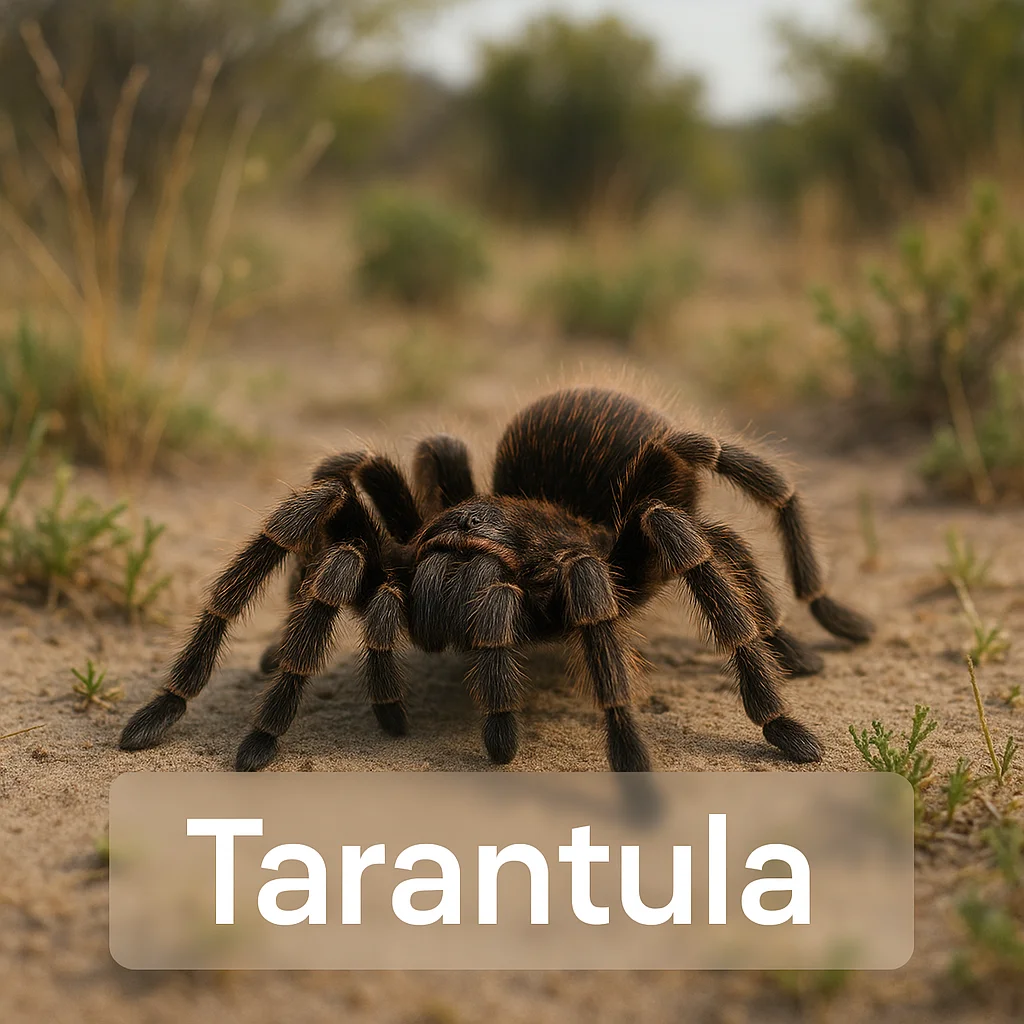
Tarantulas are large, hairy arachnids known for their intimidating presence and fascinating behaviors. Despite their fearsome reputation, these creatures play important roles in their ecosystems as both predators and prey.
- Common name(s): Tarantula
- Scientific name: Varies by species
- Animal type: Invertebrate
- Typical adult size: About 2.5 to 11 inches in leg span
- Typical lifespan: 10-30 years in captivity; often shorter in the wild
- Diet type: Carnivore; common foods include insects and small animals
- Activity pattern: Primarily nocturnal
- Social structure: Solitary
- Speed / movement highlights: Slow walkers; capable of quick bursts when threatened
- Intelligence/learning: Basic learning; relies primarily on instinct
- Primary habitats: Forests, grasslands, deserts
- Geographic range: Americas, Africa, Asia, Australasia
- Predators/threats: Birds, mammals, reptiles, and human habitat encroachment
- Conservation status: Varies by region and species
🔍 Identification & Appearance
Tarantulas can be recognized by their large bodies and hairy legs. Their coloration varies widely across species, ranging from browns and blacks to vibrant blues and reds. Age and environmental factors can influence their appearance slightly, but they remain quite recognizable.
- Top ID Tips:
- Look for large, robust bodies covered with fine hairs
- Legs are often longer than the body
- Body colors can range from dull browns to vibrant hues
- Commonly seen in defensive postures with raised front legs
- Distinctive fangs, often visible when agitated
- Body size and color patterns can help distinguish species
- Tracks are not typically left; webbing may indicate presence
- Can be mistaken for large wolf spiders; check leg span and hair density
🧱 Body Structure & Physical Adaptations
Tarantulas are built for life as ground-dwelling predators. Their stocky bodies house powerful muscles, enabling rapid bursts of speed. Their fangs are adapted to pierce and inject venom into prey. The heavy hair and robust legs aid in navigating diverse terrains and temperatures.
- Key Adaptations:
- Strong, hairy legs for traction and combat
- Venom-rich fangs for prey capture
- Strong pedipalps for handling food
- Chitin exoskeleton for protection and moisture control
- Sensitive hairs detect air currents and vibrations
- Ability to flick irritating hairs as a defensive mechanism
- Compact body reduces water loss in arid environments
- No spin webs for entrapment; use silk for burrows and egg sacs
🌍 Range & Distribution
Tarantulas inhabit a variety of regions across the globe. They are mainly found in warmer, subtropical, and tropical climates spanning several continents, including the Americas, Africa, and parts of Asia and Australasia. Elevational range and tolerable environments vary by species.
- Where You Might Find It:
- Southeastern United States
- South America, particularly Brazil
- The Caribbean islands
- Savannas of Africa
- Deserts of the southwestern United States
- Parts of South Asia
- Forests of Malaysia and Indonesia
- Australian woodlands
🏞️ Habitat & Shelter
Tarantulas prefer habitats that include forests, grasslands, and deserts, where they can find shelter underground or under natural debris. These arachnids adapt to seasonal rainfalls and temperature changes, which influence their activity levels and choice of shelter.
Understanding their habitat preferences aids in appreciating their role in controlling insect populations and their need for conservation in specific regions.
🧭 Behavior & Ecology
Tarantulas are solitary and primarily nocturnal, spending their days hidden within burrows or under natural cover. They communicate using body language and vibrations. Their ecological role mainly revolves around predation, helping control insect and small animal populations.
- Behavior Highlights:
- Solitary by nature, often territorial
- Primarily active at night for hunting and movement
- Defensive hair flicking to deter predators
- Use of silk for burrow lining rather than web entrapment
- Aggressive mimicking to scare off threats
- Vital in food chains as both predator and prey
- Occasional scavenging on dead prey
👥 Social Life & Group Dynamics
Tarantulas lead largely solitary lives, interacting minimally with others except during breeding. They do not form groups like colonies or packs, and males may be tolerated briefly during mating seasons. Territorial disputes are rare, often resolved with threat displays.
- Social Structure Notes:
- Solitary, with individual territories
- Males wander during mating seasons
- Brief interactions limited to breeding times
- Lack of cooperative behavior
- Non-hierarchical social system
- Minimal contact unless for mating
🍽️ Diet, Prey & Predators
Tarantulas are carnivorous, with diets primarily consisting of insects, though some larger species can subdue small mammals and birds. Using ambush tactics, they rely on stealth and venom to capture prey. They are preyed upon by a variety of animals, calling for evasive adaptations like burrowing or camouflage.
- Feeding Notes:
- Ambush predators, relying on surprise attacks
- Diet varies with prey availability
- Specialized fangs deliver venom to immobilize prey
- Diet primarily insect-based; occasional larger targets
- Defense against predators includes hiding and hair flicking
- Webbing use is genetic but outside typical hunting practices
- May scavenge easier meals when available
🦌 Hunting, Foraging & Movement
Tarantulas move by walking or using explosive bursts of speed when necessary. Their hunting style is primarily ambush-based, utilizing the cover of darkness to surprise their prey. They navigate their environment carefully, relying on substrate vibrations to detect movement.
- Movement & Strategy:
- Slow crawling punctuated by quick dashes
- Ambushes prey in low light or nighttime setups
- Relies on sensitive hairs to track prey and predators
- Minimal territorial movement; maintains proximity to burrow
- Nocturnal ambush hunter; waits in burrows
🧠 Intelligence & Senses
Tarantulas display instinct-driven behaviors supported by specialized senses. Their sensory hairs pick up on vibrations, playing a crucial role in hunting and threat detection. While problem-solving capabilities are basic, their survival relies heavily on learned environmental cues.
- Notable Abilities:
- Excellent vibration detection through hairs
- Limited vision, but acute sensitivity to movement
- Instinct-based adaptations to threats and prey
- Efficient in navigating home territories
- Basic learning abilities primarily to environmental changes
🪺 Reproduction, Pregnancy & Parenting
Tarantulas typically have seasonal breeding habits, engaging in elaborate courtship rituals to minimize conflict. They practice unique mating behaviors while securing mates. Female tarantulas manage egg sacs alone, with little to no male involvement post-mating.
- Reproduction Snapshot:
- Breeding occurs once a year, often in warmer months
- Mating involves dance-like movements and vibrations
- Females lay and protect large egg sacs
- Offspring are self-sufficient shortly after hatching
- Limited parental care; mothers do not tend to young
♀️♂️ Male vs Female Differences
Tarantulas exhibit sexual dimorphism, with females generally larger and more robust, and males more slender. Behavioral distinctions also exist, as males wander in search of mates. Subtle differences in coloration or patterning may also be noted.
- Sex Differences at a Glance:
- Females typically larger and broader
- Males have longer, more delicate legs
- Male palps often are modified for mating purposes
- Marked longevity differences; females live longer
- Males engage in more movement during mating season
🧬 Subspecies & Variation
There are numerous species classified under the common name "tarantula," each exhibiting its own adaptations suited to its geographic location. Variations occur in size, coloration, and behaviors across different regions and environments.
- Variation Notes:
- Variation in color and hair density distinguished by species
- Size differences reflect environmental adaptations
- Some species developed unique venom compositions
- Range adaptations may exist in tropical vs arid species
- Classification can be debated in terms of subspecies
⚠️ Threats, Conservation & Human Interaction
Tarantulas face threats from habitat loss, climate change, and the exotic pet trade. Conservation efforts vary by region, with some populations threatened by localized pressures. Coexisting with tarantulas involves respecting their habitats and understanding their ecological roles.
- Responsible Notes:
- Encroaching urban development reduces habitats
- Climate change poses unknown risks
- Capture for pet trade affects wild populations
- Excessive pesticide use can decimate prey availability
- Legal protections vary by region
✨ Fun Facts & Unique Traits
- Tarantulas can regenerate lost limbs during molts
- Despite their size, tarantulas' bites are rarely dangerous to humans
- They can flick irritating hairs from their abdomen as a defense
- Some species produce silk similar to silk moths
- They play a role in controlling insect populations
- Tarantulas have existed for millions of years with little evolutionary change
📌 Summary
- Tarantulas are large, hairy spiders known for their size
- They inhabit diverse regions including forests and deserts
- Diet primarily consists of insects and small animals
- Play a dual role as predators and prey in ecosystems
- Lead solitary lives, coming together only to breed
- Exhibit notable sexual dimorphisms
- Vital adaptations include venomous fangs and sensory hairs
- Conservation is necessary due to ecological importance
- Fascinating traits include limb regeneration and silk production