🦁 African Buffalo
🧾 Quick Facts
The African Buffalo, also known as Cape Buffalo, is a formidable and sturdy member of the bovine family, closely associated with the African savannas where it roams in large herds. Recognized for their massive horns and robust body, these animals are essential components of their ecosystems.
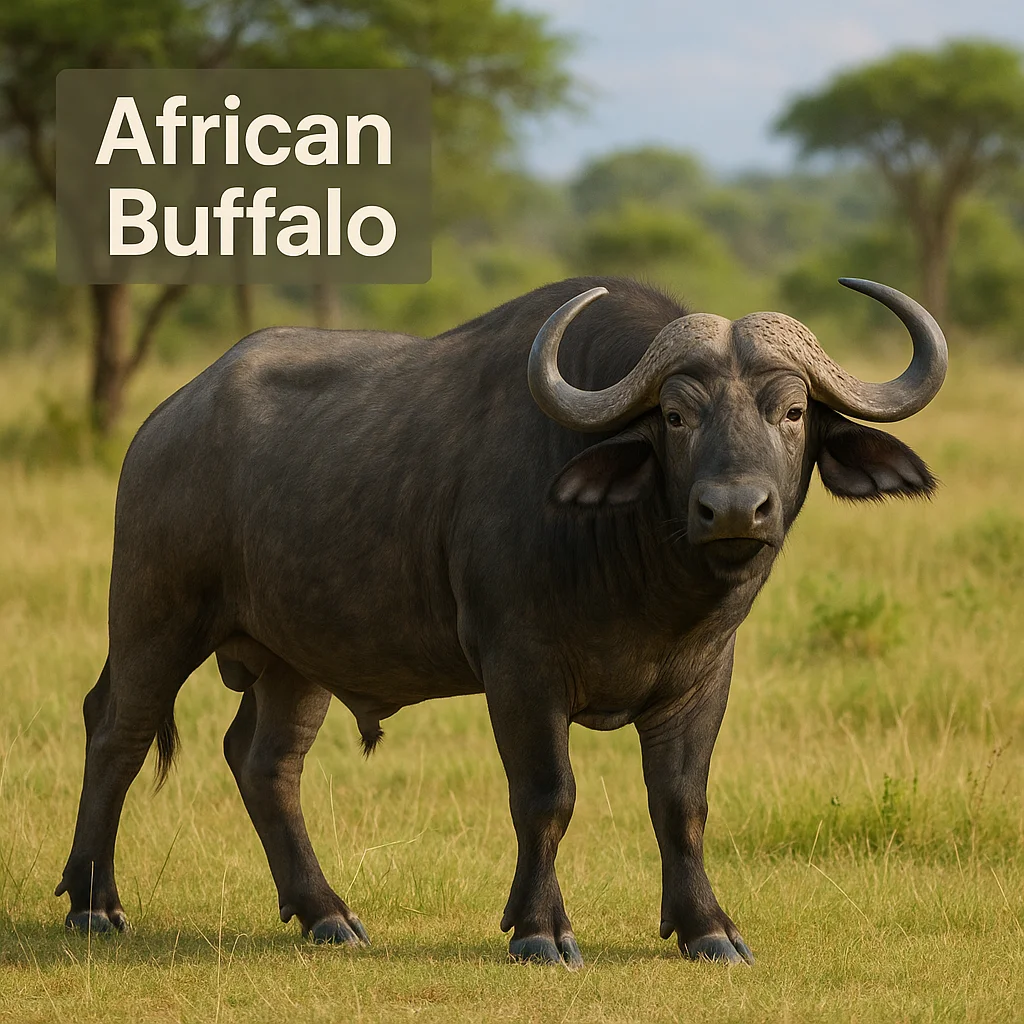
- Common name(s): African Buffalo, Cape Buffalo
- Scientific name: Syncerus caffer
- Animal type: Mammal
- Typical adult size: Length: 2.1-3.4 meters; Height: 1.0-1.7 meters; Weight: 500-900 kg
- Typical lifespan: 15-25 years in the wild
- Diet type: Herbivore; primarily grasses
- Activity pattern: Mostly diurnal with some nocturnal activity
- Social structure: Highly social; forms large herds
- Speed / movement highlights: Can run up to 57 km/h
- Intelligence/learning: Good memory; complex social behaviors
- Primary habitats: Savannas, grasslands, and semi-arid regions
- Geographic range: Sub-Saharan Africa
- Predators/threats: Lions, crocodiles, and human activities
- Conservation status: Varies by region; some populations stable, others declining
🔍 Identification & Appearance
African Buffalo are characterized by their large, sturdy bodies and prominent horns. Their appearance can be deceivingly similar to domestic cattle, but they are typically larger and more rugged.
- Stocky body with a broad, droopy head
- Dark gray to black coat with sparse hair
- Massive curved horns fused at the base, known as a "boss"
- Short, stout legs optimal for supporting heavy body weight
- Tail with a tuft of hair at the end; used for communication
- Similar look-alike: Water buffalo, distinguishable by habitat and geographic difference
- Top ID Tips
- Look for the extensive horns and thick "boss" on the head
- Their size is notably larger compared to domestic cattle
- Observe the dark and sparse coat, typical of savanna adaptation
- The tail ends with a distinct tuft
- Notice the herd formation in open savannas
- Consider their powerful build and presence in herds as a clue
🧱 Body Structure & Physical Adaptations
The African Buffalo is built for power and endurance, with physical adaptations that help it thrive in its environment.
- Stocky build with strong, sturdy bones
- Legs have thick joints to support weight and facilitate quick movements
- Wide nostrils for effective breathing during running
- Teeth: Adapted to grazing, with large, flat molars for grinding grasses
- Exceptional hearing capability; useful for detecting predators
- Eyes favor outwards and forward vision, aiding in navigational awareness
- Rough, tough skin aids against minor injuries typical in their habitat
- Key Adaptations
- Powerful limbs adapted for speed and stamina
- Prominent horns for defense and hierarchical displays
- Resilient digestive system to process tough grasses
- Strong social structures for protective herd dynamics
- Density of body mass to deter predator attacks
🌍 Range & Distribution
The African Buffalo primarily roams across a wide geographic range within Sub-Saharan Africa, favoring areas where rich grasslands and water sources are available.
- Distributed widely across safari regions and national parks
- Common in East and Southern Africa
- Elevations range from sea level to mountain foothills
- Inhabit areas with access to water bodies for drinking and wallowing
- Mostly resident but can migrate in response to seasonal grass availability
- Where You Might Find It
- Serengeti and Maasai Mara ecosystems
- Kruger National Park, South Africa
- Okavango Delta, Botswana
- Luangwa Valley, Zambia
- Open savanna regions throughout Africa
- Lakeside and riverine grasslands
🏞️ Habitat & Shelter
African Buffalo are highly adaptable, thriving across a variety of habitats as long as food and water are available.
- Favor open savannas, grasslands, and occasionally swampy or forested areas
- Seek areas with ample grazing land and water access
- Herds shelter in dense thickets or forests during the hottest parts of the day
- In drier seasons, may venture further distances to find reliable water sources
- Understanding their preferred habitat aids in recognizing their behavioral patterns and herd movements
🧭 Behavior & Ecology
The African Buffalo displays intricate social and behavioral patterns, contributing significantly to its ecosystem.
- Form tight social bonds within herds, which can number in the hundreds
- Participate in allogrooming and mutual protection by forming defensive circles against predators
- Communicate through grunts, moos, and tail flicks
- Graze in the morning and late afternoon; rest during peak heat
- Play a role as grazers in maintaining savanna ecosystems
- Compete or coexist with other herbivores for grass and water
- Behavior Highlights
- Exhibit strong herd dynamics with well-organized hierarchies
- Efficiently use body movements and sounds for communication
- Hold key positions in maintaining grasslands
- Adept at detecting and forming alliances against predators
- Complex spatial arrangement within herds during movement
👥 Social Life & Group Dynamics
African Buffalo are highly social animals, living in large, structured herds that offer protection and cooperative care.
- Often form herds ranging from small family units to large conglomerates
- Herds have a distinct hierarchy led by dominant males and females
- Cooperate in warding off predators by forming protective circles
- Care for young communally, with offspring mixing freely
- Older bulls sometimes form bachelor groups
- Some herds have been observed cooperating with other species, like zebras
- Social Structure Notes
- Herds range widely in size, adapting to resource availability
- Dominance is asserted more by strength and size rather than aggression
- Enjoy mutualistic relationships with birds like oxpeckers
- Herbivorous hierarchy can cycle seasonally
- Communication plays a multiplicity of roles in herd cohesion
🍽️ Diet, Prey & Predators
The African Buffalo is primarily a grazer, consuming vast quantities of grass while also facing threats from predators like lions and crocodiles.
- Predominantly eats grass, moving as needed to find fresh growth
- Diet variable with the season; may consume herbs and leaves during drier spells
- Lions are their primary natural predators
- Adult buffalo use their horns to fend off threats
- Calves are particularly vulnerable to attacks by predators
- Scavenging is rare as they are ample feeders of live grasses
- Feeding Notes
- Strong dependence on grass; habit dictates territory range
- Nutritious plants sought out during off-peak growth seasons
- Particularly vulnerable when away from water sources
- Regular movement ensures fresh pastures and limits grassland damage
🦌 Hunting, Foraging & Movement
Known for their nomadic foraging lifestyle, African Buffalo march across vast expanses in search of sustenance, exerting impressive speed when necessary.
- Primarily walkers with expansive home ranges based on forage availability
- Engage in grazing as a group for protection from predators
- Forage primarily in early morning and late afternoon
- Utilize robust memory and spatial awareness to navigate territories
- Skilled at conserving energy while finding optimal paths to water and grass
- Movement & Strategy
- Exhibit seasonal movements for grazing optimization
- Instinctively can detect shifts in the environment to locate essential resources
- Fast-paced once alerted by a threat; can gallop instantly
- Capable of foraging over extensive territories
🧠 Intelligence & Senses
African Buffalo are intelligent creatures with well-developed senses that aid their survival in challenging environments.
- Good memory supports their ability to locate water and pasture
- Possess strong social intelligence, vital for maintaining herd dynamics
- Excellent hearing, capable of detecting distant sounds
- Strong sense of smell helps recognize preferred grasses and detect predators
- Visual acuity supports these social and protective mechanisms
- Notable Abilities
- Capability for intricate and strategic group formations
- Utilize mutualistic relationships with other species
- Complex communication through vocalizations and physical signals
- Adept at environmental scanning and resource localization
🪺 Reproduction, Pregnancy & Parenting
Breeding among African Buffalo is synchronized with seasonal rains, which help to ensure food availability for raising young.
- Breeding is non-seasonal, but birth peaks align with rainfalls for optimal calf survival
- Gestation lasts approximately 11 months
- Calves are born quite developed (precocial) and can walk soon after birth
- Parenting mainly falls on the mothers, though the herd offers protection
- Social groups contribute to collective childcare
- Reproduction Snapshot
- Typical birth rates increase after rainy seasons
- One calf per birth is common, twins are rare
- Calves remain close to mother within the herd
- Calf development linked closely to rainfall season
♀️♂️ Male vs Female Differences
There are noticeable differences between male and female African Buffalo, notable in size, behavior, and roles within the herd.
- Males tend to be larger and bulkier than females
- Male horns are generally thicker and larger
- Males may leave mixed herds to form bachelor groups
- Both sexes have similar coat colors, dark brown to black
- Females play a more central role in herd leadership
- Sex Differences at a Glance
- Females lead family groups while males often patrol
- Males engage more in sparring over dominance
- Females are crucial for herd coordination and calf protection
🧬 Subspecies & Variation
The African Buffalo includes several subspecies, primarily distinguished by their geographical range, size, and slight habitat adaptations.
- The Cape Buffalo (S. c. caffer) is the largest and most known, inhabiting southern regions
- The Forest Buffalo (S. c. nanus), is smaller, adapted to forest environments
- West African Buffalo (S. c. brachyceros) possess different coat colors
- Considerable variability in size depending on environmental conditions
- Debates persist regarding the classification of subspecies due to overlapping traits
- Variation Notes
- Subspecies show adaptations according to habitat types
- The ecosystem plays a part in horn size and shape variance
- Forest types are generally smaller due to dense environments
- Regional differences include coat density and hue variation
⚠️ Threats, Conservation & Human Interaction
African Buffalo face numerous threats from human activities and environmental changes. Conservation efforts aim to balance these challenges.
- Habitat loss due to agriculture and deforestation
- Human-wildlife conflict leading to retaliatory killings
- Poaching for meat and trophy horns, though less common than other species
- Climate change affects the availability of food and water sources
- Protected areas and national parks are critical for survival
- Responsible Notes
- Efforts to promote harmony through community-led conservation
- Educational outreach encourages coexistence and understanding
- Biodiversity importance stressed, highlighting positive ecosystem roles
✨ Fun Facts & Unique Traits
- Known to vigorously defend each other when threatened
- Considered one of Africa's "big five" game animals
- Horns can reach up to 1.6 meters across and are used for display and defense
- Communal relationships extend cooperation past immediate family structures
- Play a role in grassland ecology, encouraging plant growth through grazing
- Extremely strong swimmers capable of crossing substantial rivers
- They have a powerful memory, essential for navigation through large landscapes
📌 Summary
- The African Buffalo, or Cape Buffalo, is a distinctive member of the bovine family
- Recognized by its massive horns and strong, hearty build
- Lives in large herds in Sub-Saharan Africa's savannas and grasslands
- Primary diet of grasses, impacting both habitats and their survival
- Prone to predation by lions, though well-adept at self-defense
- Complex social structures contribute to mutual protection and nurturing
- Shows resilience to environmental change, although threatened by human activities
- Conservation efforts focus on maintaining their role and population stability