🦁 African Elephant
🧾 Quick Facts
The African Elephant, a symbol of grandeur across the African landscapes, is often referred to as the largest land mammal on Earth. Known for its intelligence, social complexity, and important ecological roles, these mighty creatures are crucial to their habitats.
- Common name(s): African Elephant
- Scientific name: Varies by subspecies (e.g., Loxodonta africana, Loxodonta cyclotis)
- Animal type: Mammal
- Typical adult size: 3 to 4 meters tall at the shoulder; weight ranges from 4,500 to 6,800 kg
- Typical lifespan: 60 to 70 years in the wild
- Diet type: Herbivore; grass, leaves, bark, and fruits
- Activity pattern: Diurnal; active during the day especially in cooler hours
- Social structure: Highly social; matriarchal herds
- Speed/movement highlights: Can reach speeds of up to 40 km/h when running
- Intelligence/learning: Known for problem-solving skills and memory
- Primary habitats: Savannas, forests, and grasslands
- Geographic range: Sub-Saharan Africa
- Predators/threats: Natural predators include lions; human-related threats include habitat loss and poaching
- Conservation status: Varies by region; generally considered vulnerable
🔍 Identification & Appearance
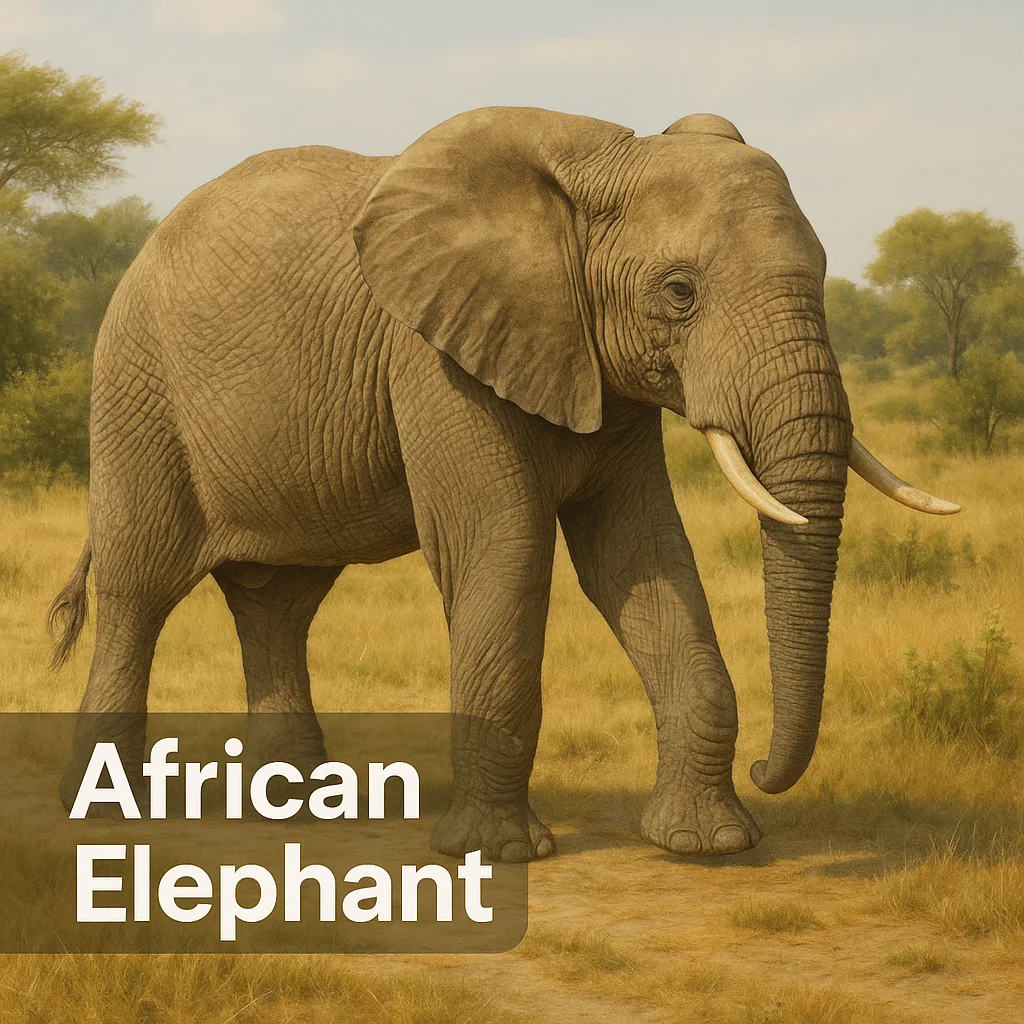
African Elephants are identifiable by their massive bodies, large ears, and long trunks. Their skin is thick and grey, with sparse hair. The trunk, an extension of the upper lip and nose, is highly dexterous.
- Body shape: Massive, with thick legs and a large torso
- Color: Grey with a potential brownish hue depending on soil/dust
- Distinctive feature(s): Large flapping ears and long trunks
- Common look-alikes: Asian Elephants; smaller ears and less wrinkled skin distinguish them
- Tracks/scat: Large, rounded footprints; dung is fibrous and large
- Massive size and distinct large, floppy ears
- Long trunk used for manipulating objects
- Thick, wrinkled grey skin
- Tusks in both males and females (though more prominent in males)
- Rounded footprints with visible toe impressions
- Visible, sizable dung often found along established paths
- Top ID Tips:
🧱 Body Structure & Physical Adaptations
African Elephants are well-adapted for their environments with muscular builds, strong limbs, and specialized adaptations for their diets and lifestyles.
- Build and proportions: Heavy, sturdy limbs for supporting massive weight
- Teeth: Large, flat molars that are used for grinding plant material
- Sensory strengths: Acute sense of smell; excellent hearing
- Claws/hooves: Large, padded feet suitable for heavy load distribution
- Massive ears for thermal regulation
- Trunks for picking food, social bonds, and communication
- Tusks for digging and defense
- Robust digestive system for cellulose breakdown
- Long gestation period to ensure offspring development
- Developed social structures for protection and care
- Key Adaptations:
🌍 Range & Distribution
African Elephants can be found in various habitats across sub-Saharan Africa, from dense forests to open savannas, where they adapt to different environmental conditions.
- Distributed widely across sub-Saharan Africa
- Inhabits countries from Mali in the west to Tanzania in the east and down to South Africa
- Favors savannas, grasslands, and forest edges
- Prefer lower elevations but adaptable
- Generally do not migrate but may move seasonally for food and water
- Open savannas of Kenya and Tanzania
- Dense forest regions in the Democratic Republic of Congo
- Watering holes across Botswanan plains
- African national parks like Kruger and Serengeti
- Grasslands adjacent to forests in West Africa
- Where You Might Find It:
🏞️ Habitat & Shelter
African Elephants play an essential role in their ecosystems by maintaining the open woodlands and savannas. They require large areas to acquire sufficient food and water.
- Prefer open savannas, grasslands, and mixed woodlands
- Use forests for cover and grazing in more closed environments
- Visit rivers, lakes, and swamps for hydration
- Seasonal variation affects movement patterns and weekly movements
- Understanding habitat is crucial as it relates to their need for large territories, food resources, and migration habits
🧭 Behavior & Ecology
The social dynamics of elephants are centered around intricate communication and deep family connections vital for survival. Their behaviors illustrate a complex social structure and an array of interactions within their environment.
- Spend majority of their time grazing, resting, and socializing
- Highly intelligent; capable of learning and remembering experiences
- Use infrasound and vocal calls for distant communication
- Help to shape their ecosystem by toppling trees, creating open area habitats
- Disperse seeds throughout their habitat via digestion
- Complex social behaviors centered around matriarchs
- Use of sound and vibration for communication
- Dust bathing as a form of skin care
- Water spraying and play as social activities
- Tree-damaging behaviors that transform landscapes
- Long-range migration in response to environmental change
- Behavior Highlights:
👥 Social Life & Group Dynamics
Elephants are known for their tight-knit social groups led by older matriarchs, which play crucial roles in their social and survival strategies. Social bonds are critical.
- Matriarchal herds are central to their social structure
- Herds include mothers, daughters, and their young
- Males typically leave the herd upon maturity but maintain bonds
- Assist one another in raising young and protect from predators
- Resolve conflicts through visual displays and vocalizations
- Females lead and provide experiential leadership
- Males form bachelor groups or live solitarily
- Herd cohesion via evolving communication methods
- Fostering of young elephants by multiple females
- Seasonal gatherings, bolstered by environmental conditions
- Social Structure Notes:
🍽️ Diet, Prey & Predators
African Elephants are primarily browsers and grazers, eating a wide variety of vegetation. Their large size makes them mostly invulnerable to predators; however, human activities threaten their survival.
- Consume grasses, fruits, leaves, and bark
- Adjust to seasonal availability of food
- Main threats include humans, lions primarily target calves
- Utilize tusks and strength to fend off potential threats
- Scavenge and dig mineral deposits from soil
- Mainly herbivorous; critical feeders collapse degrading vegetation
- Luxurious consumption impacts vegetation structure
- Use their trunk to reach high branches and dig roots
- Rich diet contributes to diverse seed dispersal
- Salt licks provide essential minerals
- Feeding Notes:
🦌 Hunting, Foraging & Movement
Their movement is characterized by significant home range explorations in search of food and water, determined by availability and environmental conditions. Strength and speed assist their powerful movements.
- Travel in herds led by experienced leaders
- Migrate seasonally when necessary
- Efficient walkers; can traverse long distances
- Navigational skills for remembering paths and resources
- Activity typically peaks in cooler dawn/dusk periods
- Can cover over 50 km in a day during resource migration
- Powerful gait allows negotiation of diverse terrain
- Trunk acts as a tool for reaching and gathering food
- Social intelligence aids in communal defense of territory
- Mother and calf remain in close proximity for security
- Movement & Strategy:
🧠 Intelligence & Senses
Renowned for their intelligence, African Elephants exhibit remarkable social understanding and practical skills, adept at problem-solving, communication, and tool use.
- Use tools like branches to swat flies
- Show empathy and complex emotions
- Navigate wide ranges using memory
- Sound is a pivotal aspect of their communication
- Highly developed sense of smell for locating resources
- Famed for problem-solving and learning behaviors
- Exemplary memory retains navigational routes
- Social bonds underlie a capacity for empathy and mutual care
- Infrasound communication
- Acute hearing complements adult interaction
- Notable Abilities:
🪺 Reproduction, Pregnancy & Parenting
Elephant reproduction involves long gestation periods and significant parental investment, with kin support vital for calf rearing.
- Breed around the year, peaks may occur depending on conditions
- Typically polygynous; males seek to compete for mates
- Gestation lasts about 22 months
- Birth intervals range from 4 to 6 years
- Calves are precocial; they walk shortly after birth but need support
- Females are primary caregivers, with other herd members assisting
- Develop socially within maternal herds
- Alloparenting improves calf survival rates
- Long gestation ensures lengthy strategy for calf development
- Mating success linked to male strength and experience
- Females synchronized birthing strategies assist herd planning
- Reproduction Snapshot:
♀️♂️ Male vs Female Differences
Male and female African Elephants display differences not only in size but also in behavioral roles and societal placement within the herd.
- Males usually larger with prominence in tusks
- Adult males are more often solitary or in bachelor groups
- Females tend to manage herds and are caretakers
- Mature earlier than males and significantly contribute maternal experience
- Display roles differ: males court, females nurture
- Degree of tusk development in males vs females
- Matriarchal leadership role delegated to females
- Male dispersal for mating contrasts herd-centered lifestyle
- Somatic size variance assists niche specialization
- Females exhibit cooperative behavior, males in competitive context
- Sex Differences at a Glance:
🧬 Subspecies & Variation
African Elephants are often divided into two subspecies based on ecological and morphological segmentation, reflecting adaptation to diverse environments.
- Two recognized subspecies: Savannah (Loxodonta africana) and Forest Elephant (Loxodonta cyclotis)
- Savannah elephants larger with bigger ears; Forest elephants smaller
- Habitat adaptations reflect different niche use (savannah vs forest)
- Divergence debated; genetic studies encourage complex views
- Local adaptation evidence in coloration and resource utilization
- Noteworthy ear size difference between subspecies
- Forest elephants have more circular ears
- Variations reflect variations in diet and habitat preferences
- Body size linked to thermal and moisture influences
- Debate around taxonomic classification remains ongoing
- Variation Notes:
⚠️ Threats, Conservation & Human Interaction
While elephants predominantly face natural challenges from predation in calving situations, human interaction poses the largest threat involving habitat alteration and illegal poaching.
- Habitat destruction due to expansion, agriculture
- Poaching driven by ivory demand remains critically damaging
- Conservation efforts need international cooperation for success
- Human-elephant conflict needs mitigation strategies
- Shelter in national parks exemplify core protections
- Conservation approaches must focus on habitat conservation
- Encourage legal action against poaching networks
- Support communal awareness to alleviate human-wildlife conflict
- Advocacy includes education on ivory impact
- Sustainability initiatives encourage coexistence
- Responsible Notes:
✨ Fun Facts & Unique Traits
- Their memory is legendary; they never forget important locations.
- The elephants' large ears aid in thermoregulation by dissipating heat.
- They can produce infrasound—barely audible sound waves used for long-distance communication.
- African Elephants have highly dexterous trunks with more than 40,000 muscles.
- Family bonds are extraordinarily strong; they mourn the death of close kin.
- The tusks grow throughout an elephant’s lifetime.
- Their presence in ecosystems helps create waterholes and maintain forest and savanna balance.
- Elephants display problem-solving skills by using tools, like using branches to scratch themselves.
📌 Summary
- Recognizable by their enormous size and large ears.
- Inhabit a variety of ecosystems across sub-Saharan Africa.
- Diet mainly consists of vegetation—grass, leaves, and bark.
- Face threats from poaching and habitat loss.
- Matriarchal social groups led by experienced females.
- Notable for their intelligence, memory, and social structure.
- Reproduce year-round, with extensive family involvement in calf-rearing.
- Tusks and trunks are among their key adaptations.
- Their role as ecosystem engineers maintains habitat balance.