🦁 Dromedary Camel
🧾 Quick Facts
The Dromedary Camel, often referred to as the "ship of the desert," is an iconic creature highly adapted to life in arid environments. Known for its single distinctive hump, this camel is well-suited to desert living and has been a vital companion to humans for centuries.
- Common name(s): Dromedary Camel, Arabian Camel
- Scientific name: Camelus dromedarius
- Animal type: Mammal
- Typical adult size: 2.2 to 3.5 meters (7-11.5 feet) in length, 1.8 to 2.0 meters (5.9-6.6 feet) in height
- Typical lifespan: 40 to 50 years in captivity; less in the wild
- Diet type: Herbivore; primarily eats grasses, leaves, and shrubs
- Activity pattern: Diurnal
- Social structure: Group-living; forms herds
- Speed/movement highlights: Can run up to 65 km/h (40 mph) in short bursts
- Intelligence/learning: Highly adaptive; known for their problem-solving abilities and strong memory
- Primary habitats: Deserts and arid regions
- Geographic range: Native to Arabian Peninsula; now widespread in North Africa and the Middle East
- Predators/threats: Predators include large carnivores; human threats include habitat loss
- Conservation status: Not currently at risk; domesticated populations thrive
🔍 Identification & Appearance
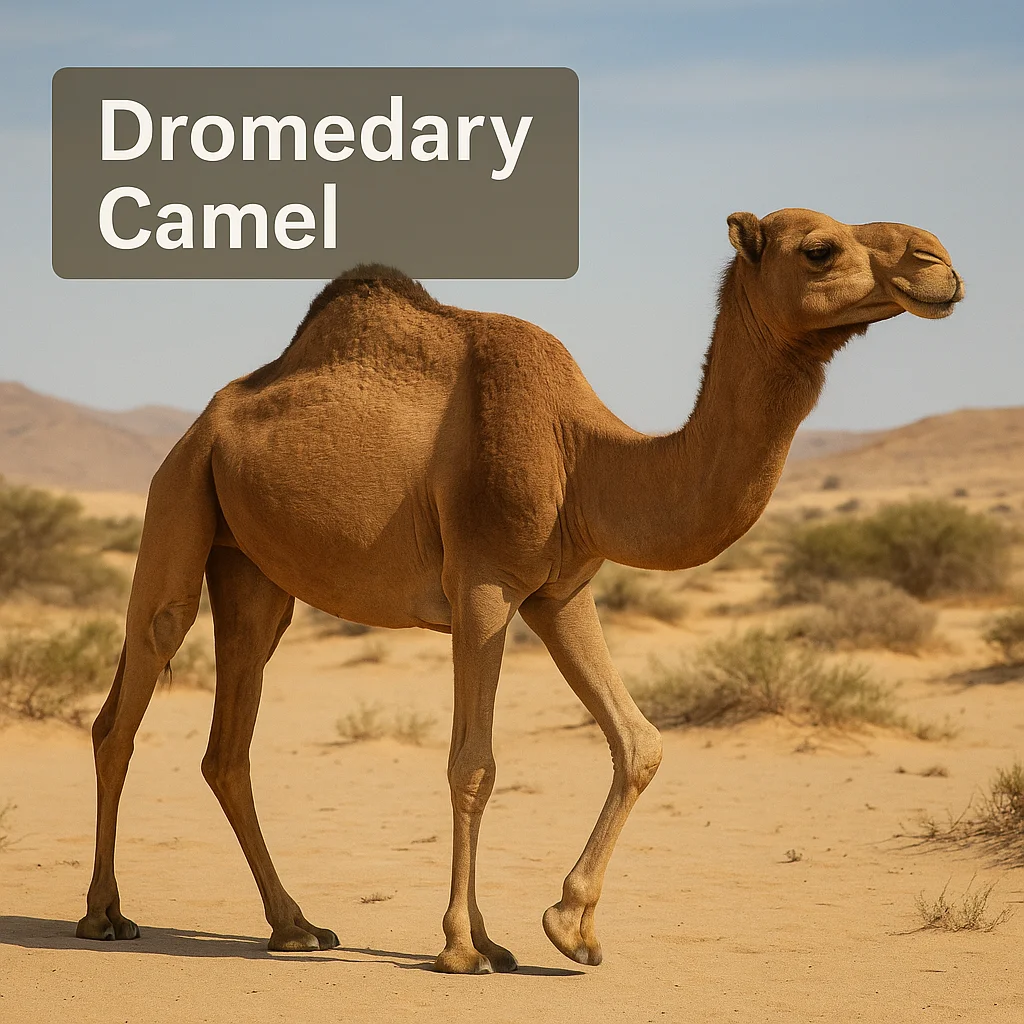
The Dromedary Camel is easily recognizable by its single hump that stores fat, not water as commonly believed. It has a long neck and slender legs that support its large body. The coat is generally a sandy brown but can vary in shade from light tan to a darker brown.
Dromedary Camels have long eyelashes and bushy eyebrows that protect their eyes from the harsh desert sun and sand. Notably, they have tough, leathery pads on their knees and chests for resting on hot desert sand.
-
Top ID Tips:
- Single hump on the back
- Long, curved neck
- Large, padded feet for walking on sand
- Sandy brown coat
- Long eyelashes and bushy eyebrows
- Sharp visual similarities with Bactrian camel (two humps)
- Distinctive camel-like silhouette
- Presence in desert regions globally
- Graceful, swinging gait
🧱 Body Structure & Physical Adaptations
The Dromedary Camel's body is uniquely structured to endure the desert environment. Its tall, narrow frame minimizes sunlight exposure and aids in regulating body temperature. Dromedaries have specialized nostrils that can close during sandstorms, and they have large ears with hair to block sand.
Their teeth are adapted to grind and chew tough, thorny desert plants. The camel's wide feet are designed to traverse loose sand without sinking, while their hump allows them to go for long periods without eating.
-
Key Adaptations:
- Single hump for fat storage
- Wide, cushioned feet for sand travel
- Leathery mouth for eating tough plants
- Ability to close nostrils against sand
- Adaptive body temperature control
- Thick fur for insulation
- Excellent eyesight for spotting distant objects
🌍 Range & Distribution
Although originally from the Arabian Peninsula, Dromedary Camels are now found across various arid and semi-arid regions around the world, particularly in the Middle East, North Africa, and parts of South Asia. They are either domesticated or live in feral populations.
Dromedary Camels do not migrate but will travel extensively in search of food and water, sometimes covering vast distances.
-
Where You Might Find It:
- Arabian Peninsula
- Sahara Desert
- Horn of Africa
- Australian outback (feral populations)
- Dry grasslands of India and Pakistan
- North African territories, such as Egypt and Morocco
- Middle Eastern deserts
🏞️ Habitat & Shelter
The Dromedary Camel is predominantly found in open deserts and arid plains. Its habitat ranges from sandy dunes to flat, rocky landscapes and dry riverbeds. In these areas, the camel faces extreme temperatures and scarce water resources.
These camels find shelter by using the natural landscape, such as lying down in shaded areas, under rocks, or next to bushes. Their ability to withstand heat without needing constant shade illustrates their perfect adaptation to desert life.
🧭 Behavior & Ecology
Dromedary Camels are active primarily during the day and tend to rest during the hottest part of the afternoon. They are social animals, commonly found in groups led by a dominant male. The camels rely heavily on vocalizations and body language for communication.
They play a significant role in their ecosystems; by grazing, they help manage vegetation and disperse seeds across vast areas, fostering plant diversity and supporting the desert food web.
-
Behavior Highlights:
- Daytime activity with rest in mid-afternoon
- Strong social bonds within herds
- Various vocalizations, such as moans and hums
- Important seed dispersers
- Resting in individually or in groups for heat relief
- Dominance displays among males
- Intense fights during breeding season
👥 Social Life & Group Dynamics
Typically, Dromedary Camels live in herds composed of females and their young, guided by a male leader. Bachelor males may form separate groups until they can establish their own herd. Social grooming is part of their bonding behavior, which helps maintain herd harmony.
The dominance hierarchy within these groups is maintained through displays of strength and wrestling, especially among males during the breeding season. Dromedary Camels are generally non-aggressive but can become quarrelsome during competitive interactions.
-
Social Structure Notes:
- Herd living, often with a singular mature male
- Younger males form bachelor groups
- Social grooming within herds
- Dominance battles among males
- Cooperative defense against predators
- Communication via vocal and physical expressions
🍽️ Diet, Prey & Predators
The Dromedary Camel's diet consists primarily of tough desert vegetation, such as thorny shrubs and dry grasses, which their tough mouthparts can handle. During seasons when vegetation is scarce, camels travel long distances to find food.
Regarded as primarily herbivorous, they are exceptionally efficient in their food conversion. Despite their predatory pressures being minimal due to their size, young camels fall prey to large desert carnivores when isolated.
-
Feeding Notes:
- Mainly feed on grasses and shrubs
- High tolerance for salt and alkaline vegetation
- Potential to obtain moisture from food
- Efficient digestion and water conservation
- Able to consume thorny plants
- Packs of wild dogs pose threats to juveniles
🦌 Hunting, Foraging & Movement
Dromedary Camels are known for their incredible endurance rather than speed. They move with a rhythmic gait that allows them to cover vast distances without tiring, often at a recent pace of 16 to 19 km/h (about 10-12 mph).
They are most active during the day, traveling to forage and find water. Observationally, they show a systematic approach to choosing their forage sites—using memory to locate previous rich feeding grounds.
-
Movement & Strategy:
- Rhythmic, energy-efficient walking
- Daytime travel and foraging
- Can sprint quickly for short distances
- Incredible water retention
- Migratory movements within territories
- Systematic grazing techniques
🧠 Intelligence & Senses
Known for their adaptability, Dromedary Camels possess a high degree of intelligence, which includes the ability to learn from experiences and recognize human caretakers. They have a strong memory that aids in navigating the vast, featureless desert environment.
Camels have acute eyesight and sense of smell, allowing them to find food and water in sparse desert regions. Research on their cognitive abilities is ongoing, but camels are generally acknowledged as intelligent among large mammals.
-
Notable Abilities:
- Strong memory for navigation
- Recognizes human faces
- Exceptional adaptability to harsh environments
- Keen problem-solving capabilities
- Acute vision and olfactory senses
🪺 Reproduction, Pregnancy & Parenting
The reproductive behavior of Dromedary Camels exhibits a seasonal pattern, often peaking in winter or early spring. Males become more aggressive during this period, competing for females through vocal and physical displays.
Following a gestation period ranging between 12 to 14 months, a single calf is typically born. Immediately after birth, calves are able to stand and begin to follow their mother, marking them as precocial animals. Maternal care is crucial for survival in the initial months.
-
Reproduction Snapshot:
- Breeding season during cooler months
- Gestation lasts 12-14 months
- Single calf per pregnancy
- Calves are precocial
- Maternal bonds are strong
- Males are polygynous
- Calves stay with mother up to two years
♀️♂️ Male vs Female Differences
Dromedary Camels exhibit some physical and behavioral differences between genders. Males typically grow larger and more robust than females. During the mating season, males may develop prominent throat pouches, or dulaa, used in displays and vocalizations.
Females, generally more social, are more often seen within the core herds. While size differences are notable, behavioral tendencies vary, influenced by ecological pressures and social structures.
-
Sex Differences at a Glance:
- Males larger with more muscular builds
- Throat pouch present in males
- Females often form the nucleus of herds
- Physical size buffers to temperature
- Males may travel more for mating opportunities
🧬 Subspecies & Variation
Though generally recognized as a single species, the Dromedary Camel does not have officially recognized subspecies. However, variations do occur based on the region, influenced by local environmental conditions.
Some camels in harsher desert climates may be smaller with lighter coats, aiding in heat dispersal. Snout and limb proportions may also vary slightly depending on their geographical range.
-
Variation Notes:
- No recognized subspecies
- Regional coat coloration variations
- Slight size differences by habitat
- Adaptations to extreme desert temperatures
- Variation influenced by national breeding programs
⚠️ Threats, Conservation & Human Interaction
Despite their domestic abundance, wild Dromedary Camels face threats from habitat encroachment and climate change, resulting in reduced forage availability and migration corridors. These pressures highlight the importance of sustainable habitat management.
As domestic animals, Dromedary Camels are often used for transport and agricultural purposes, providing essential services to people in arid environments. Ethical considerations include humane treatment and ensuring access to necessary resources.
-
Responsible Notes:
- Habitat protection plans crucial
- Significant cultural and economic value
- Ongoing competition with livestock for resources
- Promote awareness of sustainable grazing
- Regular veterinary care to ensure welfare
✨ Fun Facts & Unique Traits
- Dromedary Camels can drink up to 40 gallons of water in one go.
- The hump can weigh up to 80 pounds, crucial for energy storage.
- Camels have a unique "rolling" gait, moving both legs on one side together.
- They can close their nostrils during sandstorms to keep out sand.
- Camels can tolerate body temperature changes from 34°C to 41°C without ill effects.
- Their call consists of moans and groans, often communicated in herds.
📌 Summary
- Dromedary Camels are desert specialists with a single hump.
- Found primarily in arid regions of the Middle East and Africa.
- Adapted for traversing and surviving in harsh desert conditions.
- Feed mainly on tough, dry vegetation but can go long without water.
- Form strong, social herds; pivotal in seed dispersal.
- Their intelligence aids in navigation and survival.
- Breeds seasonally, with females nurturing precocial calves.
- Face pressures from habitat loss, with sustainable management needed.
- Known for cultural significance and essential transport roles.
- Remarkable resilience and physiology make them truly unique in the animal kingdom.