🦁 Giant Panda
🧾 Quick Facts
The giant panda is one of the most recognizable and beloved animals on the planet, known for its distinctive black-and-white coloration and laid-back lifestyle. Here are some quick facts about this fascinating species:
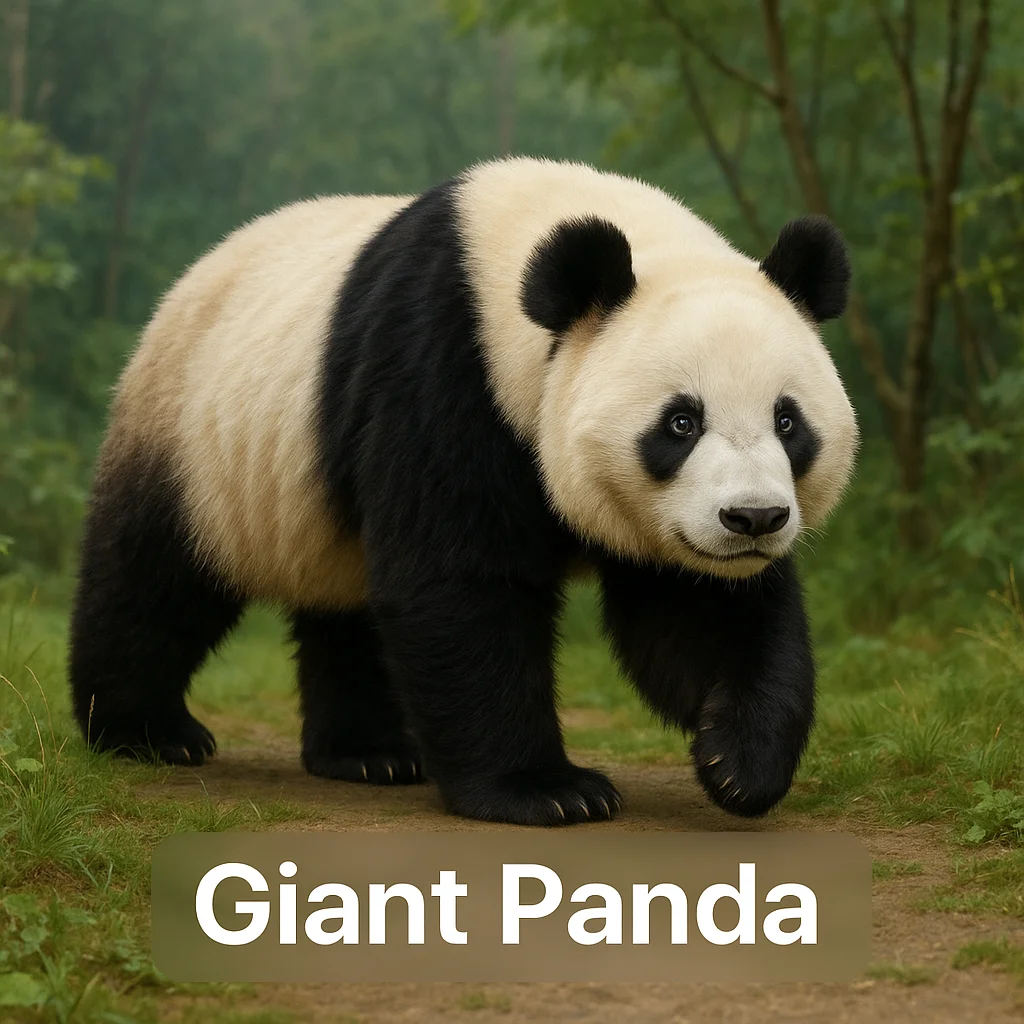
- Common Name: Giant Panda
- Scientific Name: Ailuropoda melanoleuca
- Animal Type: Mammal
- Typical Adult Size: Approximately 1.2 to 1.9 meters in length; weight ranges from 70 to 160 kilograms
- Typical Lifespan: 15 to 20 years in the wild; up to 30 years in captivity
- Diet Type: Herbivore; primarily bamboo
- Activity Pattern: Primarily diurnal, with periods of rest and feeding
- Social Structure: Solitary outside of mating season and mother-cub bonding
- Speed / Movement Highlights: Slow, deliberate movements; not adapted for high-speed pursuits
- Intelligence: Capable of learning tasks through conditioning; problem-solving abilities are moderate
- Primary Habitats: Temperate broadleaf and mixed forests in mountainous regions
- Geographic Range: Confined to Southwest China, particularly Sichuan, Shaanxi, and Gansu provinces
- Predators/Threats: Few natural predators; human activities and habitat loss are significant threats
- Conservation Status: Vulnerable; efforts are ongoing to conserve natural habitat and populations
🔍 Identification & Appearance
The giant panda is easily identifiable thanks to its unique body shape and coloration. It has a rounded body, large head, and distinctive black-and-white fur pattern. Typically, the panda's face, belly, and rear are white, while its limbs, shoulders, eyes, and ear patches are black. Its thick fur is adapted to keep it warm in the cool mountain climates it inhabits.
Giant pandas have a strong build with broad shoulders and a short tail. Their tracks are large and recognizable due to their size and the imprint of the pseudo-thumb, which helps in bamboo handling.
- Rounded silhouette with stocky build
- Distinctive black patches around eyes, ears, and limbs
- Thick, woolly fur for warmth
- Strong jaw muscles and broad skull
- Tracks include pseudo-thumb imprint
- White face with black eye patches
🧱 Body Structure & Physical Adaptations
The giant panda is well-adapted to its environment. It has a robust physique with muscular limbs and a heavy build suited for climbing and foraging. Pandas possess a pseudo-thumb, an enlarged wrist bone that functions almost like a thumb, which is critical for grasping bamboo.
The panda's dental structure, with strong molars and a powerful jaw, enables it to crush bamboo stalks efficiently. Its sense of smell is highly developed, aiding in locating food and recognizing territory markers.
- Strong, muscular build for climbing
- Pseudo-thumb for grasping bamboo
- Powerful jaw and specialized teeth for bamboo consumption
- Excellent sense of smell for detecting food and scents
- Thick fur for insulation against cold temperatures
🌍 Range & Distribution
The giant panda is endemic to China, with its primary range limited to the mountainous regions of the Sichuan, Shaanxi, and Gansu provinces. These areas feature the dense bamboo forests that are essential to the panda's diet and lifestyle.
Most giant pandas are found at elevations between 1,500 and 3,000 meters, where they can find the required forest canopy and bamboo understory. Pandas do not undertake long migrations but may move altitudinally to find food.
- Southwest China, primarily in Sichuan, Shaanxi, and Gansu provinces
- Typically found at 1,500 to 3,000 meters elevation
- Lives in temperate broadleaf and mixed forests
- Relies on dense bamboo forests
- Limited to narrow geographic range
🏞️ Habitat & Shelter
Giant pandas thrive in montane forests characterized by high humidity and dense bamboo undergrowth, which they depend on for sustenance. These forests provide not only food but also shelters like tree hollows and rock crevices to take refuge from weather and humans.
Pandas’ habitats are impacted by seasonal changes, with the creatures seeking different elevations to find food or the best climate. Habitat preservation is critical to panda survival due to its narrowly defined ecological niche.
🧭 Behavior & Ecology
The giant panda's behavior is largely centered around foraging and resting. They are mostly solitary creatures, spending a significant portion of the day eating bamboo. They mark their territory with scent marks and occasionally vocalizations.
Pandas are vital to their ecosystem as seed dispersers, contributing to forest health and biodiversity. While not traditionally thought of as social, brief interactions do occur, particularly in breeding season.
- Primarily solitary; social during breeding periods
- Spends up to 14 hours a day foraging and eating
- Relies on scent marking for communication
- May climb trees to evade danger or during playful behavior
- Important role as seed dispersers in their ecosystem
👥 Social Life & Group Dynamics
Being solitary animals, giant pandas typically avoid each other outside mating seasons. Cubs stay with their mothers until they are weaned, then set out on their own. Social interactions between adults are rare, usually limited to mating.
When pandas do gather, such as in breeding centers, they may establish a loose and temporary hierarchy, but there’s generally low aggression and conflict.
- Solitary except for mating and mother-offspring bonds
- Temporary pairs form during breeding season
- Females raise cubs alone
- Interaction mainly through scent marking
- Limited social structure with rare group dynamics
🍽️ Diet, Prey & Predators
The giant panda's diet is over 99% bamboo, consuming different species based on availability. Despite their plant-heavy diet, pandas have the digestive tract of a carnivore and require a large quantity of bamboo to meet their nutritional needs.
Natural predators are rare due to pandas' size and strength, but they must contend with habitat loss and human encroachment as significant threats.
- Mainly consumes bamboo; may eat other vegetation occasionally
- Needs to eat about 12-38 kg of bamboo daily
- Few natural predators due to size
- Relies on dense forest cover for safety
- Habitat destruction poses a major threat
🦌 Hunting, Foraging & Movement
The giant panda is primarily a forager rather than a hunter, spending most of its waking hours searching for and eating bamboo. Their movement is deliberate, and they are capable climbers, often using trees for navigation and safety.
- Slow, deliberate movements
- Exceptional climbing skills for foraging and safety
- Forages continuously to compensate for low-nutrition diet
- Utilizes spatial memory to relocate food sources
- No significant migratory behavior
🧠 Intelligence & Senses
Giant pandas showcase the ability to learn through conditioning and have shown moderate problem-solving skills. They are primarily reliant on their acute sense of smell for locating food and identifying territories.
- Moderate problem-solving abilities
- High reliance on olfactory senses
- Uses scent to communicate and identify territory
- Shows spatial memory when navigating habitat
- Behavioral adaptability in changing habitats
🪺 Reproduction, Pregnancy & Parenting
Giant pandas have a limited breeding season, occurring once a year in the spring. The species is generally solitary, reuniting temporarily for the purposes of mating.
Females typically have a gestation period of about 95 to 160 days, usually resulting in the birth of one to two cubs. The mother is responsible for raising the young.
- Breeding mainly occurs during the spring
- Gestation period lasts around 95 to 160 days
- Generally gives birth to one cub; twins are rare
- Cubs are born altricial, requiring extensive maternal care
- Mother provides sole parental care
♀️♂️ Male vs Female Differences
Males are typically larger than females, weighing up to 15% more. Morphologically, both genders appear similar without remarkable distinctions in their coloration. Behaviorally, males are more solitary and roam larger ranges.
- Males generally larger and heavier than females
- Similar coat coloration and pattern for both sexes
- Males often travel greater distances
- Little discernible difference in behavior outside breeding season
- Mating strategies vary slightly with males being more competitive
🧬 Subspecies & Variation
While historical records suggest potential subspecies of the giant panda, current genetics research does not definitively distinguish them. Variations can appear in size and coloration but are not consistent enough for formal subspecies recognition.
- Subspecies classification is debated
- Slight regional differences noted in size
- Minor color variations based on habitat location
- Genetic studies continue to refine classification
- Local adaptations may impact physical traits
⚠️ Threats, Conservation & Human Interaction
Giant pandas face significant threats from habitat loss due to human development and climate changes affecting bamboo growth patterns. Conservation efforts focus on habitat preservation and reforestation, supported by captive breeding programs.
- Primary threat: habitat loss from agricultural expansion
- Climate change affects bamboo, their main food source
- Protected by reserves and conservation programs
- Human interactions are primarily managed in conservation areas
- Rising awareness and education about pandas' needs
✨ Fun Facts & Unique Traits
- Giant pandas are one of the few bear species that do not hibernate.
- They have a pseudo-thumb, an extension of their wrist bone, to help grasp bamboo.
- Their diet is over 99% bamboo, highlighting their unique ecological niche.
- Pandas have a special ability to digest bamboo, despite having a carnivorous digestive tract.
- They can consume between 12 to 38 kilograms of bamboo a day.
- Pandas contributed to significant advancements in understanding genetic diversity.
- Giant panda cubs are born nearly blind and weigh only about 130 grams, about the size of a stick of butter.
📌 Summary
- Identified by its distinctive black-and-white fur and rotund shape.
- Inhabits temperate forests of Southwest China, relying heavily on bamboo.
- Displays solitary behavioral tendencies, except during breeding.
- Primarily eats bamboo, with few natural predators beyond habitat disruptions.
- Reproduces slowly with significant maternal investment in cub care.
- Adapted for a bamboo diet with specialized teeth and a pseudo-thumb.
- Research continues on genetic diversity and potential subspecies.
- Conservation efforts focus on habitat protection and increasing population numbers through breeding programs.