🦁 Giraffe
🧾 Quick Facts
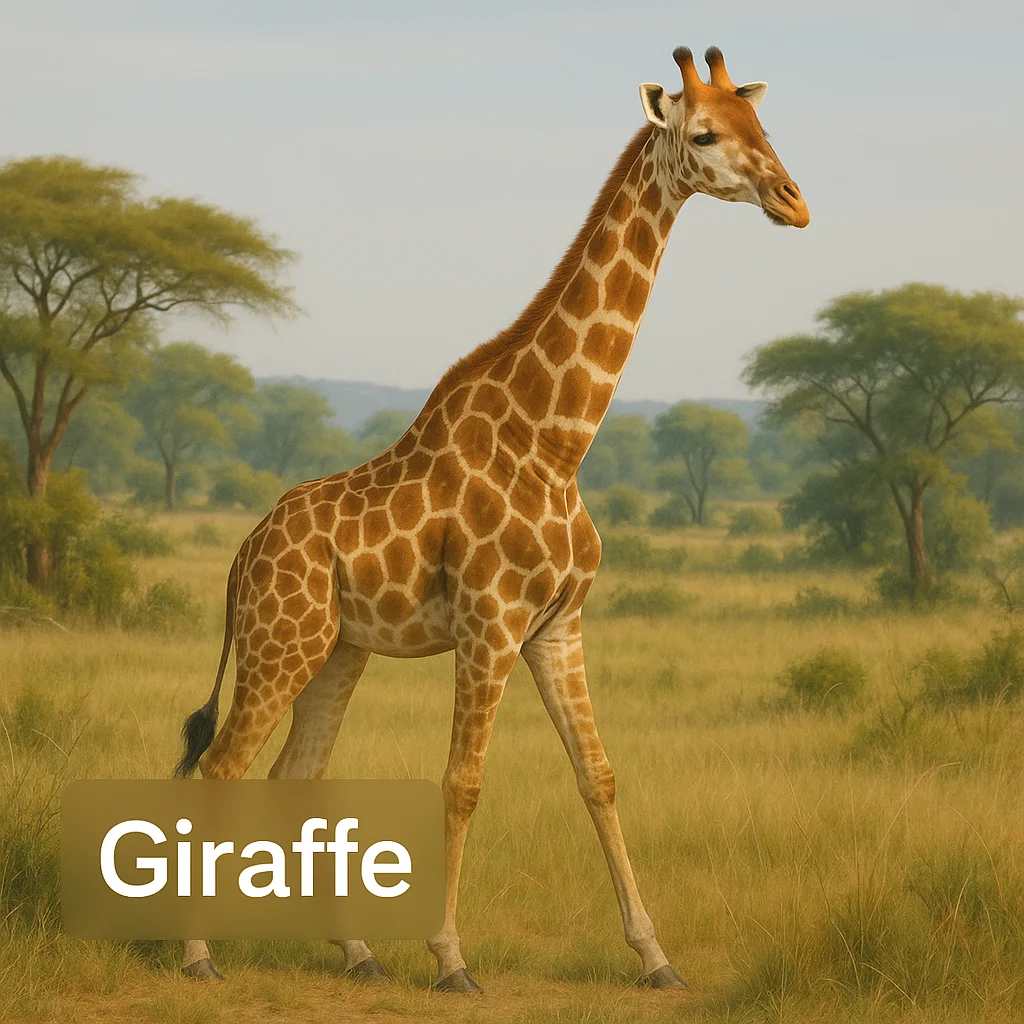
The giraffe is an iconic mammal known for its extraordinary height and unique appearance. Often called the tallest land animal, giraffes have long necks and legs that allow them to browse high in trees, a niche few other animals can exploit.
- Common name(s): Giraffe
- Scientific name: Giraffa camelopardalis (with known subspecies variations)
- Animal type: Mammal
- Typical adult size: Height: 4.3-5.8 meters (14-19 feet); Weight: 800-1,200 kg (1,760-2,645 lbs)
- Typical lifespan: 20-25 years in the wild; up to 30 years in captivity
- Diet type: Herbivore; primarily eats leaves, shoots, and flowers, especially from acacia trees
- Activity pattern: Diurnal, but can be active at any time
- Social structure: Often in loose, changing herds; not territorial
- Speed / movement highlights: Can run up to 60 km/h (37 mph) in short bursts
- Intelligence/learning: Observant and capable of social learning
- Primary habitats: Savanna, grasslands, open woodlands
- Geographic range: Across sub-Saharan Africa
- Predators/threats: Lions, hyenas, and, to a lesser extent, leopards; human activities pose significant threats
- Conservation status: Varies by region and subspecies; generally considered vulnerable
🔍 Identification & Appearance
The giraffe is unmistakable due to its towering height, long neck, and distinctive spotted coat. Its body is tall and slender, with long legs that contribute to its remarkable stature. Its coat features irregular, polygonal brown patches separated by lighter lines, forming a unique pattern for each individual.
Giraffes also have small, horn-like structures called ossicones on their heads, which are covered with skin and hair. They possess large eyes and ears that are situated high on their heads, providing excellent vision and hearing. While giraffes can look similar, attention to their distinctive coat patterns can aid in individual identification.
- Top ID Tips:
- Tallest land animal with a long neck
- Brown patches on a pale background
- Two ossicones on the head
- Long, dark tongue adapted for foliage grasping
- Slim, elongated legs
- Large expressive eyes
- Distinctive pacing gait
- Often seen in small groups
- Majestic, towering silhouette
- Characteristic graceful neck movements
🧱 Body Structure & Physical Adaptations
The giraffe's unique body structure supports its lifestyle as a high browser. Its long neck, though well-suited for reaching foliage, has the same number of vertebrae as most mammals—seven—which are highly elongated. The giraffe's legs are powerful and allow it to run swiftly across the open plains.
Giraffes have specially adapted teeth, particularly their high-crowned molars and long, prehensile tongue, which help manipulate and chew tough leaves and twigs. Their hooves are large and support their massive bodies, whereas their acute vision is an essential adaptation for spotting predators from a distance.
- Key Adaptations:
- Elongated neck vertebrae
- Prehensile, dark tongue up to 45 cm (18 inches)
- High-crowned molars for grinding foliage
- Powerful, long limbs for running
- Excellent vision and keen hearing
- Ossicones for protection and combat
- Efficient circulatory system adapted for height
- Specialized joints allowing unique gait
- Skin patterns for camouflage and recognition
🌍 Range & Distribution
Giraffes inhabit a range of sub-Saharan African landscapes, primarily concentrated in savanna and woodland regions that offer ample tree coverage. Their distribution extends across countries such as Kenya, Tanzania, Botswana, South Africa, and parts of West Africa.
Giraffes generally stay at low elevations but may roam extensively to access food resources, especially during different seasons. They are typically stationary residents but may undertake longer movements in response to environmental changes.
- Where You Might Find It:
- Serengeti and Masai Mara regions
- Kruger National Park in South Africa
- Okavango Delta in Botswana
- Etosha National Park in Namibia
- Woodlands of Malawi and Zambia
- Savannas of Angola and Zimbabwe
- Isolated patches in West Africa
- National reserves and protected areas
🏞️ Habitat & Shelter
Giraffes prefer habitats rich in acacia and other trees, where their browsing abilities give them an advantage. These habitats present both food and some degree of shelter, although the giraffe's height makes it less reliant on conventional cover.
During the dry season, giraffes may congregate around water sources or areas with higher foliage density. Understanding these habitat preferences is crucial, as habitat alteration poses a considerable threat to their survival.
🧭 Behavior & Ecology
Giraffes follow a relatively loose routine of feeding and moving between locations with abundant vegetation. They engage in grooming through mutual licking and use their ossicones and necks in 'necking' battles, especially among males.
While their interactions with other species include predation competition, giraffes play a critical role in the ecosystem as browsers that shape vegetation composition.
- Behavior Highlights:
- Regularly browse during the day
- Perform mutual grooming with their tongues
- Practice distinctive 'necking' for dominance
- Use vocalizations and infrasound for communication
- Serve as a lookout for other prey species
- Help control acacia growth through feeding
👥 Social Life & Group Dynamics
Giraffes exhibit fluid social structures where herd composition is flexible. They form loose groups that can change frequently and usually consist of females and young, while males may be solitary or part of smaller bachelor groups.
Social behaviors involve coordinated movement and mutual defense against predators. Despite a lack of a rigid social hierarchy, giraffes establish dominance through physical displays and sparring.
- Social Structure Notes:
- Non-territorial but maintain overlapping ranges
- Females often gather in nursery herds
- Males form temporary bachelor groups
- 'Necking' establishes hierarchy among males
- Cooperate in watching for predators
- Minimal vocal communication, more focused on visual cues
🍽️ Diet, Prey & Predators
Giraffes primarily feed on a diet of leaves, shoots, and occasionally fruits, favoring acacia trees for their rich foliage. Their browsing mainly occurs at high heights inaccessible to other herbivores.
The main predators of giraffes include lions, hyenas, and occasionally leopards, which may pose a threat to calves. Giraffes rely on their height and sharp vision to detect and evade predators, often using swift, powerful kicks as a defense mechanism.
- Feeding Notes:
- Major browsers of tall trees
- Prefer acacia leaves
- Can consume up to 34 kg (75 lbs) of foliage daily
- Use height and long neck to access food
- Capable of enduring longer periods without water
- Foliage variability influences seasonal diet
🦌 Hunting, Foraging & Movement
Giraffes are adept walkers, known for their signature graceful gait. They move with a pace that can be quickened into short bursts of speed, displaying surprising agility given their size.
Giraffes forage primarily by browsing vegetation high in trees. They exhibit selective feeding by pulling leaves and twigs from specific plant species, often covering significant distances daily to meet their dietary needs.
- Movement & Strategy:
- Specialized for browsing tall vegetation
- Can achieve high-speed gallops when threatened
- Adjust foraging range in response to food availability
- Lope in a coordinated, synchronous gait
- Quickly absorb visual cues for navigation
- Rely heavily on memory for foraging routes
🧠 Intelligence & Senses
Giraffes possess significant cognitive abilities, evident in their capacity for social learning and memory. Their sharp vision enables them to scan vast distances for predators, while their hearing further supports environmental awareness.
Although comprehensive research into their intelligence is limited, giraffes display problem-solving capabilities and social cooperation as part of their daily lives.
- Notable Abilities:
- High spatial awareness and memory
- Acute visual and auditory senses
- Adaptable to environmental changes
- Learn from observing other giraffes
- Capable of recognizing individual differences
🪺 Reproduction, Pregnancy & Parenting
Giraffes do not have a defined mating season, as breeding can occur year-round. They exhibit a generally polygynous system where males display competition to access receptive females.
Gestation lasts about 15 months, after which a single calf is typically born. Calves are precocial, standing and walking shortly after birth, and rely on maternal care for protection and guidance during their early life stages.
- Reproduction Snapshot:
- Breeding occurs throughout the year
- Males engage in 'necking' contests for mating rights
- Gestation period: approximately 15 months
- Usually birth a single calf
- Newborns stand within hours after birth
- Females have a primary role in calf care
- Calves wean after about a year
♀️♂️ Male vs Female Differences
Male and female giraffes differ mainly in size and behavior. Males are often larger, with more robust necks used in 'necking' displays during competitive interactions. Males also tend to have larger ossicones that are bald on top compared to the tufted ossicones of females.
- Sex Differences at a Glance:
- Males generally larger and more heavily built
- Neck elongated and more muscular in males
- Ossicones thicker and bald in adult males
- Females usually engage more in calf rearing
- Males participate robustly in competition
- Females show more cohesive social grouping
🧬 Subspecies & Variation
There are several recognized giraffe subspecies, which show variations in coat pattern and geographic range. Notable subspecies include the Masai giraffe, Reticulated giraffe, and the Northern giraffe, among others. Some subspecies like the West African giraffe are fewer in number and more geographically restricted.
Subspecies classification can sometimes be debated due to overlapping ranges and physical characteristics.
- Variation Notes:
- Differ in coat pattern and coloring
- Masai giraffes with jagged leaf-like spots
- Reticulated giraffes show polygonal, net-like designs
- Nubian giraffes display a relatively uniform coat
- Range overlaps can blur subspecies distinction
⚠️ Threats, Conservation & Human Interaction
Giraffes face natural and human-related challenges, including habitat loss, climate change, and poaching. Human expansion reduces available browsing land and poaches giraffes for their skins and tails.
Promoting conservation efforts involves habitat protection and community-based initiatives that foster appreciation and sustainable coexistence.
- Responsible Notes:
- Loss of habitat due to land conversion
- Susceptible to climate variability impacts
- Historically affected by localized poaching
- Important to support giraffe-friendly land use
- Efforts to educate and involve local communities are critical
✨ Fun Facts & Unique Traits
- The giraffe’s heart weighs about 11 kg (24 lbs) and pumps 60 liters of blood per minute
- Despite their height, giraffes only have seven neck vertebrae, like most mammals
- A giraffe’s spots operate as a thermal window to assist body temperature regulation
- Their unique gait involves moving the legs on one side of the body, then the other
- A group of giraffes is poetically referred to as a “tower”
- Giraffes are capable swimmers but rarely seen in water
- Each giraffe’s spot pattern is unique, much like a human’s fingerprint
- Unlike many mammals, giraffes sleep standing up most of the time
📌 Summary
- Giraffes are identified by their towering silhouette and unique spot patterns
- Inhabit savannas, grasslands, and open woodlands in sub-Saharan Africa
- Primarily browsers, they feed on acacia trees and other tall vegetation
- Main predators include lions and hyenas; use powerful kicks for defense
- Social structure involves loose and fluid groups, often seen in small herds
- Reproduction is year-round with a gestation period of about 15 months
- Key adaptations include elongated necks and prehensile tongues
- Subspecies variation based on geographic distribution and coat patterns
- Conservation efforts focus on habitat preservation and anti-poaching measures
- Notable for their graceful movements and critical role as browsers