🦁 Moose
🧾 Quick Facts
Moose are the largest members of the deer family and are known for their impressive antlers and robust bodies. These magnificent creatures are often associated with colder climates and dense forest environments.
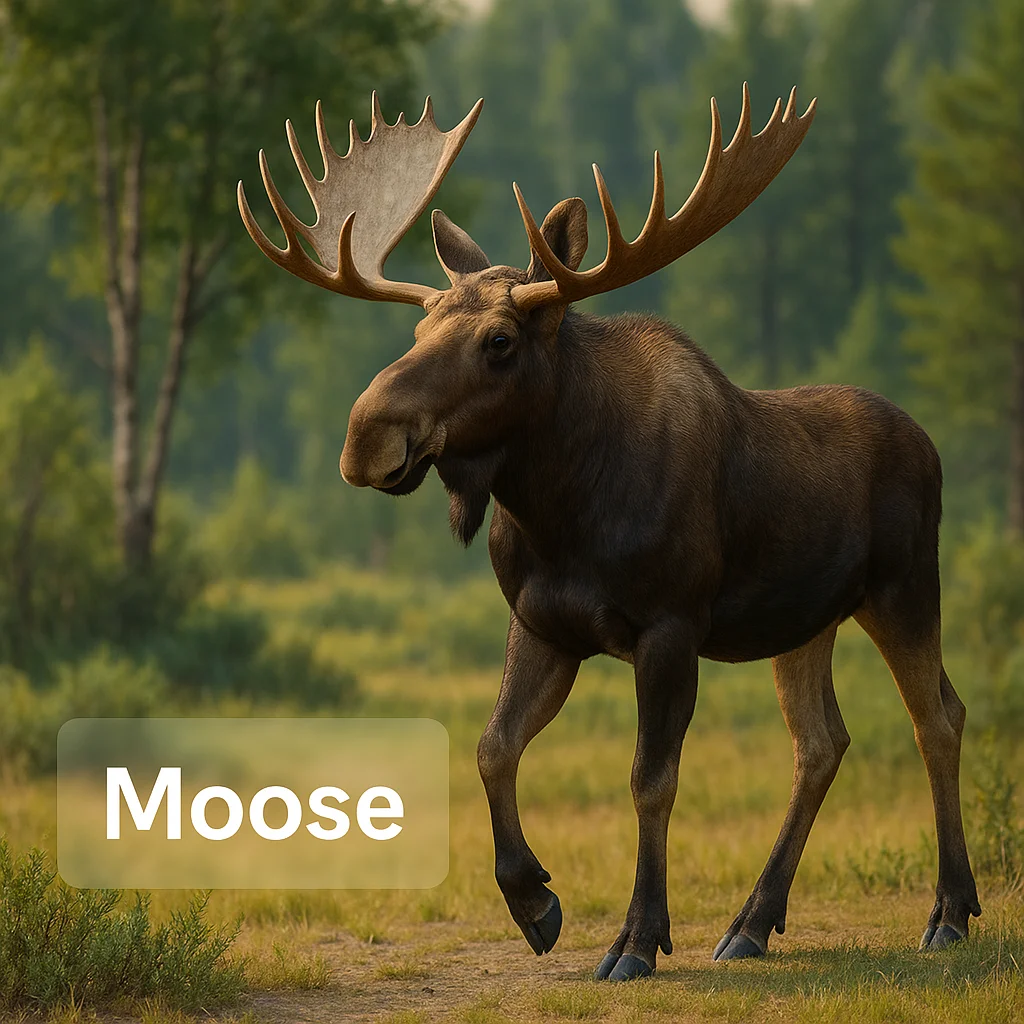
- Common name(s): Moose
- Scientific name: Alces alces
- Animal type: Mammal
- Typical adult size: Height: 5 to 7 feet at the shoulder; Weight: 800 to 1,600 pounds
- Typical lifespan: 15 to 25 years in the wild
- Diet type: Herbivore; usually browse on shrubs, leaves, and aquatic plants
- Activity pattern: Mostly diurnal and crepuscular
- Social structure: Solitary, except mothers with calves
- Speed / movement highlights: Can run up to 35 mph and swim for several miles
- Intelligence/learning: Good spatial learning and memory abilities
- Primary habitats: Temperate and boreal forests
- Geographic range: North America, Europe, and Asia
- Predators/threats: Wolves, bears, and humans
- Conservation status: Least Concern, but varies by region
🔍 Identification & Appearance
Moose are easily recognizable due to their large size and unique features. Their long legs and distinctive snout give them a rather unmistakable silhouette against the backdrop of their native habitats.
- Body shape and silhouette: Massive body with long legs and a hump on the shoulder
- Key colors/patterns: Dark brown fur with lighter legs
- Distinctive features: Large, palmate antlers in males; long, pendulous nose
- Tracks: Large, heart-shaped hoof prints
- Look-alikes: Elk, but moose have broader antlers and a larger body
- Very large body size
- Broad, flat antlers (males)
- Hump on shoulders
- Long legs with lighter coloration
- Deep, dark eyes
- Protruding, fleshy nose
- Solitary nature
- Heart-shaped hoofprints
🧱 Body Structure & Physical Adaptations
Moose are well adapted to their environments with several physical traits that support their survival and feeding habits.
- Build and proportions: Stocky with long limbs for wading through snow and water
- Teeth/jaw adaptations: Large molars for grinding vegetation
- Hooves: Large hooves that spread to act like snowshoes and assist in swimming
- Sensory strengths: Excellent sense of smell and hearing; their eyesight is less acute
- Strong, stocky build for cold environments
- Mobile upper lip for browsing on vegetation
- Specialized hooves for traversing snow
- Well-developed sense of smell
- Large ears for detecting sounds
- Heat-conserving fur coat
- Highly adaptive digestive system
- Efficient in water with swimming capabilities
🌍 Range & Distribution
Moose are predominantly found in the Northern Hemisphere forests, where they thrive in the abundant vegetation typical of these areas.
- Continents/regions: North America, Scandinavia, and parts of Asia
- Elevation range: From sea level to mountainous regions
- Seasonal movements: Mostly resident but may move in search of food during winter
- North America, especially Canada and Alaska
- Northern Europe, particularly Scandinavia
- Parts of Russia in northern Asia
- Boreal and temperate forests
- Areas with ample freshwater sources
🏞️ Habitat & Shelter
Moose are typically found in forested areas with plentiful access to water. These environments provide the necessary cover and food resources they require.
- Preferred habitats: Dense forests and areas with abundant aquatic vegetation
- Shelter: Utilize wooded areas and thick brush for cover
- Seasonal behavior: Move to higher grounds during warmer months; utilize thermal cover in winter
🧭 Behavior & Ecology
Being primarily solitary animals, moose lead lives that revolve around foraging and surviving the harsh climates of their habitats.
- Daily routine: Foraging during dawn and dusk; resting in shaded areas
- Communication: Vocalizations during mating season; visual displays like antler shows
- Community interactions: Limited interaction except during rutting season
- Role in ecosystem: Important browsers, affecting plant community dynamics
- Solitary lifestyle
- Foraging primarily on land
- Seasonal migration short distances for food
- Vital role in forest ecology
- Vocal and olfactory communication for mating
- Alter vegetation structure through browsing
- Swim to access aquatic plants
- Avoid humans to reduce conflict
👥 Social Life & Group Dynamics
Moose are not sociable animals and typically live alone except during specific times like breeding or when mothers are rearing calves.
- Solitary vs social: Mostly solitary; females with young calves
- Group types and size: Occasional small groups during mating season
- Primarily solitary
- Cows with calves form small temporary groups
- Infrequent interactions outside breeding season
- Compete for mates during rut
- Minimal cooperation among individuals
- Low tolerance for other adults outside mating
- Temporary cluster at feeding sites
🍽️ Diet, Prey & Predators
As herbivores, moose primarily consume a variety of vegetation. Their diet changes with the seasons, adapting to available resources. While they are sizable animals, they still face predation from larger carnivores.
- Diet: Leaves, bark, twigs, and aquatic vegetation
- Predators: Wolves and bears
- Anti-predator strategies: Use of large size and antlers for defense; swimming away from danger
- Seasonal diet variations
- Primarily browsers
- Access aquatic vegetation in summer
- Rely on forests with young plants for food
- Stimulate plant growth by browsing
- Potential prey for wolves
- Evade predators by using water bodies
🦌 Hunting, Foraging & Movement
Moose are primarily foragers that cover extensive ranges in search of sufficient food resources to maintain their large bodies.
- Locomotion style: Able-bodied wader and swimmer
- Foraging tactics: Browse in forests; access aquatic plants by wading
- Long-distance traveler
- Adapt to seasonal food scarcity
- Use swimming for escape
- Efficient movement through dense brush
- Expanded range during summer
- Energy conservation during winter months
🧠 Intelligence & Senses
Moose possess a good memory and spatial awareness, necessary for recalling food sources and navigation. They rely heavily on their acute senses for survival, particularly their sense of smell and hearing.
- Problem-solving and learning: Capable of overcoming obstacles to access food sources
- Senses: Highly developed sense of smell and acute hearing; moderate eyesight
- Excellent spatial memory
- Strong olfactory senses for foraging
- Memory for environmental landmarks
- Detects predators primarily by sound
- Alert to potential dangers
🪺 Reproduction, Pregnancy & Parenting
Moose have a defined breeding season where they engage in particular behaviors to attract mates. Following a gestation period, mothers are the primary caregivers of their offspring, protecting them from predators and other threats.
- Breeding seasonality: Fall, usually September to October
- Mating system: Polygynous, males mate with multiple females
- Gestation period: 8 months
- Litter size: Usually one, occasionally twins
- Parental roles: Females are sole caregivers
- Mating occurs in autumn
- Males display and may fight for mates
- Calves are born in spring
- Calves weaned by fall
- Mother teaches survival skills
- Calves stay with mother for a year
♀️♂️ Male vs Female Differences
Male and female moose can be distinguished by their size, presence of antlers, and behavior, particularly during the mating season when these traits become more pronounced.
- Size/weight differences: Males are larger than females
- Physical differences: Only males possess antlers
- Males larger overall
- Antlers on males (shed and regrown annually)
- Female lacks antlers
- Males display more during breeding season
- Males engage in combat for breeding rights
🧬 Subspecies & Variation
Moose subspecies can vary significantly in size and coat coloration, often adapted to their specific environments. These variations help them to thrive in a wide range of conditions across different continents.
- Subspecies: Alaskan moose, Eastern moose, Siberian moose, and more
- Size varies with habitat (larger in cold, smaller in temperate)
- Siberian moose are generally paler
- Adaptations to local climates
- Debates exist over subspecies classification
⚠️ Threats, Conservation & Human Interaction
Moose face a number of ecological challenges, including predation and human-induced pressures such as habitat destruction and vehicle collisions. Conservation efforts are crucial to mitigating these threats in certain regions.
- Natural challenges: Predation from wolves and bears
- Human pressures: Habitat fragmentation, vehicle collisions
- Conservation efforts: Monitoring and management in some regions
- Habitat loss due to development
- Collisions with vehicles
- Climate change influences habitat
- Legal hunting in regulated areas
- Conservation varies by location
✨ Fun Facts & Unique Traits
- A moose’s antlers can span six feet across
- Despite their size, moose are excellent swimmers
- They can dive underwater to feed on aquatic plants
- A moose's ankles emit a strong odor
- Their digestive system allows them to consume tough plant material
- Moose can run up to 35 mph to escape predators
- They have a highly insulative coat, keeping them warm in freezing temperatures
📌 Summary
- Large, solitary herbivores with expansive habitats
- Strong, stocky build suited for cold climates
- Highly diverse habitats across northern regions
- Feeding predominantly on forest and aquatic vegetation
- Predation primarily by wolves and bears
- Solitary through most of the year aside from breeding season
- Polygynous mating system with a single breeding season
- Distinctive antlers in males offer a key identification feature
- Adaptations highlight effective survival strategies for their environments