🦁 Reindeer (Caribou)
🧾 Quick Facts
The reindeer, often known as caribou in North America, are fascinating mammals adapted to cold environments. Known for their migratory behavior and iconic antlers, they play a significant role in Arctic and sub-Arctic ecosystems.
- Common name(s): Reindeer, Caribou
- Scientific name: Rangifer tarandus
- Animal type: Mammal
- Typical adult size: 1.2 to 2.2 meters (4 to 7 feet) in length, 70 to 140 kilograms (150 to 310 pounds) in weight
- Typical lifespan: 10 to 15 years in the wild
- Diet type: Herbivore, primarily lichens, moss, grasses, and shrubs
- Activity pattern: Primarily diurnal
- Social structure: Herds ranging from small groups to hundreds, depending on the season
- Speed / movement highlights: Can run up to 80 km/h (50 mph) for short distances
- Intelligence/learning: Capable of learning and memory, especially in locating feeding areas
- Primary habitats: Tundra and boreal forest regions
- Geographic range: Arctic and sub-Arctic regions of North America, Europe, and Asia
- Predators/threats: Wolves, bears, and human activity
- Conservation status: Varies by region; some populations are stable while others are threatened
🔍 Identification & Appearance
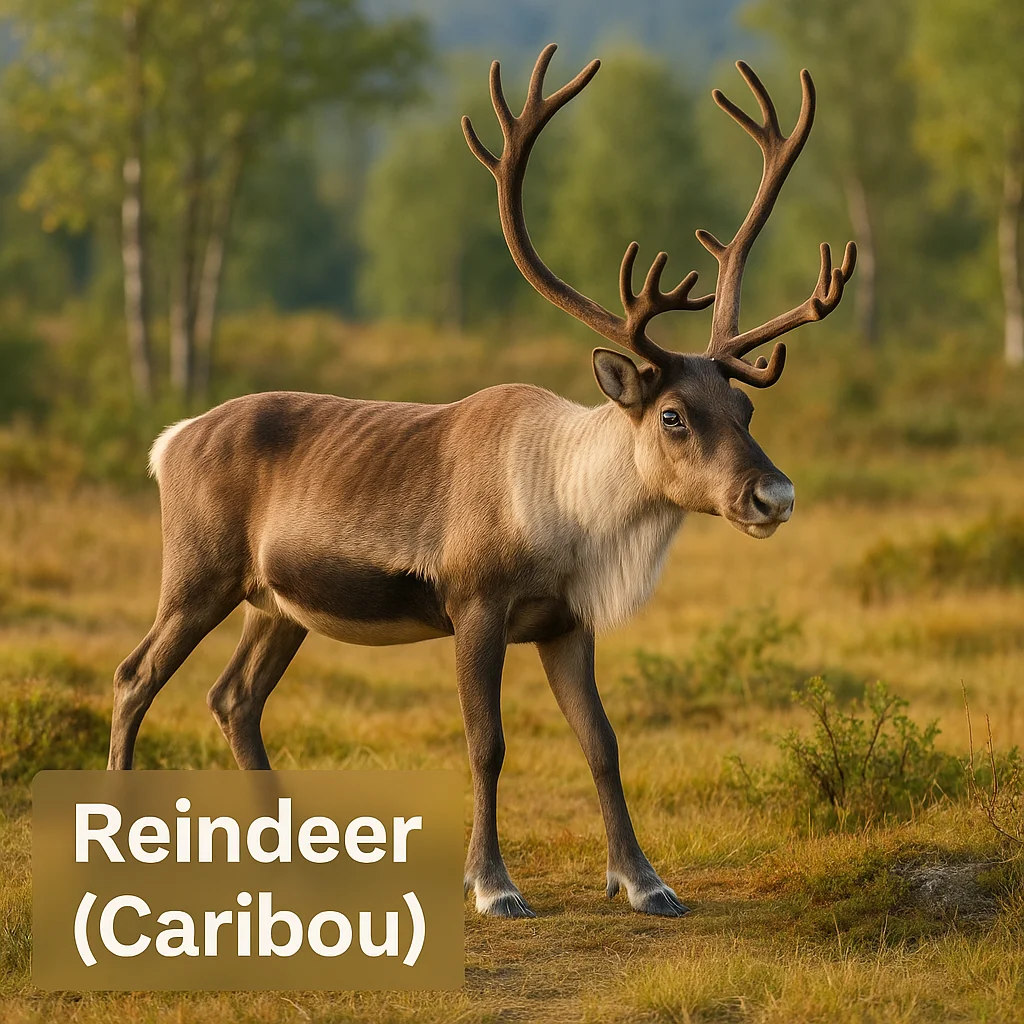
Reindeer are large, deer-like animals known for their impressive antlers that are present in both males and females, although larger in males. They exhibit a stocky body with a short tail, and their coat color can change with the seasons, going from a darker summer coat to a lighter winter one.
- Body shape and silhouette: Stocky with a robust build
- Key colors/patterns: Brownish in summer, paler with white underbelly in winter
- Distinctive features: Large antlers, even in females, broad hooves
- Tracks, scat, or other field signs: Heart-shaped hooves with a large means of supporting weight on snow
- Common look-alikes: Moose, but moose are larger and lack the distinct antlers of reindeer
- Top ID Tips:
- Look for the large antlers on both genders
- Observe the broad, heart-shaped hooves
- Notice the coloration that changes seasonally
- Check for their presence in tundra and boreal areas
- Sometimes seen in large herds
- Listen for their grunts and other vocalizations in herds
🧱 Body Structure & Physical Adaptations
Reindeer are well adapted to harsh environments. Their strong bodies and large hooves allow them to traverse snow and ice efficiently. Their nasal passages help warm the air they breathe, and dense fur insulates them from cold.
- Build and proportions: Stocky with short legs adapted for stamina
- Teeth/beak/jaw adaptations: Strong teeth for grinding lichens and tough vegetation
- Claws/hooves/wings/fins: Broad hooves for distributing weight on snow and ice
- Sensory strengths: Highly developed sense of smell important for finding food beneath snow
- Key Adaptations:
- Thick fur with hollow hair for insulation
- Large, broad hooves for walking on soft snow
- Excellent sense of smell to locate buried food
- Hot blood redirected to feet to prevent freezing
- Ability to thrive on nutrient-poor tundra vegetation
- Seasonal antler shedding to conserve energy
🌍 Range & Distribution
Reindeer are found across the northern hemispheres, spanning from North America to northern Europe and Asia. They prefer tundra and boreal forest biomes, with some populations migrating vast distances between summer and winter territories.
- Continents/regions: North America, Northern Europe, Asia
- Elevation range: Primarily lowland tundra; some in mountainous areas
- Seasonal movements: Known for long-distance migrations up to several hundred kilometers
- Where You Might Find It:
- In the tundra regions of Canada and Alaska
- Across Lapland in Northern Europe
- Throughout Siberian forested and tundra areas
- In mountainous areas during different seasons
- Within protected reserves and national parks in northern regions
🏞️ Habitat & Shelter
Reindeer are largely adapted to life in the tundra and taiga. These environments require them to be well-insulated and able to dig through snow to access food. During harsh weather, they may shelter against dense coniferous trees or in the lee of hills.
Their adaptation to these habitats helps ensure their survival, as they can exploit resources that few other species can.
🧭 Behavior & Ecology
Reindeer are typically active during the day, spending much of their time grazing. They communicate with grunts, barks, and body language, and their sense of smell aids them in food finding and social interactions. As herbivores, they graze on shrubs and lichens, playing a critical role in the tundra ecosystem by controlling vegetation and serving as prey for large predators.
- Behavior Highlights:
- Migratory behavior across large distances
- Ground pounding with hooves to uncover food in snow
- Vocal communication within herds
- Use of scent for marking by males during rut
- Role as major grazers in tundra ecosystems
👥 Social Life & Group Dynamics
Reindeer are social animals that form herds as a strategy for protection and survival. The size of herds can vary greatly, with some being small family groups and others numbering in thousands during migrations. Dominance within the group is typically established through displays and body size, especially during the breeding season.
- Social Structure Notes:
- Form large migratory herds in summer
- Smaller groups can be seen in winter months
- Males can be territorial during rut
- Females often lead herd migration
- Group coordination helps evade predators
🍽️ Diet, Prey & Predators
Reindeer are herbivores reliant on a diet that changes with the availability of vegetation. During summer months, they consume a variety of shrubs, grasses, and herbs, while in winter, they mainly rely on lichens known as "reindeer moss." Key predators include wolves and bears, and their best defenses are group vigilance and speed.
- Feeding Notes:
- "Reindeer moss" is a crucial winter food source
- Summer diet is richer in variety
- Grazing techniques involve trampling snow to reach vegetation
- Alert herding behavior helps detection of predators
🦌 Hunting, Foraging & Movement
As grazers, reindeer utilize their strong sense of smell and broad hooves to forage effectively. They migrate to optimize grazing opportunities and avoid deep snow. Reindeer are swift runners and can cover extensive distances when they migrate between seasonal ranges, exhibiting strong endurance rather than exceptional speed over short distances.
- Movement & Strategy:
- Migratory travel for foraging opportunities
- Strong flanking behavior within herd for predator evasion
- Use of visual landmarks for navigation
- Adaptation to walking in deep snow
🧠 Intelligence & Senses
Reindeer intelligence is notable in their adaptability to dynamic environments. They demonstrate spatial awareness and memory important for migration and foraging in often featureless landscapes covered in snow. Their sense of smell is exceptional, crucial for winter survival as they hunt for food buried beneath snow layers.
- Notable Abilities:
- Keen memory of migration routes
- Advanced sense of smell for finding lichens
- Responsive to environmental cues for migration
- Social intelligence within herd dynamics
🪺 Reproduction, Pregnancy & Parenting
Reindeer breed seasonally, with the rut occurring in late autumn. Males compete for females, and a single dominant male may mate with multiple females. Gestation lasts around 230 days, culminating in the birth of typically one calf. Calves are precocial, able to stand within hours of birth, which aids in survival within migratory herds.
- Reproduction Snapshot:
- Breeding occurs in late autumn
- Dominance established through antler displays and combat
- Gestation period around 7 to 8 months
- Calves can walk hours after birth
- Females are primary caregivers
♀️♂️ Male vs Female Differences
Both male and female reindeer grow antlers; however, their size and usage differ. Males typically have larger antlers used for competition during the rut. Females retain antlers through the winter, aiding in accessing food beneath snow. Males shed their antlers after the rut, while females keep theirs until after calving.
- Sex Differences at a Glance:
- Males have larger antlers than females
- Females use antlers for dig through snow in winter
- Males shed antlers post-breeding season
- Females are typically smaller than males
🧬 Subspecies & Variation
The classification of reindeer and caribou into subspecies is debated. Variation occurs largely due to differences in environment and geographic range. Subspecies differ in size, behavior, and migration patterns, with some adapted to vast tundra regions, while others reside in forested areas.
- Variation Notes:
- Barren-ground caribou adapted to Arctic tundra
- Woodland caribou often found in boreal forests
- Differences in migration tendencies
- Physical size variation among regions
- Classifications still under scientific evaluation
⚠️ Threats, Conservation & Human Interaction
Reindeer face numerous threats, including habitat loss due to deforestation and climate change. Human-induced impacts, such as industrial development and resource extraction, pose significant challenges. Conservation efforts focus on habitat preservation and managing human interactions to minimize disturbances. Several populations are under protection within reserves, but effective management requires global awareness and collaboration.
- Responsible Notes:
- Support efforts directed towards habitat conservation
- Understand the impact of climate change on migration
- Avoid disturbing herds during migrations
- Engage with local community initiatives supporting reindeer habitats
✨ Fun Facts & Unique Traits
- Both male and female reindeer grow antlers, unlike most deer species
- Reindeer are the only deer species where both sexes grow antlers
- They can run shortly after birth, which is essential for keeping up with herds
- Their hooves change with seasons, becoming spongier in the summer to wet tundra conditions
- The sound made by tendons in their legs, known as the "walking sound," aids in herd identification
- Reindeer digestion is efficient, allowing them to thrive on nutrient-poor vegetation
- They play a role in traditional cultures of indigenous peoples of the Arctic
📌 Summary
- Reindeer, or caribou, exhibit notable adaptations to cold habitats
- Both genders grow antlers, but with size differences
- Migrate vast distances between summer and winter ranges
- Diet mainly comprises lichens, mosses, and shrubs
- Face threats from predators and human encroachment
- Complex social structures with migratory herd dynamics
- Exhibit strong migratory behavior for optimal grazing
- Conservation status is varied, requiring regional assessments