🦁 African Grey Parrot
🧾 Quick Facts
The African Grey Parrot is known for its remarkable intelligence and ability to mimic human speech. These parrots are highly social animals with distinct personalities and complex vocalizations.
- Common name(s): African Grey Parrot, Grey Parrot
- Scientific name: Psittacus erithacus
- Animal type: Bird
- Typical adult size: 33 cm in length; weight 400–600 grams
- Typical lifespan: 30–50 years in captivity, 20–25 years in the wild
- Diet type: Omnivore; seeds, nuts, fruits, and occasionally insects
- Activity pattern: Diurnal
- Social structure: Pairs or small groups
- Speed / movement highlights: Slow flyers with graceful flight
- Intelligence/learning: Highly intelligent, capable of vocal mimicry and problem-solving
- Primary habitats: Tropical rainforests, savannas, and gallery forests
- Geographic range: Central to West Africa
- Predators/threats: Raptors, snakes, habitat loss, trapping for the pet trade
- Conservation status: Endangered
🔍 Identification & Appearance
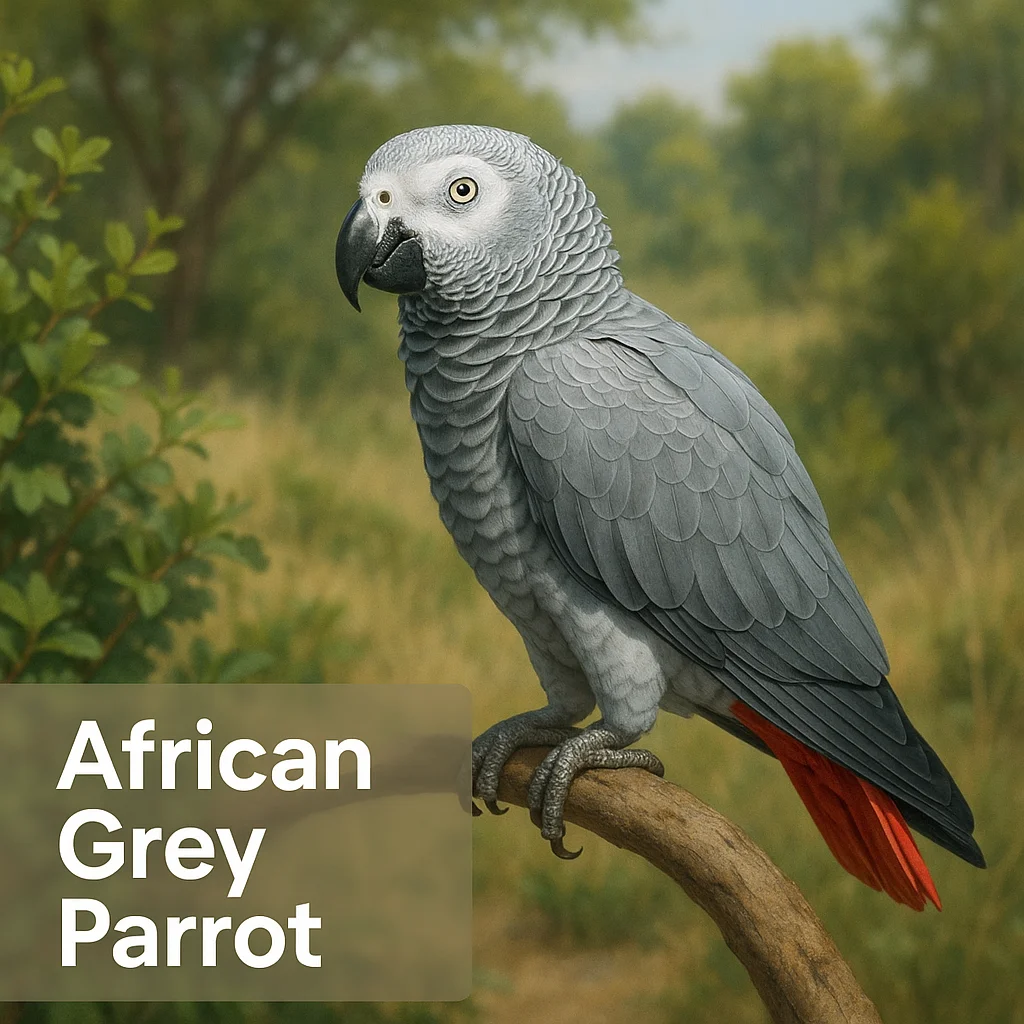
The African Grey Parrot is easily recognizable by its medium-sized, predominantly grey body and distinctive red tail feathers. Their beaks are strong and curved, perfect for cracking nuts and seeds. The eye rings are bare, and the eyes themselves are a striking pale yellow.
- Body shape and silhouette: Stocky, thick neck, medium-sized tail
- Key colors/patterns: Uniform grey plumage with a white mask and red tail
- Distinctive features: Black curved beak, bright red tail feathers
- Tracks, scat, field signs: Not commonly used for ID; prefer visual ID
- Common look-alikes: Other parrot species are smaller and lack red tails
- Top ID Tips
- Medium size compared to other parrots
- Grey body with a bright red tail
- Black beak and bare face
- Pale yellow eyes contrasting with grey head
- Distinctive squawk compared to other birds
- Smooth flight pattern while gliding
🧱 Body Structure & Physical Adaptations
African Grey Parrots are built for agility and dexterity. Their strong beaks can crack hard nut shells, and their zygodactyl feet allow them to grasp branches and food with precision. These adaptations make them formidable foragers in their natural habitat.
- Build and proportions: Medium-sized, strong, and compact body
- Beak adaptations: Strong, curved beak for cracking nuts and seeds
- Wing adaptations: Broad wings for agile flight in dense forests
- Sensory strengths: Exceptional vocal mimicry and sound recognition
- Key Adaptations
- Curved beak ideal for tough shells
- Zygodactyl feet for gripping
- Superb vocal mimicry skills
- Able flier in dense forest
- Social intelligence for complex interactions
- Sensitive hearing for communication
🌍 Range & Distribution
African Grey Parrots are primarily found across the equatorial regions of Africa, spanning countries from Côte d’Ivoire to Kenya and Tanzania. These parrots thrive in both dense rainforest and more open savannah woodland environments.
- Geographic range: West and Central Africa
- Countries: Côte d’Ivoire, Ghana, Democratic Republic of the Congo, Uganda, Kenya
- Biome: Tropical rainforests, savannas, and woodlands
- Elevation: Typically lowland areas but can be found up to 2,200 m
- Migration: Primarily residents but may move locally due to food availability
- Where You Might Find It
- Rainforests of the Congo Basin
- Western African savannas
- Gallery forests along rivers
- Highland clearings up to 2,200 m
- Near fruiting trees in forest edges
🏞️ Habitat & Shelter
African Grey Parrots prefer the lush canopies of tropical rainforests but can also be found in gallery forests and savannahs. They nest in tree cavities, providing protection against predators and extreme weather. Seasonal changes may influence their choice of habitats, particularly for available food sources.
🧭 Behavior & Ecology
The African Grey Parrot is a social creature with a complex communication system. These parrots are known for their intelligence, problem-solving abilities, and use in research on animal cognition. They play a crucial role in their ecosystem as seed dispersers, contributing to forest regeneration.
- Role in ecosystem: Vital seed dispersers and foragers
- Communication: Advanced vocalization for social interaction
- Resting: Roost in high trees for safety
- Social interactions: Playful and coordinated
- Behavior Highlights
- Highly vocal and social
- Playful interactions in groups
- Seed dispersal through feeding
- Complex vocal mimicry
- Advanced problem-solving skills
👥 Social Life & Group Dynamics
African Grey Parrots typically form strong pair bonds but are often seen in small family groups or larger flocks. Their social structure revolves around vocal communication and mutual grooming, which helps foster bonds and maintain social hierarchies.
- Group size: Pair bonds to flocks of up to 30
- Dominance: Subtle hierarchy within groups
- Cooperation: Commonly observed in grooming and alert calls
- Social Structure Notes
- Primarily form pairs or family groups
- Strong pair bonds with lifelong mates
- Communal roosting for protection
- Complex social interactions maintained vocally
🍽️ Diet, Prey & Predators
These parrots consume a diet primarily of seeds, nuts, fruits, and occasionally small insects. African Grey Parrots are preyed upon by raptors and occasionally snakes. To avoid predators, they rely on alert calls and safe nesting sites.
- Primary diet: Seeds, nuts, and fruits
- Predators: Raptors, snakes, humans
- Anti-predator strategy: Use of alarm calls and camouflaged nesting
- Feeding Notes
- Commonly feed on palm nuts
- Use feet to manipulate food for beak access
- Partial frugivores due to fruit diet in some areas
- Seek out mineral-rich clays for dietary supplements
🦌 Hunting, Foraging & Movement
Movement is primarily focused on foraging in the canopy layer. They have a strong ability to maneuver through dense branches, searching for food. Typically, African Grey Parrots are most active in the mornings and late afternoons when they forage.
- Movement & Strategy
- Active foragers in canopy and ground level
- Flight used primarily for location shifts rather than migration
- Navigate using visual landmarks
- Meticulous food searching on trees
- Peak foraging during morning and afternoon
🧠 Intelligence & Senses
African Grey Parrots are renowned for their cognitive abilities. They are capable of complex problem-solving, tool use, and have shown a deep understanding of speech mimicry in captivity. They have acute vision and hearing to aid in communication and navigation.
- Problem-solving: Capable of complex tasks and tool use
- Memory: Excellent long-term memory function
- Communication: Uses vocal mimicry for complex social dialogue
- Notable Abilities
- Strong aptitude for vocal mimicry
- High cognitive tasks capability
- Able to recognize and distinguish complex waveform sounds
- Quick learners of environmental cues
- Possess unique vocal signatures for individual identification
🪺 Reproduction, Pregnancy & Parenting
Breeding generally occurs during the dry season. Monogamous pairs select tree hollows for nests, with the female incubating the eggs. Both parents participate in raising the young, feeding them until they become independent.
- Breeding seasonality: Typically dry season
- Mating system: Mainly monogamous
- Clutch size: 3–5 eggs
- Parental care: Both parents involved
- Reproduction Snapshot
- Monogamous pairs utilizing selected tree cavities
- Shared parental care post-hatching
- Incubation period around 30 days
- Young fully dependent on parents initially
♀️♂️ Male vs Female Differences
Externally, males and females are quite similar in appearance, both possessing the characteristic grey plumage and red tails. Behavioral differences are minimal, though males may be more dominant in social groups.
- Size: Generally similar in size with subtle female lighter weight
- Behavior: Males often more active in social interactions
- Coloration: No significant difference
- Sex Differences at a Glance
- Minimal sexual dimorphism
- Subtle weight differences occasionally noted
- Less aggression in females during interactions
🧬 Subspecies & Variation
There are two main subspecies of the African Grey Parrot: the Congo African Grey and the Timneh African Grey. The Congo is larger, with a vivid red tail, while the Timneh is smaller, with a darker maroon tail and lighter plumage. Some taxonomic confusion persists regarding these variations.
- Variation Notes
- Psittacus erithacus erithacus (Congo): larger size, vivid red tail
- Psittacus erithacus timneh: smaller size, darker tail
- Some sources sometimes question the subspecies classification
- Geographic range mainly influences subspecies differentiation
⚠️ Threats, Conservation & Human Interaction
African Grey Parrots face numerous threats, including habitat destruction, illegal trapping for the pet trade, and climate change. Conservation efforts focus on protecting habitats and enforcing trade regulations. As common pet parrots, ethical ownership requires understanding their needs for mental stimulation and social interaction.
- Threats: Habitat loss, illegal trade
- Conservation efforts: Protection of habitats and trade bans
- Responsible ownership: Requires understanding of behavioral needs
- Responsible Notes
- Conserve natural habitats for protection
- Trade restrictions to curb illegal pet trade
- Awareness of ecological impact on species survival
- Pet ownership requires dedication for mental and physical care
✨ Fun Facts & Unique Traits
- African Grey Parrots can live up to 50 years in captivity, making them lifelong companions.
- They are considered one of the most intelligent bird species, comparable to primates.
- Studies show they may have the intelligence of a 5-year-old human child.
- Able to mimic hundreds of different sounds, including human voice accurately.
- Play a crucial role in their ecosystems as effective seed dispersers.
- They can understand the concept of quantity and are capable of basic counting.
- African Greys have been known to whistle tunes and hold simple conversations.
- Their vocal mimicry skills mean they often find themselves in trouble for revealing secrets!
📌 Summary
- The African Grey Parrot is easily identified by its grey plumage and red tail.
- Native to the equatorial regions of Africa, thriving in rainforests and savannas.
- Omnivorous diet includes seeds, fruits, and occasionally insects.
- Known predators include raptors and snakes.
- Highly social, forming pairs or small family groups.
- Reproduction involves monogamous pairs with shared parental duties.
- Key adaptations include strong beaks and excellent vocal mimicry.
- Renowned for their intelligence, capable of mimicry and problem-solving.
- Face significant conservation threats, including habitat loss and illegal trade.