🦁 Capercaillie
🧾 Quick Facts
The capercaillie, known for its striking appearance and fascinating courtship displays, is a notable member of the grouse family. These birds are primarily found in coniferous forests across Europe and parts of Asia. Varieties of capercaillie can differ depending on their location and environmental adaptations.
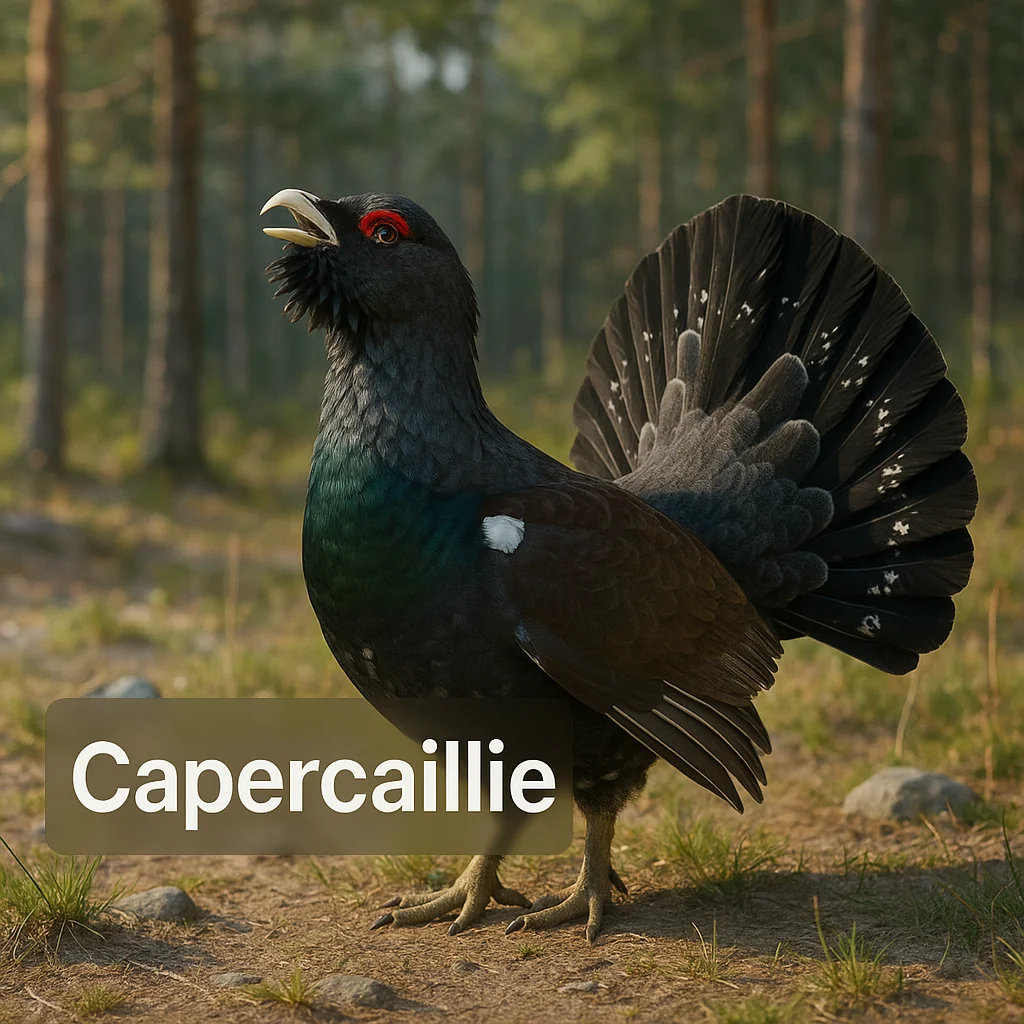
- Common name(s): Capercaillie, Wood Grouse
- Scientific name: Tetrao urogallus
- Animal type: Bird
- Typical adult size: 60-100 cm in length; 4-5 kg in weight
- Typical lifespan: 5-10 years in the wild
- Diet type: Omnivore; primarily feeds on plant material, leaves, berries, and insects
- Activity pattern: Diurnal
- Social structure: Typically solitary or in small groups; males often seen alone outside breeding season
- Speed / movement highlights: Strong, capable flyers despite heavy builds; prefer to walk
- Intelligence/learning: Moderate; capable of learning territorial boundaries and courtship displays
- Primary habitats: Boreal forests and mixed woodlands
- Geographic range: Northern and Central Europe, parts of Asia
- Predators/threats: Natural predators include foxes and raptors; human threats involve habitat destruction
- Conservation status: Varies by region; generally near threatened due to habitat loss
🔍 Identification & Appearance
The capercaillie is a large bird characterized by its robust body and striking plumage. Males often exhibit a mixture of dark greys and blacks with a metallic sheen, while females tend to be browner and more camouflaged. Distinctive features include a broad tail, powerful beak, and striking red eyebrow wattles. During courtship, males fan their tails and exhibit a unique display to attract females. Tracks in the snow show a distinctive large-footed bird pattern.
- Top ID Tips
- Look for a large, bulky bird with robust legs
- Note the striking red wattles above the eyes
- Observe the strong, slightly hooked beak
- Males: blackish plumage with shiny green breast
- Females: smaller, mottled brown plumage
- Fan-shaped tail, especially prominent in displays
- Distinctive "bubbling" call for males during mating season
- Check for large footprints in soft ground or snow
🧱 Body Structure & Physical Adaptations
The capercaillie has a sturdy build, being one of the largest members of the grouse family. It has strong, muscular wings ideal for short bursts of flight, allowing it to maneuver through dense forests quickly. Its beak is designed for foraging through leaves and berries, with sharp edges that can also handle insects. These birds possess keen eyesight and hearing, crucial for detecting predators in their forest habitat.
- Key Adaptations
- Robust body for efficient thermoregulation in cold climes
- Muscular wings for swift navigation through wooded areas
- Sturdy beak for a diverse diet
- Adaptations for silent take-offs in dense vegetation
- Feathered nostrils providing warmth in cold conditions
- Seasonal plumage adaptation for camouflage
- Improved eyesight for detecting predators
- Enhanced hearing tuned to forest sounds
🌍 Range & Distribution
Capercaillies inhabit the boreal and temperate forests across a wide range, from the lush Scottish Highlands to the vast Russian taiga. Their distribution is determined by the availability of forest cover, which offers food and protection. Capercaillies are mostly non-migratory, preferring stable wooded habitats throughout the year, although some vertical migrations can occur in mountainous regions.
- Where You Might Find It
- Boreal forests of Northern Europe
- Coniferous forests in Scandinavia
- Mixed woodland areas in Eastern Europe
- Occasional populations in the Alpine regions
- Stable populations in the Russian taiga
- Traditional ranges in Scottish Highlands
- Wooded highlands of the Pyrenees
- Isolated pockets in the Carpathians
🏞️ Habitat & Shelter
Capercaillies thrive in mature coniferous forests, where they find ample cover and foraging opportunities. These birds prefer forests with plenty of undergrowth and scattered clearings, which are key to their foraging habits. Shelter is typically found in dense forest stands, especially during harsh weather when they rely on thick foliage for protection. Knowledge of their habitat is crucial, as it influences their feeding, breeding, and survival tactics.
🧭 Behavior & Ecology
Capercaillies are known for their unique and elaborate lekking behavior, where males congregate to compete for mating rights in a public display area. Territorial and solitary for most of the year, they exhibit different social dynamics during the breeding season. Males become vocal, performing guttural clicks and swishing sounds to attract females. As an integral part of the forest ecosystems, capercaillies aid in seed dispersion and act as prey for larger predators.
- Behavior Highlights
- Annual lekking behavior with vivid displays
- Solitary outside the breeding season
- Territorial males during courtship period
- Utilizes complex vocalizations to communicate
- Opportunistic feeding habits to match availability
- Seed dispersal through droppings
- Marking territories with visual and vocal cues
- Prey for larger forest predators
👥 Social Life & Group Dynamics
Capercaillies are primarily solitary birds except during the breeding season when they shift to a more social arrangement in lek sites. During these periods, males establish dominance hierarchies, competing with flamboyant displays to capture female attention. Outside of mating, they maintain a solitary life or form small, non-permanent groups, mainly during foraging, with little social bonding.
- Social Structure Notes
- Solitary during non-breeding seasons
- Lekking groups during mating season
- Weak social bonds between adults
- Hierarchical structures in leks
- Lek size can vary by region
- Females often nest alone post-mating
- No cooperative care in rearing chicks
- Territoriality more pronounced in males
🍽️ Diet, Prey & Predators
The capercaillie diet is predominantly vegetarian, consisting mainly of buds, leaves, and berries, complemented by insects when available. In winter, they rely heavily on tree buds and needles, showcasing their adaptability. Predators include foxes, martens, and large birds of prey. Their defense strategies range from flying to dense cover, to staying perfectly still to avoid detection.
- Feeding Notes
- Largely herbivorous diet
- Prefers berries, buds, and shoots
- Winter diet includes pine needles
- Opportunistic insect consumption
- Predation by foxes and raptors
- Camouflage as a key defense technique
- Utilizes dense forest for escape
- May change diet seasonally
🦌 Hunting, Foraging & Movement
Capercaillies excel in foraging within their forested habitats, using a combination of walking and short flights to navigate dense areas. They possess a strong flight ability for quick escapes, although they prefer to walk when foraging. Not known for speed, they rely on stealth and forest camouflage to avoid predators. Their foraging strategy often involves picking nutritious plant parts from the forest floor or shrubbery.
- Movement & Strategy
- Strong flight muscles for short bursts
- Skilled at navigating dense woods
- Primarily forages by walking
- Prefers ground foraging to aerial foraging
- Utilizes stealth and camouflage in movements
- Short predator evasion flights
- Feeds during daylight hours
- Makes seasonal use of food availability
🧠 Intelligence & Senses
Inquisitive by nature, the capercaillie's intelligence aids in survival, particularly in their ability to navigate complex forest habitats and recognize territorial boundaries. They have a keen sense of hearing and sight, essential for detecting predators and communicating during the breeding season. While research on cognitive abilities is limited, they demonstrate skills in recognizing safe habitats and potential threats.
- Notable Abilities
- Keen sense of hearing for predator detection
- Acute eyesight for navigation
- Capability to learn territorial boundaries
- Complex vocalizations for communication
- Adaptability in various forest environments
- Recognizes safe habitats and escape routes
- Social intelligence evident in lekking
- Resourceful foraging strategies
🪺 Reproduction, Pregnancy & Parenting
The capercaillie's breeding season is marked by spectacular lekking displays where males gather in specific sites to court females during spring. These displays can last several weeks, with successful males typically mating with multiple females. After mating, females nest solitarily, laying around 6-12 eggs with an incubation of about 26-28 days. Chicks are precocial and can leave the nest soon after hatching, but they remain under the mother's care initially.
- Reproduction Snapshot
- Lekking season in early spring
- Polygynous mating system
- Long courtship displays
- Female lays 6-12 eggs
- Incubation period: 26-28 days
- Chicks leave nest shortly after hatching
- Mother provides initial care
- Males do not partake in childcare
♀️♂️ Male vs Female Differences
Distinct sexual dimorphism is evident in capercaillies, with males considerably larger and more vividly colored than females. Males exhibit iridescent black plumage with a distinctive white patch on the wing, whereas females have brown, cryptic plumage suited for nesting camouflage. Behavioral differences are also notable; males are more active in courtship during the breeding season, engaging in vocal displays and challenges against rivals.
- Sex Differences at a Glance
- Males larger and heavier than females
- Iridescent plumage in males
- White wing patch exclusive to males
- Females have cryptic, brown coloration
- Males engage in lek courting rituals
- Females take sole responsibility for nesting
- Behavioral differences during breeding season
- Size differences pronounced in displays
🧬 Subspecies & Variation
Several subspecies of capercaillie exist, each showcasing unique adaptations to their specific habitats. These variations may include differences in size, plumage coloration, and vocalizations. There are regional differences in behavior, partly driven by environmental factors, which can lead to contrasting conservation statuses. The classification of these subspecies sometimes remains debated among ornithologists.
- Variation Notes
- Subspecies differentiation by size and color
- Regional adaptations to local environments
- Potential variation in vocalization and behavior
- Adaptations to cold climates, like shorter extremities
- Different conservation needs in various regions
- Debates on exact classification among experts
- Island adaptations occasionally observed
- Variability in lekking behavior across ranges
⚠️ Threats, Conservation & Human Interaction
The capercaillie faces several threats, primarily from habitat destruction due to logging, urban expansion, and agriculture. Climate change also poses a long-term risk, potentially altering their habitat. Conservation efforts focus on habitat preservation and managing forested areas sympathetically. These birds can sometimes be found in wildlife reserves and are subjects of conservation-centric tourism. Ensuring ethical engagement and non-invasive observation during ecotourism is crucial.
- Responsible Notes
- Primary threat: habitat loss
- Vulnerable to climate change effects
- Managed in wildlife reserves
- Focus on habitat preservation
- Conservation status varies; often near threatened
- Ethical watching encouraged in eco-tourism
- Regulated hunting in some areas
- Promoting awareness through educational programs
✨ Fun Facts & Unique Traits
- Capercaillie means "horse of the woods" in Gaelic.
- Males can perform courtship displays for several hours a day.
- Utilizes "lekking" sites that can be used for generations.
- Capercaillie chicks are independent shortly after hatching.
- They possess a unique "bubbling" mating call.
- Known to be one of the heaviest flying birds in Europe.
- Integral to maintaining forest ecosystems through seed dispersion.
- Due to their large size, they rarely achieve extended flight.
📌 Summary
- Large, robust bird of the grouse family.
- Vivid displays during mating season called lekking.
- Found in boreal and mixed forests across Europe and Asia.
- Prefers a diet of plant materials and occasional insects.
- Main predators include foxes and birds of prey.
- Generally solitary; social interactions peak in the breeding season.
- Distinct size and color differences between males and females.
- Faces threats mainly from habitat loss and climate change.