🦁 Common Raven
🧾 Quick Facts
The Common Raven, scientifically referred to as Corvus corax, is one of the most adaptable and widespread species of birds. Known for their intelligence and versatility, ravens display a remarkable range of behaviors and occupy diverse habitats across the globe.
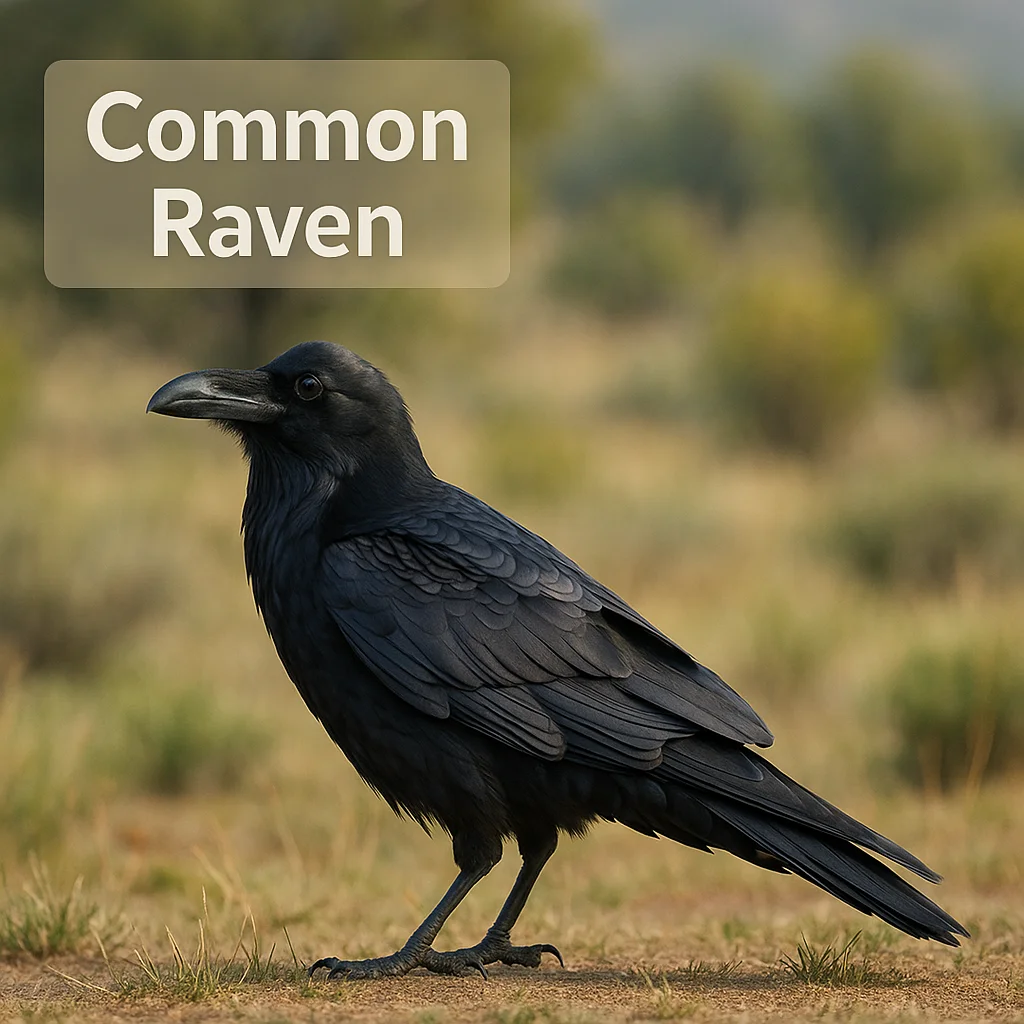
- Common name(s): Common Raven, Northern Raven
- Scientific name: Corvus corax
- Animal type: Bird
- Typical adult size: 56–69 cm (22–27 in) in length; wingspan 115–150 cm (45–59 in)
- Typical lifespan: 10–15 years in the wild; up to 40 years in captivity
- Diet type: Omnivore; includes small mammals, birds, insects, fruits, and carrion
- Activity pattern: Diurnal, with periods of rest during the night
- Social structure: Often found in pairs or small family groups
- Speed/movement highlights: Strong flier capable of acrobatic flight
- Intelligence/learning: Highly intelligent with problem-solving capabilities
- Primary habitats: Forests, mountains, deserts, grasslands, urban areas
- Geographic range: Holarctic, including North America, Europe, Asia, and North Africa
- Predators/threats: Large birds of prey, humans (habitat destruction, hunting)
- Conservation status: Least Concern; populations are stable in many regions
🔍 Identification & Appearance
The Common Raven is a large bird with a thick neck and shaggy throat feathers. It is entirely black, with a prominent beak and wedge-shaped tail visible during flight. Its glossy plumage may display a bluish or purplish sheen in sunlight.
- Body shape and silhouette: Robust, with a heavy beak and long tail
- Key colors/patterns: Completely black, often with a metallic sheen
- Distinctive features: Shaggy feathers on the throat known as "hackles"
- Tracks, scat, or other field signs: Large, four-toed footprints; scat is black and often contains fur or feathers
- Common look-alikes: American Crow, distinguishable by size and tail shape
- Watch for the distinctive wedge-shaped tail in flight
- Listen for a deep, croaking "kraa" call
- Note the large, curved beak and prominent throat hackles
- Observe the glossy sheen that shows under direct light
- Look for them in open landscapes and forest edges
- Commonly seen alone or in pairs, unlike crows which gather in larger groups
🧱 Body Structure & Physical Adaptations
Ravens have a sturdy build, optimized for strength rather than speed. Their large beak is adapted for tearing flesh, breaking seeds, and exploring a variety of food sources. Ravens' wings are broad and ideal for soaring and maneuvering in various environments.
- Build and proportions: Stocky and robust with long wings
- Beak adaptations: Large, strong, slightly curved beak for diverse diets
- Wings: Broad wings, ideal for sustained soaring
- Sensory strengths: Acute vision and hearing, able to detect distant sounds and movements
- Heavy, curved beak for breaking apart food
- Thick plumage aids thermoregulation in cold climates
- Powerful wings for long-distance travel
- Adaptable to a wide range of foods due to beak and cerebral abilities
- Excellent vocal mimicry and a broad repertoire of sounds
🌍 Range & Distribution
Common Ravens are a cosmopolitan species, found across much of the Northern Hemisphere. They can live in a wide variety of habitats, from rural to urban environments, and are often found in mountainous areas.
- Regions: Occupies most of North America, Europe, Asia, and parts of North Africa
- Elevation range: Found from sea level to high mountain ranges
- Seasonal movements: Typically non-migratory, though some may move locally for food
- Widely distributed across northern and western American regions
- Also found in Scandinavia, Russia, and other parts of Europe
- Prefers areas with open landscapes and cliffside nesting sites
- Often found in woodlands, tundra, high desert, and coastal areas
- Also adapted to human-altered environments like cities and farmlands
🏞️ Habitat & Shelter
Ravens are highly adaptable, able to make use of various habitats. They often select elevated perches like trees and cliffs for nesting and roosting. Their adaptability to diverse habitats is key to their success across different regions.
- Preferred habitats: Forests, open landscapes, deserts, grasslands
- Microhabitats and shelter: Nests on cliffs, trees, and urban buildings
- Seasonal changes: Behaviors can vary with food availability and weather
🧭 Behavior & Ecology
Ravens are known for their complex behaviors and social structures. They are territorial birds, with mated pairs often staying together throughout the year. They use a wide range of vocalizations and displays to communicate with each other and are also adept at mimicking sounds from their environment.
- Daily routine: Active during daylight, spending time foraging and exploring
- Communication: Use varied vocalizations and body language
- Interactions with other species: Opportunistic feeders, often seen with predators or scavenging carrion
- Role in ecosystem: Scavenger and potential seed disperser
- Active mostly during daylight hours
- Employ versatile vocal communications
- Interact freely with many animal species
- Known as intelligent opportunists
- Key role as scavenger, affecting carcass spread
👥 Social Life & Group Dynamics
Ravens are typically found alone or in pairs, except when food is plentiful. Young ravens may form flocks until they are mature enough to establish territory and pair up. They demonstrate cooperative behaviors and complex social structures within their family units or temporary groups.
- Solitary vs social tendencies: Primarily solitary or paired but social when young
- Group types: Flocks of juveniles
- Cooperation: Share food sources
- Conflict resolution: Utilize displays and vocalizations to claim dominance
- Tend to form long-term pair bonds
- Juveniles may gather in temporary groups
- Pairs often defend territories cooperatively
- Involve courtship displays and collective parenting
- Show intrigue and curiosity in new interactions
🍽️ Diet, Prey & Predators
Common Ravens are highly opportunistic feeders, capable of consuming a vast range of food types. As omnivores, their diet includes carrion, small animals, seeds, and fruit. They are skilled in finding food and will often scavenge from other predators. Predators of ravens are limited but can include larger birds of prey.
- Diet: Varied, including small rodents, insects, fruit, and carrion
- Seasonal variations: Will shift diet based on availability
- Main predators: Raptors like hawks and occasionally humans
- Voracious appetite for accessible food sources
- Regularly observed scavengers of carcasses
- Displays multi-modal feeding behavior
- Utilizes intelligence to steal food from others
- Enhanced adaptability and resourcefulness ensure survival
🦌 Hunting, Foraging & Movement
As powerful fliers, ravens are capable of covering significant distances in search of food. Their foraging strategy is highly adaptable, using their keen intelligence to exploit varied opportunities from scavenging to hunting small animals.
- Locomotion style: Efficient fliers and walkers
- Speed and endurance: Can soar for extended periods
- Foraging tactics: Combines scavenging with opportunistic predation
- Sustains long flights utilizing thermal currents
- Engages in aerial acrobatics and agile flight
- Develops keen navigation and orientation skills
- Highly adaptable forager
- Exhibits strategic behavior for efficient resource use
🧠 Intelligence & Senses
Ravens are known for their remarkable intelligence, often considered one of the most intelligent bird species. They are skilled in problem-solving, exhibit memory and learning capabilities, and can use tools in various situations.
- Problem-solving: Capable of manipulating objects and solving puzzles
- Tool use: Utilizes sticks and similar objects when needed
- Senses: Acute vision aids in locating food; hearing is strong
- Displays complex social behaviors and coordination
- Mimics sounds from environment
- Possesses cognitive adaptability to new challenges
- Shows ingenuity in solving environmental puzzles
- Demonstrates impressive retention and memory
🪺 Reproduction, Pregnancy & Parenting
Breeding usually occurs once a year, with elaborate courtship displays. Ravens are generally monogamous, forming long-lasting pair bonds. Nesting often takes place in high, inaccessible places, such as cliffs or tall trees. Both parents are involved in raising the young.
- Breeding seasonality: Occurs in late winter to early spring
- Mating system: Mostly monogamous
- Incubation period: About 18-21 days
- Clutch size: 3-7 eggs
- Parenting roles: Both parents feed and care for chicks
- Extensive courtship involving aerobatics
- Nests are large, often holding several clutches
- Chicks fledge about 35–42 days post-hatching
- Both parents share feeding responsibilities
- Intelligent and strategic in caring for offspring
♀️♂️ Male vs Female Differences
Males and females are generally similar in appearance, with subtle differences in size. Such differences are usually only distinguishable when the birds are observed closely together.
- Size/weight: Males are slightly larger and heavier than females
- Coloration: No noticeable differences
- Behavioral role: Both engage in territory defense
- Sexes display near identical plumage
- Males may demonstrate more prominently in courting
- Size differences are often minimal
- Both sexes contribute to nesting and rearing
🧬 Subspecies & Variation
The Common Raven is divided into several subspecies, distinguished by geographic distribution and subtle differences in size and calls. Such variations reflect adaptations to specific environmental niches.
- Known subspecies: Varies across different global regions
- Local adaptations: Diet and vocalizations may shift according to region
- Certain subspecies may show minor plumage differences
- Geographical isolation can lead to call variations
- Ecological adaptability enables expansive range
- Select subspecies exhibit anatomical adaptations to local climates
⚠️ Threats, Conservation & Human Interaction
While the Common Raven is abundant, it faces challenges such as habitat loss and persecution in some regions. Ravens have shown themselves resilient, and populations are generally stable; however, they require continued monitoring to ensure long-term health.
- Human-related pressures: Habitat destruction and pollution
- Natural challenges: Predation by larger birds of prey
- Strive for cohabitation and balance in shared spaces
- Engage in non-invasive monitoring to ensure stable populations
- Avoid creating dependency via feeding
- Encourage habitat conservation to maintain biodiversity
✨ Fun Facts & Unique Traits
- Common Ravens are known to mimic human speech and other sounds
- These birds show advanced problem-solving skills that can rival primates
- They maintain large territories and have complex social structures
- Ravens display play behavior, such as sliding down snowbanks
- They have been observed using tools to obtain food
- Ravens are adaptable birds, capable of thriving in diverse environments
- They are known for their intelligent gaze and inquisitive nature
📌 Summary
- Identified by their large size, wedge-shaped tail, and all-black plumage
- Occupies a vast range across the Northern Hemisphere
- Primary habitats include forests, mountains, and urban areas
- Omnivorous diet with a range from animal proteins to fruits
- Adaptations include a strong beak and wings for diverse diet and flight
- Complex behaviors such as tool use and social interactions showcase their intelligence
- Monogamous pairs with well-coordinated parenting roles
- Engage in vibrant communication through varied calls
- Vital role as scavengers in the ecosystem