🦁 Great Hornbill
🧾 Quick Facts
The Great Hornbill is an impressive bird known for its striking appearance and unique behaviors. It's an emblematic species of the forests in Southeast Asia, playing a vital role in its ecosystem.
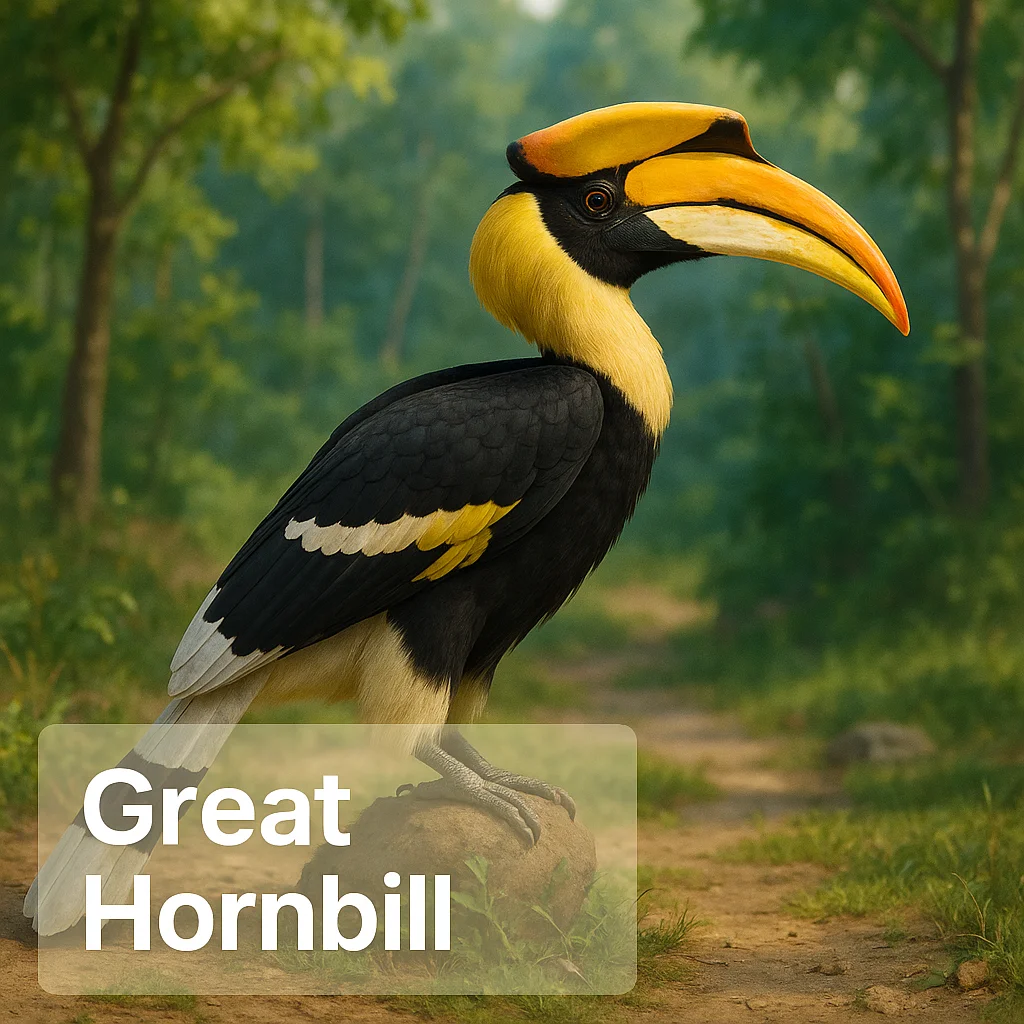
- Common name(s): Great Hornbill, Great Indian Hornbill
- Scientific name: Buceros bicornis
- Animal type: Bird
- Typical adult size: 95 to 120 cm in length, 2 to 4 kg in weight
- Typical lifespan: 30 to 50 years in the wild
- Diet type: Omnivore; primarily fruit, but also small mammals, birds, and insects
- Activity pattern: Diurnal
- Social structure: Often found in pairs or small family groups
- Speed / movement highlights: Soars or glides long distances between feeding areas
- Intelligence/learning: High; known for problem-solving skills and complex communication
- Primary habitats: Dense forests, both evergreen and mixed deciduous
- Geographic range: India, Bhutan, Southeast Asia, and Sumatra
- Predators/threats: Humans (hunting/deforestation), raptors, and large cats
- Conservation status: Near Threatened
🔍 Identification & Appearance
The Great Hornbill is easily recognized by its impressive size and striking coloration. Its most notable feature is the enormous yellow and black casque atop its massive bill. This conspicuous structure is used for both visual displays and acoustic resonance. The bird's body is primarily black and white, with a black tail featuring white bands. The eyes of the male are red, while the female's eyes are white.
- Top ID Tips:
- Large yellow and black casque on the bill
- Black and white plumage
- Red eyes in males, white in females
- Black tail with white bands
- Robust body and broad wings
- Long wingspan for soaring
- Distinctive loud call
🧱 Body Structure & Physical Adaptations
Great Hornbills have a robust and muscular body, optimized for their life spent mostly in the canopy layer of forests. Their massive beak, while seemingly cumbersome, is lightweight, supported by an arrangement of hollow elements. This enables the bird to pluck fruits easily from tree branches. Their wings are strong and broad, suitable for gliding over large distances. Their sharp vision assists them in spotting food and rivals.
- Key Adaptations:
- Lightweight, yet large beak
- Strong, broad wings for soaring flight
- Excellent vision for spotting fruits and predators
- Adapted vocal sacs for amplified calls
- Strong feet for gripping branches
- Robust neck muscles to support the massive bill and casque
🌍 Range & Distribution
The Great Hornbill is primarily found in the tropical and subtropical regions of Asia, notably from India to the Malay Peninsula and Sumatra. It prefers dense forests where it can find an abundance of fruiting trees, which are its main food source.
- Where You Might Find It:
- Western Ghats in India
- Northeast India
- Lowland forests of Bhutan
- Forests of Myanmar and Thailand
- Rainforests of Sumatra and Malaysia
- Hill forests in Nepal
🏞️ Habitat & Shelter
Great Hornbills inhabit a variety of forest habitats, ranging from lowland tropical rainforests to mountainous evergreen forests. They rely heavily on mature forest ecosystems with abundant fruiting trees to meet their dietary needs. During breeding, they seek out large trees for nesting.
🧭 Behavior & Ecology
Great Hornbills are diurnal and highly vocal, using their calls to maintain communication and establish territory. Their diet mainly consists of fruit, but they are also known to consume small mammals, insects, and other birds. In the ecosystem, they play a crucial role in seed dispersal, thereby contributing to forest regeneration.
- Behavior Highlights:
- Exhibits complex vocal communication
- Active seed dispersers
- Highly territorial during breeding
- Capable of flying long distances daily
- Defensive displays using their large casques
👥 Social Life & Group Dynamics
Great Hornbills are primarily monogamous, forming close pair bonds that often last a lifetime. They are usually seen in pairs or small family groups, especially outside of the breeding season. While they don't form large flocks, they can occasionally be seen with other hornbill species in mixed feeding parties.
- Social Structure Notes:
- Strong monogamous pair bonds
- Occasional family groups
- Interaction with other hornbill species
- Cooperative parenting observed during breeding
- Communication key to social interaction
🍽️ Diet, Prey & Predators
The Great Hornbill primarily feeds on a variety of fruits, which constitute the majority of its diet. Figs are particularly favored due to their year-round availability. They also hunt small animals, serving as opportunistic predators when the opportunity arises.
- Feeding Notes:
- Figs make up a significant part of their diet
- Eat varied species of fruits seasonally
- Occasionally partake in hunting small mammals
- Predators include larger birds of prey
- Humans pose a significant threat through habitat destruction
🦌 Hunting, Foraging & Movement
Great Hornbills are predominantly frugivorous, spending a lot of their time foraging in the dense forest canopy. They use their massive bills to pluck and crush fruits. Their powerful wings aid them in covering large distances either in search of feeding grounds or to mark their territory.
- Movement & Strategy:
- Powerful, steady flight for long-distance travel
- Forages primarily in the upper levels of the forest
- Known to visit fruiting trees regularly
- May fly up to 100 km in a day in search of food
🧠 Intelligence & Senses
Great Hornbills are intelligent birds known for their vocal communications and problem-solving skills. They have excellent vision, aiding them in long-distance flights. While not known for tool-use, they exhibit social intelligence related to group dynamics and bonding.
- Notable Abilities:
- Complex vocal communication
- Strong pair and group bonding
- Excellent long-distance navigation
- Advanced visual acuity
🪺 Reproduction, Pregnancy & Parenting
Great Hornbills have a unique breeding system, nesting in large tree cavities where the female seals herself in with her mate's assistance, leaving only a small slit for passing food. The female remains enclosed for the incubation period until the chicks are ready to fledge.
- Reproduction Snapshot:
- Monogamous pair bonding
- Breeding season varies regionally but often coincides with the fruiting season
- Female seals herself in the nest cavity
- Incubation lasts about 40 days
- Both parents care for the offspring post-fledging
♀️♂️ Male vs Female Differences
While both male and female Great Hornbills look quite similar, there are some differences. The male's eyes are red while the female's are white. Males are typically larger, with a more prominent casque.
- Sex Differences at a Glance:
- Red eyes in males, white in females
- More prominent casque in males
- Males are slightly larger than females
- Roles differ during nesting; males provide food
🧬 Subspecies & Variation
There are no officially recognized subspecies of the Great Hornbill, but regional variations exist in size and casque shape. These differences are usually attributed to adaptations to different habitats and available resources.
- Variation Notes:
- Geographical size variations observed
- Possible casque shape differences between regions
- Coloration may vary slightly based on environmental factors
⚠️ Threats, Conservation & Human Interaction
The Great Hornbill faces a number of threats, primarily due to habitat loss from deforestation. Hunting for its casque and feathers also poses a significant risk. Conservation efforts are essential to maintain populations, and some areas have established protected reserves to safeguard these stunning birds.
- Responsible Notes:
- Habitat protection is critical
- Regulations may help reduce hunting pressure
- Education campaigns could promote awareness
- Improved forestry practices needed
✨ Fun Facts & Unique Traits
- The Great Hornbill's casque may function as a resonating chamber to amplify its calls.
- They are culturally significant in various regions, symbolizing strength and longevity.
- The "gak-gak" call of the male is unique and serves various communication purposes.
- They have a cooperative breeding system endemic to hornbills.
- Great Hornbills participate in seed dispersal, crucial for forest regeneration.
- Their nesting behavior, involving sealing the female in a tree cavity, is a unique survival strategy.
📌 Summary
- Great Hornbills are large birds with distinctive yellow and black casques.
- Primarily reside in the forests of Southeast Asia.
- Omnivorous diet, with a preference for fruit.
- Key seed dispersers in their ecosystems.
- Monogamous, with unique nesting behaviors.
- Face threats from habitat loss and hunting.
- Exhibit strong social bonds and vocal communications.
- Prominent in local cultures, representing longevity.