🦁 Greater Rhea
🧾 Quick Facts
The Greater Rhea (Rhea americana) is a large, flightless bird native to South America. Often found in open grasslands and semi-arid regions, this bird is known for its impressive speed and striking appearance.
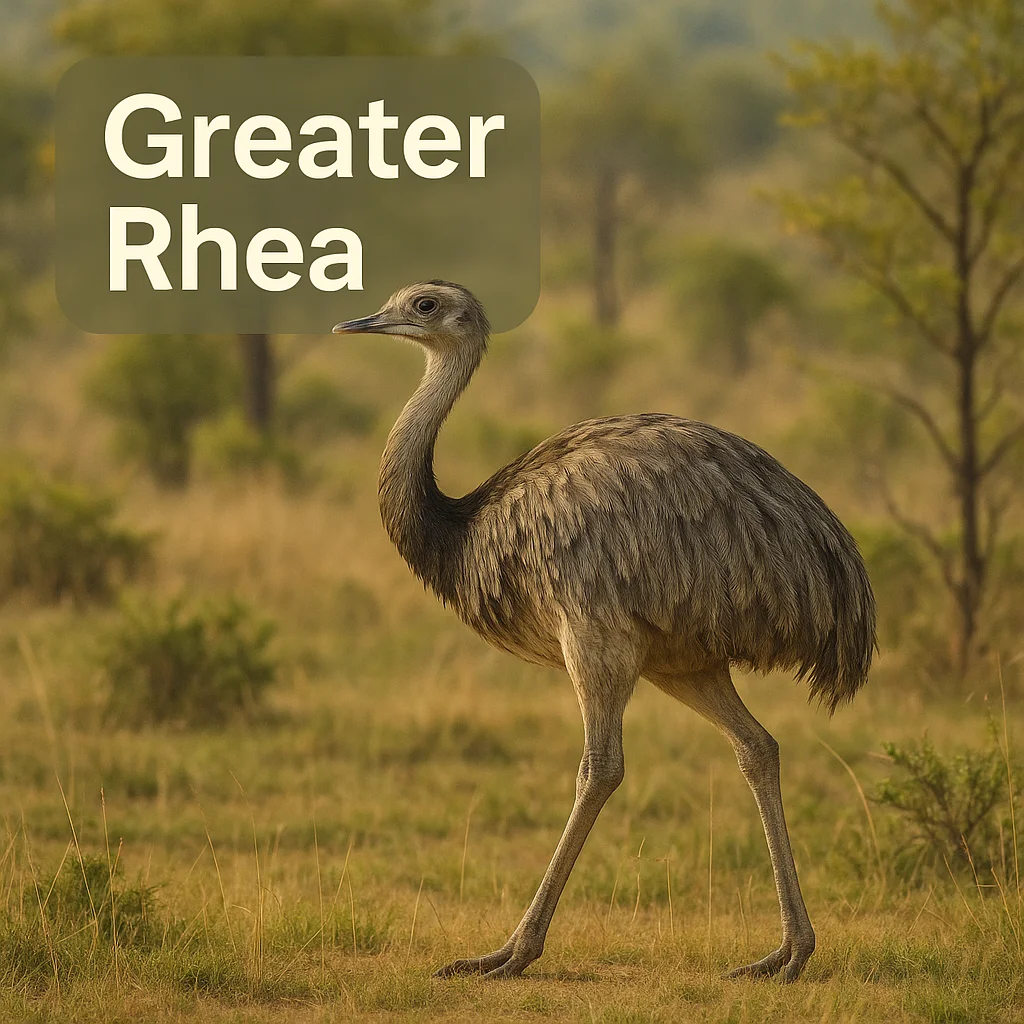
- Common name(s): Greater Rhea, American Rhea
- Scientific name: Rhea americana
- Animal type: Bird
- Typical adult size: 4.5-5.6 feet tall, 44-66 pounds
- Typical lifespan: 10-20 years in the wild
- Diet type: Omnivore; primarily plants, insects, small vertebrates
- Activity pattern: Diurnal
- Social structure: Group-living, forming flocks
- Speed / movement highlights: Can run up to 40 mph
- Intelligence/learning: Capable of learning and problem-solving
- Primary habitats: Grasslands, savannas, open woodlands
- Geographic range: Eastern South America, including Brazil, Argentina, and Uruguay
- Predators/threats: Jaguars, pumas, habitat loss
- Conservation status: Near Threatened
🔍 Identification & Appearance
The Greater Rhea is characterized by its large size, long neck, and powerful legs. Its plumage is typically gray to brown, with longer feathers around the head and neck, giving it a fluffy appearance. Unlike its relatives the ostrich and emu, the Greater Rhea lacks a tail and has three toes on each foot.
- Top ID Tips:
- Large, flightless bird with long legs and neck
- Feathers are mostly gray or brown, without a tail
- Three toes per foot, unlike the two toes of an ostrich
- Distinct fluffy plumes around neck and back
- Juveniles have a more mottled pattern compared to adults
- Easily differentiated from emus by location and slight color variations
- Heads have a more pronounced feathering than ostriches
🧱 Body Structure & Physical Adaptations
The Greater Rhea is adapted for running, with a slender build, long legs, and a proportionally small head. Its beak is short and broad, suitable for foraging a wide variety of foods. Wings are short and used for balance while running, rather than for flight. Its large eyes provide good vision, crucial for spotting predators in open habitats.
- Key Adaptations:
- Long legs for high-speed running
- Short, broad beak adapted to omnivorous diet
- Skeletal structure optimized for running with a strong breastbone
- Large eyes for enhanced visual detection of predators
- Reduced wing size contributes to balance rather than flight
- Soft, fluffy feathers offer insulation and camouflage
- Three-toed feet aid in stability during sprints
🌍 Range & Distribution
The Greater Rhea is found in the open landscapes of eastern South America, spanning countries such as Brazil, Argentina, Uruguay, Paraguay, and Bolivia. It inhabits a range of ecosystems from pampas and savannas to grassy wetlands. The species generally does not migrate and is considered largely resident.
- Where You Might Find It:
- Brazilian grasslands
- Argentinian pampas
- Uruguayan savannas
- Paraguayan open woodlands
- Bolivian semi-arid regions
- Pasturelands and disturbed fields
- Protected areas within their range
🏞️ Habitat & Shelter
The Greater Rhea prefers open, expansive habitats where it can utilize its running abilities to escape predators. It thrives in grasslands, savannas, and occasionally wetlands, where its diet varies with seasonal vegetation availability. Shelter is typically limited to using dense shrubs or tall grasses for cover. Habitat knowledge is crucial for understanding the behavioral adaptations of this ground-dwelling bird, which relies on its speed and camouflage for survival.
🧭 Behavior & Ecology
Greater Rheas are primarily active during the day. They spend significant time foraging for food, either individually or in groups. Communication involves typical bird vocalizations as well as visual displays. Within its ecosystem, the Greater Rhea plays important roles such as seed dispersal and contributing to the balance of plant and insect populations.
- Behavior Highlights:
- Diurnal, most active in early morning and late afternoon
- Flushing behavior to scare off predators
- Visual and auditory communication
- Play key role in seed dispersal
- Partake in group foraging activities
- Adaptively uses flight-like motion for threat displays
👥 Social Life & Group Dynamics
Social structures within Greater Rheas are fluid. During breeding seasons, males become territorial. Outside of this period, they often form mixed-gender flocks ranging in size but typically comprising around 10-50 individuals. Cooperation usually involves group vigilance, primarily for predator detection and alerting.
- Social Structure Notes:
- Form large, mixed-gender flocks
- Non-breeding season flocks reduce predation risk
- Males become solitary or territorial during breeding
- Displays communal nesting behavior
- Dominance less emphasized outside breeding season
- Predator detection and vigilance shared among group members
🍽️ Diet, Prey & Predators
The Greater Rhea has an opportunistic feeding strategy. It focuses on leafy plants, seeds, and fruits, supplemented by insects and small vertebrates as available. Juveniles have a more protein-rich diet to support growth. Major natural predators include large carnivores such as jaguars and pumas. Defensive behaviors include rapid flight and using open space to detect threats.
- Feeding Notes:
- Omnivorous diet with seasonal variations
- Significant intake of leafy greens and seeds
- Insect consumption particularly by juveniles
- Opportunistic reversal of diet during dry seasons
- Rapid running employed as antipredator strategy
🦌 Hunting, Foraging & Movement
Movement primarily involves running at high speeds with strong endurance. Greater Rheas forage excellently in open terrains, often using their agile legs to swiftly cover areas in search of food. They navigate using memory and spatial awareness, maintaining extensive, although not fixed, home ranges.
- Movement & Strategy:
- Running at speeds up to 40 mph
- Forages widely in grasslands
- Uses open terrain for visibility and predator detection
- Efficient long-distance roaming
- Agile footwork aids in maneuvering through habitat
🧠 Intelligence & Senses
Greater Rheas demonstrate moderate cognitive abilities, often utilizing visual cues for navigation and threat identification. They show learning behaviors particularly in dietary selection and predator avoidance. The species has strong eyesight for assessment of surroundings, although olfactory senses are not as developed.
- Notable Abilities:
- Effective threat detection through eyesight
- Memory-driven navigation across vast areas
- Learning evident in adaptive foraging
- Smart avoidance of known predator tracks
🪺 Reproduction, Pregnancy & Parenting
Breeding occurs in the austral summer, with males displaying engaging mating dances. The species is typically polygynous, with dominant males courting multiple females. Incubation lasts about 35-40 days, handled solely by males, who also play major roles in chick-rearing. Clutch sizes can be large, with numerous eggs incubated simultaneously.
- Reproduction Snapshot:
- Nesting during warmer months
- Polygynous mating structures
- 35-40 days incubation by males
- Large clutches ranging from 10 to 30 eggs
- Precocial chicks
♀️♂️ Male vs Female Differences
Males tend to be slightly larger than females, particularly during the breeding season when they exhibit pronounced plumage displays. Behavioral roles diverge with males taking on nesting and chick-rearing tasks, while females primarily participate in foraging activities.
- Sex Differences at a Glance:
- Males slightly larger than females
- Distinct male melee plumage display during breeding
- Males undertake incubation and chick-rearing
- Females contribute majorly to foraging efforts
🧬 Subspecies & Variation
Within the Greater Rhea, several subspecies are generally recognized, with variations mainly based on geographic distribution. These subspecies display slight differences in size and plumage coloration which correlate to their regional habitats. As with many species, continued research may refine these classifications.
- Variation Notes:
- Subspecies vary across habitat regions
- Slight size differences across geographic areas
- Plumage coloration adaptations based on local environment
- Classification subject to ongoing research
⚠️ Threats, Conservation & Human Interaction
The primary threats facing Greater Rheas include habitat loss and fragmentation due to agricultural expansion. Hunting and collection for feathers also pose threats to some populations. Conservation efforts focus on habitat preservation and regulation of hunting practices. Coexisting responsibly involves respecting protected areas and supporting conservation initiatives.
- Responsible Notes:
- Agricultural land conversion limits natural habitats
- Feather hunting pressure varies regionally
- Habitat preservation key in maintaining populations
- Conservation calls for regulated human-wildlife interactions
✨ Fun Facts & Unique Traits
- Despite being flightless, Greater Rheas are known for their agility.
- Males dance to impress during the breeding season.
- They use their wings for balance during high-speed chases.
- Greater Rheas are important seed dispersers in their ecosystems.
- They engage in communal nesting with several females depositing eggs in a single nest.
- Reside in social groups during non-breeding seasons for increased safety against predators.
📌 Summary
- Recognizable by tall, slender build and fluffy feathers
- Inhabits South American grasslands
- Omnivorous diet with plant and insect varieties
- Preyed upon by jaguars and pumas in certain territories
- Socially dynamic forming large flocks
- Male-driven parenting with communal nesting
- Adaptively uses speed and vision for survival