🦁 Kori Bustard
🧾 Quick Facts
The Kori Bustard is one of the heaviest birds capable of flight, known for its impressive size and majestic appearance. It is native to the open grasslands and savannas of Africa and is renowned for its unique ecological role and behavioral adaptations.
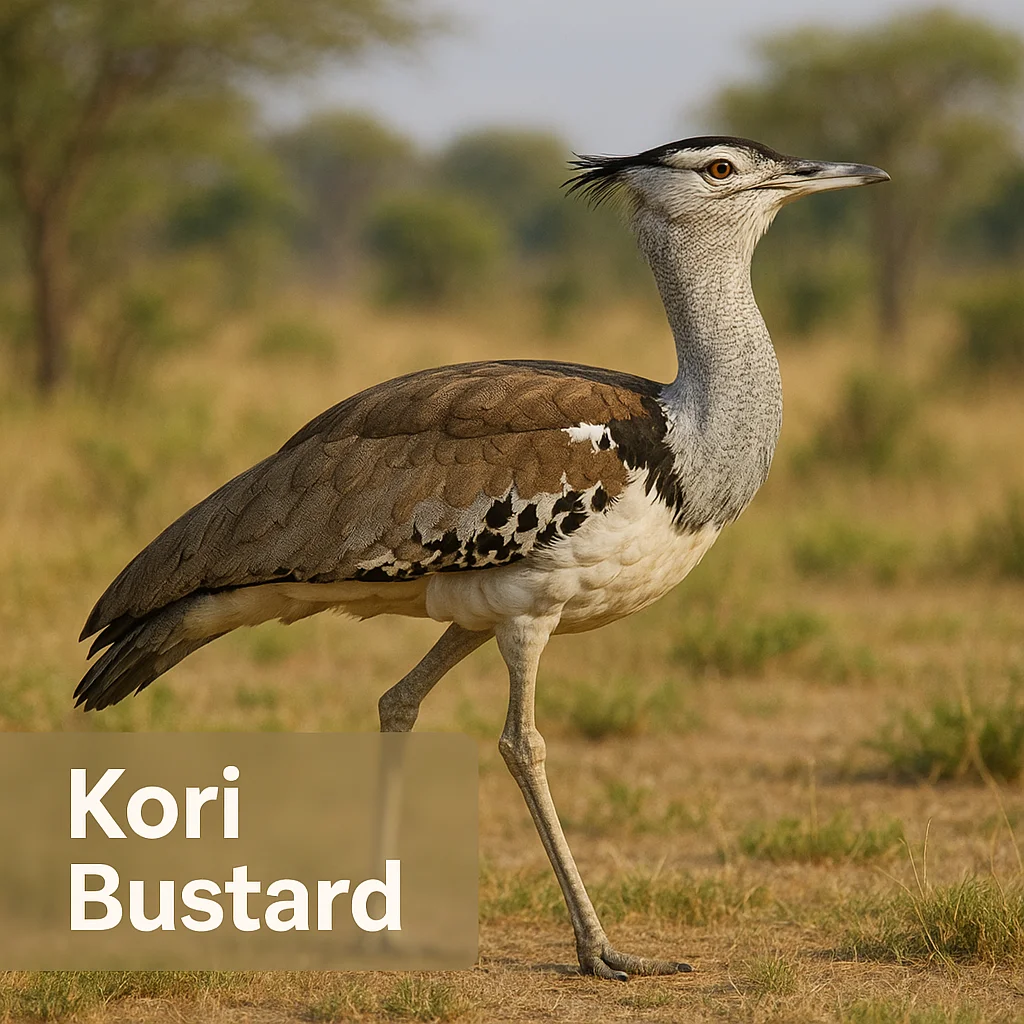
- Common name(s): Kori Bustard
- Scientific name: Ardeotis kori
- Animal type: Bird
- Typical adult size: 1.2 to 1.5 meters tall; 7 to 19 kg in weight
- Typical lifespan: 15 to 20 years in the wild
- Diet type: Omnivore; common foods include insects, small mammals, and plant matter
- Activity pattern: Diurnal
- Social structure: Solitary or in small groups
- Speed/movement highlights: Capable of short bursts of flight and fast running
- Intelligence/learning: Keen observational skills and memory for recognizing different predators
- Primary habitats: Savannas and open grasslands
- Geographic range: Southern and Eastern Africa
- Predators/threats: Jackals, eagles, human encroachment
- Conservation status: Near Threatened
🔍 Identification & Appearance
The Kori Bustard is one of the largest flying birds in Africa with a distinctive heavy body, long legs, and a thick neck. Its plumage is primarily a mix of grey and brown, providing excellent camouflage in its native grassland habitat.
- Body shape and silhouette: Sturdy build with a prominent chest and long neck
- Key colors/patterns: Mottled grey and brown with white and black markings on the wings
- Distinctive features: Large head with a dewlap, broad wings
- Tracks/scat: Large, three-toed tracks with a distinctive rear toe
- Common look-alikes: Easy to differentiate from smaller bustard species by size
- Look for the unique size among birds in Africa
- Mottled grey-brown plumage aids identification
- Check the large, stout bill
- Long, powerful legs are a key feature
- Observe the distinct solitary or small group behavior
- Note the broad wings with white and black markings during flight
- Top ID Tips:
🧱 Body Structure & Physical Adaptations
The Kori Bustard has evolved to optimize both terrestrial and aerial life. Its large wings allow short bursts of powerful flight, while its strong legs are perfect for long-distance running and walking in search of food.
- Build and proportions: Heavily built with broad wings and a stocky body
- Beak adaptations: Thick, strong beak for pecking and foraging
- Leg and wing structures: Long legs for ground movement; broad wings for sustained gliding
- Sensory strengths: Good vision aids in detecting predators and locating prey
- Heavy body for endurance on the ground
- Strong, thick beak for varied diet
- Adaptable to both grassland and semi-arid environments
- Excellent camouflage from mottled plumage
- Efficient digestion system for omnivorous diets
- Large wings aid in infrequent, but necessary, flights
- Key Adaptations:
🌍 Range & Distribution
The Kori Bustard is predominantly found across the savannas and open landscapes of Southern and Eastern Africa. Its range includes areas in countries such as Botswana, Namibia, and South Africa, where it thrives in grassland ecosystems.
- Where You Might Find It:
- Savannas of Northern Botswana
- Open plains of Namibia
- Eastern regions of South Africa
- Dryland areas in Tanzania
- Open spaces throughout Zimbabwe
- Across Angola's grasslands
- Lowland areas of Kenya
- Spacious areas in Western Mozambique
- Widespread across semi-arid savannas
🏞️ Habitat & Shelter
The Kori Bustard prefers open grasslands and savannas, where it can forage with ease and have a broader field of vision for spotting predators. It occasionally takes cover in scattered shrubs or acacia woodlands but generally avoids dense forest areas.
Seasonal changes impact its habitat use, with movements in search of food and water resources during dry seasons. Understanding these habitat preferences is crucial for conservation efforts and understanding their ecological role in the savanna biome.
🧭 Behavior & Ecology
The Kori Bustard is primarily diurnal, spending most of the day foraging for food on the ground. Its behaviors include a mix of solitary exploration and small group dynamics, particularly during the breeding season or when food is abundant.
Communication is primarily visual and often involves elaborate displays during the breeding season. The Kori Bustard plays a significant role in its ecosystem as both a grazer and an occasional predator, aiding plant seed dispersal and contributing to the food web.
- Behavior Highlights:
- Typically solitary but forms small groups during certain times
- Relies on vision for detecting predators
- Engages in significant preening for feather maintenance
- Often observed participating in sunbathing
- Displays territorial behaviors with body postures and vocalizations
- Forages mainly at dawn and dusk
- Participates in mutualistic relationships with other grazers
- Seasonal migrations based on food availability
- Mother-offspring bond during early life
- Contributes to seed dispersal across savannas
👥 Social Life & Group Dynamics
While generally solitary, Kori Bustards sometimes form small groups called 'leks' during the breeding season, where males display to attract potential mates. They are known to tolerate other birds in shared feeding grounds, showing less aggression compared to other species.
Socially, they exhibit loose associations rather than tightly-knit groups, which are primarily observed during courtship displays or when food is abundantly available. Cooperation in defense or childcare is not typically observed.
- Social Structure Notes:
- Solitary existence outside breeding season
- Males congregate in leks during breeding displays
- Fledglings stay briefly with parents for learning
- Males known for elaborate mating dances
- Females often seen with offspring
- Occasional group interactions during migratory movements
- No fixed hierarchical group structure
- Limited cooperation beyond breeding rituals
🍽️ Diet, Prey & Predators
As omnivores, Kori Bustards have a varied diet that includes insects, small mammals, seeds, and berries. Their feeding strategies are opportunistic, often shifting to the most readily available resources throughout the seasons.
The chief predators of Kori Bustards include larger carnivores such as jackals and birds of prey like eagles. Their primary defense strategy lies in their size, speed, and formidable flight capabilities, allowing for quick escapes when threatened.
- Feeding Notes:
- Preference for grasshoppers and beetles
- Feeds on small reptiles opportunistically
- Consumes a variety of seeds and grains
- Diet shifts to fruit-bearing trees in rainy seasons
- Foraging typically occurs near dawn and dusk
- Relies on visual cues to identify prey
- Rapid sprinting used in capturing faster prey
- Sometimes consumes carrion or leftover predator kills
🦌 Hunting, Foraging & Movement
The Kori Bustard is mainly a ground forager that uses its excellent vision to spot and catch prey. While it can fly, it prefers to walk or run, moving with sturdy, yet elegant strides. Flying is generally reserved for escaping predators or long-distance travel.
Its methodical foraging involves slowly walking across its habitat, pausing to peck or pursue mobile prey. Seasonal movements or migrations are influenced by food and water availability, moving between habitats to exploit different ecological niches.
- Movement & Strategy:
- Ground foraging in grasslands during calm weather
- Engages in ambush rush for catching insects
- Stealthier movement during hunting or escaping
- Occasional flight for predator avoidance or migration
- Mostly limited to walking or short bursts of running
- Long-range navigation influenced by environmental changes
- Strategically selects areas with complex cover for foraging
- Alternate grazing areas to prevent human encounters
🧠 Intelligence & Senses
Kori Bustards are intelligent birds with a range of learned behaviors, especially for avoiding predators and interacting with others of their kind. Their eyesight is particularly keen, aiding in identifying both threats and food sources from a distance.
While research on their cognitive abilities is limited, they demonstrate problem-solving skills, especially during the breeding season when males engage in ornate display behaviors to attract mates.
- Notable Abilities:
- Excellent memory for navigating landscapes
- Capable of recognizing individual predators over time
- Complex courtship displays require efficient cognitive processing
- Relies heavily on visual inputs for daily decisions
- Demonstrates adaptive prey capture strategies
- Seasonal migratory behavior suggests navigational skills
- Limited vocalizations imply reliance on visual communication
- Adjustable feeding strategies based on changing conditions
🪺 Reproduction, Pregnancy & Parenting
Kori Bustards have an interesting breeding system involving males gathering in leks to perform display rituals to attract females. The courtship involves complex physical displays, including puffing up neck feathers and vocal booming.
Females are responsible for all child-rearing, from incubating eggs to raising the young. Clutch sizes typically range from 1 to 2 eggs, and hatchlings are precocial, leaving the nest soon after hatching to follow their mother.
- Reproduction Snapshot:
- Breeding season coincides with rainy months
- Polygynous mating system with males showcasing displays
- Females solely incubate and raise offspring
- Clutch size is usually one or two eggs
- Incubation period lasts about 23 to 28 days
- Newborn bustards are precocial and highly mobile
- Young remain with mother for learning crucial survival skills
- Displays include feather fluffing and booming sounds
- Males establish territories by elaborate displays
- Females prefer mature males with pronounced displays
♀️♂️ Male vs Female Differences
The remarkable dimorphism in Kori Bustards is marked by size and display behavior differences. Males are generally larger and heavier compared to females, providing a competitive advantage during displays and attracting mates.
While coloration and patterns are generally similar between the sexes, males display more frequently and perform intricate courtship rituals involving feather puffing and body postures while females remain more cryptic and focused on reproductive duties.
- Sex Differences at a Glance:
- Males significantly larger and heavier than females
- Males engage in prominent courtship displays
- Similar plumage color and pattern across sexes
- Females are sole caregivers post-breeding
- Males establish territories, primarily for showcasing
- Females exhibit more cryptic behavior for protection
- Male dominance is based more on display than aggression
🧬 Subspecies & Variation
The Kori Bustard exhibits limited subspecies variation, with slight differences observed in body size and coloration across its range in Africa. These variances are minimally distinct and often a result of adaptation to local environmental conditions.
- Variation Notes:
- Subspecies classified based on geographical range and minor size differences
- Adaptations align with habitat-specific resources availability
- Potential for color variation influenced by local environments
- Differences in display behaviors noted across regions
- Minimal genetic variance across subspecies indicates adaptability
⚠️ Threats, Conservation & Human Interaction
Kori Bustards face several threats, chiefly habitat loss due to agricultural expansion and human settlement. Other pressures include hunting and egg collection, though these practices vary widely across its range.
Conservation efforts focus on habitat protection and monitoring population trends. As a species, they highlight the importance of grassland conservation and sustainable land use practices.
- Responsible Notes:
- Avoid excessive land development in grassland areas
- Support local conservation initiatives
- Limit human-wildlife conflict for agriculture
- Discourage egg collection and poaching
- Promote education around habitat preservation
- Advocate for protection of vital migratory corridors
- Acknowledge the role of ecotourism in conservation funding
- Enhance understanding of traditional ecological knowledge
✨ Fun Facts & Unique Traits
- Kori Bustard is often considered the heaviest bird capable of flight.
- They spend large portions of the day sunbathing, which is thought to help with parasite control.
- Kori Bustards have been known to ingest pebbles to help grind down and digest food.
- Their elaborate male courtship displays can involve booming calls that carry long distances.
- This species is sometimes depicted in African art and cultural folklore.
- They play an important role in the ecosystem as both seed dispersers and predators of insects.
- Kori Bustards are known to cooperate loosely with other grassland species in resource tracking.
- Surprisingly, they can fly despite their weight, using powerful wing flaps for takeoff.
📌 Summary
- The Kori Bustard is a large, ground-dwelling bird native to African savannas.
- Known for its tremendous size and gray-brown plumage, it stands out among avian species.
- It thrives in open grasslands and avoids dense forests, favoring open landscapes.
- Omnivorous diet includes insects, small animals, and plant materials.
- Vigilant to predators like jackals and eagles, it uses flight and speed for defense.
- Displays a range of complex mating rituals featuring male displays.
- Conservation concerns focus on habitat loss and human interaction.
- Adaptations include remarkable flight capability for its size and efficient foraging.
- Provides ecosystem benefits as a seed disperser and insect predator.
- A beloved subject of African cultural narratives and folklore.